
A search for the best roofing company near me usually starts after a leak, broken tile, lifted membrane, or a storm that put the roof back on the priority list. In Phoenix and Tucson, that search needs to go beyond reviews and ad placement, because Arizona roofs fail for very Arizona reasons.
What "Best Roofing Company" Means in Arizona
A homeowner spots a water stain on the ceiling a day after a monsoon. The tiles still look fine from the driveway. That is common in Arizona, and it is why the best roofer is not just the one who can patch a leak fast. It is the one who can trace where water got in, document what the storm damaged, and separate old wear from claim-related damage before the insurance carrier does it for them.
Arizona roofs fail in ways that are easy to miss if a contractor treats this like any other market. Heat and UV break down underlayment long before many tile roofs look bad from the street. Flat and foam roofs often leak at penetrations, scuppers, seams, and edge metal after drainage problems or deferred coating maintenance. Monsoon wind adds another layer. It can shift tiles, lift flashing, drive rain uphill, and open small entry points that only show up under the right storm conditions.
That is why “best” in this state has more to do with diagnosis than marketing.
A Phoenix homeowner with brittle shingles needs one kind of evaluation. A Tucson property manager with a coated flat roof needs another. In both cases, the contractor should be able to explain what failed, what is storm-related, what is age-related, and what needs photo documentation now if an insurance claim may follow. A vague inspection write-up can cost real money when the adjuster asks for marked photos, test areas, moisture mapping, or a line-by-line scope that matches the damage.
For Arizona properties, the best roofer usually does four things well:
- Knows local roof systems: They understand tile underlayment, shingle ventilation, flat roof drainage, foam wear, and the repair limits of each system in desert conditions.
- Reads monsoon damage correctly: They know where wind and driven rain show up first, including ridge details, flashings, edge metal, parapet transitions, and low-slope weak points.
- Documents for insurance review: They take clear photos, note slopes and elevations, identify collateral indicators, and write scopes that support a claim instead of leaving the owner to argue with incomplete paperwork.
- Has a real Arizona presence: They operate as an Arizona roofing company, with local crews, local references, and familiarity with the roof problems that show up here every summer.
Good roofing work matters. Good documentation matters too.
If a contractor cannot show how they inspect storm damage, label photos, and build a scope that an adjuster can follow, they may still be able to install a roof. They are not automatically the best choice for an Arizona property owner trying to protect both the building and the claim.
How to Find Potential Roofing Contractors
A basic search is only a starting point. It can show who paid to appear first. It doesn't tell a homeowner who has a real Arizona track record, who understands local roof types, or who will still be around if a workmanship issue shows up later.
Start with contractors that have a real local footprint
The first filter should be simple. Look for companies that clearly work in Phoenix or Tucson, answer their phones locally, and show service pages tied to the area, such as a Phoenix roofing company.
That matters because Arizona roofing isn't generic. Tile underlayment replacement, foam recoating cycles, parapet drainage, and monsoon leak tracing all require local familiarity. A contractor who mainly works outside the region may miss the details that cause repeat problems.
Use better screening sources than search results alone
A stronger shortlist usually comes from combining a few channels:
- Arizona license verification: Check that the contractor's license is active and appropriate for the work being proposed.
- Insurance confirmation: Ask for proof of current coverage before any job starts.
- Local supplier reputation: Roofing supply counters often know which contractors buy regularly, stay active, and maintain stable operations.
- BBB review of business practices: This won't replace an inspection, but it can help screen for responsiveness and complaint handling.
As of 2025, the Better Business Bureau lists over 3,400 accredited roofing contractors nationwide, and BBB accreditation rates have increased 22% since 2020. In Texas, Colorado, and Arizona, the number of BBB-accredited roofing contractors grew 18% between 2020 and 2024, according to the BBB roofing contractor directory. That doesn't mean every accredited company is the best fit, but it does show more contractors are moving toward stronger accountability standards.
Build a shortlist, not a winner
The goal at this stage isn't to pick one contractor immediately. It's to create a manageable list of candidates worth vetting.
A practical shortlist usually includes contractors who can show:
A contractor doesn't need to be the biggest name in town. They need to be easy to verify, easy to reach, and competent on the roof system that's actually on the building.
The Vetting Process Questions You Must Ask
Most hiring mistakes typically occur this way. A lot of roof problems don't come from bad materials. They come from weak vetting, vague promises, and assumptions made before the estimate is signed.
According to NARI, 78% of consumers who verified credentials like state licensing and insurance reported zero post-installation failures, compared to 42% failure rates among those who did not. That gap is too large to ignore.
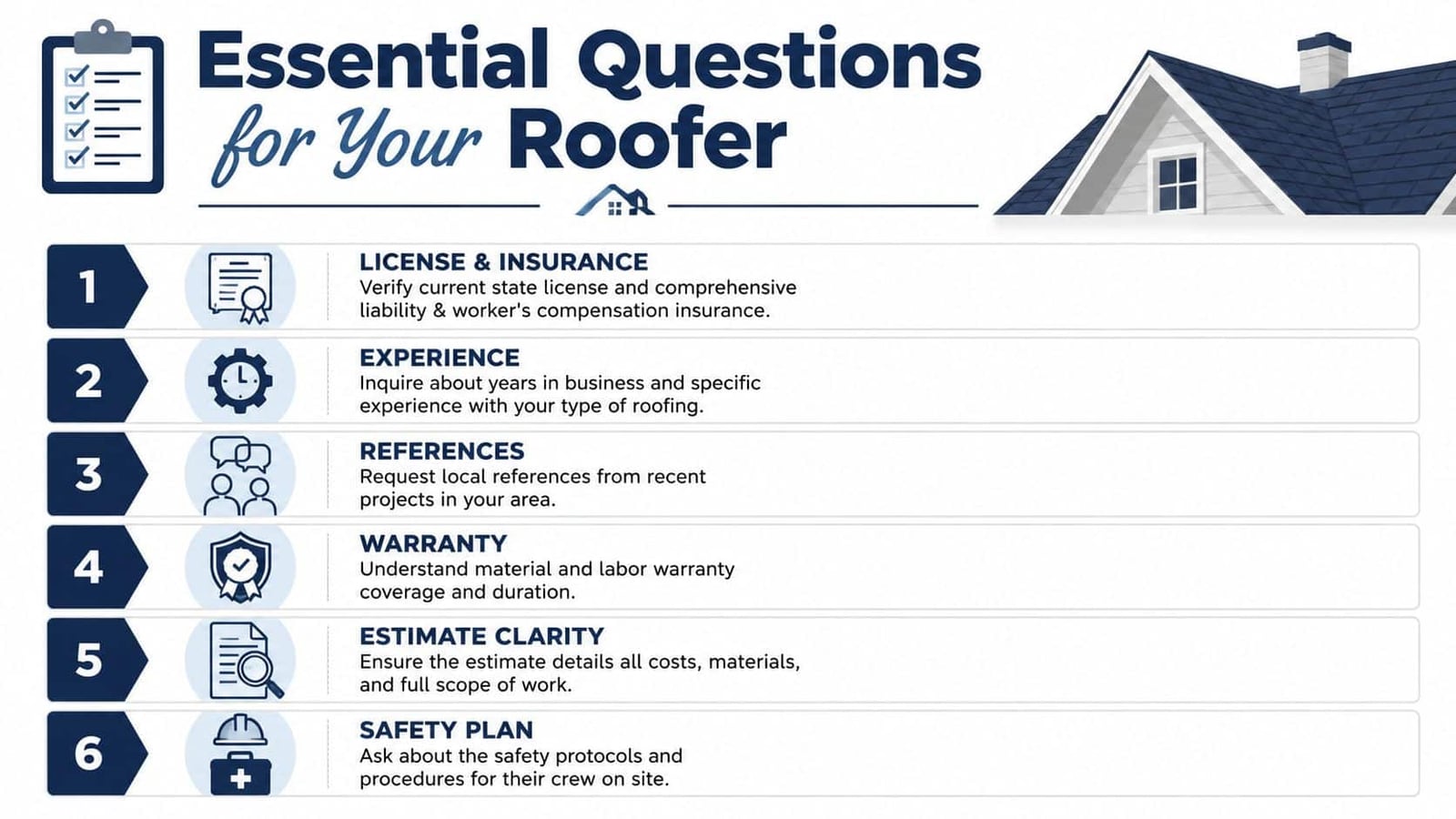
Ask about license and insurance first
Start with the questions that reduce risk fastest.
- Is the Arizona license active and in good standing? A real contractor should answer this directly and provide the information without delay.
- Is there current liability coverage and workers' compensation coverage? If the answer gets vague, that's a problem.
- Will the company provide documentation before work starts? It shouldn't take repeated follow-up to get basic paperwork.
A homeowner doesn't need a long speech here. Clear proof matters more than polished sales language.
For readers who want a simple refresher on insurance language before these conversations, this guide to hiring safely gives a useful plain-English breakdown of what those terms mean and why they matter when work is happening on a property.
Ask whether they actually know your roof type
Not every roofer is equally strong on every system. A company may be fine at shingle replacement and still be weak on tile lift-and-relay work, foam maintenance, or commercial flat roof leak diagnosis.
Ask questions like these:
- What type of roofs do they work on most often?
- How do they inspect underlayment on an older tile roof?
- What do they look for on a foam roof before recommending a recoat or reroof?
- How do they trace a leak on a flat roof with parapets and drains?
Good answers sound specific. Weak answers stay broad and sales-oriented.
Ask for recent local examples
Local references matter more than generic praise. A contractor should be able to point to recent work in the same market and on a similar roof type.
That means:
- Tile homes for tile homeowners
- Shingle replacement examples for shingle owners
- Commercial flat roof projects for property managers
- Repairs after monsoon damage if storm work is the issue
A contractor who works in Arizona regularly should also be able to speak clearly about access issues, roof pitch, drainage patterns, debris removal, and permit expectations without sounding uncertain.
Practical rule: If a contractor can't clearly describe the failure points on your roof system, that contractor hasn't earned the job yet.
Ask how they document storm damage
This question gets missed too often, and it matters more in Arizona than most online guides admit.
For storm-related work, the contractor should explain how they document:
- Lifted or displaced tiles
- Cracked clay or concrete tiles
- Membrane tears on flat roofs
- Wind-driven rain entry points
- Flashing displacement
- Water staining or interior leak paths that connect to roof damage
A homeowner should also ask whether the inspection photos, notes, and scope will be organized well enough to support an insurance discussion if one becomes necessary. That answer should be concrete, not vague.
For a stronger interview list before signing anything, these key questions for Arizona roofers are worth reviewing.
How to Compare Roofing Estimates in Arizona
A roofing estimate is only useful if it's detailed enough to compare properly. A low number on page one doesn't mean much if the scope is vague, the materials are underspecified, or important roof details are left out.
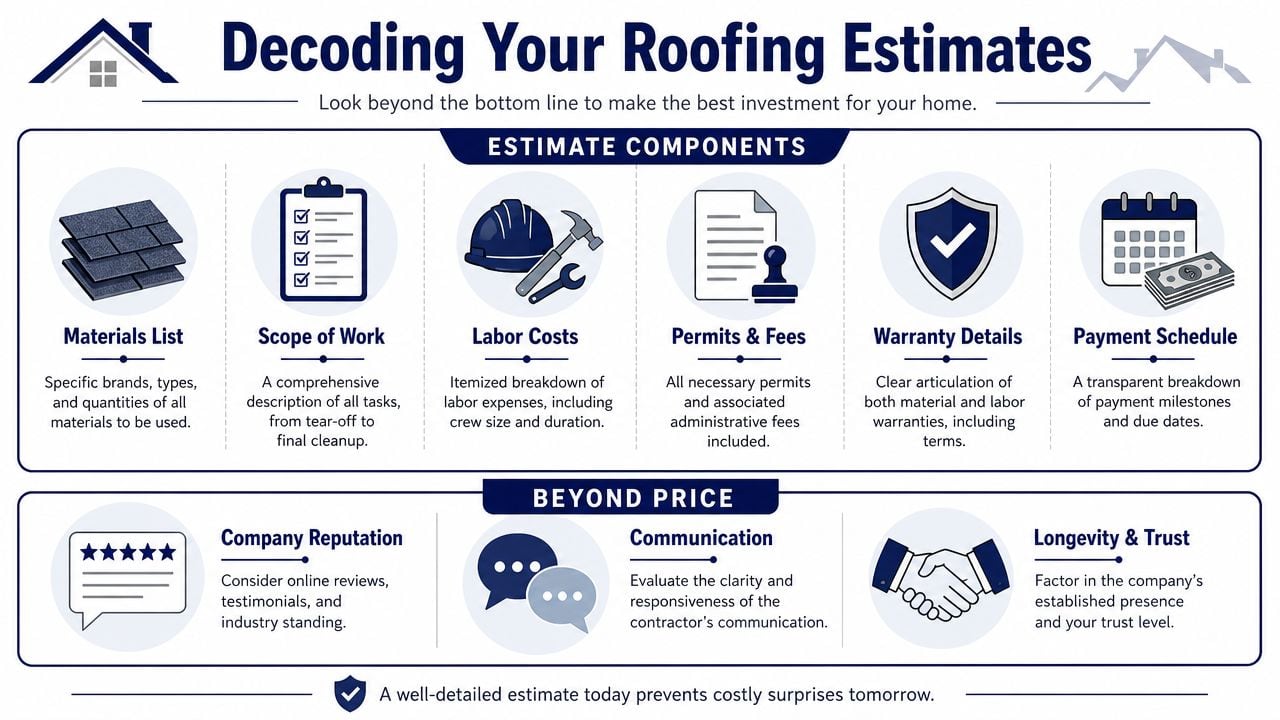
What a usable estimate should spell out
An Arizona roofing estimate should identify the actual work, not just the final total. It should make it easy to tell what's included, what's excluded, and what assumptions the contractor is making about the existing roof.
A solid estimate usually includes:
If the estimate is too short to explain the work, it's too short to protect the property owner.
Vague estimates create real problems
The verified guidance in the brief is right on this point. Ambiguous contracts are a common source of roofing disputes. That makes sense in the field. A homeowner may think “replace roof” includes rotten decking replacement, full underlayment replacement, flashing work, and cleanup. The contractor may mean something narrower.
That gap is where arguments start.
If two estimates have different scopes, they are not competing prices. They are different projects on paper.
A useful comparison isn't “Which one is cheaper?” It's “Which one clearly addresses the roof's actual condition?”
Red flags that belong in the reject pile
Watch for this: a proposal that uses broad phrases like “repair as needed” or “replace bad areas” without identifying what those areas are.
Other red flags include:
- Pressure to sign immediately: A rushed decision usually benefits the seller, not the property owner.
- Missing material detail: If the estimate doesn't identify the system clearly, it's hard to hold anyone accountable later.
- Weak warranty language: If workmanship terms are missing or unclear, that's a problem.
- No mention of drainage or penetrations: On flat roofs, these are common leak points. Ignoring them is not a minor omission.
- A payment schedule that feels front-loaded: The owner should understand exactly what each payment covers.
When the paperwork is detailed, it becomes much easier to compare value instead of guessing. Homeowners who want a direct side-by-side starting point can get a roof estimate and compare the scope against other proposals line by line.
Arizona Climate Demands the Right Materials and Warranties
A roof can look fine in May and fail hard in August. That is common in Arizona, especially after the first monsoon pushes wind-driven rain under loose flashing, broken tile, or a dried-out transition that already had one foot in the grave.
Shingle, tile, flat, and foam roofs age differently here
Arizona sun shortens the life of roofing materials. A shingle roof that still has decent curb appeal can already be brittle, thin on granules, and close to the point where repair stops making financial sense. Driveway views miss a lot.
Tile roofs fool owners in a different way. The tile may still look respectable while the underlayment below it is dried out, cracked, or patched too many times. On older tile systems, the primary question is often not whether the tile can stay. It is whether the waterproofing layer under it still has enough life left to trust through another monsoon season.
Flat and foam roofs need maintenance on schedule, not whenever a leak shows up. UV exposure beats up coatings, and once coatings wear down, water intrusion and insulation loss get more expensive to fix. On low-slope roofs, a contractor should pay close attention to drains, scuppers, seams, penetrations, and ponding areas because those are the places Arizona storms expose first.
Monsoon performance depends on installation details and documentation
Monsoon weather does not create many second chances. A roof either sheds water and handles uplift, or it starts showing you every weak detail at once.
That matters for insurance, too. A roofer in Arizona should do more than point at damage and say the storm caused it. They should document it in a way a carrier can use. That means dated photos, marked test areas, counts of broken or displaced tile, closeups of lifted shingles, membrane splits, metal damage, interior leak mapping, and notes that separate fresh storm damage from older wear. If they cannot explain how they document monsoon damage for a claim file, keep looking. That gap can cost a property owner thousands in missed or denied line items.
For homeowners in northern Arizona who are also comparing maintenance decisions around debris and roof condition, it can help to learn about Flagstaff roof cleaning costs before deciding whether buildup is cosmetic or part of a larger roof care problem.
Warranties only matter if the roof system and contract are specific
A warranty is only as useful as the scope behind it.
There are usually two separate protections:
- Manufacturer material coverage: This applies to product defects.
- Workmanship coverage: This applies to installation mistakes.
The distinction matters because many Arizona leaks start at flashings, penetrations, transitions, edge metal, or drainage details. Those are installation issues. A material warranty usually will not fix a bad tie-in around a vent, poorly set underlayment, or a leak path created by sloppy detail work.
Good warranty language is plain. It states what is covered, how long the coverage lasts, what maintenance is required, and what can void it. It should also be clear who handles repairs if a problem shows up after a monsoon event. Owners sorting through transfer questions and warranty terms can review Phoenix roof warranty information before signing.
Making Your Final Choice A Hiring Checklist
By the time the estimates are in, the final decision should feel narrower and cleaner. The best roofing company near me usually becomes obvious when the contractor has answered questions clearly, documented the roof well, and written a scope that matches the building's real needs.
Use a pre-signing checklist
Before hiring, the property owner should confirm these points:
- Contract matches the estimate: The materials, scope, exclusions, and cleanup terms should match what was discussed.
- Timeline is stated clearly: The owner should know the expected scheduling window and what could affect it.
- Communication is assigned: There should be a clear point of contact during the job.
- Site protection is addressed: This matters on occupied homes, multifamily sites, and commercial properties.
- Payment terms are understandable: No one should be guessing about when payments are due or why.
- Warranty language is written: If it isn't in writing, it doesn't help much later.
Don't skip the storm documentation question
This is the step most online articles miss, and in Arizona it can be costly to skip. Verified data states that 42% of Arizona homeowners face initial claim denials due to inadequate storm documentation, while 78% of top-ranking roofing pages omit specific guidance on monsoon-specific evidence protocols.
That means a roofer may be able to repair a roof and still be the wrong choice for a storm-related claim situation.
A property owner should ask:
- How will storm damage be photographed and described?
- Will the report identify wind-related displacement, membrane tears, tile breakage, and leak entry points clearly?
- Will the documentation separate old wear from new storm damage?
- Can the contractor provide a written scope that supports claim review without exaggeration or guesswork?
Those details matter because Arizona monsoon damage often isn't just “a roof leak.” It can involve wind-lifted components, impact breaks, displaced tiles, flashing movement, and water intrusion patterns that need to be documented carefully.
The right roofer doesn't just say there's storm damage. The right roofer shows it in a way that holds up under review.
Pick the contractor whose paperwork is as strong as the roof plan
A polished salesperson can win attention. Clean documentation wins trust. When the roof type, local weather exposure, estimate detail, warranty language, and storm documentation process all line up, the hiring decision gets much easier.
A homeowner or property manager should feel comfortable with the answers before signing. If the contractor is vague before the job, communication usually won't improve once the roof is open.
If a property owner in Phoenix or Tucson wants that level of roofing detail before making a decision, America Roofing is a practical next call. The team handles residential and commercial roofing across Arizona, including repair, replacement, flat roofs, foam roofing, coatings, leak repair, and storm damage work. Call 602-237-2478 or request a roofing estimate to get a roof inspected and a scope written clearly.