
A building owner in Phoenix or Tucson usually starts asking what commercial roofing is when a leak shows up over inventory, a tenant starts calling about ceiling stains, or a flat roof is old enough that every monsoon storm feels like a gamble. At that point, the roof stops being background infrastructure and becomes an operating risk.
What is commercial roofing? It's not just a flat top on a building. It's a full roof system designed to protect a business, manage water, handle equipment and foot traffic, and hold up under Arizona sun, dust, wind, and storm pressure.
Beyond a Flat Top What Commercial Roofing Really Is
A lot of property owners hear “commercial roof” and picture a flat surface with a membrane on top. That's incomplete. A commercial roof is an engineered assembly built for non-residential buildings such as offices, warehouses, industrial facilities, retail centers, and multifamily properties.
That assembly usually includes the roof deck, insulation, a waterproofing layer or membrane, flashing, edge metal, penetrations, and drainage components. If one of those parts fails, the roof can still leak even if the field membrane looks fine from a distance.
Commercial roofs also carry more responsibility than residential roofs. A house roof mainly sheds water and protects living space. A commercial roof often supports HVAC units, exhaust fans, conduit runs, skylights, service traffic, and sometimes future equipment changes. It also has to perform across a much larger footprint, where drainage errors and detailing mistakes get magnified fast.
Why the system matters more than the surface
In Arizona, the difference between a roof covering and a roof system matters. A membrane can be perfectly acceptable on paper and still fail early if the insulation is poorly attached, the drainage is weak, or the parapet and edge details were underspecified.
Commercial roof design is also tied to code. Low-slope commercial assemblies are built to meet structural and wind-uplift requirements, and in higher-wind conditions those design capacities often exceed 60 psf, with edge flashing and securement designed around site-specific uplift pressures from building height, exposure, geometry, and wind conditions, as explained in this overview of key commercial roofing standards.
Practical rule: A leak rarely means “the roof material is bad.” More often, it means the assembly was stressed at a seam, curb, drain, edge, or transition.
That's one reason commercial roofing in Arizona needs a risk-management mindset, not just a material choice. The roof protects inventory, tenants, equipment, schedules, and insurance documentation, not only the deck below it.
Why owners should care before the leak starts
Commercial roofing also represents a large part of the market. Commercial projects account for about 57% of total roofing industry revenue, and within North America more than 90% of that activity is for roof replacement, which says a lot about the age of the existing building stock and the need for lifecycle planning, according to roofing industry market data.
For Phoenix and Tucson owners, that means one thing. Most commercial roofing decisions aren't about a brand-new building. They're about deciding what to do with an aging roof before it starts affecting operations.
Common Commercial Roofing Systems in Arizona
Arizona doesn't reward a one-size-fits-all roof. The right system depends on building use, roof access, drainage, chemical exposure, parapet details, and how long the owner plans to keep the property. Heat and UV matter, but so do service traffic and the quality of the existing substrate.
Single-ply systems
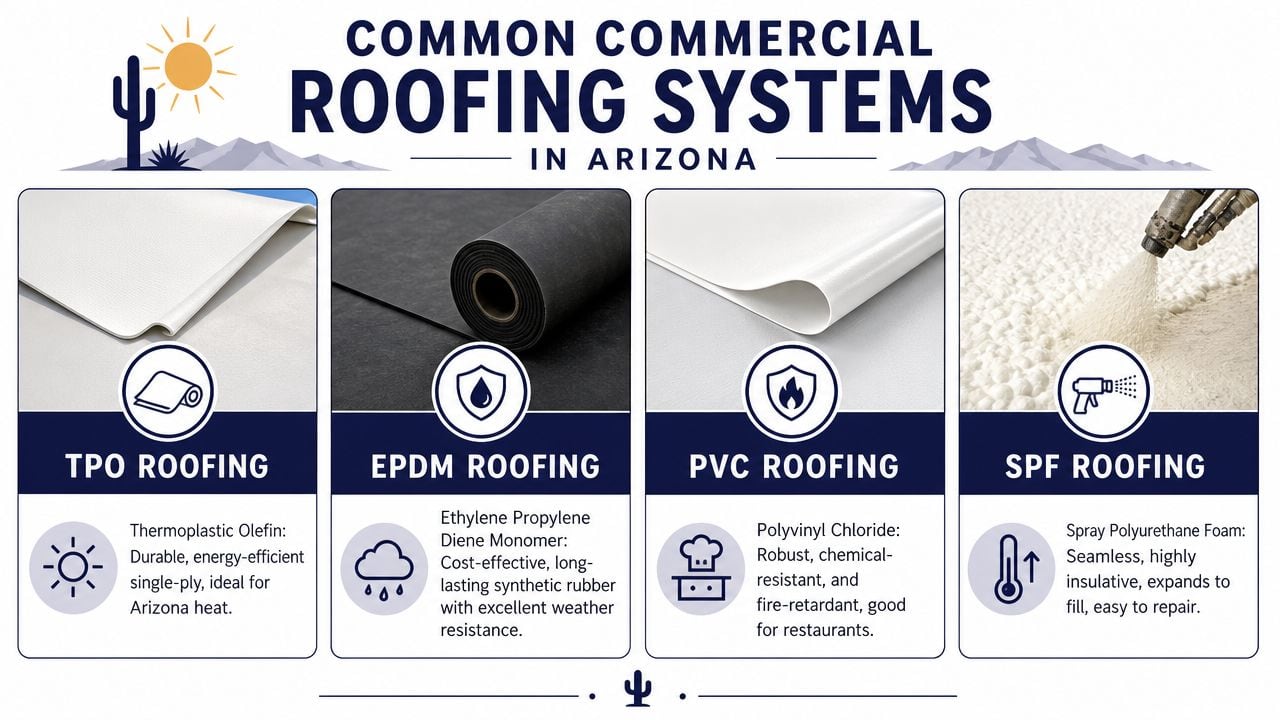
TPO, EPDM, and PVC all fall into the single-ply category, but they don't behave exactly the same.
TPO is common on Arizona commercial buildings because it gives owners a light-colored membrane with welded seams and a fairly clean installation process. It's especially relevant because single-ply membranes, particularly TPO, account for over 40% of new and reroofing installations in the U.S. commercial roofing market, according to the NRCA market surveys. In practical terms, TPO is often chosen when owners want a reflective membrane and a straightforward reroofing path on a low-slope building.
EPDM is a synthetic rubber membrane. It has a long track record and can be a workable option on certain low-slope buildings, especially where flexibility matters. In Arizona, building owners have to think carefully about surface heat and detailing because a roof's local conditions can be more important than the product category itself.
PVC is often considered where grease, chemicals, or other contaminants are part of the operating environment. Restaurants, food production spaces, and some industrial properties often need a membrane that handles those exposures better than a standard layout intended for a cleaner roof environment.
Foam, modified bitumen, and metal
Spray polyurethane foam, often called SPF or foam roofing, fits Arizona better than many out-of-state owners expect. It creates a monolithic surface, adds insulation value, and can be recoated instead of fully replaced in some scenarios. Foam also works well on roofs with irregular penetrations because it conforms around curbs, pipes, and transitions without creating as many seams.
A lot of Phoenix and Tucson owners like foam because it's practical to maintain when the roof is inspected regularly and recoated on schedule. The trade-off is that it needs ongoing care. Foam neglected under intense sun will show that neglect.
Modified bitumen remains a proven option on some low-slope roofs. It's an asphalt-based system that can provide redundancy through multiple layers. On buildings with frequent service traffic, some owners value that more substantial feel underfoot, though proper detailing still matters as much as the membrane selection.
Metal roofing shows up more often on commercial buildings with steeper sections, canopies, or specific industrial layouts rather than true flat roofs. It handles sun well when designed and installed correctly, but penetrations, fasteners, transitions, and expansion details have to be taken seriously in Arizona's temperature swings.
For owners comparing systems on a commercial flat roof, the best question usually isn't “What's the best commercial roof?” It's “What system fits this building's use, drainage, traffic, and maintenance plan?”
Arizona Commercial Roofing System Comparison
What tends to work and what tends to fail
What works in Arizona is usually simple in principle. The roof needs to reflect or tolerate heat, drain reliably, resist UV breakdown, and stay serviceable around penetrations and rooftop equipment.
What doesn't work is just as predictable:
- Weak edge details: Wind pressure usually finds the perimeter first.
- Too many patch layers: Repeated spot repairs can leave a roof harder to diagnose and harder to warranty.
- Cheap fasteners in harsh conditions: Corrosion at attachment points can turn a localized issue into a larger failure. On certain low-slope assemblies and edge details, material choice down to the hardware matters, and resources on premium 316 stainless fasteners are useful when reviewing specifications for demanding environments.
- Ignoring access traffic: A roof with frequent technician traffic needs protection and a maintenance plan, not just a membrane.
A commercial roof should be selected the same way a building owner selects any other major system. Based on use, failure points, maintenance burden, and replacement strategy.
How Arizona's Climate Attacks Commercial Roofs
Arizona roofing failures rarely come from one dramatic event alone. More often, sun, heat, dust, and storm water work together until a small weakness becomes a building problem.
UV and heat wear the roof every day
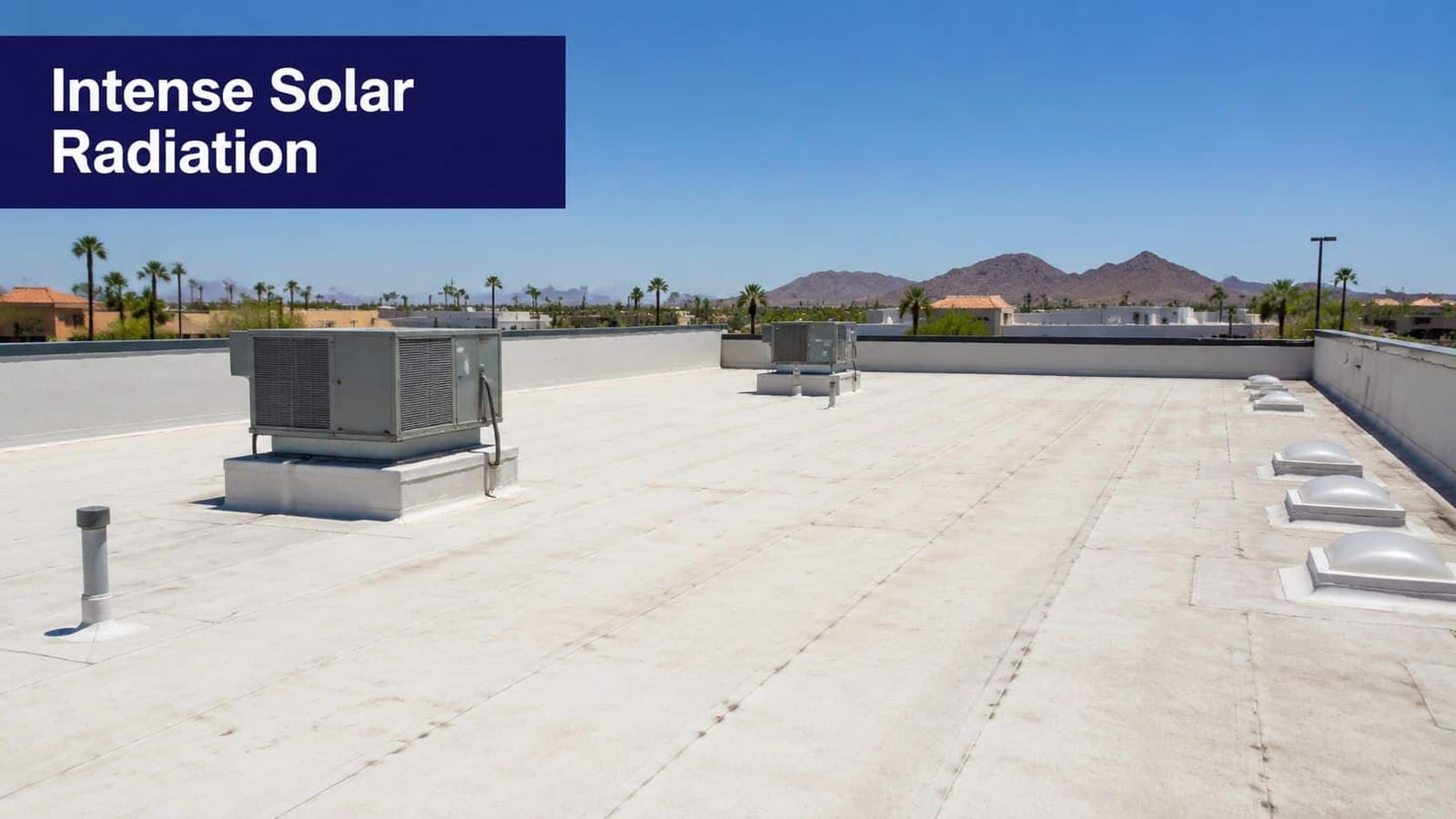
In Phoenix and Tucson, constant sun exposure punishes exposed roofing surfaces. Coatings chalk, membranes age, sealants dry out, and flashing transitions can lose flexibility. On low-slope roofs, that aging may not look dramatic at first. It often shows up as shrinking, cracking, seam stress, or brittle surface conditions around penetrations and parapet walls.
Heat adds another layer of stress. Roof surfaces expand and contract, especially around metal details, curbs, and mechanical supports. Adhesive failure, movement at seams, and cracking at transitions are common patterns on aging roofs in the desert.
Monsoon storms expose every weak point
Monsoon season changes the problem from slow wear to sudden testing. A roof that looked acceptable in dry weather can fail quickly when intense rain hits clogged drains, weak scuppers, open seams, or neglected ponding areas.
Dust also matters. Arizona roofs collect debris that blocks drainage paths and traps water where it shouldn't stay. On a large commercial roof, even small drainage restrictions can push water toward door thresholds, wall transitions, or equipment curbs.
For a broader local overview, this guide on how Arizona weather affects roofs is worth reviewing before budgeting for repairs or a reroof.
Roof failures in Arizona often start at the details. Not in the middle of the field membrane.
Why climate stress becomes an operations issue
A commercial roof leak isn't just a maintenance line item. It can interrupt tenants, damage inventory, create slip hazards, stain interiors, and force emergency work during the worst possible week. That's why commercial roofing in Arizona has to be managed as part of business continuity, not handled only when water reaches the floor.
Spotting Trouble Signs of Commercial Roof Failure
Most commercial roofs give warning signs before they fail badly. The problem is that many owners don't go up there until there's already interior damage. A simple walk-through after storms and during routine property checks can catch issues earlier.
What to look for on the roof surface
Start with the obvious field conditions:
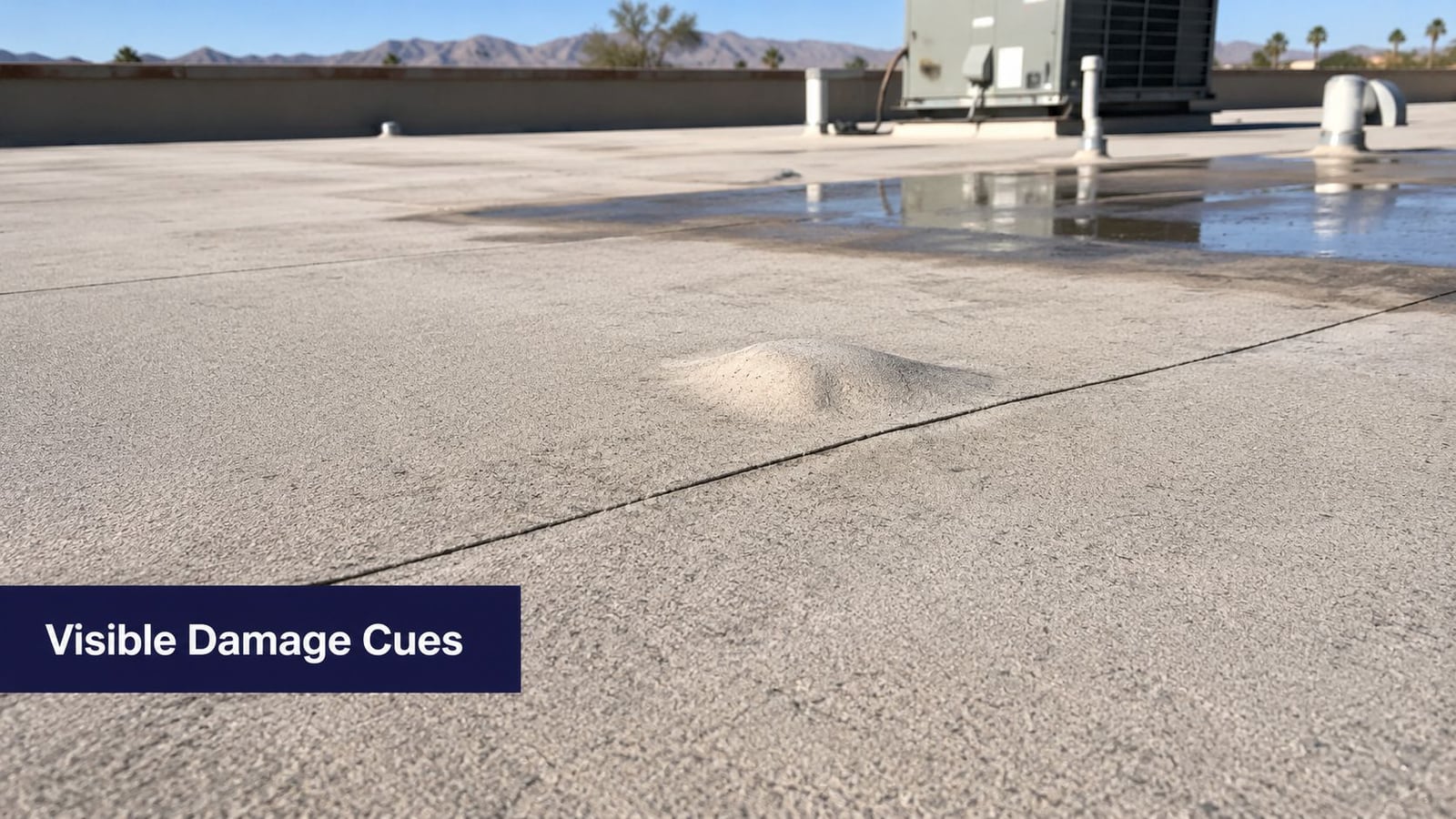
- Blisters or bubbles: Raised areas in the membrane or coating can point to trapped moisture, air, or adhesion problems.
- Open seams: Separation at membrane laps is a direct water-entry risk.
- Cracked coatings: On foam and coated roofs, widespread cracking or worn-through areas mean the protective surface is no longer doing its job.
- Punctures and traffic wear: Walk pads, service routes, and areas around equipment often fail first.
Some signs look small but aren't. A short seam split near a curb can leak farther into the assembly than an owner expects.
Check the roof edges, drains, and penetrations
The field membrane gets most of the attention, but leaks often start at transitions.
- Flashing separation: Look where the roof turns up walls, parapets, curbs, and pipe penetrations.
- Clogged drains and scuppers: If debris is blocking outflow, the roof is one storm away from ponding.
- Standing water after storms: Water that remains well after weather clears usually means the roof has drainage trouble or deck deflection that needs evaluation.
- Loose edge metal: Wind can exploit even minor movement at perimeter details.
Watch closely: If staining shows up indoors directly below a wall, parapet, skylight, or rooftop unit, the leak path may start much higher or farther away than the ceiling mark suggests.
Know the limits of a visual check
A building owner can and should notice symptoms. That doesn't mean every problem is safe to investigate without training. Wet insulation, hidden deck damage, and unstable surfaces aren't always visible from a casual walk.
Owners should avoid climbing onto steep or unstable areas, opening roof components, or stepping onto suspect decking. On occupied commercial properties, safety and documentation matter as much as the repair itself.
Repair Restore or Replace Your Options
When a commercial roof starts failing, owners usually have three paths. Patch the damaged area, restore the system with a coating, or replace the roof. Choosing the wrong one can waste money in either direction.
A repair makes sense when the roof is still largely serviceable and the issue is localized. That might mean fixing storm damage, resealing a penetration, replacing wet sections around a drain, or correcting flashing defects. Repairs work best when the roof still has enough life left that the fix supports a larger maintenance plan.
When restoration is the smart middle path
Restoration usually means cleaning, preparing, detailing, and coating an existing roof that's weathered but still a good candidate. On Arizona foam and some low-slope systems, restoration can be a practical way to extend service life without the disruption of a full tear-off.
That option only works if the underlying roof is dry enough, stable enough, and properly bonded. A coating is not a cure for saturated insulation, failed decking, or widespread movement in the existing assembly.
- Choose repair when: Damage is isolated and the overall system is still sound.
- Choose restoration when: The roof is aging at the surface but hasn't crossed into deep moisture or structural failure.
- Choose replacement when: Leaks are recurring, trapped moisture is extensive, or the assembly has reached the point where each new patch just moves the problem.
When replacement is the responsible choice
Some roofs are too far gone for more patching. If an owner is paying for repeated leak calls, interior repairs, and tenant disruption, the “cheaper” option can become the expensive one.
That's part of why the decision matters in a mature market. The U.S. commercial roofing market is projected to cover about 83.2 million squares in 2024, with growth of less than 1 percent annually, which reflects a competitive, established environment where owners need to make careful long-term decisions about repair, coating, or replacement, according to the Freedonia commercial roofing study.
A replacement also gives an owner the chance to fix design problems that repairs can't solve, such as poor drainage layout, incompatible old materials, excessive penetrations, or failing edge conditions. If that's where the building stands, planning for commercial roof replacement is usually more responsible than continuing to buy temporary relief.
A coating belongs on a roof that still has a future. It doesn't belong on a roof that already missed its exit.
How to Choose an Arizona Commercial Roofing Contractor
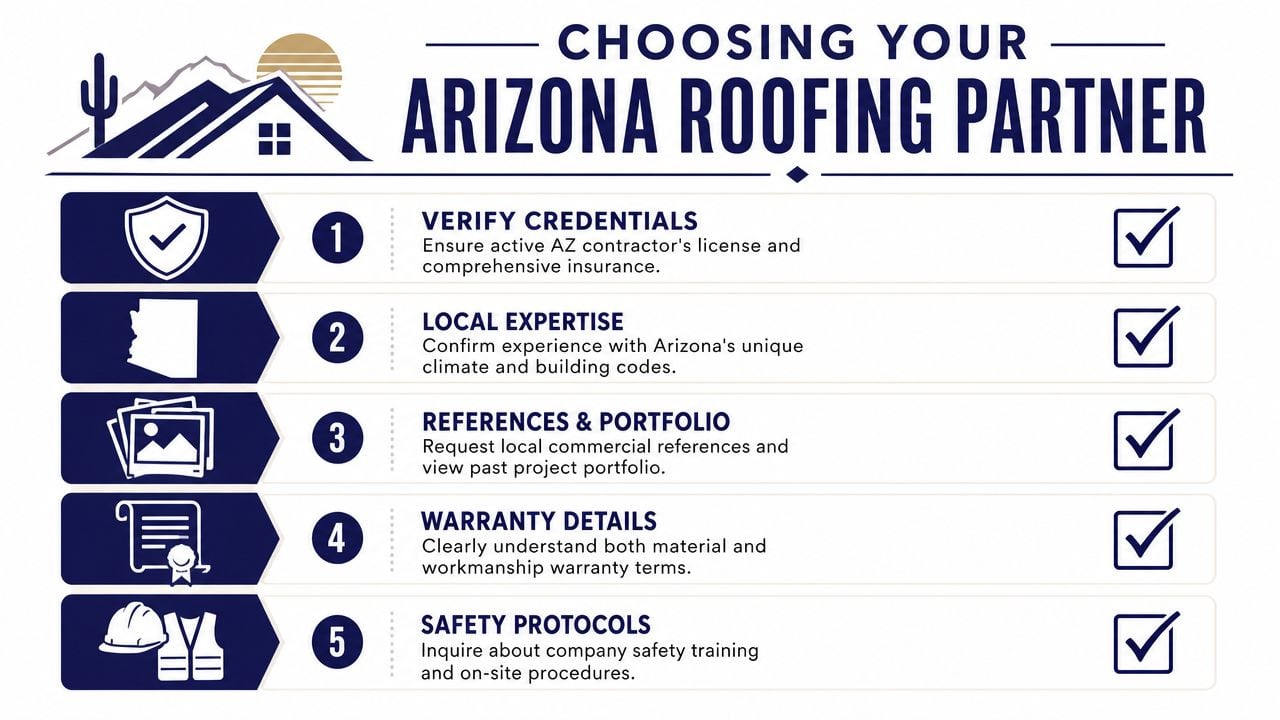
A bad roofing hire usually does not show up on day one. It shows up during the first monsoon leak, the first warranty dispute, or the first tenant complaint after a drain backs up and water gets inside. On an Arizona commercial property, the contractor you choose affects more than the roof. It affects operating costs, tenant retention, insurance headaches, and whether a preventable roof issue turns into business interruption.
Questions that help separate qualified bidders from risky ones
Start with how the contractor works in Arizona, not just whether they can install a roof. A low-slope system that performs well on paper can still fail early if the crew misses edge securement, drainage corrections, flashing details, or proper surface prep. Phoenix heat exposes shortcuts fast.
Ask direct questions.
- Arizona experience: Ask which low-slope systems the contractor installs and repairs most often in Phoenix and Tucson, and what typically fails on those roofs.
- Insurance proof: Ask for current liability and workers' compensation documentation.
- System-specific scope: Ask how the proposal handles drains, scuppers, penetrations, edge metal, wet insulation, and substrate preparation.
- Warranty clarity: Ask what the workmanship warranty covers, what voids it, and how leak calls are handled after completion.
- Project supervision: Ask who is responsible on site each day, who documents conditions, and who has authority to approve field changes.
A general checklist can help before those interviews. This article on how to choose a reputable contractor is a useful starting point for screening process and documentation.
Red flags that usually lead to trouble
The lowest number on the bid sheet often carries the highest long-term cost. I see that when a proposal leaves out tear-off quantities, assumes the existing substrate is sound without testing, or treats drainage work like an optional add-on. Those omissions matter in Arizona because ponding water, heat stress, and heavy rooftop equipment wear out weak details first.
Watch for these warning signs:
- Vague proposals: If the scope does not spell out removal areas, prep work, detail treatment, exclusions, and unit pricing for hidden damage, disputes usually follow.
- High-pressure sales tactics: Urgency without a clear scope is a risk signal, especially on older buildings where unknowns need to be priced accurately.
- No local roof-specific answers: A contractor should be able to explain how Arizona sun, dust, monsoon runoff, and rooftop traffic affect material choice and maintenance planning.
- Unclear change-order process: If hidden moisture or damaged decking is found, you need to know how pricing, approvals, and schedule impacts will be handled.
- Thin manpower or weak supervision: Good materials do not fix a poorly run crew.
For owners who want a more detailed screening framework, America Roofing's guide to roofers covers the practical points to review before signing a contract.
Keep the discussion tied to risk, not sales talk
The right contractor conversation sounds more like asset management than marketing. Ask how the work will affect tenant access, rooftop equipment protection, interior operations, weather exposure during the project, and what the contractor recommends if hidden moisture or deck damage shows up after tear-off.
That is the level where real value shows up. A contractor who can explain risk clearly, document the scope, and set realistic expectations usually protects the building owner better than one who only promises a quick install and a low price.
Your Next Steps for a Healthy Roof
A commercial roof isn't a set-it-and-forget-it building part. It's a managed asset tied to leak risk, tenant stability, maintenance budgets, and business continuity. Owners who understand the system, watch for early warning signs, and make timely repair-versus-replacement decisions usually avoid the worst emergency costs.
For an aging roof in Phoenix or Tucson, the next step is usually straightforward. Inspect it before monsoon season, document visible trouble spots, review drainage and penetrations, and decide whether the roof is still a repair candidate or needs a larger plan. Waiting rarely makes the decision easier. It usually just makes the eventual scope bigger.
If a commercial roof in Phoenix or Tucson is showing leak signs, drainage problems, coating wear, or repeated storm issues, America Roofing handles inspections, repairs, reroofing, foam roofing, flat roofing, and coatings for Arizona properties. Building owners and property managers can call 602-237-2478 or request a quote to discuss the roof's condition and the most practical next step.