
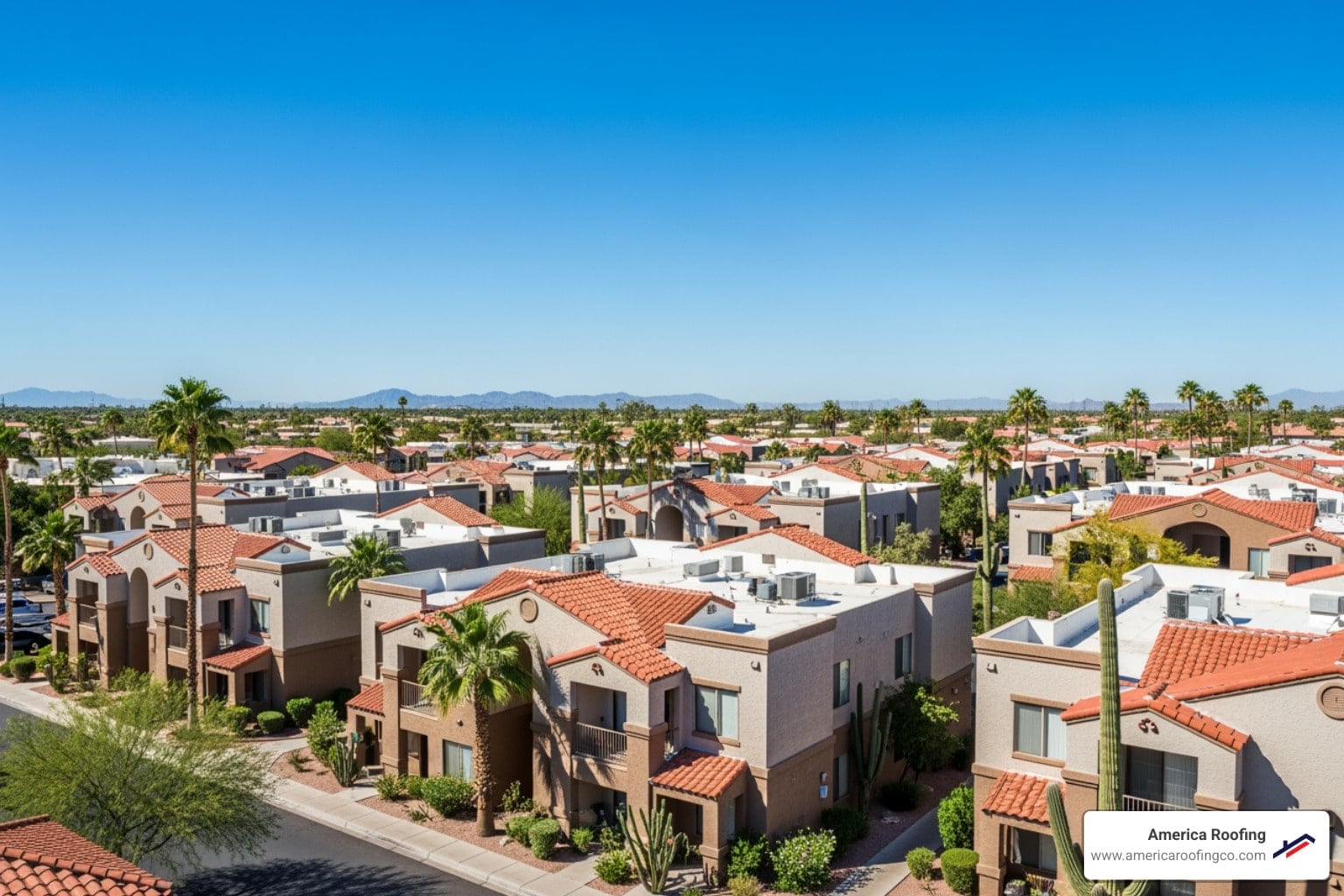
Arizona multi-family roofing contractors handle some of the most demanding roofing work in the country. Between brutal summer heat, monsoon storms, and the complexity of keeping tenants safe during repairs, the stakes are high. Honestly, here's what property managers need to know before hiring to protect their investment.
Why Multi-Family Roofing in Arizona Is More Complicated Than It Looks
Multi-family roofing in Arizona: What Property Managers Need to Know
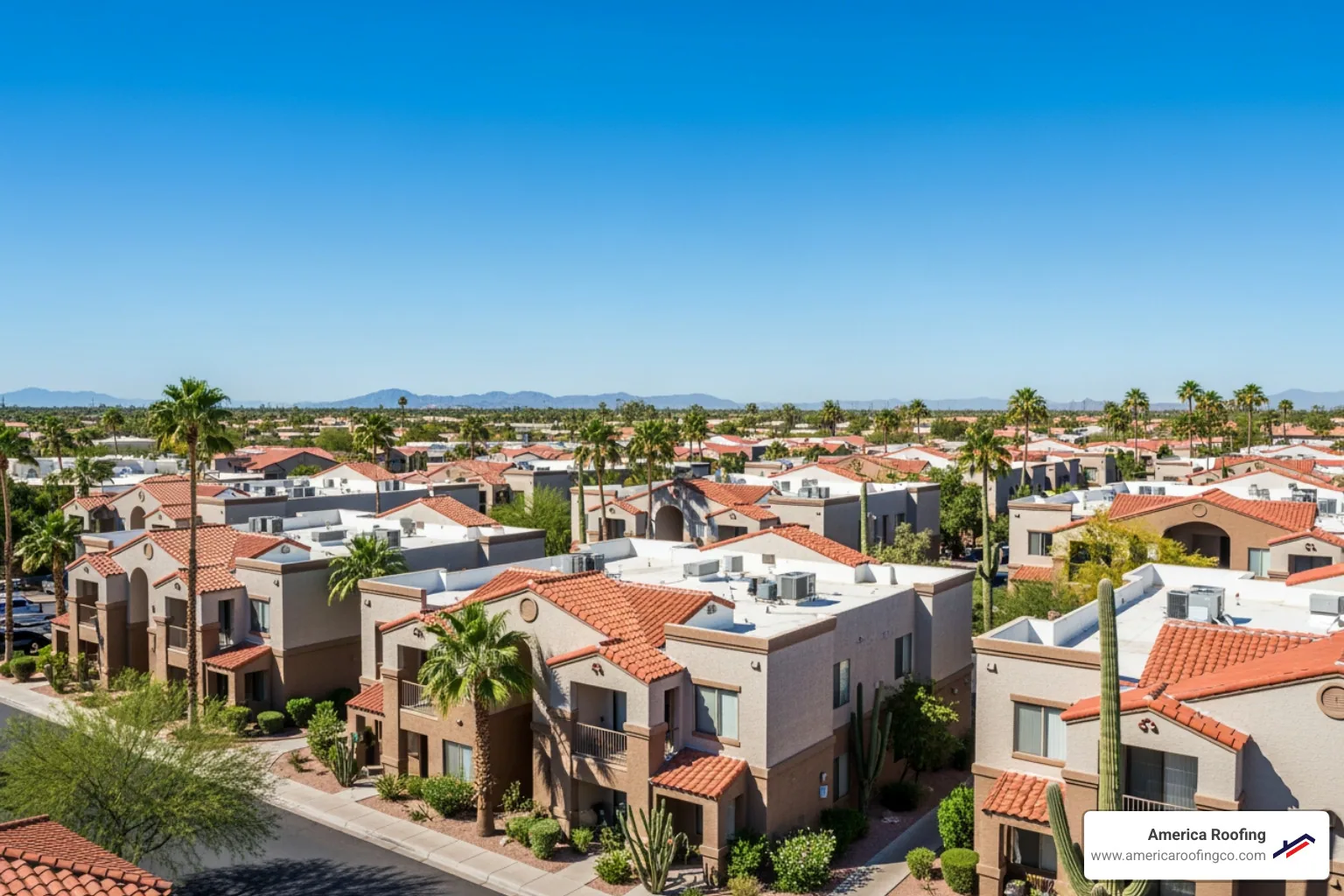
Quick Answer: What to Look for in Arizona Multi-Family Roofing Contractors
| Factor | What to Look For |
|---|---|
| Experience | 10+ years on multi-family properties specifically |
| Licensing | Arizona ROC licensed, bonded, and insured |
| Materials | TPO, tile, foam, metal suited to desert heat |
| Services | Inspections, repairs, full replacement, emergency response |
| HOA/PM Support | Coordinates with boards and property managers |
| Warranty | At least 10 years; up to 30-50 years on premium systems |
| Inspection Tech | Drone photography, thermal imaging, moisture meters |
| Scheduling | Phased work to minimize tenant disruption |
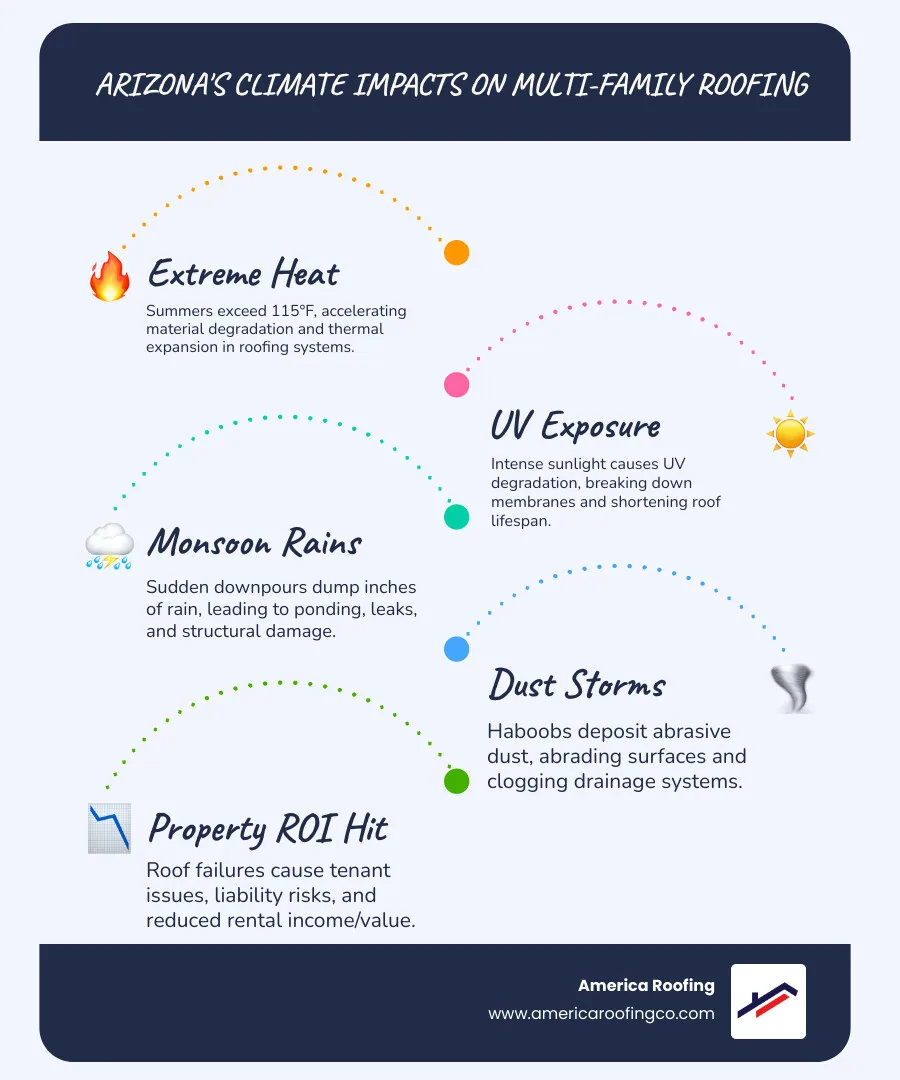
Honestly, managing a roof over a single home is one thing. Managing a roof — or several — over dozens of occupied units in one of the hottest climates in North America is a completely different challenge. Let me explain: Arizona summers regularly push past 115°F. Monsoon season brings sudden, intense downpours that can dump inches of rain in minutes. Add UV degradation, thermal expansion, dust storms, and the constant wear from HVAC systems and foot traffic, and you have a roofing environment that punishes shortcuts fast.
For property managers and owners, a roofing failure isn't just a maintenance issue. It's a tenant safety issue, a liability issue, and a direct hit to your rental income and property value.
Basic arizona multi-family roofing contractors glossary:
The Unique Challenges for Arizona Multi-Family Roofing Contractors
Have you ever wondered why some apartment roofs in the Valley fail after just a few years while others stand strong for decades? Managing an apartment complex, HOA, or townhome community in the Valley isn't just about fixing leaks; it's about orchestrating a complex ecosystem. Unlike a single-family home, a multi-family property has a massive surface area with shared structural systems. This means a problem in Unit 302 can quickly cascade into a nightmare for the residents in 202 and 102.
Extreme Heat and UV Exposure
In Phoenix and Mesa, summer temperatures routinely exceed 115°F. This isn't just uncomfortable for residents; it’s devastating for roofing materials. Constant UV exposure causes asphalt shingles to become brittle and lose their protective granules, while flat roof membranes can bake until they crack. This accelerated degradation means roofs in Arizona often have a shorter lifespan than the national average.
Thermal Expansion and Contraction
Have you ever heard your roof "pop" at night? That’s thermal shock. In the desert, a roof can go from 160°F in the afternoon sun to 80°F after a sudden monsoon downpour. This rapid temperature swing causes materials to expand and contract violently. Over time, this stresses the seams, flashing, and fasteners, leading to "alligatoring" on flat roofs and shifted tiles on pitched roofs.
Monsoons, Haboobs, and Wind Damage
Arizona’s monsoon season is famous for a reason. Microbursts can rip shingles off a roof in seconds, while heavy rains test the drainage capacity of every scupper and gutter. Furthermore, "haboobs" (massive dust storms) can clog drainage systems with silt and debris, leading to ponding water—the number one enemy of a flat roof.
High Foot Traffic and HVAC Penetrations
Multi-family roofs are busy places. Between HVAC technicians servicing dozens of units and satellite dish installers, the "human element" causes significant wear. Every vent, pipe, and AC unit creates a "penetration"—a potential leak point that requires expert sealing.
Essential Materials for Desert Durability
Honestly, when it comes to selecting materials, "cheap" is the most expensive word in roofing. Arizona multi-family roofing contractors must recommend systems that balance initial cost with long-term ROI.
Concrete and Clay Tile
Tile is the king of the desert for a reason. Concrete tiles are incredibly durable, often lasting 40 to 50 years. They offer excellent thermal mass, keeping buildings cooler, and provide natural ventilation through the gaps between tiles. However, the underlayment—the waterproof layer beneath the tiles—usually needs replacement every 20-25 years.
TPO (Thermoplastic Polyolefin)
For flat or low-slope apartment buildings, TPO is a qualified choice. This white, reflective membrane bounces solar energy away from the building, significantly reducing cooling costs. It’s flexible enough to handle thermal expansion and resistant to chemical and UV damage. More info about flat roof services can help you decide if this is right for your complex.
Spray Polyurethane Foam (SPF)
Foam roofing is a favorite for many property managers because it provides seamless insulation. It’s lightweight, incredibly energy-efficient, and can be "re-coated" every decade to extend its life indefinitely. It’s particularly effective at eliminating ponding water by creating custom slopes toward drains.
Asphalt Shingles
While standard shingles last about 15-20 years in Arizona, high-quality architectural shingles offer a cost-effective solution for townhomes and HOAs. We always recommend lighter colors to minimize heat absorption. More info about pitched roof options explains how these systems stack up.
Multi-Family Roofing Material Comparison Table
| Material | Lifespan (AZ) | Heat Reflectivity | Best For |
|---|---|---|---|
| Concrete Tile | 40-50+ Years | Medium | HOAs, Luxury Apartments |
| TPO Membrane | 20-25 Years | High (Cool Roof) | Flat-roof Complexes |
| Spray Foam | 30+ Years* | High | Energy Savings, Flat Roofs |
| Metal Roofing | 50+ Years | High | Modern Design, Low Maintenance |
| Asphalt Shingles | 15-20 Years | Low-Medium | Budget-friendly Townhomes |
*With proper recoating every 10-15 years.
Navigating HOA Approvals and Tenant Safety
You know what? The technical side of roofing is only half the battle. The other half is logistics. Arizona multi-family roofing contractors must be experts in communication.
HOA and Board Coordination
If you’re managing a condo or townhome community, you’re dealing with CC&Rs and board approvals. We provide detailed documentation, material samples, and color palettes that comply with community standards. We handle the paperwork so you don't have to.
Tenant Safety and Minimal Disruption
Replacing a roof on a 100-unit complex while people are living there is like performing surgery on a marathon runner while they’re still running. We prioritize:
- Phased Scheduling: We work on one building at a time to keep parking and access clear.
- Noise Mitigation: We schedule the loudest work during mid-day hours when many residents are out.
- Safety Protocols: We use debris chutes, perimeter flags, and ground spotters to ensure no tenant or pet wanders into a work zone.
Communication is Key
Residents hate surprises. We provide property managers with digital notices and timelines they can email or post for tenants. Knowing exactly when a crew will be over their unit reduces complaints and keeps everyone happy. For more on this, check out More info about commercial roof maintenance or More info about choosing a commercial roofer.
When to Call Arizona Multi-Family Roofing Contractors for Repairs
Let me explain: waiting for a ceiling to drip is the most expensive way to manage a roof. By the time you see a leak inside, the insulation is already ruined and mold may be starting to grow.
Signs Your Property Needs Attention
- Ponding Water: If water sits on a flat roof for more than 48 hours after a rain, your drainage is failing. This weight can eventually cause structural sagging.
- Blistering or Bubbling: On flat roofs, these "bubbles" indicate trapped moisture or air, meaning the membrane is delaminating.
- Cracked or Slipped Tiles: In Arizona, wind and heat can shift tiles. Once a tile moves, the underlayment is exposed to direct UV rays, which will destroy it in months.
- Interior Stains: Look for yellow or brown rings on top-floor ceilings.
- Clogged Scuppers: If you see plants growing in your gutters or drains, you have a major problem brewing.
Early intervention is the key to avoiding a full replacement. More info about roof repair solutions and More info about storm damage repair cover these scenarios in depth.
Advanced Technology Used by Arizona Multi-Family Roofing Contractors
Honestly, the days of a roofer just walking around with a clipboard are over. Qualified contractors now use "high-tech" tools to provide more accurate assessments.
Drone Inspections
Drones allow us to inspect massive multi-family roofs safely and quickly. We can capture high-resolution imagery of every inch of the roof, identifying cracked tiles or failing flashing that might be missed from the ground.
Thermal Imaging
This is a meaningful advantage. Using infrared cameras, we can detect "hot spots" or "cold spots" that indicate moisture trapped under the roof membrane. This allows us to perform "surgical" repairs—fixing only the wet areas instead of replacing the entire roof.
Digital Documentation and Asset Monitoring
We provide property managers with a digital "health report" of their roof. This includes photos, moisture readings, and a projected timeline for future maintenance. This helps with budget planning, so you aren't hit with a $200,000 surprise next year. Watch how advanced inspections identify hidden leaks to see this in action. For a deep dive into the process, see More info about professional roof inspections.
Conclusion: Protecting Your Property with America Roofing
Honestly, you know what? Choosing a contractor isn't just about the lowest bid; it’s about finding a partner who understands that a leak in Unit 204 can quickly become a headache for the entire building. America Roofing brings decades of experience as a veteran-owned, third-generation authority in Maricopa County, offering fully transparent 2025 pricing and a commitment to E-E-A-T standards that ensures your property remains a safe, profitable asset.
Let me explain: with our specialized knowledge of monsoon-ready systems and UV-resistant materials, we don't just fix roofs—we provide peace of mind for you and your tenants. Whether you are in Phoenix, Tucson, Mesa, or Gilbert, we know exactly how the Arizona sun treats your investment. Here’s the thing: your roof is too important to leave to chance, so reach out to the experts who treat every project like it’s their own. We are fully licensed (ROC#186438), insured, and ready to help you plan your next phased replacement or emergency repair. To get started, call us at 602-237-2478 or Request a Free Quote today.