
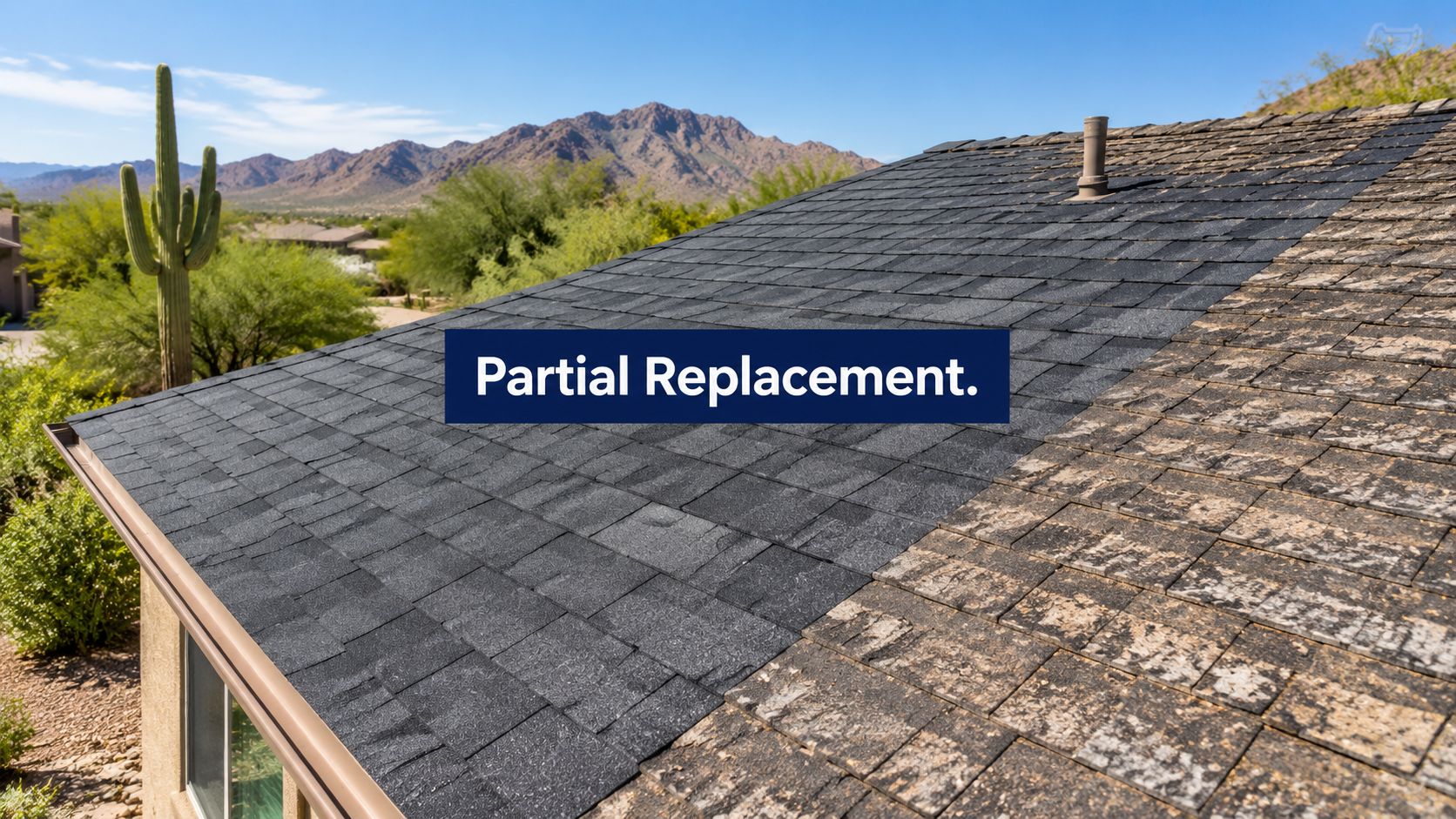
A Phoenix homeowner may wake up after a monsoon to find wind damage on one roof slope, while the rest of the roof still looks solid. In that situation, the right answer may be a partial roof replacement, but only if the damaged area, roof age, material, underlayment, and transition details all support it.
When a Partial Roof Replacement Makes Sense
A partial roof replacement removes and rebuilds one defined slope, roof plane, or contained section while keeping sound areas in service. It is a larger scope than a spot repair, which may replace only a few shingles, tiles, flashing components, or a small membrane area.
After a Phoenix monsoon, localized damage can make this approach reasonable. A falling branch, concentrated wind event, or hail strike may affect one side of a sloped roof while the opposite slopes remain structurally sound. Roofing guidance generally supports partial replacement when the roof is relatively young and the damaged area covers less than roughly one-quarter to one-third of the surface, with the commonly cited range under 25% to 30% of the roof area.
A partial job generally makes sense when:
- The damage is localized: One slope or clean section has failed, while adjacent materials remain serviceable.
- The remaining roof has useful life left: As a rule of thumb, untouched slopes should be less than about 15 years old on a shingle roof. The next section explains the age thresholds in more detail.
- The material can be matched: Replacement shingles, tile, underlayment, or membrane components must be available and compatible with the existing system.
- The transition is practical: The new work should end at a ridge, wall, edge, or another detail that can be properly waterproofed.
Practical rule: Replacing a whole plane is usually safer than stopping halfway across a slope.
Partial work does not pencil out when the roof is evenly aged, tile underlayment is failing across several slopes, or a flat-roof substrate has absorbed water. Covering saturated decking may look finished until the next monsoon exposes the weakness. Mixed-age materials can also create visible color differences, complicate warranty responsibility, and raise questions during resale.
The area threshold and roof age are only the first screen. Insurance requirements, current code, material availability, and the timing of Arizona's storm season can shift a defensible partial job into a full replacement. Tile, shingle, flat, and foam systems each change what partial replacement involves.
The 25% Rule and the Age Thresholds Behind the Decision
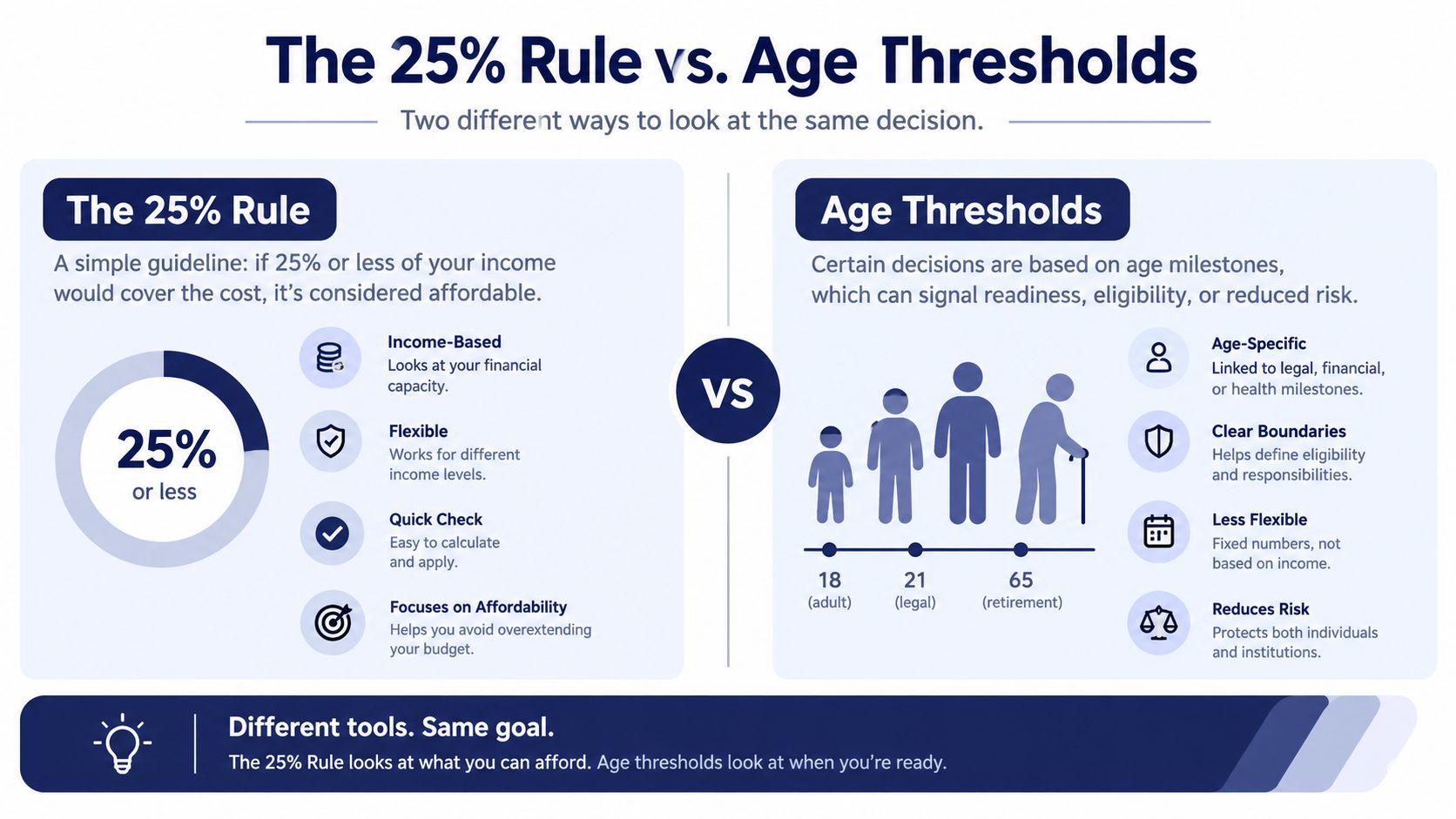
Arizona roof decisions often turn on two screens: how much of the system is damaged and how much useful life remains. The 25% rule is a practical threshold used in roofing, insurance, and code discussions. Once damaged or deteriorated roofing reaches about one-quarter of the roof area, a partial repair may no longer be economical, and full replacement becomes more likely (Arizona roofing explanation of the 25% rule). Guidance also describes work at or below 25% of the total roof area or roof section within a 12-month period as a scope that may remain eligible for partial work. Larger projects may require the affected roof, or the full system, to meet current code.
That threshold is only a screening point. An adjuster, code official, manufacturer, or contractor can still reject partial work because of concealed damage, incompatible materials, unsafe transitions, or deterioration beyond the visible area. After a monsoon, that distinction matters. A roof that appears to have one damaged section may have wet decking or failed flashing extending farther than the storm impact.
Age supplies the second filter. Asphalt shingle roofs under about 15 years old are generally more repair-friendly, while roofs beyond roughly 20 years more often justify replacement consideration. Another age benchmark treats roofs with less than half their expected service life remaining as stronger repair candidates, while roofs past roughly 80% of expected life deserve serious replacement review (roof age assessment guidance).
For owners comparing longest-lasting Arizona roof materials, surface life and underlayment life must be judged separately. Tile may still look sound while brittle underlayment needs replacement. Foam may remain in place while oxidation or coating failure reduces protection. Insurance requirements, code, material availability, and storm-season timing can turn a defensible partial scope into a full replacement.
How Partial Replacement Works by Roof Type
The same partial replacement plan can produce very different results depending on the roof system. A Phoenix shingle slope, a Tucson tile roof, and a commercial foam roof don't fail in the same way, so they shouldn't be scoped the same way.
| Roof Type | Best-Case Partial Scenario | Common Hidden Problem | Typical Outcome |
|---|---|---|---|
| Asphalt shingle | A relatively young roof has storm damage confined to one slope | Faded or discontinued shingles, brittle seal strips, hidden deck or flashing damage | Partial slope replacement may work when the new section has a clean termination |
| Concrete or clay tile | Broken or displaced tiles are limited to one plane and compatible tile is available | Failed underlayment, damaged battens, old fastener holes, cracked tiles beyond the visible area | The affected slope often needs underlayment work, not just tile swapping |
| Flat or foam roof | Damage is confined to a defined area and the substrate is dry and structurally sound | Ponding, saturated decking, oxidized foam, failed coating, weak seams and penetrations | A localized repair or section replacement can work, but widespread surface failure points toward reroofing |
Asphalt shingles
Partial shingle replacement is most defensible when one slope took a single storm hit and the surrounding roof still has meaningful service life. New shingles rarely blend perfectly into a weathered field. Sun exposure fades the installed roof, and a product from a different manufacturing run may look different even when the label appears similar.
A contractor should also inspect the underlayment, flashing, valleys, and roof deck. Replacing shingles over a slope with widespread brittleness only hides the larger problem.
Tile roofing
Tile makes partial replacement more complicated. Broken tiles may be the visible symptom, while the underlayment beneath the affected plane is the actual waterproofing layer. The Tile Roofing Industry Alliance advises removing broken tiles carefully, clearing old fasteners, and sealing or patching underlayment holes during individual tile replacement. It also recommends using contractors with verifiable tile experience, confirming licensing and insurance, and obtaining at least two written bids (tile roof maintenance protocol).
A property owner considering a larger tile section can also review this tile roof replacement guide. On an older tile roof, replacing only part of the underlayment may be a short-term bridge rather than a durable solution.
Flat and foam roofing
Flat and foam roofs demand attention to drainage, penetrations, seams, and substrate moisture. Arizona storms can deliver one to three inches of rain in 30 to 60 minutes, according to an Arizona restoration reference (monsoon roof leak and water damage guidance). If a drain, scupper, parapet transition, or low area is already failing, a small patch may just move the leak to the next weak point.
Foam recoating can be reasonable when the underlying foam remains sound and the coating failure is contained. It's a poor fit when oxidation, ponding, or saturation affects broad areas.
Inspection and Documentation Before Any Partial Work
A partial replacement shouldn't be approved from a verbal walk-around. Before a Phoenix or Tucson owner signs a scope, the contractor should identify the affected slope or roof plane, measure the area, and explain what remains in service.
The inspection file should include:
- A roof diagram: Mark each slope, plane, valley, penetration, drain, parapet, and flashing transition.
- Dated photos: Photograph damaged materials, lifted edges, cracked tiles, exposed underlayment, roof penetrations, and interior staining.
- Underlayment findings: On tile roofs, lifting at least one tile per affected slope can reveal brittleness, rot, old fastener holes, or previous repairs.
- Moisture checks: Interior ceilings should be checked with a moisture meter rather than a flashlight alone.
- Flat-roof investigation: If saturation is suspected, the contractor should explain whether a core sample or another appropriate test is needed.
- Storm notes: Record the storm date, likely wind direction, hail observations when applicable, and the roof faces that took the impact.
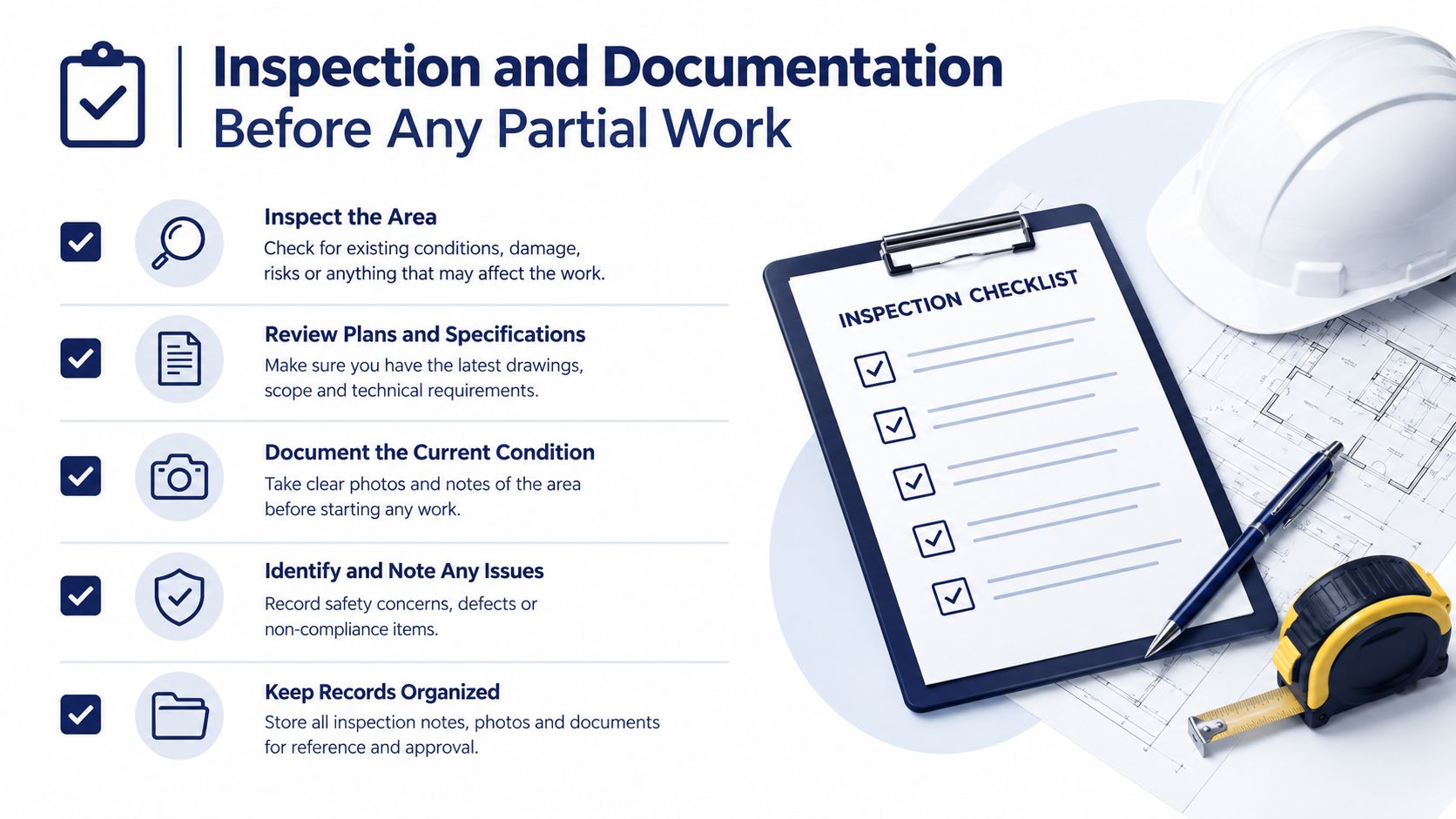
Documentation matters when an adjuster questions the scope, when a warranty inspector reviews the work, or when a future buyer asks why one section is newer. Roof owners can also review this guide to roof cleaning by Pine Country for maintenance context, but cleaning won't diagnose concealed underlayment or deck problems.
A certified roof inspection can provide a more formal record when the damage is disputed or the property has commercial reporting requirements. The written scope should distinguish a true section replacement from a spot repair and state exactly where the new work stops.
Arizona Conditions That Change the Math
Arizona's climate shortens the margin for error. The National Weather Service defines monsoon season as June 15 through September 30, a period when heat, wind, dust, and rain repeatedly test roof surfaces and drainage systems (National Weather Service monsoon information).
A localized storm can still create a sharply defined loss. Wind may lift shingles on one exposure, hail may crack tile on one elevation, or intense rain may expose a weak drain connection on a commercial flat roof. That doesn't mean the rest of the roof is healthy. It means the inspection must separate storm damage from age-related deterioration.
| Factor | Arizona Condition | Impact on Patch Longevity |
|---|---|---|
| Monsoon rain | Short, intense storms place heavy demand on drainage and transitions | Weak tie-ins, drains, scuppers, and flashing may fail quickly |
| Wind and hail | Storm cells can concentrate damage on one roof face | A partial scope may be appropriate, but only after nearby materials are checked |
| Heat and thermal cycling | Repeated expansion and contraction stresses seams, sealants, and underlayment | New and aged materials may move and weather differently |
| Dust and debris | Debris can collect around drains, valleys, walls, and rooftop equipment | Blocked drainage can turn a localized defect into broader water damage |
| Sun exposure | South- and west-facing surfaces often weather differently from shaded areas | Color and material condition may not match across the roof |
A commercial property manager should pay particular attention to ponding, rooftop equipment curbs, parapet walls, and access paths. A residential owner should focus on valleys, tile transitions, skylights, walls, and the slopes that receive the strongest afternoon sun.
A partial job is only as durable as the weakest transition left in service.
Why Partial Replacement Can Backfire on an Aging Roof
Partial replacement can save unnecessary tear-off when the failure is isolated. On an evenly aged roof, however, the apparent saving can disappear through mismatched materials, limited warranty boundaries, and repeat leak work.
The new section may have a manufacturer warranty, but that doesn't automatically cover the seam between new and old materials or failures originating in the untouched roof. Warranty terms can also be prorated over time, so the owner needs the actual written language rather than a verbal assurance.
Appearance creates another problem. Weathered shingles and tile change color under Arizona sun. Even compatible tile from a different production run may remain visibly different from the street, which can affect an owner's perception of the property and complicate resale discussions in Phoenix or Tucson.
Flashing and valleys deserve special caution. If the partial replacement ends at a vulnerable transition, a future leak may require disturbing the newly installed section to reach the underlying defect. That's an expensive sequence for a roof that was supposed to be a controlled repair.
Before approving the work, owners should review the roof longevity factors explained. A roof that has already consumed most of its expected service life is often a poor candidate for a new isolated section, especially when several slopes show similar wear.
Insurance can also change the decision. A carrier may evaluate mixed-age materials, repair history, code requirements, and the condition of the remaining roof when reviewing a claim or renewal. The right question isn't only whether a partial replacement can be installed. It's whether the resulting roof will remain insurable, serviceable, and defensible when the next problem appears.
Choosing a Qualified Arizona Contractor for Partial Work
Partial work requires tighter scoping than a routine repair. A contractor who quotes it without inspecting the roof plane, transition details, and substrate is asking the owner to accept unknown conditions.
A Phoenix or Tucson property owner should verify the following before signing:
- License status: Check the Arizona Registrar of Contractors lookup and confirm that the contracting entity is active and properly classified for the work.
- Insurance documentation: Request proof of general liability and workers' compensation coverage that applies to roofing operations, not a generic handyman policy.
- Relevant references: Ask for references involving the same system, such as shingle-to-shingle replacement, tile re-lay with new underlayment, or foam work on a defined flat-roof area.
- Written scope: The proposal should name the slope or plane, identify the underlayment or membrane materials, describe fastener or attachment methods, and explain the tie-in.
- Warranty terms: Ask whether coverage applies only to the new section, whether it's prorated, and what happens if the existing roof fails beside the work.
The contractor should walk the deck where safe and explain how hidden conditions will be handled. On a tile roof, that includes the underlayment. On a flat roof, it includes drainage and moisture. On a foam roof, it includes the condition of the foam beneath the coating.

Red flags include a sight-unseen quote, pressure to sign immediately during monsoon season, refusal to document the roof condition, or vague answers about the transition warranty. America Roofing handles residential and commercial roofing evaluations, including repair, replacement, tile, shingle, flat, foam, coating, and storm-related work in Phoenix and Tucson.
Decide Your Next Step and Get a Local Roofing Estimate
A Phoenix roof can look repairable from the driveway while the critical decision sits under the surface. Start with the damage pattern and the roof's remaining service life, then compare partial work with full replacement.
Use this decision path:
- Map the affected area: Record the roof plane, slope, penetration, valley, drain, or flashing detail involved. A single storm-damaged slope carries a different risk from leaks across several roof faces, widespread shingle aging, failing tile underlayment, or ponding on a flat roof.
- Apply the area screen: Compare the damaged scope with the commonly used 25% threshold, then confirm whether local code, insurance terms, or warranty requirements call for broader work. As noted earlier, that threshold is only a screening point, not an automatic approval.
- Check age and remaining life: A roof under about 15 years old may justify partial work. A roof approaching 20 years deserves a serious full-replacement comparison, as covered in the age thresholds above.
- Inspect below the visible surface: Check tile underlayment, shingle brittleness, deck moisture, foam condition, drainage, and transition details. Mixed-age patchwork can create visible variation, harder warranty disputes, and resale questions. Monsoon timing also matters. A temporary patch before storms may be reasonable, while a larger tie-in rushed before heavy rain may not be.
- Request two written scopes: Compare partial and full replacement side by side. Require materials, exclusions, code-related work, warranty language, and the conditions that would change the price.
Contractors can review marketing roofing company tips to organize responses, but owners should require a measured roof condition and written scope from every bidder.
Phoenix and Tucson owners can get a roof estimate and ask for both paths. Preserve the existing roof only when its remaining sections are sound enough to justify the tie-in.
America Roofing evaluates partial and full replacement options in Phoenix and Tucson. Call 602-237-2478 or visit America Roofing for an on-site evaluation and written recommendation.