
A new roof shouldn't leave a homeowner staring at a ceiling stain after the first hard monsoon rain. Yet that's exactly when workmanship warranty roofing becomes more important than the brochure, the product label, or the promise of a long material warranty.
In Arizona, a roof has to handle heat, UV exposure, dust, thermal movement, and sudden wind-driven rain. When a new roof fails early, the first issue often isn't the shingle, tile, or membrane itself. It's how the roof was installed.
Your Roof's First Line of Defense a Workmanship Warranty
A workmanship warranty is the contractor's written promise to stand behind the labor used to install the roof. It covers installation mistakes. That includes errors like faulty flashing, incorrect fastening, poor sealing at penetrations, or other crew-related problems that cause leaks or premature failure.
That's different from a manufacturer warranty. A manufacturer warranty covers defects in the product itself, not the way the roofing crew put it together. If the tile, shingle, underlayment, or membrane was installed wrong, the manufacturer usually won't pay to fix it.
For homeowners and property managers in Phoenix and Tucson, that distinction matters. Arizona roofs don't fail gently. Small installation defects can stay hidden through dry weather, then show up fast when monsoon rain drives sideways under loose flashing or when heat opens up a weak seam on a flat roof.
What a workmanship warranty actually protects
A useful workmanship warranty should address the parts of the job the contractor controls:
- Installation methods: Fastener placement, flashing details, underlayment laps, edge treatment, and sealing.
- Crew errors: Missed details around vents, parapets, valleys, skylights, drains, and transitions.
- Correction work: The labor needed to fix installation-related defects.
Practical rule: If the problem happened because the roof system was installed incorrectly, the workmanship warranty is the first place a property owner should look.
A lot of owners focus on the longest warranty number in the proposal. That can be a mistake. The better question is who will answer the phone if the roof leaks in a few years, and whether the warranty language covers the defect.
For a helpful guide for Phoenix property owners on contractor protections and why they matter, it's worth reviewing the basics before signing any roofing agreement. For local service background, America Roofing in Phoenix works in the same real conditions Arizona roofs face every summer.
Workmanship vs Manufacturer Warranty The Two Types of Guarantees
Most new roofs come with two separate protections. One is tied to the materials. The other is tied to the installer. They sound similar on paper, but they work very differently when there's a leak claim.
The core difference
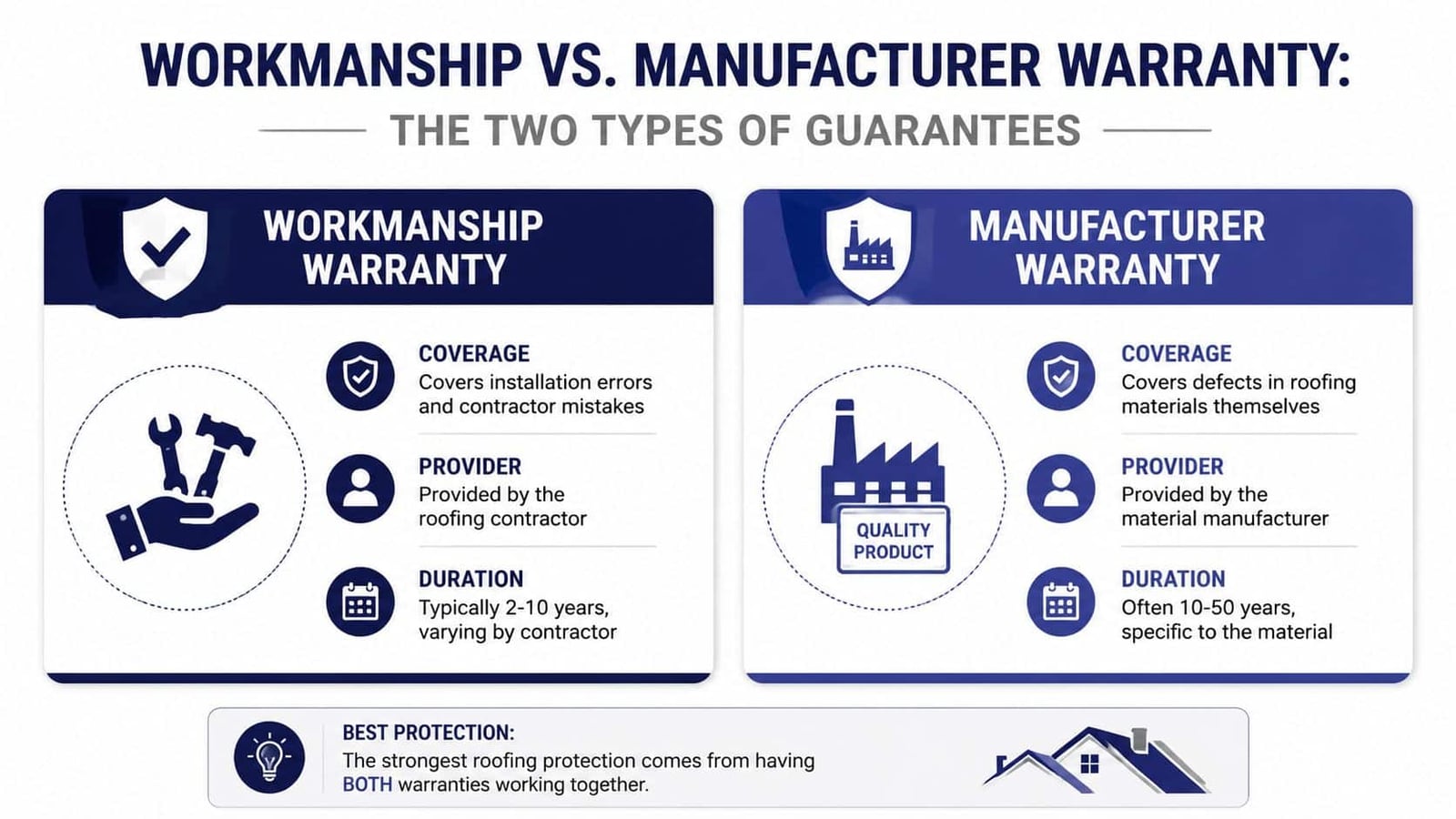
A workmanship warranty is issued by the roofing contractor. It covers installation mistakes.
A manufacturer warranty is issued by the material manufacturer. It covers defects in the roofing product itself.
Those differences become critical when a roof leaks after installation. According to this roofing warranty analysis, workmanship warranty terms in the roofing industry typically range from 1 to 10 years, while factory-certified contractors under enhanced programs can extend this to 25 years. In contrast, manufacturer warranties that become prorated after 10 years can reduce coverage to as little as 20% of material value and typically exclude all labor, tear-off, and disposal costs.
Workmanship Warranty vs. Manufacturer Warranty
Why Arizona owners get tripped up
The phrase “lifetime” or “limited lifetime” on a product doesn't mean the whole roof is covered from every angle. It usually means the material has some level of long-term product protection. It doesn't mean the installer's mistakes are included.
That matters more in Arizona than many owners realize. Tile roofs need correct spacing and fastening. Shingle roofs need clean fastening patterns and strong flashing details. Flat and foam roofs need proper drainage, adhesion, seam work, and coating application. If those details are off, the roof can fail while the material itself remains within spec.
A long material warranty can still leave the owner paying for labor, tear-off, disposal, and interior damage if the real cause is bad installation.
Enhanced programs can close some of that gap, but they usually depend on factory-certified installation and strict compliance with registration and system rules. For a deeper look at how those documents differ, this Arizona roof warranty information page helps clarify what limited lifetime language often means in practice.
Decoding Your Warranty Whats Covered and Whats Not
A workmanship warranty only matters if the language matches actual failure points seen on Arizona roofs. That means the document should speak to installation defects clearly, not hide behind broad phrases that sound good until a leak shows up.
According to this roof warranty guide, approximately 71% of roofing call-backs within the first five years are caused by installation errors, not material defects. That makes workmanship coverage the key protection for early-life problems such as improperly sealed flashing and under-nailed shingles.
What a strong workmanship warranty should cover
On residential and commercial roofs in Phoenix and Tucson, useful coverage often includes installation-related problems like these:
- Flashing mistakes: Poorly sealed wall flashings, vent flashings, pipe boots, scuppers, parapet transitions, or valley details.
- Fastening errors: Incorrect nail placement, missed fasteners, under-fastened shingles, or fastening patterns that don't match code or system requirements.
- Underlayment defects: Bad overlaps, poor attachment, or weak detailing around penetrations and roof edges.
- Slope and drainage errors: Areas that hold water because the roof assembly was installed out of tolerance.
- Flat-roof seam issues: Open seams, failed terminations, or weak edge details that let monsoon rain travel under the system.
- Foam and coating application errors: Uneven application, weak prep work, missed reinforcement, or poor detailing around drains and penetrations.
Arizona-specific examples that matter
Arizona roofing isn't forgiving. Small installation mistakes can turn into expensive failures because the climate stresses every part of the assembly.
For asphalt shingles in Arizona's high-wind monsoon zones, this Arizona roofing reference states that best practices and codes call for 8d galvanized roofing nails with 3/4-inch penetration into the deck, spaced 6 inches apart along the eave and 12 inches for subsequent rows, with roofing cement at nail heads in areas prone to 40+ mph wind-driven rain. If a crew cuts corners on fastening, the roof may not hold the way it should during storm season.
For Tucson tile roofs, this Tucson roofing reference notes that clay tile roofs must use 6 to 8 nails per tile and maintain 1/8 inch spacing to allow thermal expansion. Gaps narrower than 1/16 inch can lead to cracking during temperature swings from 90°F to 110°F. That's a workmanship issue, not a tile-manufacturing issue.
On Arizona roofs, the failure point is often the detail. A flashing edge, a drain, a tile fastening pattern, or a seam termination causes the leak long before the field of the roof does.
What workmanship warranties usually do not cover
A lot of frustration comes from owners assuming the warranty covers every roof problem after installation. It doesn't.
Common exclusions include:
- Storm events beyond the warranty scope: Wind, hail, or external weather events that aren't tied to installation error.
- Third-party damage: Work by satellite installers, solar contractors, HVAC crews, or anyone else who penetrates or disturbs the roof.
- Material defects: If the product itself fails, that usually falls under the manufacturer side.
- Neglect: Debris buildup, blocked drains, ignored leaks, or missed maintenance can create denial issues.
- Unauthorized repairs: Another contractor's patch can complicate or void a claim.
Why the contractor's staying power matters
A workmanship warranty is only enforceable if the contractor is still operating and willing to honor it. That's the hidden risk many owners miss. A long written term doesn't help if the company that issued it has disappeared, changed hands, or won't respond.
For owners who are also thinking about resale or property transfer, America Roofing on transferable warranties is worth reviewing because transfer rules can change the actual value of a warranty later.
The Fine Print Red Flags and Hidden Warranty Clauses
The most dangerous warranty language usually isn't obvious. It sits in the fine print, under service conditions, owner obligations, or exclusions. That's where a good-looking promise can turn into a weak contract.
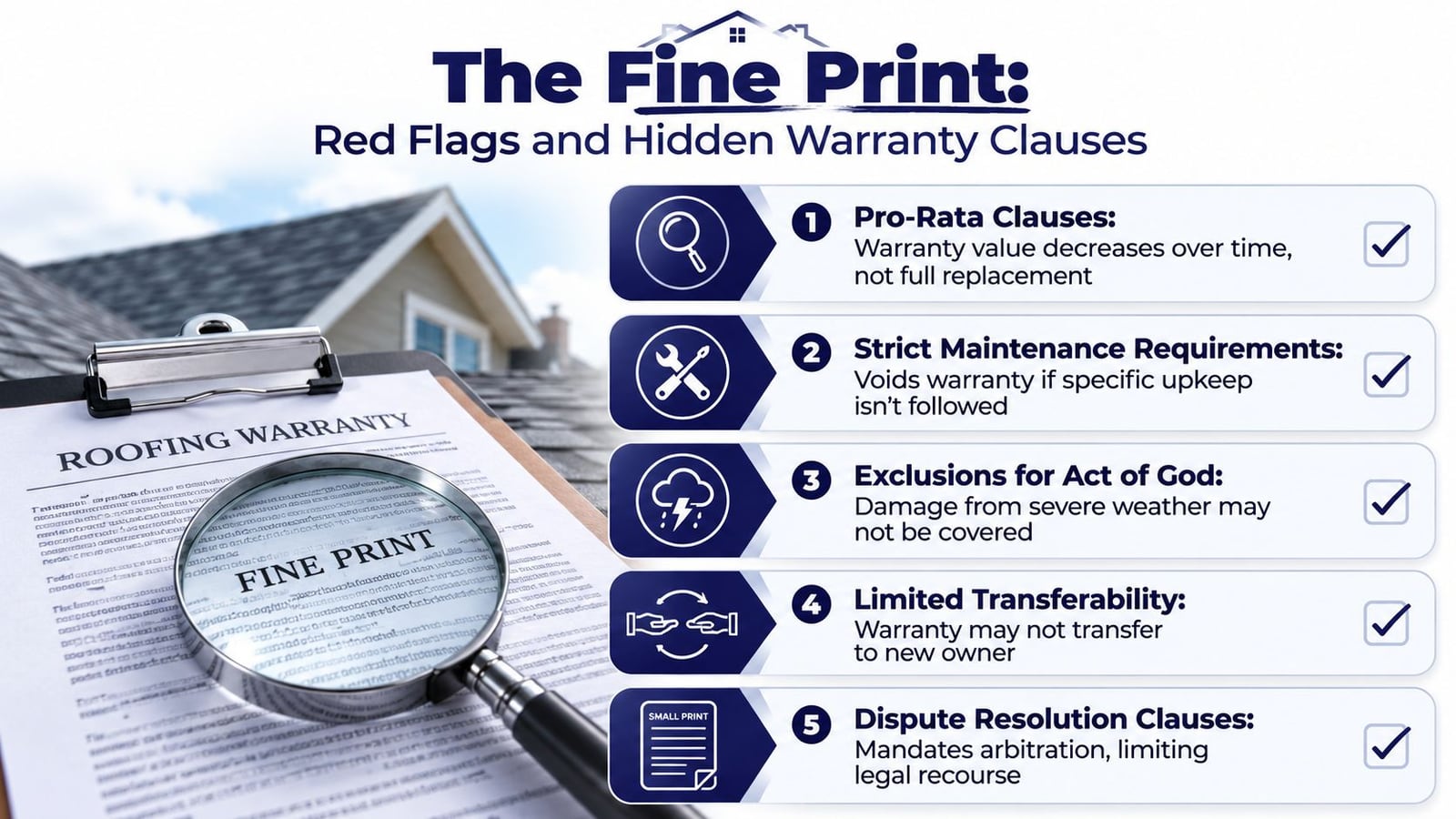
According to this contractor guarantee guide, many standard workmanship warranties exclude diagnostic or trip fees, which means the owner may have to pay for the inspection that determines whether the leak came from contractor error. The same guide notes that warranty validity is often tied to annual maintenance, and missing that requirement can void coverage.
Clauses that deserve a second look
Some language should make an owner stop and ask questions before signing:
- Diagnostic fee exclusions: The contractor will repair covered workmanship defects, but only after charging to inspect the problem.
- Trip charge language: A service call isn't free unless the contractor decides the issue qualifies.
- Annual maintenance requirements: Coverage stays active only if the owner completes specific inspections or service visits.
- Vague exclusion wording: Broad phrases like “improper use,” “environmental conditions,” or “acts beyond our control” can be stretched too far.
- Registration requirements: If paperwork isn't filed correctly, enhanced coverage may never activate.
Good language versus weak language
A strong warranty usually sounds plain and specific. It states what installation errors are covered, how claims are handled, and whether inspection charges apply.
Weak language often relies on undefined terms and broad exceptions.
Watch for this: If the warranty says repairs are covered but the inspection is billable, the owner may be paying to prove the contractor made the mistake.
Examples of stronger wording:
- The contractor covers labor to correct installation defects during the stated term.
- The contractor states whether diagnostic visits for suspected workmanship issues are included.
- The contractor lists owner responsibilities clearly, including any maintenance rules.
Examples of weaker wording:
- Coverage applies at the contractor's sole discretion.
- Service charges may apply to evaluate reported concerns.
- Warranty may be voided for lack of required maintenance, without spelling out what maintenance means.
What owners should ask before signing
Instead of asking only “How long is the warranty?” ask these:
- Does a claim inspection cost anything if the issue turns out to be workmanship-related?
- What maintenance is required to keep the warranty active?
- Who determines whether the problem is workmanship, storm damage, or third-party damage?
- Is the warranty transferable, and under what conditions?
- What happens if the roof is modified later for equipment or other penetrations?
A short warranty with clear terms can be more useful than a long warranty filled with loopholes. The true measure is whether the contract explains how a problem gets resolved without putting the burden back on the owner.
Making a Warranty Claim A Guide for Arizona Property Owners
When a ceiling stain appears after a storm or a tenant reports a fresh leak, the first response should be organized, not rushed. A clean claim starts with documentation and a careful review of the warranty paperwork.
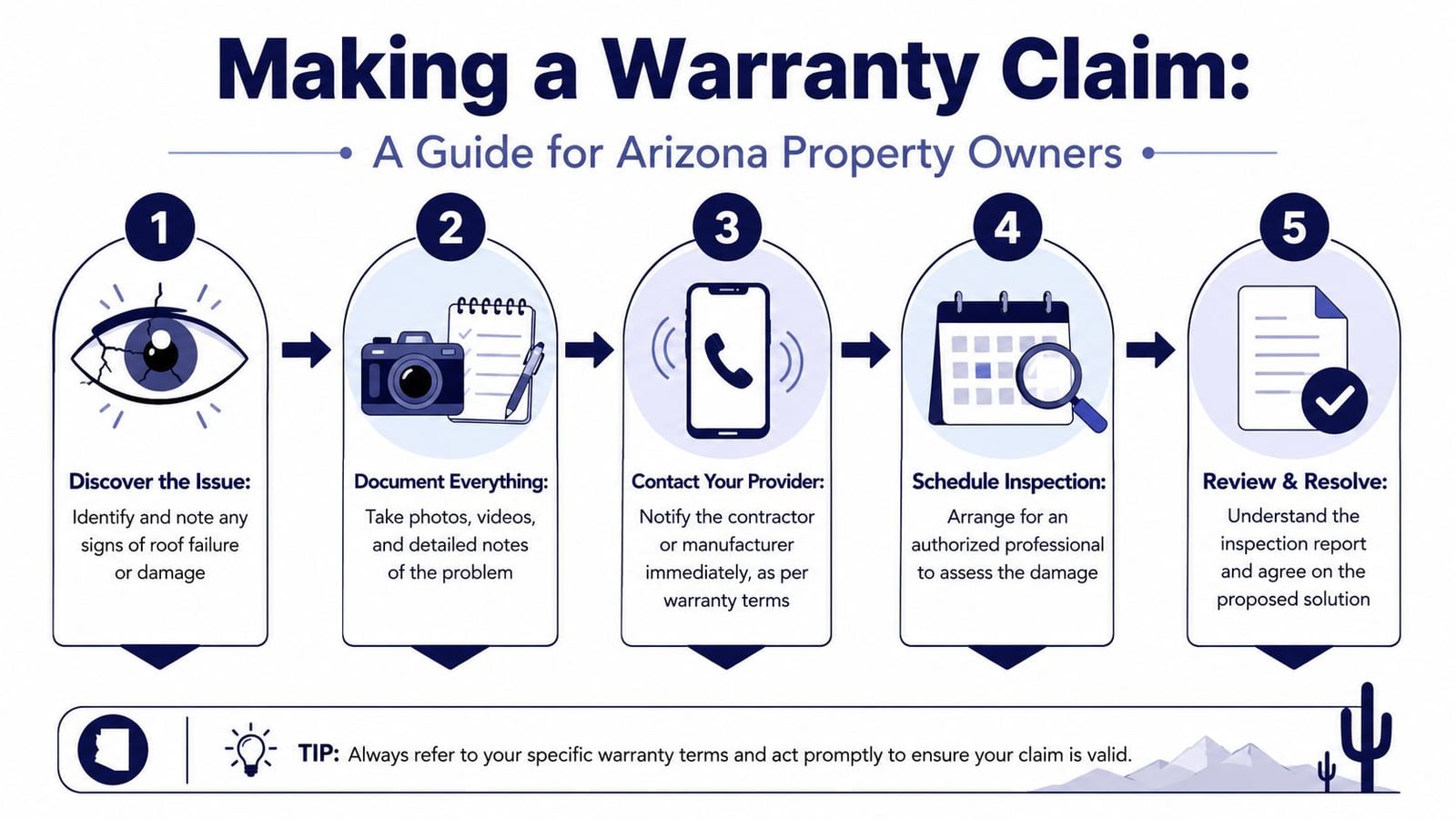
According to this workmanship versus manufacturer warranty overview, workmanship warranties don't cover damage from external factors such as monsoon-driven wind exceeding design speeds, hail, or third-party installations like solar panels. Claims require documented proof of an installation error, such as an inspection report showing code-non-compliant fastening or flashing.
A practical claim checklist
- Document the problem immediately: Take clear photos of ceiling stains, wall damage, ponding water, loose materials, flashing gaps, or visible membrane issues.
- Pull the original paperwork: Find the contract, warranty document, permit record, invoice, and any maintenance reports.
- Write down timing: Note when the leak appeared, what weather occurred, and whether any recent work happened on the roof.
- Contact the installing contractor first: Explain the symptoms clearly and request a warranty inspection in writing.
- Avoid random repairs: Temporary emergency protection may be necessary, but untracked patching can complicate a claim.
For owners dealing with storm-related confusion, this resource on documenting roof damage for claims helps organize photos, notes, and records in a way that supports the file.
Know what the inspector needs to see
A warranty claim gets stronger when the inspection can connect the leak to a specific installation defect. General statements like “the roof failed” won't carry much weight. Specific evidence matters more, such as loose flashing, bad fastener placement, open seams, or details installed out of code.
That's especially important on flat and low-slope systems where water can travel before it appears inside. The leak location indoors may not be the defect location on the roof.
If the claim depends on workmanship, the owner needs proof of workmanship. Photos, dates, permit records, and inspection notes usually matter more than opinions.
If the contractor is gone
This is the hardest situation, and it's the reason contractor stability matters so much. If the company that issued the workmanship warranty is out of business, unreachable, or unwilling to respond, the paper itself may have little practical value unless there is separate manufacturer-backed coverage in place.
For storm-related conditions that may fall outside workmanship coverage, a professional storm damage roof inspection can help separate installation issues from weather damage and third-party causes.
A Warranty You Can Count On In Phoenix and Tucson
A workmanship warranty has value only when the contractor behind it is stable, reachable, and willing to honor it years after the job is complete. That matters in Phoenix and Tucson, where roofs take constant punishment from UV exposure, dust, thermal movement, and monsoon weather.
The warranty document also has to sit on top of proper process. In most Arizona jurisdictions, including Phoenix, a building permit is required for roof replacements affecting more than one square (100 sq ft), and unpermitted work can void guarantees, as noted in this Arizona roofing permit reference. If the installation wasn't permitted when required, the warranty may not mean much when a dispute starts.
What actually makes a warranty worth keeping
A reliable warranty usually comes from a contractor that does the following:
- Uses proper permitting: Required permits and inspections help support the legitimacy of the installation.
- Puts scope in writing: The contract should identify what system is being installed and what workmanship is covered.
- Explains owner responsibilities: Maintenance, access, drainage care, and third-party roof work should be addressed before the project starts.
- Stays local and reachable: Long-term presence in the service area matters more than attractive wording alone.
For owners comparing contractors, a Phoenix roofing company with established local operations is generally in a better position to support future claims than a company that appears for one season and disappears. America Roofing handles residential and commercial roofing in Phoenix and Tucson, including repairs, replacements, flat roofs, foam roofing, coatings, tile, shingles, leak repair, and reroofing.
The short version is simple. A good workmanship warranty protects against installer error. A bad one shifts cost and risk back to the owner. The difference usually comes down to the contract language, the company's stability, and whether the roof was installed correctly in the first place.
If questions came up about an existing roof, a replacement project, or warranty language before signing a contract, contact America Roofing at 602-237-2478 or request a roofing estimate for a practical review of the roof, the scope, and the protection that is important.