
Roof financing can feel intimidating, but it doesn't have to be. When the Arizona sun, monsoon storms, and haboobs start pushing an older roof past its limits, smart financing is often what lets families fix problems now instead of "someday." Honestly, if you're staring at a big roofing estimate and wondering how you'll swing it, this guide is for you.
Why Roof Financing Matters for Arizona Homeowners
Roof financing makes it possible to protect your home with a quality roof replacement or repair—even when you don't have thousands of dollars saved up. With the average roof replacement in Arizona costing between $9,500 and $30,000 (and sometimes more for premium materials), financing options can turn an overwhelming expense into manageable monthly payments.
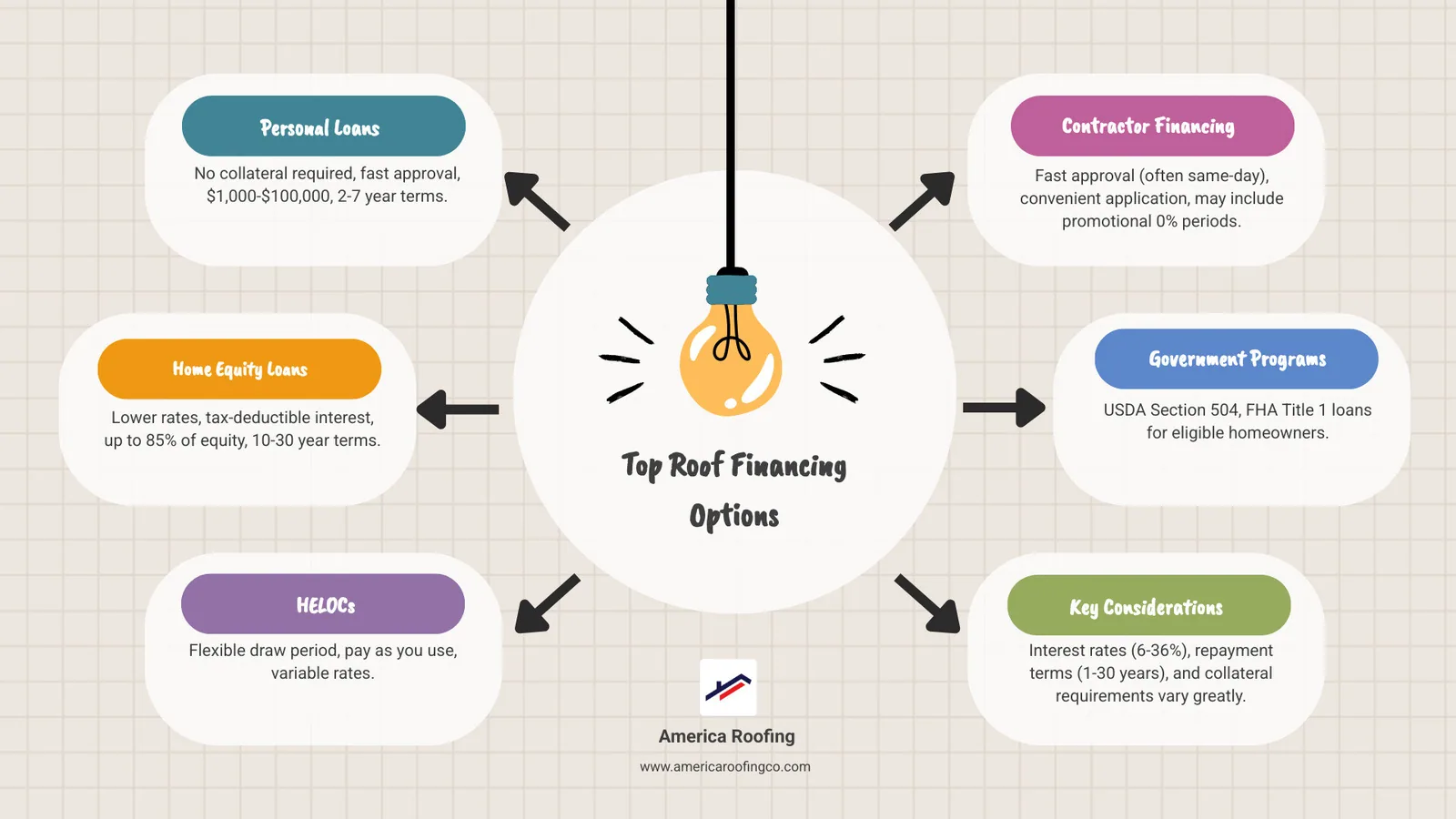
Quick Answer: Top Roof Financing Options
- Personal Loans – No collateral required, fast approval, $1,000-$100,000, 2-7 year terms
- Home Equity Loans – Lower rates, tax-deductible interest, up to 85% of equity, 10-30 year terms
- HELOCs – Flexible draw period, pay as you use, variable rates
- Contractor Financing – Fast approval (often same-day), convenient application, may include promotional 0% periods
- Government Programs – USDA Section 504, FHA Title 1 loans for eligible homeowners
Here's the thing: Arizona's intense heat and monsoon storms take a serious toll on roofs. When your roof starts leaking or shows serious wear, waiting isn't an option. But coming up with $10,000 or more on short notice? That's not realistic for most families.
Financing transforms your roofing project from impossible to achievable. Instead of draining your emergency fund or maxing out high-interest credit cards, you can spread the cost over months or years with predictable payments. Better yet, many financing options offer promotional periods with 0% interest—meaning you could pay zero extra if you pay off the balance in time.
The ROI makes sense too. According to the 2019 NARI Remodeling Impact Report, homeowners can recover up to 107% of their roof replacement cost when they sell. A new roof also cuts your AC bills (huge in Phoenix summers), prevents costly water damage, and may even qualify you for insurance discounts.
But not all financing is equal. Interest rates range from around 6% to 36% depending on your credit score and loan type. Terms can stretch from 12 months to 30 years. Some loans use your home as collateral (which means lower rates but more risk), while others don't require any collateral at all.
Understanding Your Investment and Financing Basics
You know what? For most Phoenix, Mesa, and Chandler homeowners, the first shock isn’t the leak—it’s the estimate. Replacing a roof is a significant investment, and roof financing is often what makes that investment realistic instead of overwhelming.
Let's be honest, replacing a roof is a significant investment. We've seen countless homeowners in Phoenix and Mesa grapple with the sticker shock. While HomeAdvisor reports an average cost of $9,354, this can easily exceed $30,000 depending on your home's size, location, and materials. The cost isn't just about shingles; several factors contribute:
- Roof Size and Pitch: Larger or steeper roofs require more materials and labor.
- Materials: Asphalt shingles are affordable, while tile or metal roofs cost more upfront.
- Labor Costs: Skilled professionals command fair wages, which can be a large portion of the bill.
- Job Complexity: Multiple valleys, dormers, or chimneys increase complexity and cost.
- Structural Repairs: Unforeseen damage to the underlying decking or trusses adds to the final price.
- Permits and Inspections: Local regulations in cities like Scottsdale and Tempe require permits, which have associated fees.
While the upfront cost is daunting, a new roof is an investment in your home's value and integrity. A 2023 report suggests asphalt roofs have an ROI of 61% and metal roofs around 49%. Beyond resale value, a new roof improves energy efficiency (lowering utility bills), prevents costly water damage, and boosts curb appeal. This is why we created our guide on How to Save Thousands on Your Roof Cost.
How Your Credit Score Impacts Roof Financing
Your credit score is a huge factor in what roof financing you can get. Lenders use it to gauge risk.
- Eligibility & Rates: A higher score (670+) improves your approval odds and helps you qualify for the lowest interest rates, potentially saving you thousands. Personal loan APRs can range from 6% to 36%, with the best rates reserved for those with scores of 690+.
- Loan Terms: Good credit can also open up larger loan amounts and more flexible repayment terms.
- Bad Credit Options: If your credit isn't perfect, you're not out of luck. Government-insured loans, like FHA Title 1 loans, can be more forgiving, sometimes approving borrowers with scores as low as 500 if other conditions are met.
Let me explain why this matters: a few percentage points on your APR can mean the difference between a payment that fits your budget and one that keeps you up at night.
The Application Process: From Quote to Approval
Applying for roof financing can be straightforward. Here’s a general overview:
- Get Estimates: Start by getting at least three detailed, written estimates from reputable roofing contractors. Our Roof Repair Estimates guide explains what to look for.
- Review Your Budget: Determine a realistic monthly payment you can afford.
- Get Pre-qualified: Many lenders offer pre-qualification with a soft credit check, allowing you to compare rates without impacting your score.
- Gather Documents: You'll typically need proof of income (pay stubs, W-2s), bank statements, and a government-issued ID.
- Apply and Get Approved: Submit your application. Approval times vary: personal loans and contractor financing can be approved in hours, while home equity loans may take a few weeks.
You know what really helps? Going into this process with a clear number in mind for your monthly comfort zone. That way, when the approval comes back, you’re deciding with confidence—not pressure.
Your Complete Guide to Roof Financing Options
When it comes to paying for a new roof, you have a variety of avenues to explore. Each option has its own set of pros and cons, and the "best" choice really depends on your financial situation, credit score, and how quickly you need the funds. Let me explain: the right roof financing plan should protect both your house and your long-term budget.
Here's a quick comparison of some popular choices:
| Financing Option | Interest Rate Type | Repayment Term | Pros | Cons | Best For |
|---|---|---|---|---|---|
| Personal Loan | Fixed | 2-7 years | No collateral needed; fast funding process. | Higher interest rates, especially for lower credit scores. | Homeowners with good credit who need funds quickly. |
| Home Equity Loan | Fixed | 10-30 years | Lower interest rates; interest may be tax-deductible. | Uses your home as collateral; longer application process. | Homeowners with significant equity who prioritize low, fixed rates. |
| HELOC | Variable | 10-30 years | Flexible draw period (use what you need); interest-only payments initially. | Variable rates can increase; uses your home as collateral. | Projects with uncertain costs or for ongoing access to funds. |
| Contractor Financing | Fixed or Variable | 1-10+ years | Convenient one-stop-shop; promotional 0% APR offers. | Can have high interest rates after the promo period ends. | Homeowners looking for the simplest and fastest application process. |
Honestly, there is no one-size-fits-all answer. Some Arizona homeowners prefer the predictability of a fixed payment, while others want the flexibility of drawing what they need over time. The key is to compare:
- Total interest cost over the life of the loan
- Monthly payment vs. your comfort zone
- Whether your home is used as collateral
- Fees, prepayment penalties, and promo rate expirations
Secured vs. Unsecured Loans for Your Roof
The biggest difference between loan types often comes down to whether they are "secured" or "unsecured." This simply means whether you offer collateral to back the loan.
- Secured Loans: These loans use an asset, usually your home, as collateral. Because the lender has something to fall back on if you can't repay, these loans typically come with lower interest rates and longer repayment terms.
- Home Equity Loans: This is a second mortgage that gives you a lump sum of cash, secured by the equity you've built in your home. They usually have fixed interest rates and repayment terms up to 30 years. The interest you pay on these loans for home improvements may be tax-deductible if you itemize deductions, according to the IRS.
- Home Equity Lines of Credit (HELOCs): Similar to a credit card, a HELOC is a revolving line of credit secured by your home's equity. You can draw funds as needed during a "draw period" (often 10 years) and only pay interest on the amount you use. HELOCs typically have variable interest rates.
- Pros of Secured Loans: Lower interest rates, potentially tax-deductible interest, larger loan amounts, longer repayment terms.
- Cons of Secured Loans: Your home is collateral, meaning you could lose it if you default. The application process is longer, involving appraisals and closing costs (typically 2-5% of the loan amount).
- Unsecured Loans: These loans are not backed by any collateral.
- Personal Loans: These are typically fixed-rate, fixed-term loans that you repay in monthly installments. They are unsecured, meaning your home isn't at risk if you can't pay. Personal loans can fund quickly, often within a few days. Loan amounts typically range from $1,000 to $100,000, with repayment terms of 2 to 7 years.
- Credit Cards: While quick and easy to access, standard credit cards carry very high interest rates (average APRs on new cards recently hit 24.35%). They are generally not recommended for large expenses like a roof replacement unless you can take advantage of a 0% introductory APR offer and pay off the entire balance before the promotional period ends.
- Pros of Unsecured Loans: No collateral required (your home isn't at risk), faster funding (especially personal loans), simpler application process.
- Cons of Unsecured Loans: Higher interest rates (especially with lower credit scores), shorter repayment terms, potentially smaller loan amounts.
Here's the thing: secured loans can feel safer because of the lower rate, but you're literally putting your home on the line. Unsecured options usually cost more in interest, but they keep your house out of the collateral equation.
Government Programs and Other Avenues
Beyond traditional loans, there are specific programs and avenues that can help with roof financing, especially for those who meet certain criteria.
- Insurance Claims: If your roof damage was caused by a sudden, unexpected event like a monsoon storm, hail, or a fallen tree, your homeowner's insurance might cover a significant portion of the cost. We specialize in assisting our Arizona clients with Roofing Insurance Claims: A Step-by-Step Guide to ensure you get the coverage you deserve.
- FHA Title 1 Loans: Administered by the Federal Housing Administration (FHA), these are fixed-rate loans designed to finance home improvements. They can be used for essential repairs, including roofs, on properties that have been owned for at least 90 days. Loans up to $7,500 are typically unsecured, while larger amounts must be secured by a mortgage or deed of trust on the property.
- USDA Section 504 Program: This program provides loans to very-low-income homeowners in eligible rural areas to repair, improve, or modernize their homes. It also offers grants to elderly (62 or older) very-low-income homeowners to remove health and safety hazards. The maximum loan is $40,000, and the maximum grant is $10,000. Loans have a fixed 1% interest rate over 20 years. To check if your property is in an eligible rural area, you can use the USDA Eligibility Site.
- FHA 203(k) Loans: These are renovation loans that allow you to finance the cost of a home purchase or refinance and include the cost of repairs and improvements, like a new roof, into a single mortgage. The loan amount is based on the home's value after the improvements are made.
You know what surprises a lot of homeowners? How often a mix of these options—like an insurance payout plus a smaller loan—creates the most comfortable solution.
Choosing Your Partner and Finalizing Your Project
Finding the right roof financing is only half the battle; you also need a reputable roofing contractor who delivers quality work. Many companies, including America Roofing, offer contractor financing, which simplifies the process by bundling the project and payment. As we explain in Why You Should Opt for Roofers That Provide Financing, this can be incredibly convenient, but always compare the terms to other loan options.
What to Look for in a Roofing Contractor
Choosing the right contractor is as critical as choosing the right loan. Here’s what to look for in the Phoenix area:
- Licensed & Insured: This is non-negotiable. Verify their license (our ROC# is 186438) and insurance to protect yourself.
- Local Experience: Arizona's climate is harsh. You need a contractor who knows what materials and techniques work best here.
- Transparent Pricing: Get a detailed, itemized estimate with no hidden fees.
- Customer Reviews and Reputation: Check online reviews on Google, BBB, and Yelp. A strong track record of satisfied customers is a great sign. Learn more about our commitment on our About Us page.
- Warranties: Ask about both material and labor warranties to protect your investment.
Our Guide to Choosing a Roof Company offers more tips.
Your Next Steps to a Secure Roof
Ready to move forward? Here's a quick checklist:
- Get multiple quotes from reputable local roofers.
- Compare financing options to find the best fit for your budget.
- Review loan terms carefully, including the APR, repayment period, and any fees.
- Verify contractor credentials before signing a contract.
- Schedule your project and enjoy peace of mind.
You’ve now got a clear picture of how roof financing works, which options tend to fit Arizona homeowners best, and how to choose a contractor you can truly trust. If you’d like honest, no-pressure guidance on both your roof and your payment options, call us at 602-237-2478 or Request a Free Quote today so we can help you protect your home on a budget that feels right for you.