
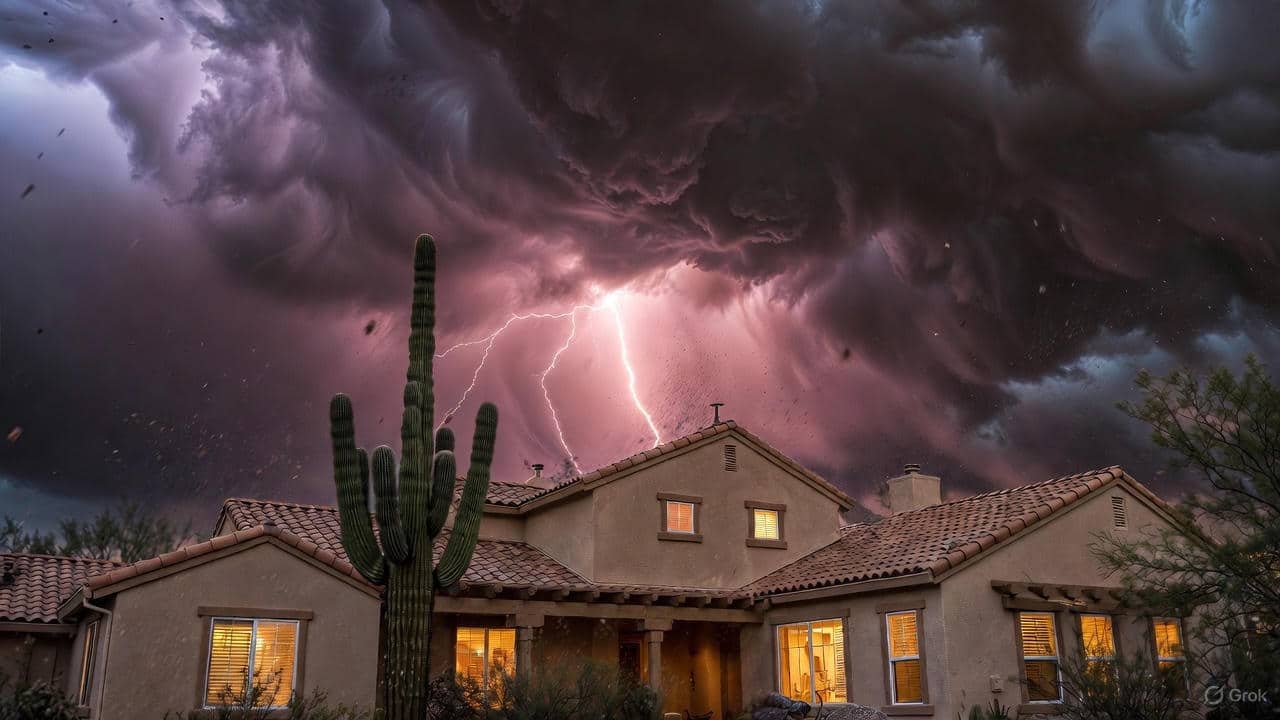
Phoenix monsoons don’t knock — they kick the door down with 70 mph winds, golf-ball hail, and rain that falls sideways. Every single July we get the same panicked calls from homeowners watching their ceilings turn into waterfalls because they figured “it’s just a little dust storm.” The truth we’ve learned after 25+ Valley summers? The roofs that survive untouched are the ones that got real love in April, May, or early June — not the ones people prayed over in July.
Phoenix Monsoons Don’t Play – Why Preparation Actually Matters Here
Everyone thinks Seattle gets the worst weather for roofs. Nope. Our monsoons are shorter but way more violent. The National Weather Service recorded wind gusts up to 100 mph in some Valley microbursts in recent years, and hail the size of quarters is common in north Scottsdale and Cave Creek.
When you combine that with tile roofs that are already 20–30 years old and underlayment baked brittle by 115° heat, you’ve got a recipe for disaster. But here’s the part that should give you hope: 80% of the storm-damage calls we run in July and August could have been prevented with basic roof maintenance done in the spring.
The Exact Pre-Monsoon Roof Maintenance Checklist We Give Every Client
We literally print this list and hand it to customers. Follow it and you’ll sleep better when the first thunder rolls.
- Clean gutters and scuppers completely — Valley dust + cotton from cottonwood trees = concrete in your gutters by June. Clogged gutters during a monsoon = water shooting over the edge and under your fascia.
- Blow or sweep the entire roof — leaves, seed pods, and gravel stop-up valleys and hold water against tiles.
- Inspect and re-seal pipe collars, vents, and HVAC flashing — these shrink and crack every winter.
- Check for slipped, cracked, or missing tiles that “walked” over winter — even one loose tile can let wind-driven rain in.
- Trim trees touching or overhanging the roof — we’ve seen entire branches rip off half a roof in 60 mph winds.
- Have attic ventilation checked — poor airflow cooks your underlayment from below and shortens roof life dramatically.
- Re-coat foam roofs if they’re 5+ years old — the white coating is your UV shield; once it chalks off, the foam dies fast.
- Walk the perimeter and look for low spots or ponding areas on flat sections.
Do these eight things between March and May and you’ve just eliminated most monsoon headaches.
The Hidden Weak Spots We Find on 9 Out of 10 Valley Roofs in Spring
Every spring we do hundreds of free inspections, and the same problems show up again and again:
- Baked-out underlayment on tile roofs — tiles look perfect, but the felt paper underneath is cracked and leaking. This is the #1 silent killer in Phoenix.
- Cracked or lifted valley metal — water rockets down valleys at high speed; any gap means instant leaks.
- Failed pipe jack flashing — the rubber boots around plumbing vents shrink and split in our heat.
- Granule loss on shingle roofs — north-facing slopes especially; once granules are gone, UV destroys the shingle in one summer.
- Clogged or disconnected scuppers on flat/foam roofs — two inches of rain in an hour overwhelms them and creates ponding that collapses sections.
We had a client in Anthem last year who ignored a few cracked tiles. One July storm later, we replaced 22 sheets of decking and all the drywall in three rooms. The prep visit would have cost nothing. The repair cost $18,400. You do the math.
How to Do Your Own Quick Roof Inspection (Without Killing Yourself)
You don’t need to walk the roof like a billy goat. Most issues are visible from the ground or a ladder.
- Grab binoculars and walk the entire perimeter — look for slipped tiles, cracked ones, or bare spots on shingles.
- Check all visible flashing (metal pieces around chimneys, walls, vents) for rust, lifting, or missing caulk.
- Look at gutters for shingle granules (looks like black sand) or tile chunks.
- Go in the attic with a good flashlight — look for water stains, mold, or daylight peeking through.
- Check your summer electric bills from last year — spiking bills often mean lost insulation from roof leaks.
If you see any of these, stop DIY and call a pro. Seriously.
| Task | Best Month to Do It in Phoenix |
|---|---|
| Full professional inspection | March–April |
| Gutter cleaning & roof blow-off | May |
| Tree trimming | February–April (before leaves fill in) |
| Minor repairs & sealing | April–May |
| Foam roof re-coating | March–early June at latest |
Tree Trimming, Gutters and the Little Things That Save Big Money
We cannot stress tree trimming enough. Palo verdes, mesquites, and especially those giant eucalyptus trees people planted in the 80s — they become missiles in monsoon winds. We’ve removed entire trees off roofs after storms. Trim anything touching your roof, and anything within 10–15 feet if it’s tall and sketchy. Gutters are the unsung heroes. If yours dump water right next to the foundation, extend the downspouts or add buried drain lines. Standing water against your walls during a storm leads to foundation cracks and interior damage that insurance often won’t cover.
When “Good Enough” Isn’t – Red Flags That Mean Call Us Now
Be brutally honest with yourself:
- Roof is 20+ years old (tile underlayment likely shot)
- You see multiple cracked or slipped tiles
- Attic shows stains or mold
- Foam roof coating is chalking or bare in spots
- You’ve had even one leak in the past two years
If any of these apply, schedule an inspection today. Waiting until June means you’re competing with 5,000 other panicked homeowners when the first storm hits, and crews are booked solid for weeks.
Emergency Storm Prep Most Homeowners Forget Until It’s Too Late
Keep these in your garage right now:
- Heavy-duty tarp (20x30 minimum)
- 2x4s or furring strips to secure tarp
- Roll of Henry 208R Wet Patch roofing cement
- Phone number of a local roofer who does emergency tarping (hint: us)
And please — update your insurance policy photos this month. Take pictures of every room, attic, and the roof itself. When disaster strikes, you’ll be glad you did. If you want real peace of mind before the 2025 monsoon season kicks off,
click here to schedule your free pre-monsoon roof inspection
. We’ll come out, document everything with photos and drone footage, and give you an honest report — no charge, no pressure. We’ve been getting Valley families ready for monsoon season since 1999, and we’d love to help you avoid becoming another July horror story.
Sources
- National Weather Service Phoenix – Monsoon Safety https://www.weather.gov/psr/MonsoonSafety
- AZ Family – Preparing Your Home for Monsoon Season (2024) https://www.azfamily.com/2024/06/14/how-prepare-your-home-monsoon-season/
- Roofing Insights – Monsoon Roof Damage Statistics Arizona https://www.roofinginsights.com/news/arizona-monsoon-roof-damage
- Owens Corning – Preparing Your Roof for Severe Weather https://www.owenscorning.com/en-us/roofing/blog/how-to-prepare-your-roof-for-severe-weather
Related reading: