
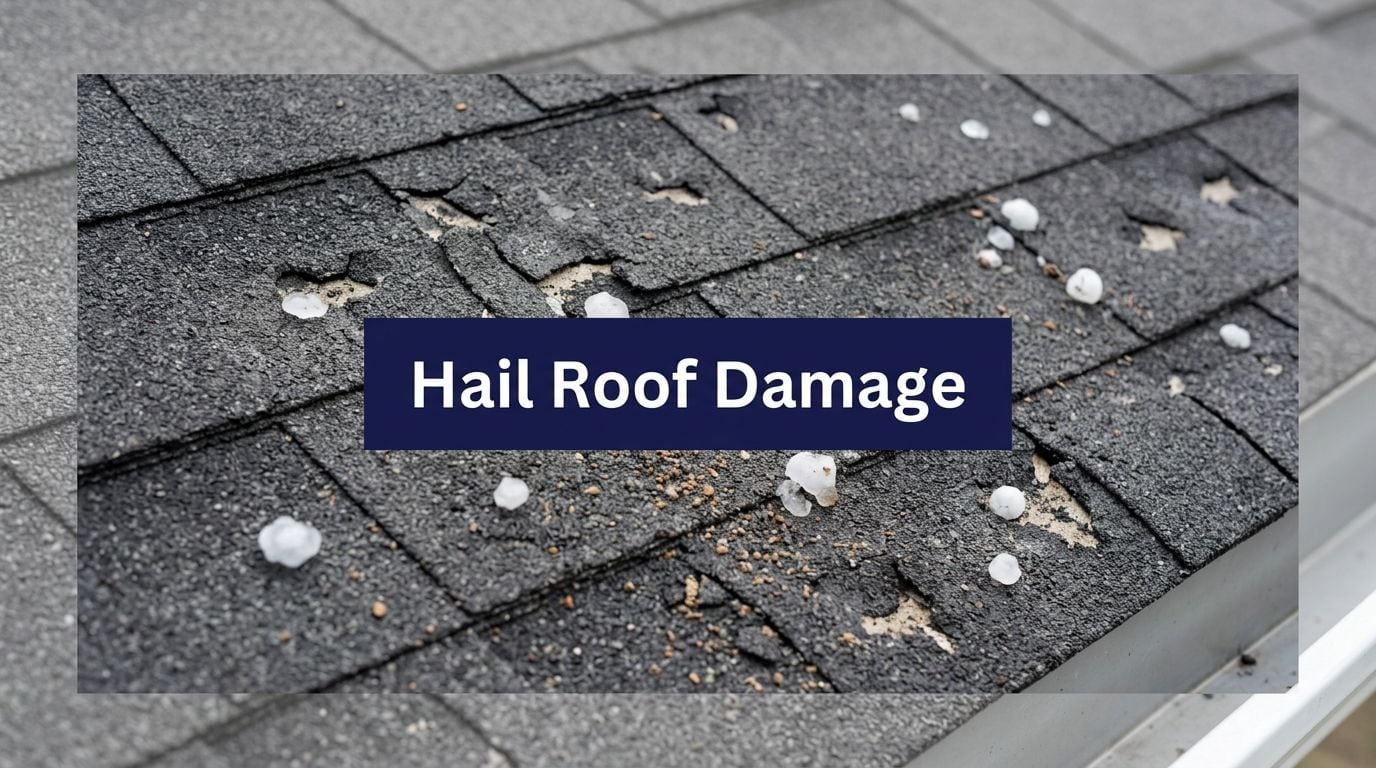
A monsoon hailstorm moves through Phoenix or Tucson fast. The noise stops, the yard looks mostly normal, and the roof appears fine from the driveway. That's exactly when roof damage from hail storm gets missed in Arizona, especially on tile, foam, and flat roofs where failure often shows up later as a leak instead of an obvious break.
What Hail Damage Looks Like on Different Arizona Roofs
A Phoenix homeowner can walk the perimeter after a hailstorm, see no missing pieces, and assume the roof made it through fine. On Arizona roofs, that is often the wrong call. Tile, foam, and low-slope systems frequently take impact damage that stays quiet until sun, heat cycling, and the next rain expose it.
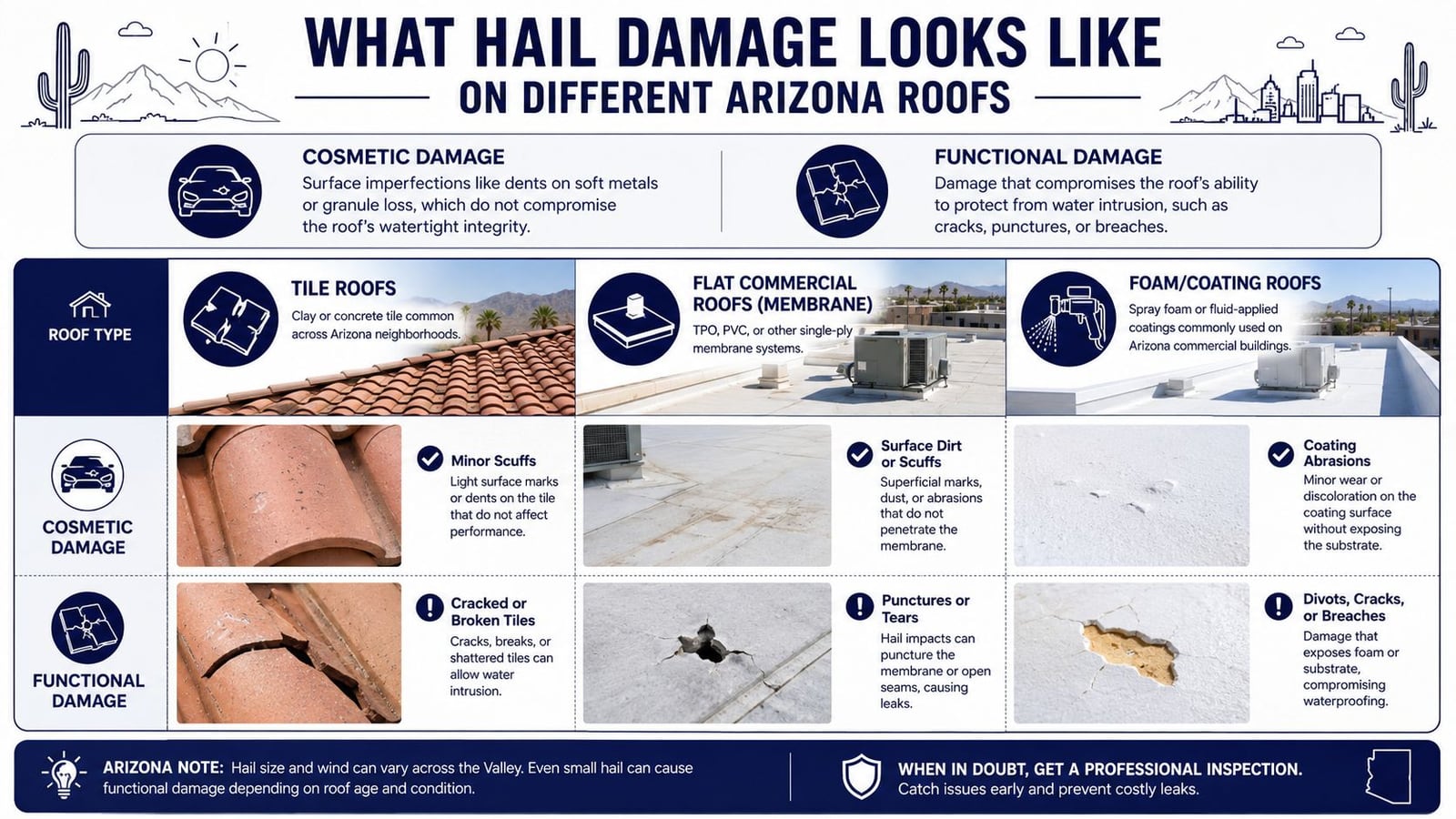
Cosmetic damage and functional damage
The first job is separating cosmetic damage from functional damage.
Cosmetic damage affects appearance. Functional damage affects the roof's ability to keep water out. Insurance decisions usually hinge on that second category.
That distinction sounds simple, but on Arizona roofs it gets tricky fast. A tile can take a small impact that barely shows from the ground, yet the crack is enough to let more water reach the underlayment. A foam roof can show only a shallow divot, while the coating at that spot has been thinned enough for UV to start breaking it down. A flat roof membrane can look dirty and scuffed after a storm, but the actual problem is a stressed seam at a drain or curb.
Shingle roofs give property owners a familiar reference point. Hail damage there often shows up as bruising, granule loss, or exposed asphalt mat. For a closer explanation of how impact changes roof performance, see understanding hail damage to roofs. Arizona roofs often fail in a less obvious way.
Tile roofs in Phoenix and Tucson
Concrete and clay tile roofs are built for Arizona heat, but hail damage on tile is rarely limited to one obvious broken piece.
The easy damage to spot is a cracked field tile, a chipped edge, or fragments that slide into a valley. The harder calls involve hairline fractures, impact points near fastener locations, and small breaks around hips, ridges, and penetrations. Those areas may hold for a while. Then expansion, contraction, and monsoon moisture turn a minor strike into an active leak path.
Older tile roofs deserve extra attention. In many cases, the tile is only part of the system. The underlayment below provides the primary waterproofing. If hail shifts tiles, breaks mortar at key points, or opens repeated water entry at one location, the leak may show up inside long after the storm date.
What matters on tile roofs
- Cracked or fractured field tiles: Even a narrow crack can increase water intrusion below the tile layer.
- Broken ridge, hip, or rake pieces: These details take more exposure and often fail sooner than the main field.
- Impacts near valleys, skylights, vents, and chimneys: Water concentrates in these areas, so small damage matters more.
- Tile displacement: A tile does not have to shatter to create a problem. Movement can expose underlayment or weaken adjacent pieces.
- Spalling or fresh surface loss: On concrete tile, fresh impact marks can indicate the strike had enough force to damage more than the visible surface.
Shingle roofs and the classic bruise pattern
Asphalt shingles are less common here than tile, foam, and other desert-friendly systems, but they still show up on many homes, rentals, and multifamily buildings. Hail damage on shingles usually leaves the most recognizable pattern in the industry.
Look for concentrated granule loss, random dark spots, and circular impact marks that feel soft under light pressure during a professional inspection. That bruise means the asphalt layer has been compressed or fractured below the surface. The shingle may still be in place, but its service life has changed.
This type of damage is easier to explain to an adjuster because it has a well-known pattern. It is also why many national articles focus heavily on shingles. In Arizona, that can mislead owners into expecting hail damage to be obvious on every roof type. It often is not.
Foam roofs and flat commercial systems
Arizona-specific experience matters most.
Spray foam and low-slope roofs often show delayed-failure damage. After the storm, the roof may still look continuous from the ground and may not leak right away. The problem is that hail can compress the foam surface, fracture the protective coating, or create small punctures that stay hidden under dust and rooftop traffic marks.
Once the coating is compromised, Arizona sun does the rest. UV exposure dries and weakens the impacted spot. Normal expansion and contraction widen it. Water then finds the opening during the next storm cycle, and the leak appears weeks or months later.
On flat membrane roofs, the key trouble spots are details, not just open field areas. Check drains, scuppers, seams, parapet transitions, curbs, flashings, and equipment supports. Hail can stress a seam, split a flashing edge, or damage a drain area enough to slow proper drainage. A roof can remain mostly intact and still lose reliability at those points.
That delayed pattern is common across Arizona roof types, but it is especially common on foam and flat roofs because the failure often starts as coating loss, seam stress, or a small puncture instead of a dramatic opening.
A Homeowner's Guide to Spotting Hail Damage Safely
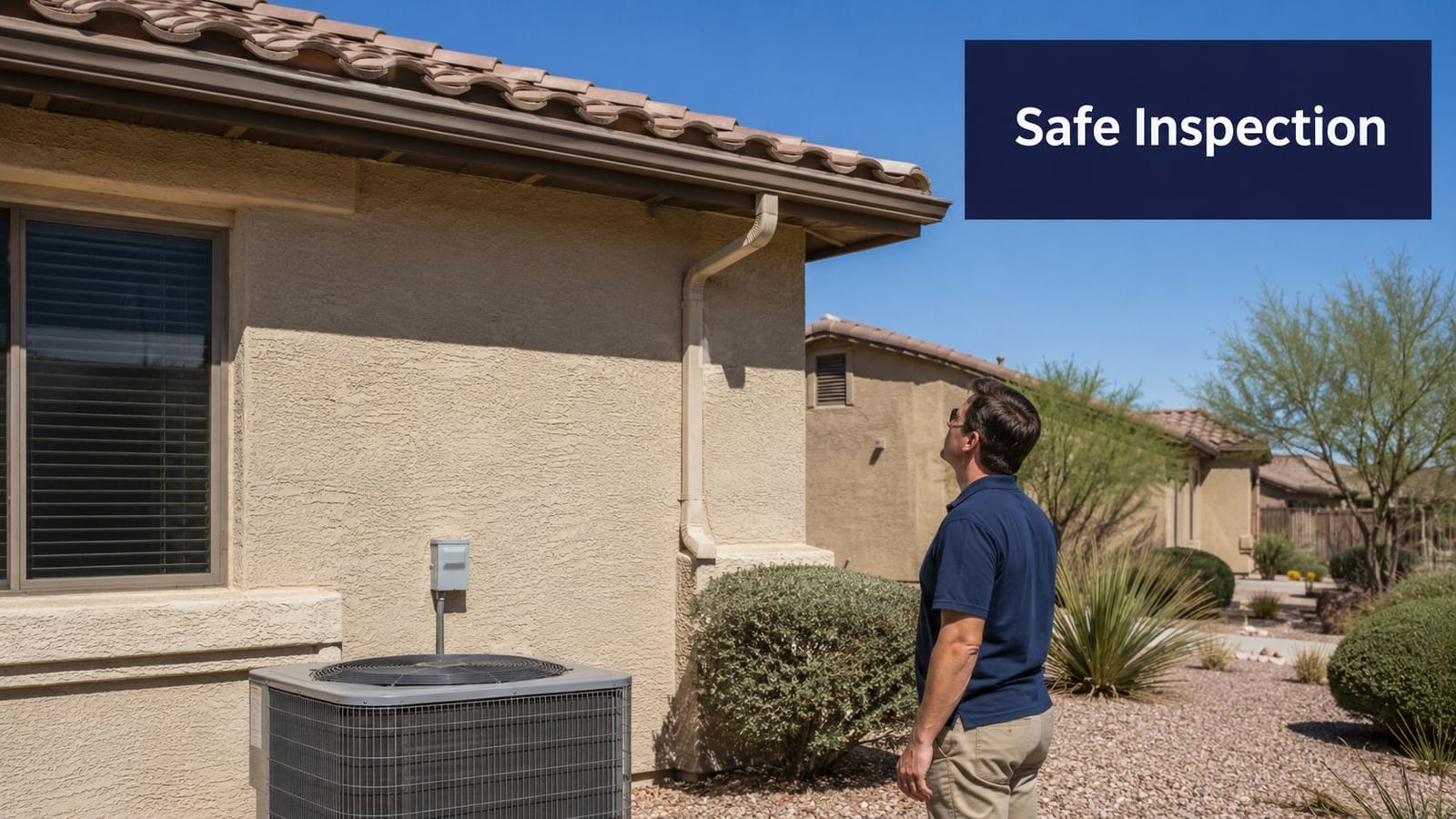
The morning after a hailstorm, many Arizona roofs look fine from the driveway. That is common, especially on tile, foam, and flat systems. The smart move is a ground-level inspection that helps you decide whether the roof needs a closer professional review.
Start with the evidence around the roof
On Arizona properties, the first clear signs often show up on softer materials and exposed metal before they show up on the roof covering itself.
Check gutters, downspouts, vent caps, flashing edges, AC housings, patio covers, metal fencing, window screens, and painted trim. Fresh dents, chipped paint, torn screens, or impact marks help confirm the storm had enough force to damage the roof. They also help establish storm direction, which matters when one slope took the hit and another did not.
This step is especially useful on tile and foam roofs. Those systems often hide hail damage from ground view, so the surrounding clues matter more than many homeowners expect.
Check what you can see from the ground
Use binoculars if you have them. Stay on stable ground and walk the full perimeter slowly.
Look for cracked tile, shifted tile, broken ridge pieces, exposed underlayment, fresh debris in valleys, granules collecting near downspout outlets, and impact marks on visible roof accessories. On foam roofs, look for areas that appear scuffed, flattened, or unusually dark. On flat roofs, the field of the roof may not be visible at all, so focus on parapet caps, edge metal, drain areas, and any new interior ceiling staining near exterior walls.
One practical rule applies here. If the storm clearly marked metal, screens, and outdoor equipment, but the roof still looks clean from below, do not assume the roof escaped damage.
Pay attention to aging sections
Arizona sun changes how hail damage shows up.
South- and west-facing slopes usually age faster because they take more UV exposure. Older tile gets more brittle. Foam coatings lose thickness over time. Flat roof details around drains, seams, and penetrations often become the weak points first. Hail on those weathered areas may not create an obvious opening, but it can shorten the roof's remaining service life and lead to leaks later.
That delayed-failure pattern is what many national shingle-focused guides miss.
What homeowners should not do
Do not climb onto the roof after hail. Do not walk tile to check for looseness. Do not press on bruised-looking shingles. Do not poke foam divots, blisters, or coating breaks. Those steps can turn limited damage into a bigger repair and create disputes about what the storm caused versus what happened afterward.
A professional inspection is necessary if you see supporting impact evidence around the property, even when the roof surface looks mostly intact. Hidden punctures, fractured tile underlaps, coating loss, and stressed flashing details are easy to miss from the ground. America Roofing's guide explains what a proper inspection should cover. For a broader post-storm documentation checklist, see steps after DFW storm damage.
A homeowner inspection has one job. It helps you decide whether to call for a professional roof inspection.
What to Do Immediately After a Hail Storm
A common Arizona mistake happens the morning after the storm. The yard looks rough, the windows are intact, and the roof appears fine from the driveway, so cleanup starts right away. Then a few weeks later, a ceiling stain shows up under a foam split, a flat-roof flashing opens up, or a cracked tile underlap starts letting water in.
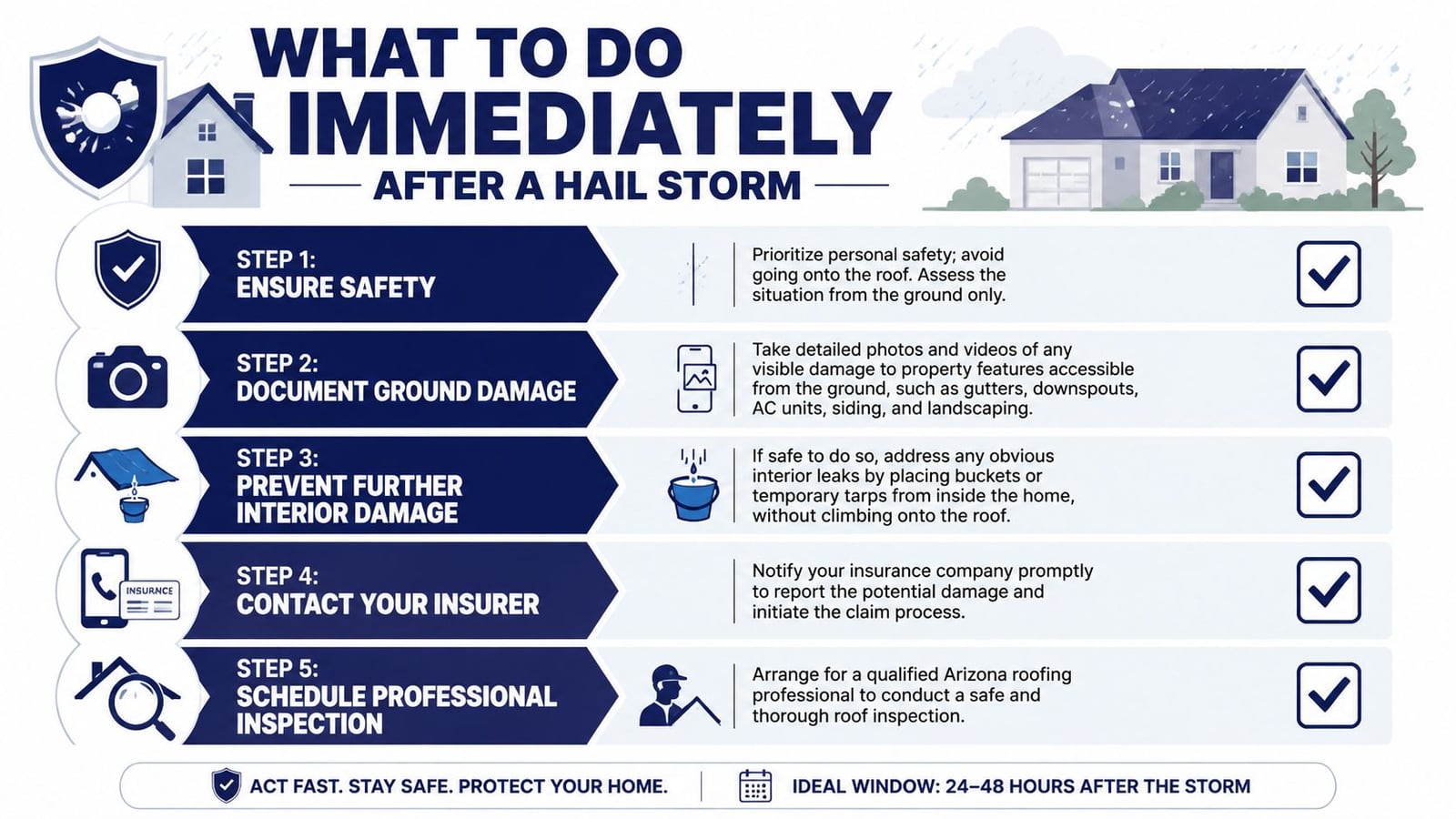
What you do in the first 24 hours should protect two things. The building itself and the evidence of what the storm did.
First actions that protect the claim and the building
- Stay off the roof Start with safety. Check for broken glass, fallen branches, downed power lines, slick patios, and active water entry. On Arizona tile roofs, foot traffic after a storm often causes more breakage than the hail you are trying to inspect. On foam and flat roofs, wet surfaces can hide punctures, coating damage, and soft spots.
- Photograph the property before cleanup Take wide shots first, then close-ups. Capture dents on metal, cracked or displaced tiles visible from the ground, damaged screens, gutters, downspouts, patio covers, AC fins, fence lines, and any debris pattern that shows storm direction. If water showed up inside, photograph stains, wet insulation, baseboards, and anything you moved to limit damage.
- Stop active interior water intrusion Use buckets, towels, plastic, and furniture protection inside the home. If water is entering through a light fixture, shut off power to that area if you can do it safely and call for help. Temporary dry-in work should be handled by a qualified roofer, especially on tile, foam, and flat systems where the leak point is often not directly above the stain.
- Write down what you saw while it is fresh Note the date of the storm, the approximate time, where you first saw damage, and which rooms or roof areas seem affected. That record helps later if the failure shows up as a delayed leak instead of immediate water entry.
What to save and what to avoid
Save every photo, inspection note, and receipt tied to temporary protection. Keep storm-damaged materials only if your contractor or carrier asks for them. Do not throw away broken tile pieces, detached metal, or interior materials removed during emergency mitigation until you know they have been documented properly.
For an outside perspective on post-storm documentation and sequencing, the checklist on steps after DFW storm damage is a useful companion resource.
Do not sign a repair contract at the door. Do not approve permanent repairs before the roof has been inspected and documented. Fast cleanup is fine. Fast commitment is where owners get into trouble.
Make the next two calls
Once the property is stable, make two calls. Contact your insurance carrier to report possible storm damage, and schedule a qualified roof inspection with a contractor who knows Arizona roof systems.
That local experience matters. Hail on asphalt shingles usually leaves obvious granule loss or bruising. Arizona roofs often fail in less obvious ways. Tile can crack at the underlap or break at high-stress points. Foam can lose coating or split later under UV exposure. Flat roofs may show impact damage around seams, drains, scuppers, and penetrations before they show a clear leak inside. If you need a contractor who knows how to identify those patterns, find storm damage roofing help.
Most policies require prompt notice after a storm. The practical rule is simple. Report the loss soon, document conditions before they change, and avoid permanent repairs until the damage has been inspected unless delay would cause more interior harm.
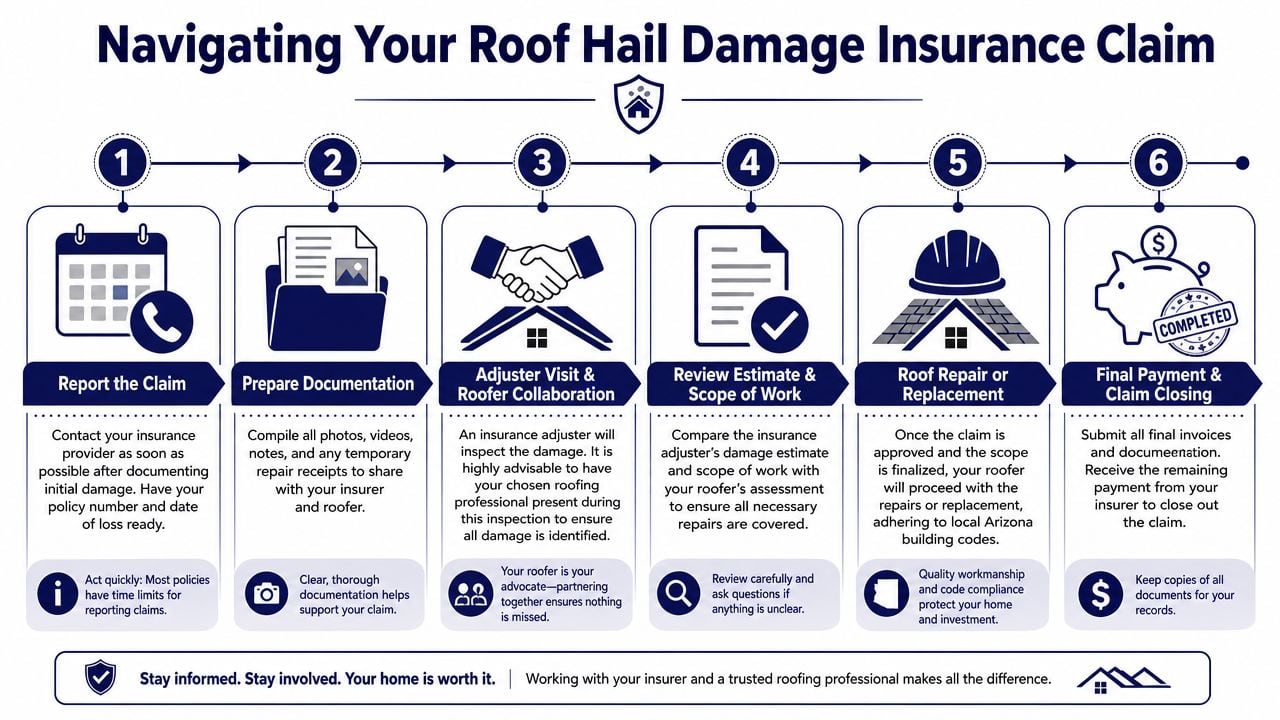
Navigating Your Roof Hail Damage Insurance Claim
A hail claim is won or lost on scope. In Arizona, that matters because tile, foam, and flat roofs often show subtle impact damage that does not look dramatic from the ground, but still leads to later failure if it gets missed.
Start the claim with an organized file
Report the loss with the storm date, policy number, site photos, and a short description of what was observed. Keep every email, claim number, inspection note, and temporary repair receipt in one folder. If the carrier asks a follow-up question two weeks later, quick access to that file saves time and reduces confusion.
Arizona owners should not assume a newer roof is automatically fine after hail. I have seen tile roofs with only a few visible breaks but damaged underlayment below. I have seen foam roofs that looked serviceable right after the storm, then showed coating loss and split areas once the sun and heat kept working on the impact points. Those are the claims that get underwritten short if nobody documents the full roof system early.
What the adjuster is actually looking for
The adjuster is trying to separate storm damage from age, foot traffic, prior repairs, installation defects, and normal wear. On Arizona roofs, that can be harder than it is on hail-damaged shingles in other states because the damage pattern is often less obvious.
Expect the inspection to cover the main roof surface, flashings, vents, soft metals, HVAC surrounds, drains, scuppers, and any interior signs of moisture. On tile roofs, visible broken pieces are only part of the story. On foam and flat roofs, the important findings may be coating displacement, punctures near penetrations, membrane stress, or impact damage around seams that has not leaked yet.
It helps to have a roofer present who understands those roof types and can point out where delayed failure is likely.
Key terms worth understanding
These terms affect expectations. Approval does not always mean the full amount is paid at once, and the payment schedule often depends on the policy and whether the work is completed.
Compare the scope of work line by line
Once the insurance estimate arrives, read the scope closely. Do not stop at the total.
A tile claim may need more than replacing the pieces that are plainly cracked. The real repair may also involve lifting and resetting surrounding tiles, checking battens, replacing damaged underlayment sections, and addressing collateral damage at flashings or ridge details. A foam or flat roof claim may require coating restoration, substrate drying, seam work, drain-area repairs, or insulation investigation if impact opened a path for moisture.
For a broader overview of process and documentation, filing a roof hail damage claim offers a useful reference.
If the estimate misses part of the damage, that does not automatically mean the claim is being handled improperly. It often means the roof needs better photos, a clearer inspection summary, or supporting documentation that ties the storm event to the repair scope. Owners who need local help with that process can get Phoenix roof damage claim assistance to match the roofing findings to what the carrier has on file.
Deciding Between Roof Repair and Replacement
A lot of Arizona hail claims sit in the gray area. The roof does not look destroyed from the ground, but the storm may have shortened its remaining life. That is common on tile, foam, and flat roofs here, where hail damage often shows up later as underlayment failure, coating breakdown, small splits at seams, or leaks around penetrations.
The repair-or-replace decision should start with one question: will this work restore reliable weather performance for the next several years, or only buy time?
When repair makes sense
Repair is usually the right call when the damage is limited and the rest of the roof still has solid service life left.
That often includes:
- Isolated tile damage where matching tile is available, adjacent tiles can be lifted without creating more breakage, and the underlayment below the impact area is still sound
- Localized foam damage where the affected area can be cut out, dried, rebuilt, and recoated so the repair ties into the surrounding system properly
- Small flat-roof impact areas where seams, insulation, and drainage conditions remain intact outside the damaged section
- Damage at accessories or rooftop components when the main roof field is still performing as it should
On Arizona roofs, that last part matters. A few broken tiles do not always mean replacement. A few broken tiles over brittle underlayment often point in a different direction.
When replacement is the smarter call
Replacement makes more sense when hail exposed problems across the system, not just at one spot. I see this most often on older tile roofs where the visible breaks are only part of the problem. Once tiles are lifted, the underlayment may be dried out, torn at fasteners, or too brittle to survive a proper reset. On foam roofs, repeated hail strikes can leave scattered weak points across the surface, especially if the coating was already thin from Arizona sun. On flat roofs, impact damage combined with aging seams, ponding areas, or wet insulation usually turns a "small repair" into recurring service calls.
Material matching also matters. If replacement tile is unavailable, if a patch leaves the roof with several vulnerable transitions, or if the repaired areas will likely fail before the rest of the system, patching is often the more expensive choice over time.
A practical rule is simple: if the proposed repair fixes the visible damage but leaves an aging roof with multiple remaining failure points, replacement deserves serious consideration.
The upgrade question
Replacement also gives owners one chance to correct a weakness instead of restoring it. That does not mean chasing the hardest-looking product on a brochure. It means choosing a roof system that fits the structure, the climate, and the budget, then paying attention to the details that control hail performance, attachment method, underlayment, edge metal, penetrations, and drainage.
For metal roofing, appearance and performance are not the same thing. A panel can show dents and still keep water out. The core question is whether the impact affected locks, fasteners, seams, coatings, or flashing details. For a repair-focused look at how material-specific those details can be, Bulls Eye Repair's guide to fixing roofs is a useful reference.
If you are weighing short-term patching against a larger corrective project, this Arizona-specific guide on roof replacement vs. repair lays out the decision in more detail.
Hail Damage Repair Timelines and Cost Factors
A hail claim can be approved and still stall at the roofing stage. In Arizona, the delay is often not the storm itself. It is the roof system. Tile repairs slow down when matching pieces are hard to find. Foam and flat-roof repairs slow down when crews need dry conditions, surface prep, and the right temperature range for coatings, mastics, or adhesive work.
The biggest timing mistake is assuming visible damage sets the full schedule. On Arizona roofs, subtle hail damage often shows up in the details that take longer to inspect and repair correctly. Cracked tile may be easy to spot, but torn underlayment beneath it changes the scope. A foam roof may show only small impact marks at first, then require broader corrective work once the coating and substrate are checked. On flat roofs, damaged seams, punctures around rooftop units, or bruised areas that hold water can turn a short repair into a larger project.
What changes the timeline
A simple repair on a walkable single-story roof can move quickly. A multi-level home with fragile tile, limited access, or previous patchwork usually does not.
Several factors affect scheduling and production time:
- Roof type: Tile, foam, membrane, coated, and shingle systems all have different inspection and repair steps.
- Material matching: Tile is the biggest issue here in Arizona. If the profile or color is discontinued, the repair plan may need to change.
- Damage below the surface: Broken components, wet insulation, compromised underlayment, and damaged flashing are often found after closer inspection or selective removal.
- Weather conditions for the repair method: Foam and coating work cannot be rushed in poor application conditions.
- Building use: Commercial flat-roof projects may need phased work around tenants, rooftop equipment, delivery access, and drain protection.
- Storm demand: After a widespread hail event, qualified crews book out fast.
Insurance timing also affects the calendar, but it is rarely the only bottleneck. I have seen projects wait on approval, and I have seen approved projects wait longer on tile availability than on paperwork.
What drives the quote
Price follows labor, materials, access, and how far the damage extends into the system. The roof covering matters, but the details often decide whether the repair holds up through the next monsoon season.
The main cost drivers are:
- Extent of damage: Isolated impact points cost less than damage spread across multiple slopes or roof sections.
- Repair method: Replacing a few broken tiles is different from lifting sections, replacing underlayment, and resetting the field tile.
- Roof access and safety setup: Steep areas, parapets, fragile tile, and limited staging space increase labor time.
- Penetrations and transitions: Vents, skylights, edge metal, drains, scuppers, and wall flashings often require the most careful work.
- Moisture-related findings: Once water has entered insulation, decking, or interior finishes, the cost goes beyond the outer roof surface.
- Temporary protection needs: Some properties need emergency dry-in work before permanent repairs can start.
Arizona owners should expect more variation in hail repair pricing than many national guides suggest. Those guides often center on asphalt shingles. Here, the primary trade-off is whether the job is a clean surface repair or a system repair that reaches under tile, into foam, or across a low-slope assembly. That distinction changes both the timeline and the cost.
Common Questions About Roof Hail Damage in Arizona
Can a roof have hail damage without leaking right away
Yes. Hidden hail damage may not remove roofing material or produce an immediate drip. It can leave punctures, tears, or compressed areas that don't show up until later weather exposure turns them into leaks.
Is minor-looking hail damage safe to ignore
Usually not until the roof has been checked properly. Small impact marks on tile, foam, or flat roofs can become larger failures under Arizona heat, UV exposure, and monsoon rain cycles. What looks minor from the ground may be the start of a water-entry path.
Does newer roofing still need inspection after hail
Yes. Newer roofs can still suffer functional storm damage. Age helps, but it doesn't make a roof immune.
How quickly should the damage be documented
As soon as conditions are safe. Early photos and notes help preserve the condition of the property before cleanup, foot traffic, or later weather changes the evidence.
Should the owner climb up for better pictures
No. That creates safety risk and can damage the roof further. Ground-level photos, interior photos, and a professional inspection are the better combination.
If you've experienced roof damage from a hail storm, don't wait for a small problem to become a major leak. Contact America Roofing today at 602-237-2478 or request a roofing estimate to get a professional inspection.
America Roofing serves homeowners, commercial property managers, and building owners in Phoenix and Tucson with practical roof inspections, repairs, replacements, tile roofing, flat roofing, foam roofing, coatings, leak repair, and storm damage work. When the roof may have hidden hail damage, the next step is simple. Document what can be seen safely, avoid walking the roof, and contact America Roofing at 602-237-2478 or request a quote.