
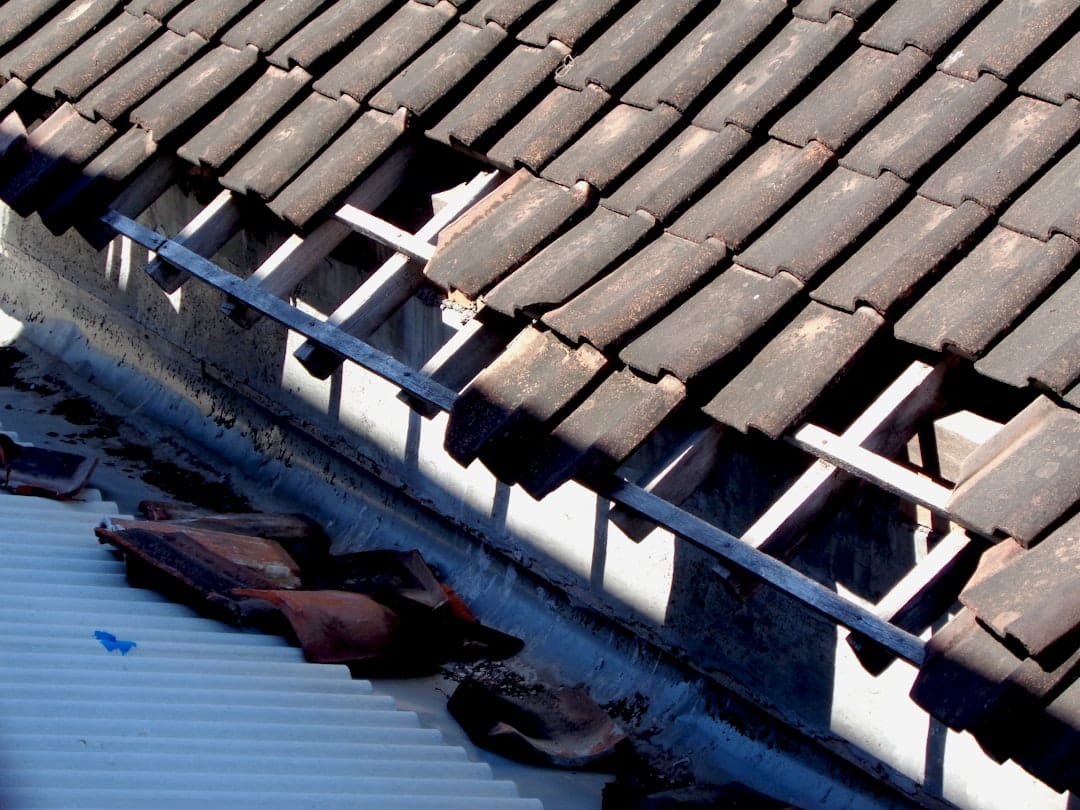
Finding a drip in your warehouse is more than just a nuisance; it's a threat to your entire operation. Commercial roof leak detection is the only way to stop minor moisture issues from turning into structural nightmares. Honestly, ignoring a small stain today often leads to a massive repair bill tomorrow.
How to Detect a Commercial Roof Leak: Quick Answer
Commercial roof leak detection is the process of locating water intrusion points in a commercial roofing system using specialized tools and techniques. Here's a fast overview of how it works:
- Visual inspection - Look for water stains, mold, bubbling paint, or damp ceilings inside the building
- Infrared thermography - Uses heat cameras to spot moisture trapped under the roof membrane
- Electronic leak detection (ELD) - Applies a low-voltage electrical current to pinpoint breaches in waterproofing membranes
- Drone surveys - Aerial imaging to safely scan large or hard-to-reach roof areas
- Moisture mapping - Identifies the spread of water saturation across insulation layers
- Flood or water hose testing - Controlled water application to confirm leak locations
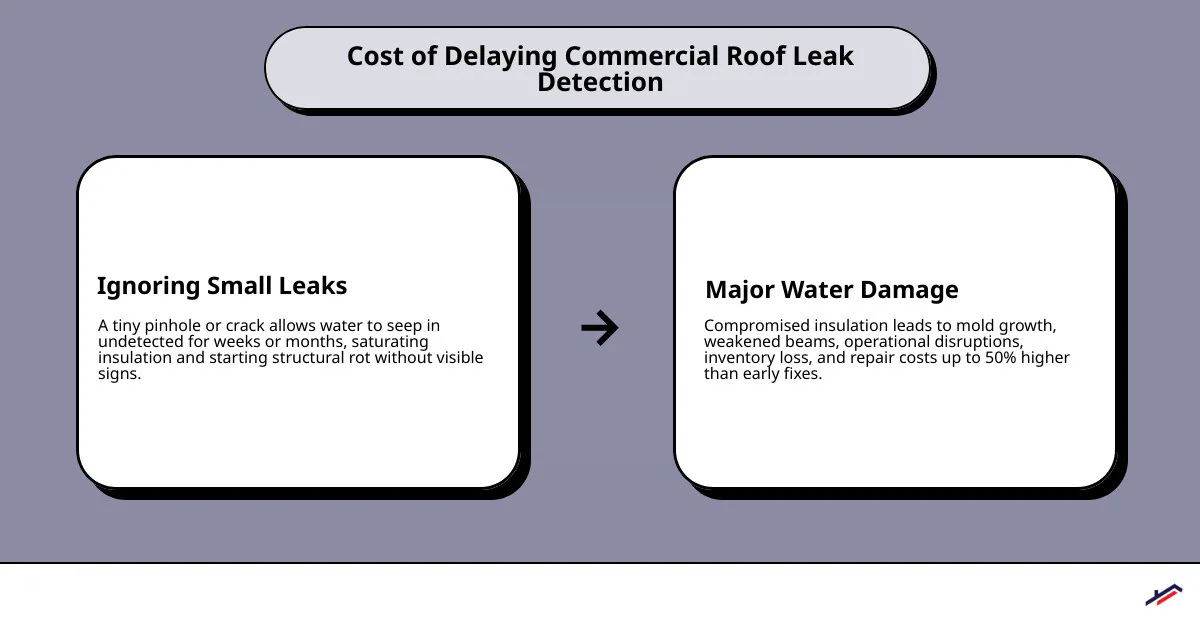
Key stat: Addressing leaks early can reduce repair costs by up to 50%. The longer you wait, the more expensive the fix.
Here's the thing — leaks in commercial roofs rarely announce themselves. A tiny pinhole in a flat roof membrane, a hairline crack in flashing, or a blocked drain can quietly funnel water into your building's structure for months before any visible sign appears. By then, insulation is saturated, structural materials may be rotting, and mold can already be growing inside your walls.
For commercial properties — especially flat-roofed office buildings, warehouses, and retail spaces — the stakes are high. A leak doesn't just damage the building. It can interrupt operations, destroy inventory, create electrical hazards, and drive up energy costs as compromised insulation forces HVAC systems to work harder.
Commercial roof leak detection terms to learn:
The Science and Strategy of Commercial Roof Leak Detection
When we talk about finding leaks in a commercial setting, we aren't just sending a guy up a ladder with a flashlight. Modern commercial roof leak detection is a blend of advanced physics and strategic engineering. Because water follows the path of least resistance, where a leak drips inside your warehouse is rarely where the hole is on the roof. Water can travel dozens of feet along steel beams or through insulation layers before it ever hits the floor.
To solve this, we use non-destructive testing (NDT). This allows us to "see" through the roof surface without tearing it apart. Let me explain: by examining the science that powers roof leak detectors, we utilize thermal, electrical, and hydraulic principles to find the exact point of entry. This precision ensures we aren't suggesting a full roof replacement when a targeted repair would suffice.
Comparing Detection Methods
| Method | How it Works | Best For | Precision |
|---|---|---|---|
| Infrared Thermography | Detects heat signatures of trapped water | Flat roofs, finding wet insulation | High (Visual mapping) |
| Electronic Leak Detection (ELD) | Uses electrical current to find breaches | Single-ply membranes (TPO, PVC) | Pinpoint accuracy |
| Nuclear Moisture Survey | Measures hydrogen atoms in water | Large-scale moisture mapping | High (Depth analysis) |
| Drone Surveys | Aerial high-res and thermal imaging | Large facilities, hard access | Excellent (Overview) |
| Visual Inspection | Expert physical assessment | Flashing, seams, and drains | Moderate (Surface only) |
By utilizing these commercial roof inspections, we remove the guesswork. Instead of "chasing" a leak through trial and error, we use data to drive our repair strategy.
Common Causes and Signs of Intrusion
Why do commercial roofs leak in the first place? Honestly, most issues stem from a few usual suspects. On flat roofs, ponding water is the primary enemy. If water sits on your roof for more than 48 hours, it puts immense pressure on the membrane seams. Eventually, that pressure finds a weakness.
Other common causes include:
- Membrane Punctures: Often caused by HVAC technicians dropping tools or heavy foot traffic.
- Faulty Flashing: The "edges" where the roof meets walls or pipes are the most vulnerable spots.
- Clogged Drainage: If your scuppers or drains are blocked by debris, water backs up and seeps under the membrane.
- Age and UV Exposure: In our Arizona climate, the sun literally "cooks" roof materials, causing them to become brittle and crack.
You know what? You don't always need to be on the roof to know there's a problem. Keep an eye out for these early warning signs:
- Musty Odors: A lingering "old basement" smell usually means mold is growing.
- Bubbling Paint or Wallpaper: Moisture is trapped behind the finish.
- Increased Energy Bills: Wet insulation loses its R-value, making your AC work overtime.
- Stained Ceiling Tiles: The classic "coffee ring" sign of water intrusion.
It is important to remember that moisture leads to mold and mildew health impacts, which can affect your employees' respiratory health and indoor air quality. If you see these signs, it's time to look into commercial roof damage repair before the structural integrity of your building is compromised.
Advanced Methods for Commercial Roof Leak Detection
We’ve come a long way from the days of just pouring a bucket of water on a roof and waiting to see where it drips. Today, we use tech that feels like it’s straight out of a sci-fi movie.
Infrared Thermography is our "bread and butter" for flat roofs. Water has a high thermal mass, meaning it holds onto heat longer than dry roofing materials. As the sun goes down and the roof cools, the wet spots stay warm. Our cameras pick up these "thermal fingerprints," showing us exactly where moisture is trapped under the surface.
Drone Surveys have revolutionized how we handle large-scale commercial building leak detection. Instead of spending days walking a 100,000-square-foot warehouse, we can fly a drone equipped with thermal and 4K sensors to map the entire surface in hours.
Moisture Mapping takes this data and creates a literal map of your roof's health. We can show you exactly what percentage of your roof is saturated. This is a meaningful advantage for insurance claims because it provides objective, visual proof of the damage extent.
How Electronic Leak Detection (ELD) Works for Commercial Roof Leak Detection
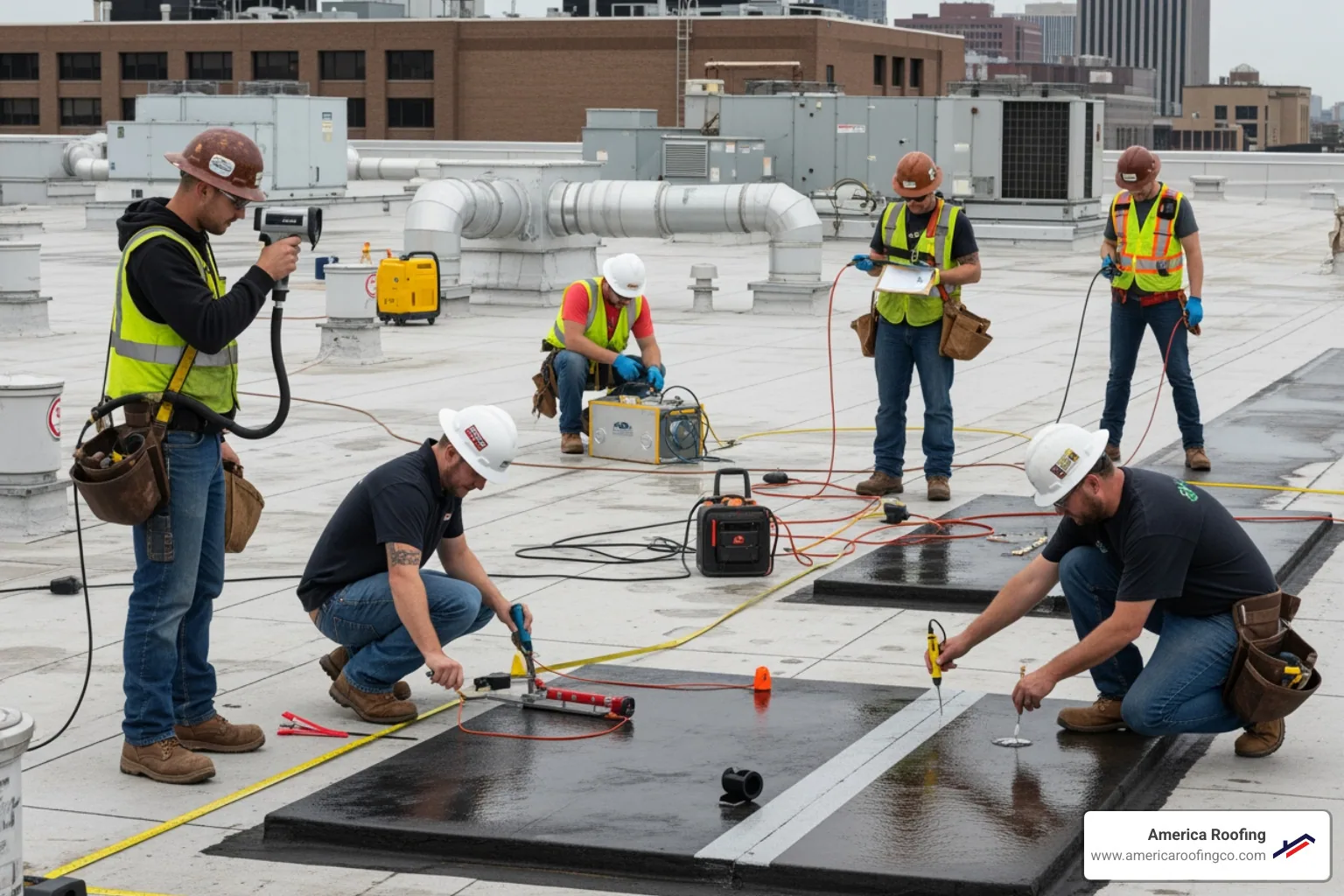
Electronic Leak Detection (ELD) is perhaps the most precise tool in our kit, boasting an accuracy rate of over 90%. It works on a simple principle: most roofing membranes (like TPO or PVC) are non-conductive, but water is a great conductor of electricity.
There are two main types of ELD:
- Dry Testing (High Voltage): We use a "charged brush" over the dry roof surface. If there is a pinhole or crack, the electricity completes a circuit with the building's earthed structure, triggering an alarm. It's perfect for finding tiny punctures invisible to the naked eye.
- Wet Testing (Low Voltage): Also known as Earth Leakage testing, we apply a small amount of water to the roof and use a pulse generator. We then use "detective probes" to follow the electrical flow to the exact breach.
This method is particularly effective for commercial flat roofs where finding a needle-sized hole in a football-field-sized roof would otherwise be impossible.
Arizona’s Unique Challenges: Monsoons and Extreme Heat
Living and working in Maricopa County means our roofs face conditions that would make a Midwest roof crumble. We don't just deal with rain; we deal with "Arizona rain."
Our monsoon season brings intense, vertical downpours that can dump inches of water in minutes. This sudden volume often overwhelms drainage systems, leading to "flash flooding" on your roof. When you combine that with "haboobs" (massive dust storms) that clog drains with silt and debris, you have a recipe for disaster.
Furthermore, the extreme heat causes significant thermal expansion. Your roof grows in the 115°F afternoon sun and shrinks in the 80°F night. This constant "breathing" puts massive stress on seams and flashing. Over time, the UV exposure breaks down the chemical bonds in your roof membrane, leading to cracks that are prime targets for the next storm's water.
Whether you are in Phoenix, Scottsdale, or Peoria, these regional factors make regular Arizona roof repair and inspections a necessity rather than an option.
The Professional Repair and Integrity Testing Process
Once we’ve located the leak, the real work begins. We don't just "slap a patch on it." Our process follows strict industry standards, including those aligned with British Standards and NHBC guidelines, to ensure the repair is as strong as the original roof.
Our 4-step professional process:
- Validation: We use ELD or thermal imaging to confirm the exact source.
- Preparation: We clean and prep the area. In Arizona, this often means removing "baked-on" silt and oxidation.
- Targeted Repair: We use high-performance materials compatible with your specific membrane (TPO, PVC, EPDM, or Modified Bitumen).
- Integrity Testing: After the repair, we re-test the area to ensure a 100% watertight seal.
By focusing on commercial roof repair solutions, we help businesses avoid the massive disruption of a full roof replacement. Our goal is a 99% success rate in stopping leaks on the first visit.
Protecting Your Investment with Proactive Maintenance
Let's be honest: nobody likes spending money on their roof. But here is the reality: water damage is responsible for roughly 40% of all building-related issues. By investing in a bi-annual maintenance plan, you aren't just "fixing holes"—you're protecting your inventory, your equipment, and your bottom line.
At America Roofing, we recommend a "Spring and Fall" inspection schedule. In the Spring, we check for damage caused by winter temperature swings. In the Fall, we clear out the debris left behind by monsoon season and prepare the roof for the cooler months. This proactive approach can reduce your long-term repair costs by up to 50%.
We’ve disclosed many of our commercial roof maintenance details because we believe an educated customer is our best partner. When you choose an ultimate Arizona commercial roofer, you’re getting a partner who understands the local climate and the specific needs of your facility.
You know what? Staying ahead of a leak is always cheaper than reacting to a flood. Let me explain: by the time you see a stain on the ceiling, the insulation is already compromised and the structural rot has begun. If you suspect your facility is at risk, don't wait for the next haboob to find out. Contact us today at 602-237-2478 or Request a Free Quote to secure your building's future.