
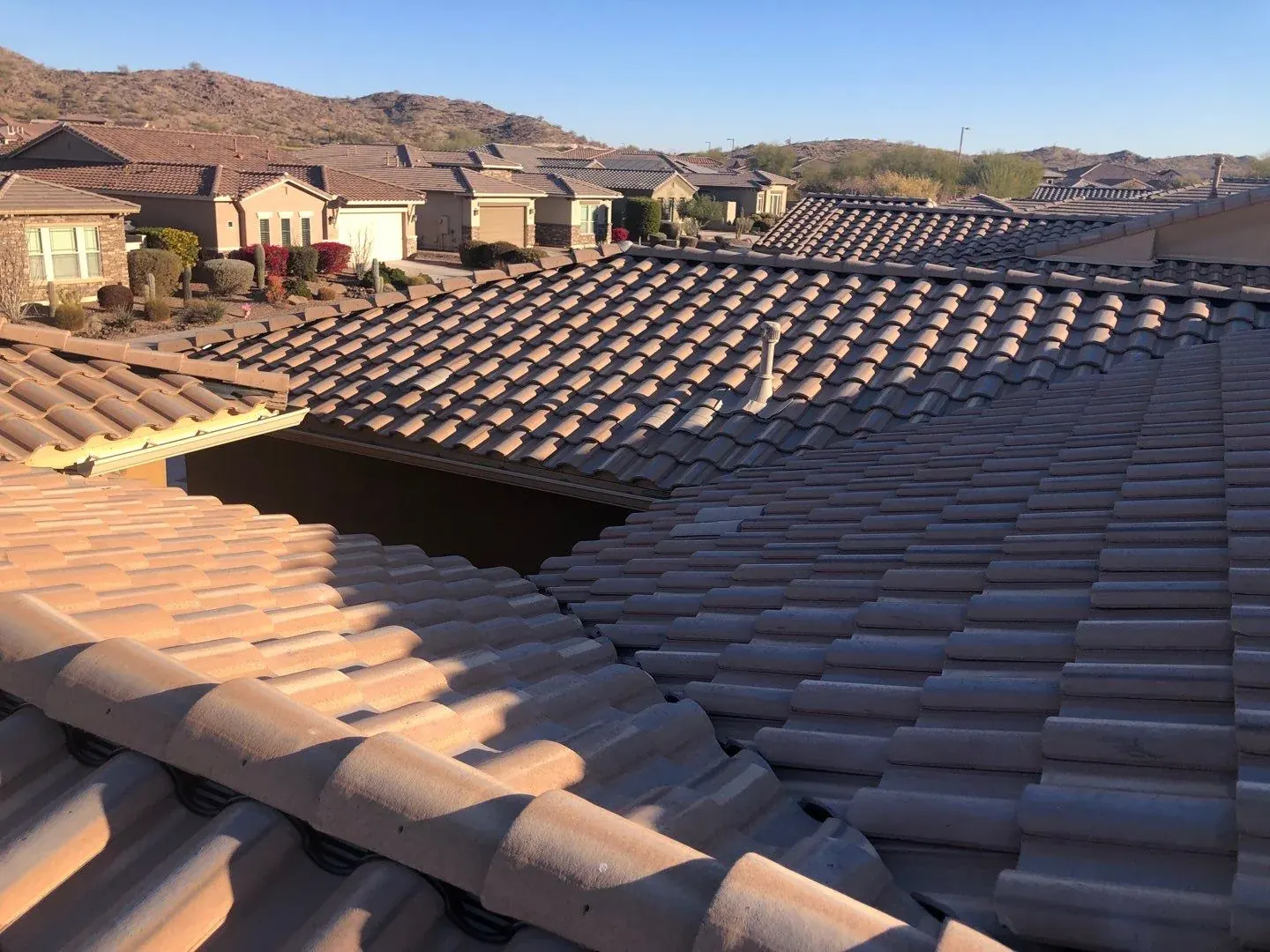
A ceiling stain in Phoenix rarely tells the whole story. By the time water shows up inside, it may have traveled across underlayment, decking, framing, or insulation before it ever drips into a room. That's why roof leak repair in Phoenix has to start with diagnosis, not guesswork.
Active leak or storm damage?
America Roofing traces tile, shingle, flat, foam and commercial roof leaks in Phoenix.
Request a free roof leak inspection
or call
.
Finding the Real Source of Your Roof Leak
Most homeowners look straight above the water spot and assume the leak is there. That's the mistake that leads to repeat repairs. Water often enters uphill, then follows framing or insulation until it finds an opening into the house.
A Phoenix-specific guide from America Roofing notes that leak tracing should begin in the attic and then move to the roof, and it warns that multiple stains, sagging, daylight in the attic, or recurring leaks can point to a problem that's larger than a simple patch, as outlined in this guide to how to repair a roof leak.
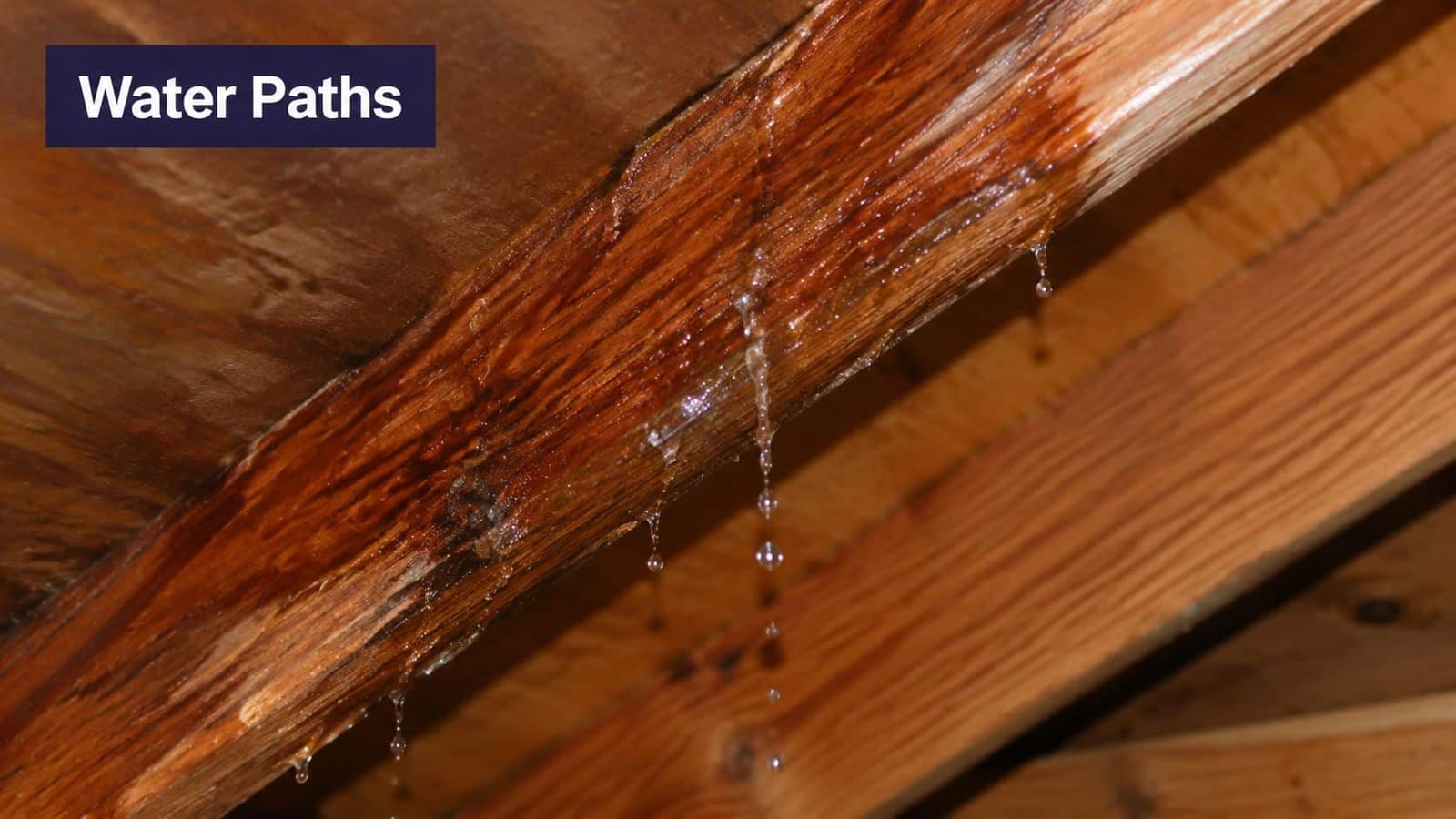
Start inside, not on the roof
The safest first move is usually indoors. If there's attic access, the inspection should happen there before anyone starts moving tiles, lifting shingles, or spreading sealant.
Look for:
- Wet insulation that feels heavy or matted down
- Dark staining on the roof deck or rafters
- Visible daylight coming through the roof assembly
- Rust or staining around penetrations like vent pipes, exhaust caps, or skylight curbs
- More than one water trail, which often means water is traveling before it drops
At this point, homeowners often find the first clue that the ceiling stain is only a symptom.
Practical rule: The interior drip point is where the water exits. It is not necessarily where the water enters.
The usual leak locations in Arizona roofs
On Phoenix homes and buildings, the problem area is often one of the roof transitions or penetrations rather than the middle of an open field of roofing. Trouble tends to show up around valleys, flashing details, pipe boots, vent penetrations, skylights, wall intersections, and drain transitions on low-slope roofs.
Dust, heat, UV exposure, and monsoon wind all work against these details. A tile roof may look intact from the ground while the underlayment below has failed around a penetration. A flat roof may hold for months, then start leaking where seams, scuppers, or flashing edges have opened up.
For homeowners who want a second resource on the indoor side of tracking moisture, this Phoenix homeowner's leak detection guide helps explain how leaks can show up far from the original entry point.
When basic tracing stops being enough
If the attic shows widespread staining, sagging deck areas, or multiple active leak paths, the next step shouldn't be random patching. A roof needs a proper diagnostic path and, after storms, often a documented storm damage roof inspection before repair decisions are made.
A controlled hose test can help on some roofs, but only when it's done methodically and safely. Randomly soaking large sections of roof usually creates confusion instead of answers. The point is to isolate a suspect area, not flood the whole system.
Monsoon Season Emergency Steps for a Leaking Roof
A leak during a monsoon storm is different from an old stain found on a dry afternoon. The priority shifts from finding the permanent fix to limiting interior damage and keeping people safe.
The first steps should stay inside the house or building unless a trained crew is handling the roof. Wet tile, wet shingles, and storm-damaged low-slope roofs are dangerous. Wind makes that worse.
What to do right away
- Protect the interior: Move furniture, electronics, rugs, and anything absorbent out of the drip zone.
- Catch active water: Use buckets, storage bins, or towels to control spread across floors.
- Relieve ceiling bubbles carefully: If water is pooling behind paint or drywall and the ceiling is visibly bulging, a small puncture into a bucket can release trapped water and reduce the chance of a wider collapse.
- Document the damage: Take photos of stains, wet insulation, damaged finishes, and any visible roof debris.
- Shut off power if needed: If water is near light fixtures, ceiling fans, or electrical devices, a licensed electrician may be needed after the roof issue is stabilized.
Photographing damage matters. It creates a record of what happened before wet materials are opened up or removed.
What a roofer does first in an emergency
A sound leak-response workflow starts with leak-source tracing, then temporary dry-in measures such as tarping or stabilization before damaged materials are removed, as explained in this roof leak repair process overview. That matters because patching the visible drip point instead of the uphill entry point often causes repeat leaks and hidden deck damage.
In practical terms, temporary dry-in usually means stopping active water intrusion, securing loose materials, and protecting exposed sections until the roof can be properly opened and repaired in dry conditions.
For urgent situations after dark or during a storm window, homeowners dealing with active intrusion can review options for emergency roof leak repair.
What not to do
Some actions make the situation worse:
- Don't walk a wet roof: That includes tile, shingle, foam, and coated roofs.
- Don't smear caulk everywhere: It rarely solves the actual failure point.
- Don't trap moisture inside the system: Covering wet materials without a repair plan can hide damage and delay proper drying.
- Don't assume one stain means one leak: Monsoon wind can drive water into more than one weak detail.
Repair or Replace Your Arizona Roof
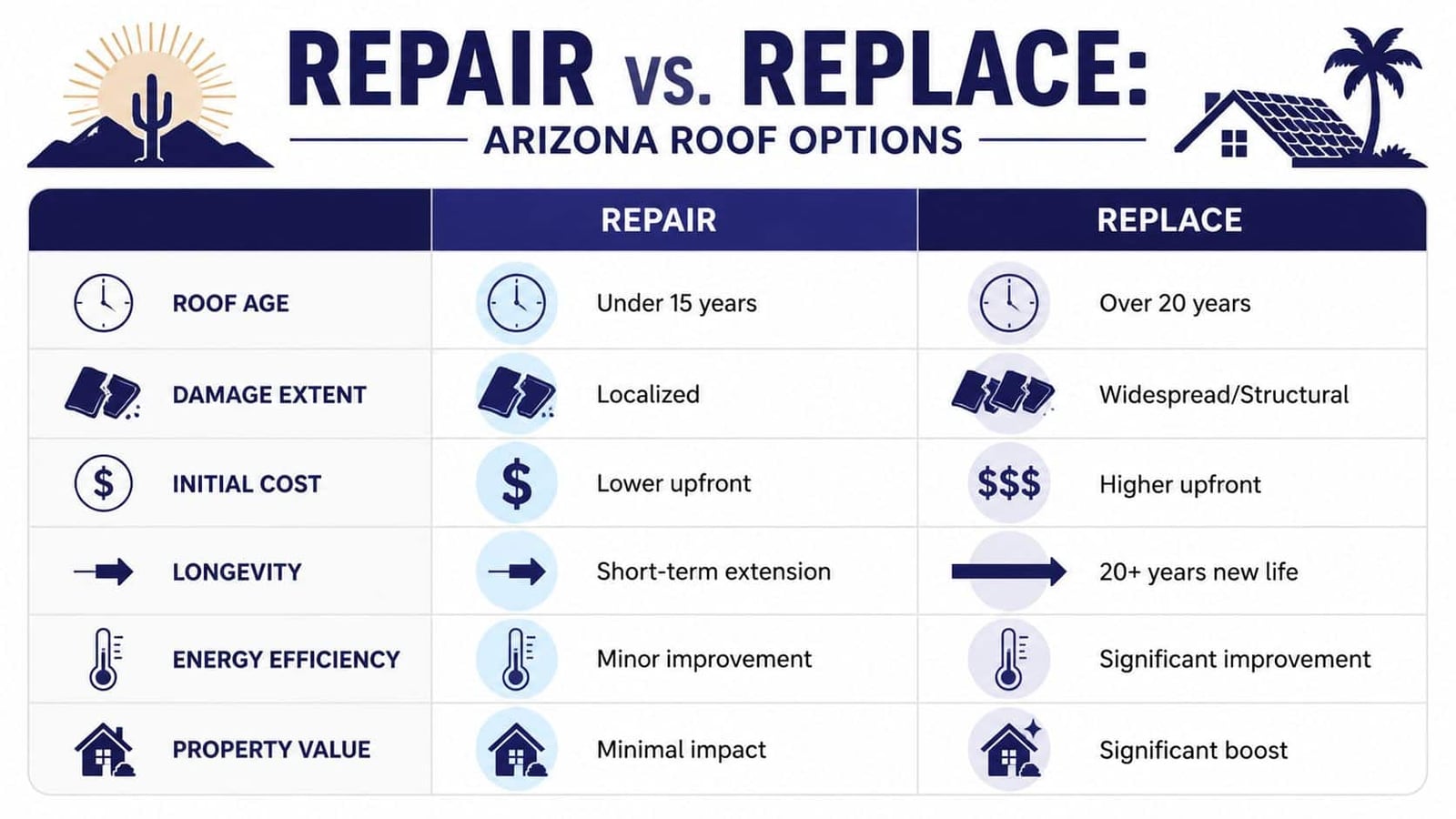
Not every leak means the whole roof is done. But not every leak should be patched, either. In Arizona, that decision usually comes down to roof type, how isolated the failure is, whether the system has a history of repeat leaks, and how much hidden damage shows up once materials are opened.
Tile roofs
A tile roof can often be repaired when the problem is limited to a small area, such as slipped or cracked tiles, localized flashing failure, or a single penetration issue. The visible tile isn't always the cause of the issue. On many Arizona tile roofs, the leak decision turns on the condition of the underlayment beneath the tile.
Repair makes sense when damage is isolated and the surrounding system is still sound.
Replacement becomes the better call when leak areas keep appearing in different sections, underlayment deterioration is widespread, or opening one section reveals a broader failure pattern.
Shingle roofs
Shingle roofs are usually more straightforward to patch when the issue is small and the surrounding shingles still hold properly. But once shingles become brittle, poorly sealed, wind-damaged in multiple locations, or backed by soft decking, repairs become short-lived.
If one section leaks because of a flashing or penetration issue, repair may be enough. If several areas are failing under Arizona sun exposure and storm movement, patching one area can leave the owner chasing the next weak spot.
A patch is smart when it isolates the problem. A patch is wasteful when it only delays a broader failure that's already underway.
Flat roofs, foam roofs, and membrane systems
Low-slope roof leaks in Phoenix often need a foam or commercial roofing approach, not a quick bead of sealant. If the leak is on a flat or foam section, see Phoenix foam roofing. If it is a business, HOA, retail or managed property, see commercial roofing in Phoenix.
Low-slope systems require more discipline than many owners expect. For these roofs, the benchmark isn't just stopping visible water. The substrate has to be dry, the patch has to match the membrane type, and the repair has to preserve the original system specifications, as explained in this guidance on the roof repair process for low-slope systems.
That's why overusing caulk or sealant is such a common failure. Sealant can finish a repair detail, but it shouldn't replace damaged flashing, wet underlayment, or failed membrane sections.
A practical decision table
The age question without guesswork
Roof age matters, but age alone shouldn't make the decision. A younger roof with a badly executed prior repair can justify a larger corrective scope. An older roof with one isolated flashing failure may still be a repair candidate if the rest of the system is holding.
When the repair estimate starts stacking onto known weak areas, it's time to compare that spend against a planned Phoenix roof replacement. That comparison gets clearer once the roof is opened enough to confirm whether the damage is local or widespread.
Phoenix Roof Repair Costs and Timelines
Most property owners don't need a price list. They need a realistic range and an explanation of what pushes the number up or down.
In Phoenix, roof repair projects average $1,834, with most jobs falling between $175 and $3,075. Roof leak repair specifically is estimated at $550 to $2,500. The city's permit fee for roof work averages $159. Asphalt shingle repairs run about $3.50 to $6 per square foot, and tile repairs about $4 to $11 per square foot, according to this Phoenix-specific breakdown of roof repair costs.
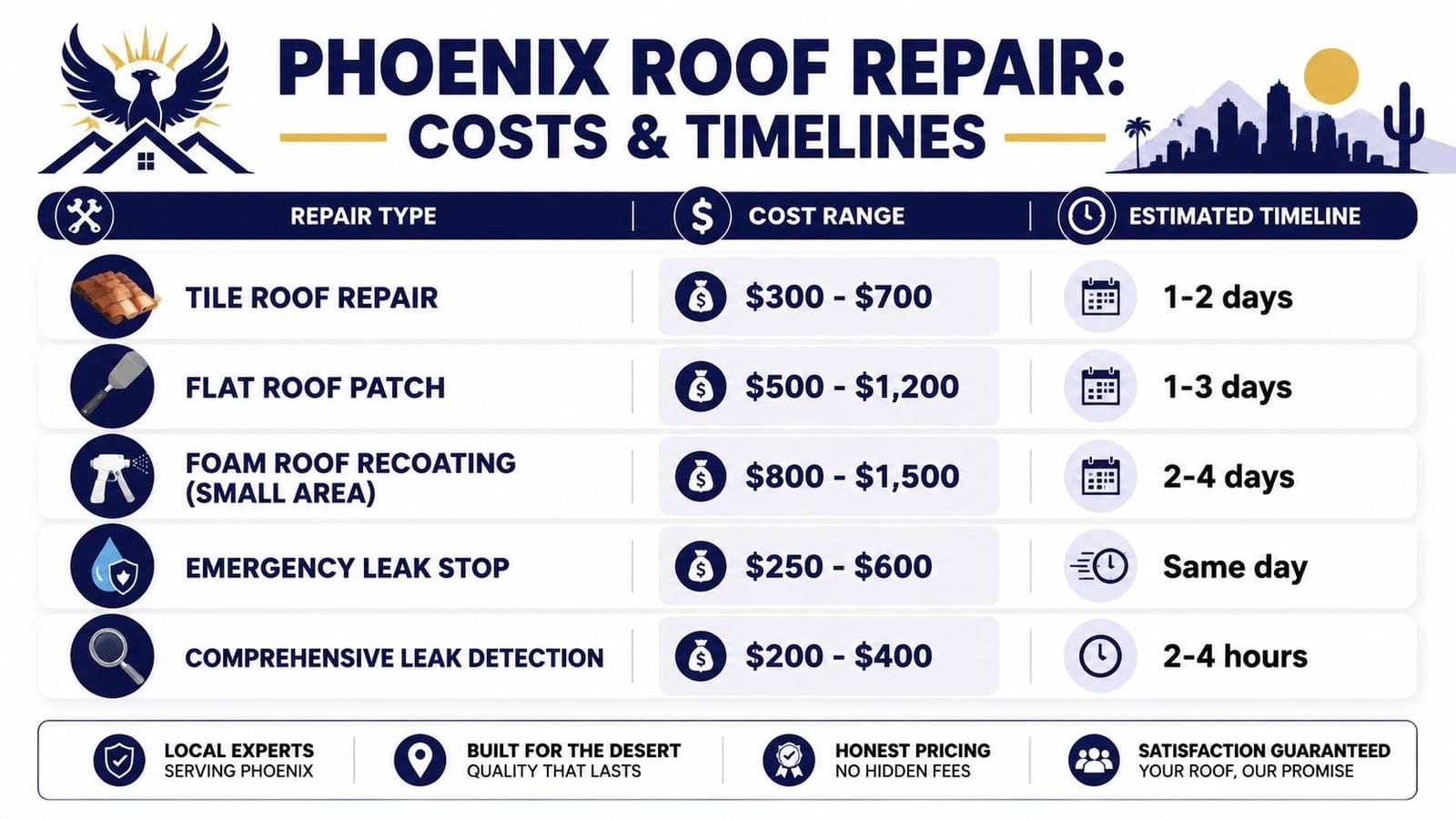
What changes the final repair cost
The same leak symptom can produce very different scopes.
A few of the biggest variables are:
- Roof type: Tile usually takes more handling and more access care than a simple shingle patch.
- Access: Steep roofs, fragile tile layouts, parapets, and limited entry points all affect labor.
- Hidden damage: Once wet underlayment, rotted sheathing, or failed flashing show up, the repair grows.
- Scope of fix: A true repair replaces failed components. A surface patch alone is usually cheaper at first and more expensive later if it fails.
- Permits and inspections: Some work needs them, especially when the repair grows beyond a small isolated area.
Why timelines vary in Phoenix
A leak can sometimes be stabilized quickly, but the full repair timeline depends on weather, roof drying, material matching, permit needs, and schedule pressure after storms.
The repair market also has a capacity issue. The U.S. roofing contractor market generated more than $56 billion in 2023, more than 135,000 people worked as roofers in the U.S. in May 2023, roofers earned an average of $26.85 per hour, and projected employment growth from 2022 to 2032 is only 2%, which helps explain why repair timelines can tighten in busy markets after storm demand spikes, according to this overview of roofing industry statistics.
During monsoon season, the first available crew may be handling stabilization work all day and permanent repairs later. Owners who call early usually have better scheduling options.
For a more detailed local budgeting discussion, homeowners and managers can review this guide to Arizona roof repair pricing.
Signs Your Roof Leak Needs a Professional
Some leaks are clearly beyond homeowner troubleshooting. The risk isn't just getting wet. It's missing hidden damage, falling through compromised decking, or creating a repair that traps moisture and makes the next failure worse.
Red flags that shouldn't be treated as a simple patch
- Multiple interior leak spots: More than one stain often means water is traveling through the roof assembly or entering in more than one place.
- Sagging roof deck or ceiling areas: This can indicate saturated materials or structural weakening.
- Recurring leaks after a prior repair: If the same area leaks again, the original source may have been missed.
- Visible daylight in the attic: Open paths through the roof system need proper repair, not surface sealant.
- Flashing and penetration problems: These details fail in ways that aren't always visible from the ground.
- Low-slope roof leaks around seams, drains, or parapets: These systems depend on compatibility and dry substrates. Shortcuts fail fast.
DIY limits show up quickly in Arizona
Phoenix and Tucson roofs don't just deal with rain. They deal with heat, UV exposure, dust, thermal movement, and monsoon wind. That combination makes temporary fixes unreliable when they aren't tied to a correct diagnosis.
A homeowner may be able to contain interior water or spot obvious staining. That's different from restoring underlayment, membrane interfaces, flashing geometry, or wet deck sections.
If a leak has already moved past the visible surface and into insulation, decking, or wall assemblies, it's no longer a simple exterior patch problem.
Why early scheduling matters
After storms, repair demand rises quickly and crew availability tightens. In markets like Phoenix and Tucson, waiting too long can turn a manageable leak into a broader damage claim and a longer repair queue. The practical move is to document the issue, protect the interior, and get a qualified roofer involved before the wet area expands.
Vetting Your Phoenix and Tucson Roofing Contractor
Hiring the right roofer matters as much as finding the leak. A poor diagnosis wastes money. A poor repair can hide moisture, damage decking, and leave the owner with the same leak at the next storm.
Questions worth asking before any work starts
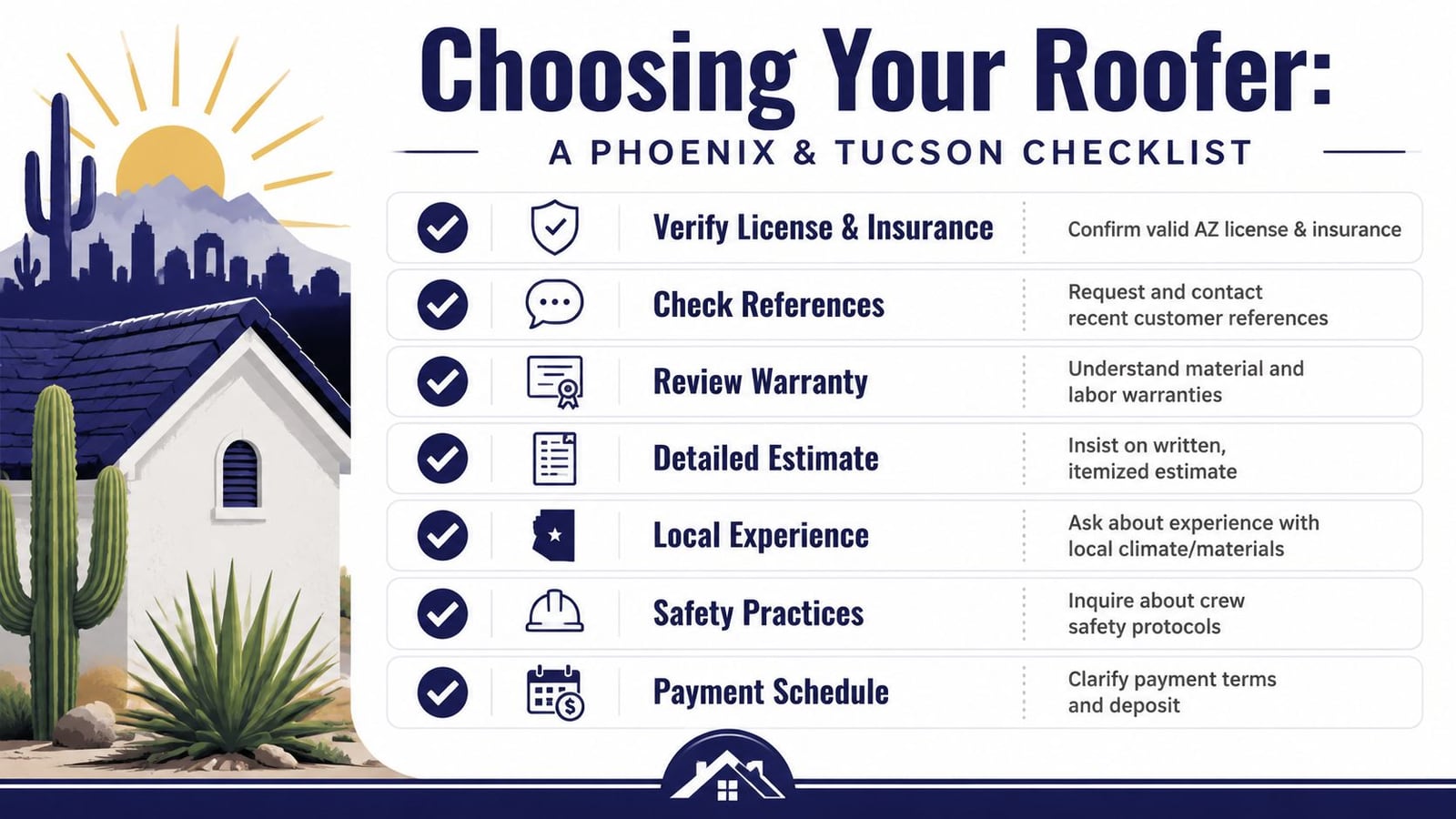
A solid contractor should be ready for direct questions. The answers should be specific, written down when needed, and tied to the actual roof system.
Ask about:
- License and insurance: Confirm Arizona licensing and ask for proof of coverage.
- Material experience: Tile, shingle, foam, coatings, and commercial flat roofs each require different repair methods.
- Diagnosis process: Ask how the contractor determines the true entry point instead of only treating the stain location.
- Scope documentation: The estimate should say what gets removed, what gets replaced, and what gets reused.
- Warranty terms: Understand what applies to labor and what applies to roofing materials.
- Safety practices: Crews should have a defined approach to access, fall protection, and storm conditions.
- Payment schedule: Clear payment terms are part of a professional job.
For owners who want background on why insurance documentation matters, this resource on general liability for roofing businesses gives useful context on contractor coverage.
Warning signs during the estimate phase
Some problems show up before the first shingle or tile is touched.
Be cautious if a contractor:
- Pushes a full replacement immediately without explaining why repair won't work
- Offers a leak fix without attic or assembly tracing when interior access is available
- Avoids written detail about flashing, underlayment, or substrate repairs
- Promises permanent results from sealant alone
- Pressures for a large upfront commitment before scope is clear
One practical option for owners comparing contractors is to work with a local Phoenix and Tucson roofing company that handles residential and commercial leak diagnosis, repair, reroofing, tile, shingle, flat, foam, and coating work across Arizona.
What a good estimate should actually clarify
The best estimates answer the questions owners usually have after a bad storm or recurring leak. Is this localized? Is decking damaged? Are wet materials being removed? Will the repair tie back into the existing system correctly? Is a permit likely?
If those answers stay vague, the estimate isn't ready.
If a roof leak is active or recurring, the next step is simple. Get the leak traced to its true source, find out whether the damage is local or widespread, and base the decision on the roof system that's there. America Roofing serves Phoenix and Tucson with residential and commercial roofing work, including leak repair, flat roof repair, tile and shingle repairs, reroofing, and replacement. Call 602-237-2478 or request a roofing estimate.
Document the Leak Before the Evidence Dries
Good documentation helps the roofer understand timing and movement, and it can be useful if the damage may involve an insurance claim. Photograph the interior stain, active drip points, wet materials and any safe attic evidence. Note the date, approximate time, wind direction if known, and whether water appeared during wind-driven rain or continued after the storm stopped.
Do not delay emergency protection just to collect perfect photos. Safety and limiting damage come first. Once the immediate water is controlled, keep damaged materials and repair receipts until the insurer or property manager confirms what documentation is needed. A roofer can document roof-side conditions, but should not promise what a carrier will cover.
Preventing the Next Phoenix Roof Leak
Prevention is mostly about finding vulnerable details before heavy weather does. For tile roofs, cracked or displaced pieces should be corrected without assuming the tile itself is the waterproof layer. Valleys, penetrations, wall transitions and underlayment exposure deserve attention. Shingle roofs need checks around lifted tabs, flashing, pipe boots, edge damage and areas where granule loss or brittleness is widespread.
Flat, foam and membrane roofs need clear drainage and intact transitions. Scuppers, drains and gutters should not be packed with debris. Coatings should be inspected for splits, adhesion loss and damage around service paths or rooftop equipment. Sealant is a maintenance material, not a universal roof system; repeated beads of caulk over a moving or wet defect usually postpone the real diagnosis.
A practical inspection rhythm is before monsoon season, after a significant storm and whenever interior evidence appears. That does not mean paying for unnecessary work every few months. It means giving a qualified person a chance to catch an isolated defect before water spreads through insulation, decking and finishes.
Questions Phoenix Property Owners Ask After a Leak
Can a roof leak be repaired during monsoon season?
Emergency protection may be possible once conditions are safe. Permanent repairs depend on roof type, moisture, forecast, access and the material being installed. No responsible roofer should put a crew on a wet or wind-exposed roof just to satisfy an unrealistic timeline.
Will one ceiling stain mean the whole roof needs replacement?
No. One stain can result from one failed flashing or penetration. Replacement becomes more likely when inspection finds widespread deterioration, multiple leak paths, failed underlayment, trapped moisture or a repair history showing the system is failing in new locations.
Should I let someone pressure-wash or flood-test the roof?
Not as a casual first step. Water testing should be controlled, limited to a suspected area and performed with an understanding of the roof assembly. Randomly flooding a roof can create new interior damage and muddy the evidence.
How quickly should I schedule an inspection?
Active water, sagging, electrical exposure or widespread wet materials require immediate attention and may involve emergency or restoration professionals as well as a roofer. A dry historical stain still deserves inspection before the next storm, especially if the source was never confirmed.