
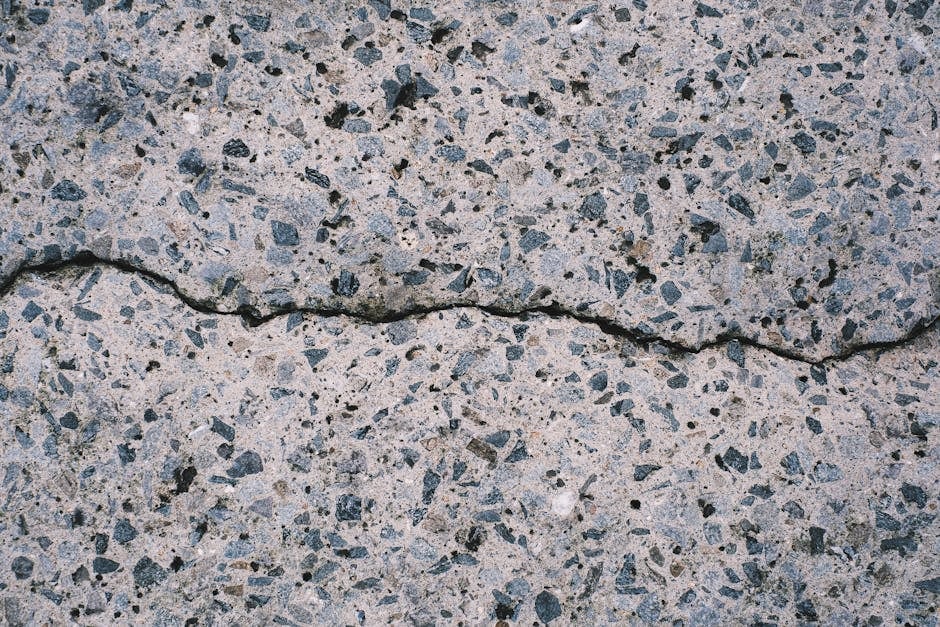
Finding a puddle on your floor after a desert downpour is a homeowner's nightmare, but ignoring the issue only leads to structural decay. If you need to fix leaking concrete roof issues, you must act quickly to address the porosity and cracks that naturally develop in Arizona’s harsh climate. Honestly, a small drip today can become a major structural failure tomorrow if not sealed with the right professional-grade materials.
Introduction
If you own a home in Arizona, you already know how brutal the combination of summer heat and monsoon season can be on your roof. Fix leaking concrete roof problems fast — because what starts as a hairline crack can quickly turn into a costly structural repair. Here's what you need to do right away:
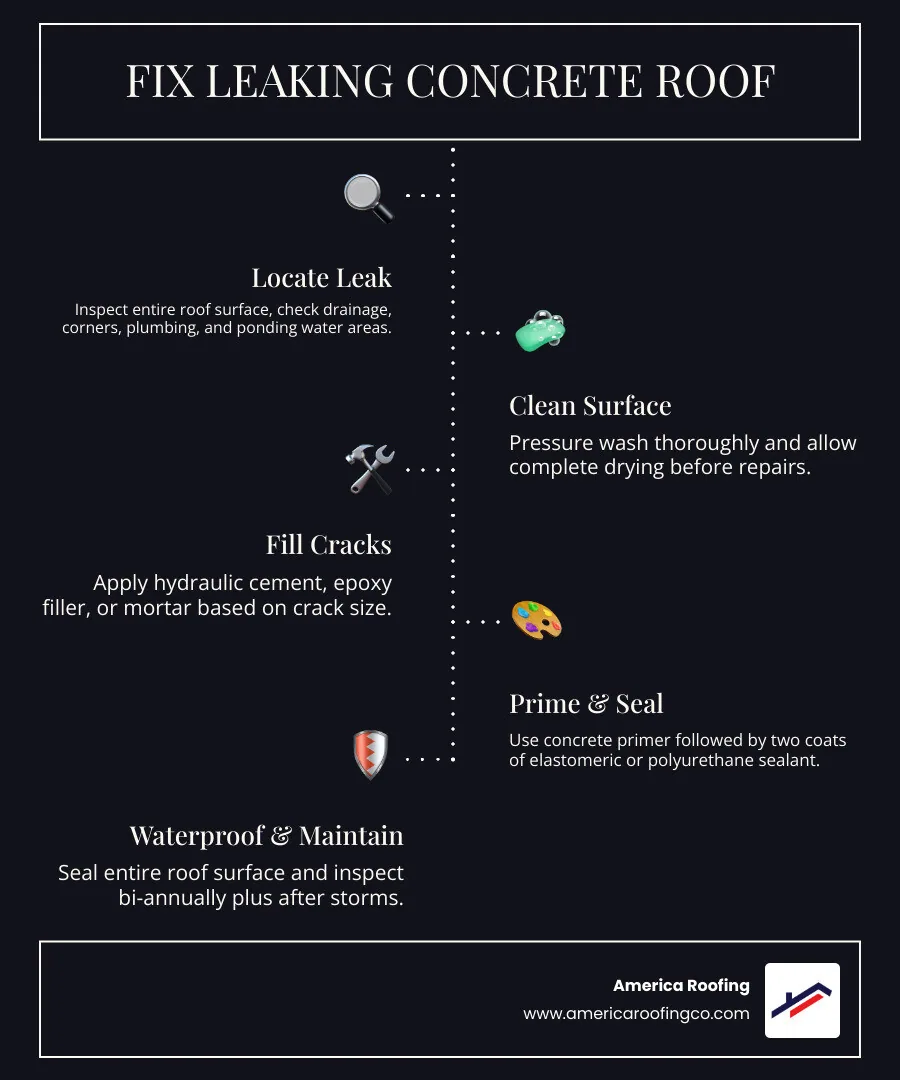
How to Fix a Leaking Concrete Roof (Quick Answer):
- Locate the leak — inspect the entire roof surface, not just the area above the interior drip. Check drainage, corners, plumbing, and any ponding water.
- Clean the surface — pressure wash the roof and let it dry completely before any repair work.
- Fill cracks — use hydraulic cement, epoxy filler, or mortar depending on the size of the crack.
- Prime and seal — apply a concrete primer, then two coats of elastomeric or polyurethane waterproofing sealant.
- Waterproof the whole roof — don't just patch the visible spot. Seal the entire surface to prevent new leaks from forming.
- Monitor and maintain — inspect twice a year and after every major storm.
Here's the thing — concrete feels solid and permanent, but it is naturally porous. Moisture works its way in through tiny cracks, expands in Arizona's extreme heat, and slowly breaks the structure down from the inside. In fact, research shows that 60-70% of roof leaks are caused by installation errors or improper repairs, not the concrete itself failing. That means most leaks are preventable — and fixable — with the right approach.
Arizona's climate adds an extra layer of complexity. Intense UV exposure degrades sealants faster than in milder regions. Monsoon rains arrive suddenly and dump large volumes of water onto roofs in a short window. And ponding water — defined as water that sits on a flat roof for more than 48 hours after rain — accelerates material breakdown significantly. If your roof has drainage issues, that standing water is doing damage every single day.
Fix leaking concrete roof terms to remember:
When we talk about concrete roofs, we aren't just talking about a slab of stone. Concrete is a porous material made of calcium carbonate—essentially the remains of ancient sea life. In the wet environments created by our intense Arizona monsoons, this material can actually begin to dissolve and weaken over decades. You know what? Most homeowners don't realize that concrete is susceptible to "crazing" (fine surface cracks), "spalling" (surface chipping), and "scaling."
The real enemy in places like Phoenix and Mesa is thermal movement. During a typical July day, the roof surface can reach 160°F, only to be hit by a flash thunderstorm that drops the temperature by 40 degrees in minutes. This rapid contraction causes the concrete to crack. Once that happens, the roof's natural porosity allows it to retain moisture like a sponge. If water remains on a flat concrete roof for more than 48 hours, it's officially "ponding," which is the leading cause of accelerated material degradation.
The Step-by-Step Process to fix leaking concrete roof Damage
Repairing a concrete roof isn't as simple as slapping some caulk on a crack. To properly fix leaking concrete roof issues, you need a systematic approach that ensures the repair actually bonds to the substrate.
Surface Preparation
The most critical step is cleaning. We always use a high-pressure washer to remove dirt, algae, moss, and loose debris. Honestly, if the surface isn't pristine, your expensive sealants will just peel off like a sunburn. After washing, the concrete must be bone-dry. Applying sealant to damp concrete traps moisture inside, which will eventually "blister" and pop the repair.
Adhesion Testing and Priming
Before committing to a full coating, we perform an adhesion test. This ensures the chosen product will stick to your specific concrete mix. Most bare concrete requires a dedicated primer—either bitumen-based or a specialized concrete primer—to create a "bridge" between the porous stone and the waterproof topcoat.
Material Comparison for Repairs
| Material Type | Best Use Case | Longevity |
|---|---|---|
| Low-Viscosity Epoxy | Hairline cracks and deep penetration | High (Permanent) |
| Polyurethane Foam | Active leaks and moving/wide cracks | High (Flexible) |
| Elastomeric Sealant | Surface waterproofing and UV reflection | 5-10 Years |
| Bitumen/Roof Cement | Temporary emergency patches | Low (1-2 Years) |
Essential Repair Tools
- Pressure washer (minimum 3000 PSI)
- Angle grinder with a V-groove blade
- Putty knives and trowels
- Caulking gun for high-viscosity resins
- Stiff-bristled brooms and industrial vacuums
- Reinforcement fabric (poly-scrim) for seams
Identifying the Source of a Concrete Roof Leak
Finding the entry point on a concrete roof is tricky because water travels laterally. A drip in your kitchen might be coming from a crack 20 feet away on the roof.
- The Hose Test: Wait for a dry day. Have one person inside the attic/crawlspace with a flashlight while another person slowly runs a hose over specific sections of the roof, starting from the lowest point and moving up.
- Visual Markers: Look for "steam rings" or dirt circles. These often indicate where water has pooled and evaporated, leaving minerals behind.
- Check the "Details": Leaks rarely happen in the middle of a flat slab. They happen at the corners, around plumbing vents, and where the roof meets the parapet wall.
- Internal Signs: How to spot and prevent roof leaks often starts with looking for musty smells or damp insulation in your loft before the ceiling even shows a stain.
Essential Materials to fix leaking concrete roof Cracks
To get a professional-grade result, you need more than just "roof cement"—which we often call the "duct tape of roofing" because it’s only a temporary fix. For long-term success, we use:
- Elastomeric Sealants: These are like liquid rubber. They stretch and contract with Arizona’s heat.
- Polyurethane Injections: For structural cracks, these resins react with moisture to expand and fill the entire void.
- Bitumen Primers: Essential for ensuring the waterproof layers don't delaminate.
- Reinforcement Fabric: We embed this into the wet sealant over cracks to provide "tensile strength," preventing the crack from reopening.
- Rated Excellent on Trustpilot materials are often the benchmark for DIYers, but for Arizona's extreme UV, we stick to industrial-grade solvent-based systems.
Repairing Cracks and Managing Ponding Water
For wider cracks, we use a technique called "V-grooving." Let me explain: we use a grinder to open the crack into a V-shape, which creates more surface area for the sealant to grab onto. We then fill this with hydraulic cement—a special product that expands as it cures, creating a watertight plug.
If your roof has "ponding" issues (water sitting for 48+ hours), a simple patch won't work. You have two choices:
- Mechanical Drainage: Installing new drains or clearing blocked ones.
- Tapered Insulation: Adding sloped boards under a new membrane to ensure water flows toward the drains. According to Scientific guide on concrete leakage, a minimum pitch of 1:40 is required to prevent standing water.
Professional Maintenance and Long-Term Waterproofing
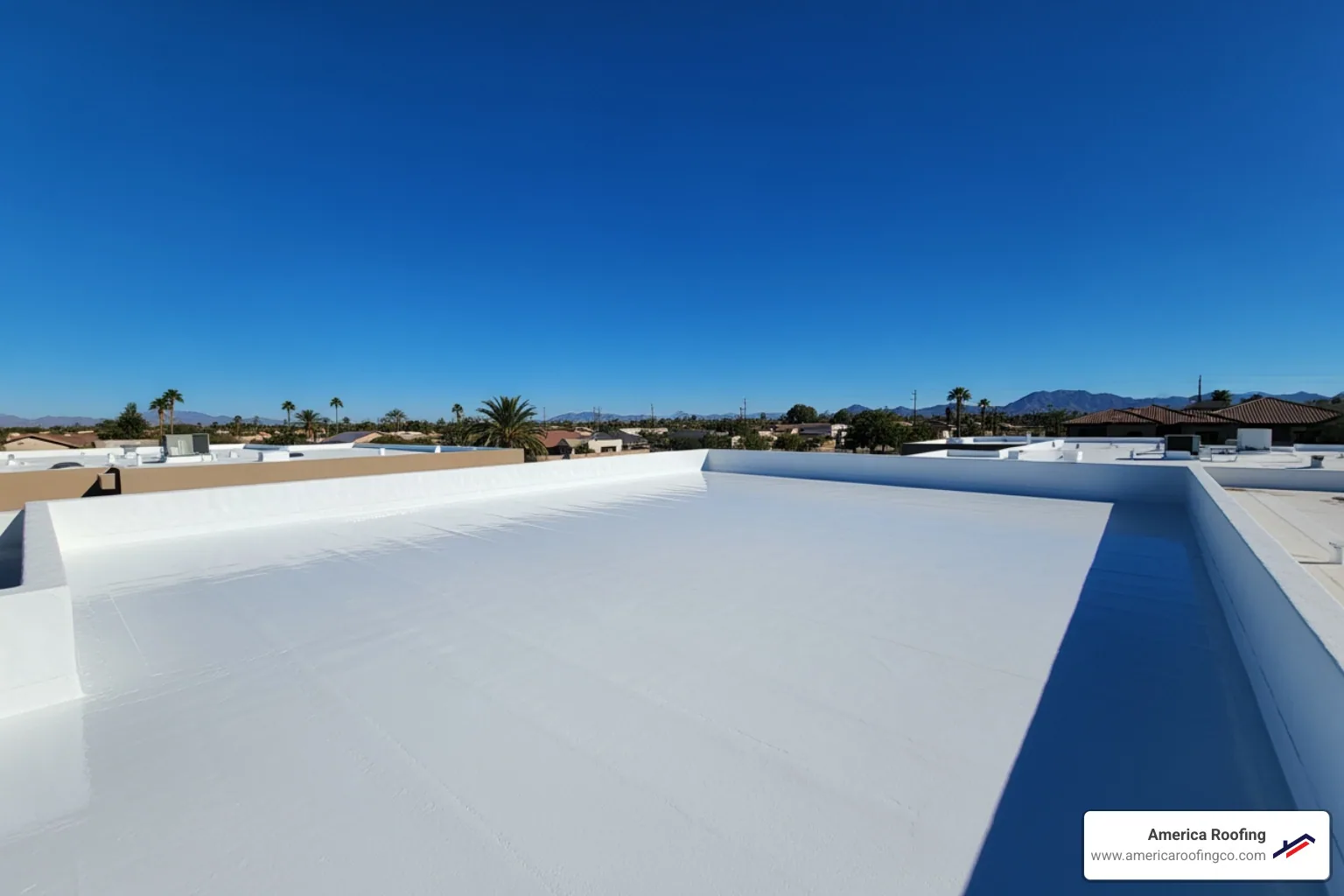
Once the cracks are filled, the entire roof should be coated with a reflective, UV-stable waterproofing system. This protects the concrete from the sun and prevents the "sponge effect" of porosity. At America Roofing, we specialize in these high-performance systems that are engineered specifically for the Maricopa County climate.
Why Arizona Homeowners Need Specialized Concrete Roof Care
Honestly, a roof in Seattle has a much easier life than a roof in Scottsdale. Our "Haboobs" (giant dust storms) blast the roof with abrasive sand, stripping away thin coatings. Our UV index is consistently in the extreme range, which "cooks" standard roofing felt and cheap sealants until they become brittle and snap.
Specifics matter here:
- Thermal Expansion: Concrete can move significantly between a 115°F afternoon and a 70°F night.
- Monsoon Prep: If your drains are clogged with palo verde needles before a storm, your concrete roof becomes a swimming pool.
- Concrete tile roof specifics: If you have a tiled roof, the leak is often in the underlayment, not the tiles themselves. Concrete tiles are heavy; walking on them to find a leak often causes more damage than the leak itself!
DIY vs. Professional Concrete Roof Repair
Can you DIY a concrete roof repair? For a tiny hairline crack, maybe. But for a persistent leak, the risks usually outweigh the rewards.
- Safety: Concrete roofs, especially when wet or covered in algae, are incredibly slippery.
- Hidden Damage: Water trapped under a DIY patch can rot the rebar inside the concrete, leading to "spalling" where chunks of the ceiling start falling off inside your home.
- Cost-Benefit: A failed DIY repair often costs double to fix because a professional has to scrape off all the "wrong" material before starting the "right" repair.
- ROC Compliance: As a licensed and insured contractor (ROC#186438), we provide warranties that a DIY patch simply can't offer. You can find more details in our comprehensive roof repair guide.
Maintaining Your fix leaking concrete roof Results
Maintenance is the way to a 50-year roof. We recommend:
- Bi-Annual Inspections: Check the roof in the spring (before the heat) and the fall (after the monsoons).
- Debris Removal: Keep those gutters and scuppers clear!
- Vegetation Control: Don't let moss or algae take root; their roots can penetrate concrete.
- 12 tips for quick fixes: Small issues like a loose flashing can be handled in minutes if caught early.
- Recoating: Every 5 to 10 years, apply a fresh topcoat of UV-reflective sealant to keep the system flexible.
Whether you are dealing with a minor hairline crack or significant ponding water, taking decisive action is the only way to protect your home’s value. For expert assistance and a permanent solution, call the local authorities at 602-237-2478 or Request a Free Quote today.