
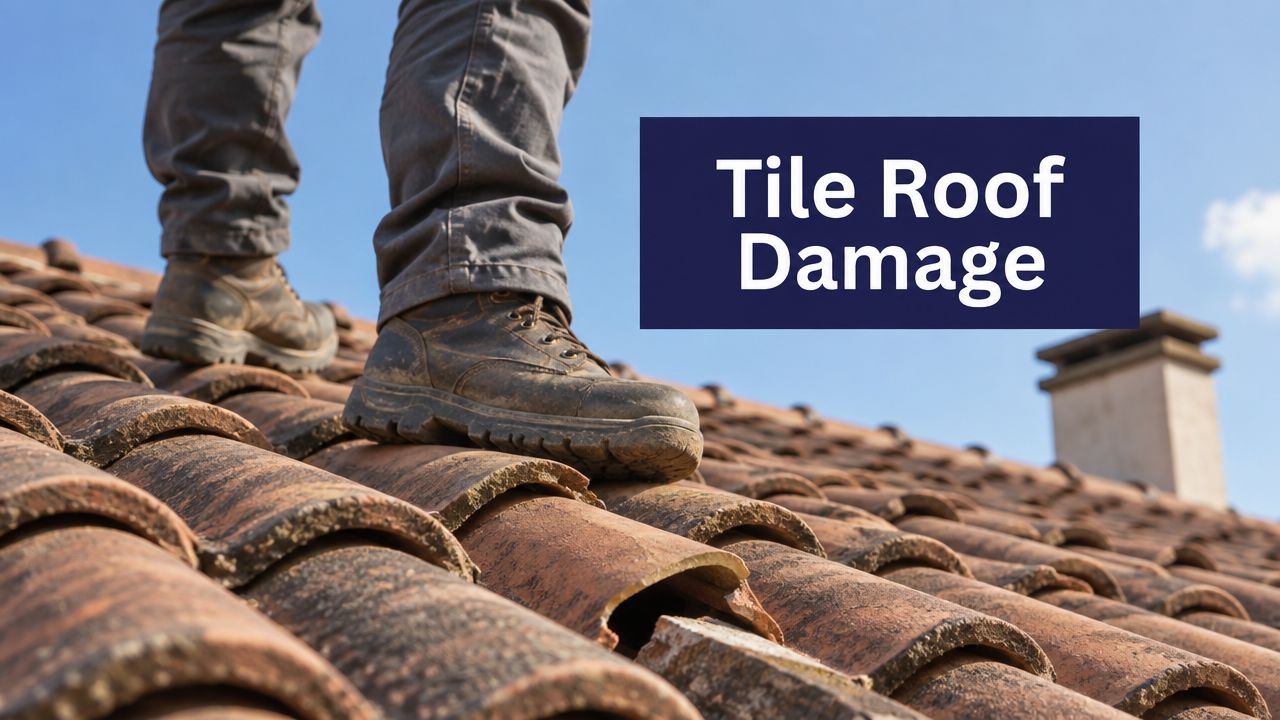
Yes, walking on a clay or concrete tile roof can crack or dislodge tiles, especially when a person steps on unsupported centers, older tiles, or barrel and S-shaped profiles. Hidden micro-fractures may not show from the ground, then allow leaks after monsoon rain.
A Phoenix homeowner may climb up to check a suspected leak, clear debris before a storm, or reach a roof-mounted fixture and see no obvious breakage afterward. That doesn't prove the roof is unharmed. Tile damage can be visible, such as a chipped corner, or hidden in a hairline fracture beneath the surface and in the underlayment below.
Introduction Can Walking on a Tile Roof Cause Damage
The direct answer is yes. Tile roofs can withstand Arizona weather, but the tiles themselves aren't designed to act like a walking surface. A person's weight creates a concentrated point load, and the wrong step can crack or shift a tile even when the roof looks normal immediately afterward.
This matters in Phoenix and Tucson, where homeowners, property managers, and building owners may need roof access for inspections, gutter work, holiday lights, equipment service, or monsoon preparation. A short visit across a sloped tile roof can create damage that becomes apparent only when wind-driven rain reaches the opening.
The Tile Roofing Industry Alliance warns that some walking methods can damage tiles enough to void a warranty, so foot traffic isn't only a cosmetic concern. Its guidance explains that the safest supported stepping zone is the lowest 3 inches of each installed tile, where the tile overlaps the one below and transfers weight toward the roof deck. The practical details matter even more on clay and high-profile S-tiles common in hot Arizona markets.
A homeowner comparing repair with broader work can also review this guide to tile roof replacement cost before deciding how urgently to arrange an inspection. The right next step depends on whether the problem is a single broken tile, displaced components, or damage involving flashing and underlayment.
How Tile Roofs Carry Weight and Why Foot Traffic Breaks Them
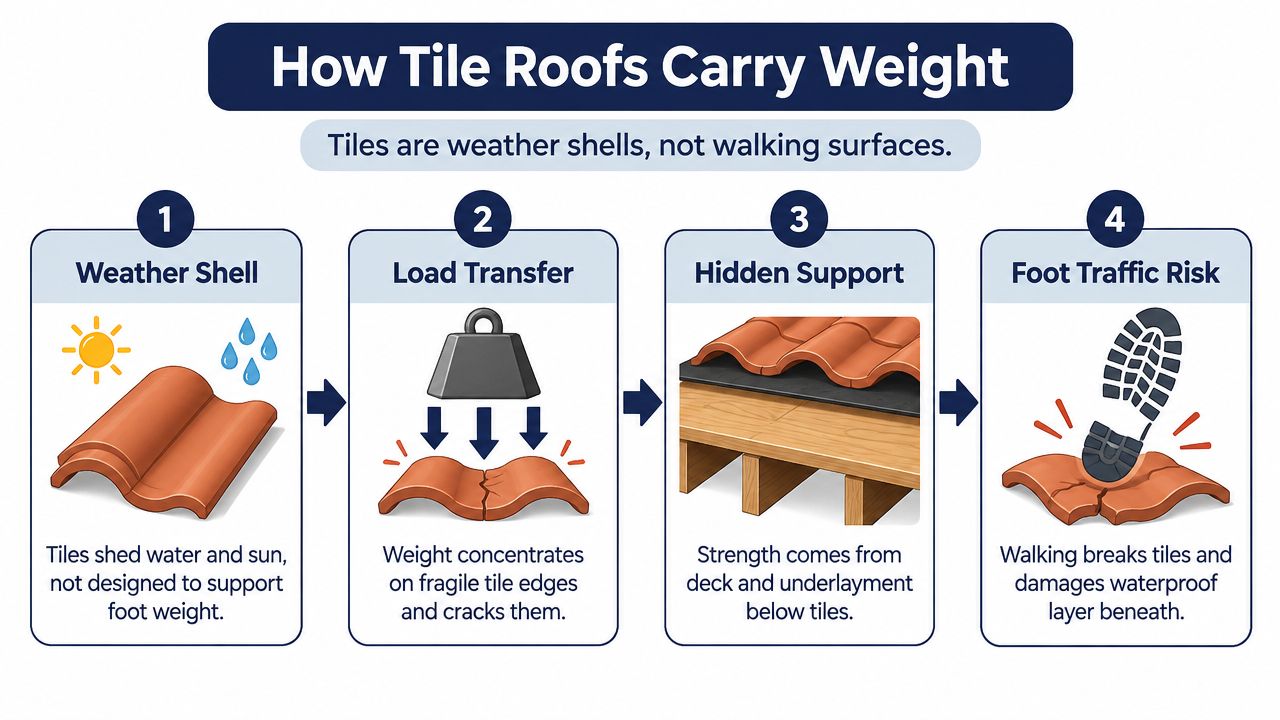
A tile roof works more like a rain shell placed over a structural system than a tiled floor inside a home. The tile sheds water and sun, while the battens, underlayment, deck, and framing carry the broader loads. A foot, however, places force in a small area, and unsupported tile can't spread that force safely.
A simple analogy helps. A bridge can carry a person when the person stands over its supports, but a thin cover between supports may flex or break. Tile overlaps perform a similar role. The headlap, or overlapping lower portion, is supported by the tile below, while the middle or exposed portion may have less support beneath it.
The Tile Roofing Industry Alliance identifies the lowest 3 inches of an installed tile as the supported area for necessary foot access. Its walkability guidance also recommends orienting feet horizontally, distributing weight evenly, walking as softly as possible, moving parallel to the ridge, and avoiding hips and valleys where cut tiles are more difficult to replace. See the Tile Roofing Industry Alliance walkability technical brief for the technical guidance.
Why the center is a problem
Barrel and S-shaped tiles often have raised profiles. Stepping on the center can concentrate force on a narrow curved surface, which raises the chance of cracking. Industry guidance says damage is less likely when weight lands on the headlap, ideally spanning supported portions rather than pressing down on an exposed center.
Practical rule: A tile's weather resistance doesn't make every part of its surface safe for a person's weight.
The same principle applies during repair. A roofer who needs to cross the roof may use walk boards, foam pads, or a roof ladder to spread force over a larger area. That approach protects the tile covering and reduces the chance that a hidden fracture reaches the waterproofing layer beneath.
What Changes Your Risk by Tile Type Age and Condition
Not every tile roof has the same foot-traffic risk. Clay and concrete differ in material behavior, but age, installation quality, support, profile, and existing wear can matter just as much as the label on the tile.
Clay tiles can become more brittle with age, while concrete tiles can also fracture under concentrated pressure. High-profile barrel and S-shaped tiles create raised surfaces that are harder to support with a foot. Lower-profile tiles may offer a more predictable overlap, but that doesn't make casual walking safe.
A forensic assessment of tile roofs identifies foot traffic as a common cause of fractures in clay and concrete tiles and notes that tiles are susceptible to accidental damage from foot traffic or poor installation. The assessment also reinforces that weather durability doesn't eliminate point-load vulnerability. More detail appears in this regional assessment of wind distress at tile roofs.
Tile Roof Walking Risk by Type and Condition
| Roof Factor | Lower Risk Scenario | Higher Risk Scenario |
|---|---|---|
| Tile material | Sound tile with no visible deterioration | Older or brittle clay, or weathered concrete tile |
| Tile profile | Lower-profile tile with clear supported overlaps | Raised barrel or S-shaped tile stepped on at the center |
| Installation | Consistent alignment with stable support below | Loose, uneven, poorly supported, or already shifted tiles |
| Roof location | Supported overlap away from edges and cut areas | Hips, valleys, penetrations, and cut tiles |
| Access method | Walk boards, foam pads, or a roof ladder used by a professional | Direct foot traffic with concentrated weight |
| Warranty position | Terms reviewed before access or repair | Foot-traffic breakage excluded from coverage |
The quality and age of the installation also affect the outcome. An expert technical note explains that walking on clay tile always carries some chance of breakage, with risk influenced by tile quality, age, and installation. It specifically advises stepping on headlaps and avoiding old tile, while manufacturer guidance commonly excludes foot-traffic breakage from tile warranties. Property owners should review the applicable warranty before assuming a cracked tile will qualify for coverage.
For owners comparing materials during a reroof, comparing concrete vs clay tiles can clarify differences, but neither option should be treated as a routine walking surface.
Why Arizona Heat Monsoon and Sun Make Tile Damage Worse
Arizona weather can turn a small access mistake into a larger roof problem. Prolonged heat and UV exposure stress the underlayment and flashings beneath tile, while repeated heat can loosen fasteners, open seams, crack tiles, and weaken roof assemblies over time. These conditions don't mean every tile roof is failing, but they make careful access and timely inspection more important.
A tile that appears intact after someone steps on it may still have a hairline fracture. Monsoon rain can find that opening, especially when wind drives water across tiles, valleys, wall transitions, chimney areas, and other details. The concern is often delayed. The first visible ceiling stain may appear after the weather event rather than immediately after the foot traffic.

What the weather changes
Phoenix roofs face intense sun and heat across long periods. Tucson properties face the same broad stresses, along with dust, wind, and sudden monsoon rainfall. The roof covering may still look serviceable while the underlayment or flashing has less remaining resilience.
A useful local reference is the America Roofing Arizona weather guide, which discusses how heat, UV exposure, and monsoon conditions affect roofing systems. Drainage deserves particular attention because debris or displaced tiles can redirect water into valleys and roof-to-wall areas.
For a commercial property, the issue can involve more than one person stepping on a roof. Repeated access for maintenance, equipment work, inspections, or drain checks can expose tile areas to recurring point loads. Commercial owners should establish controlled access routes instead of allowing different trades to cross the roof without coordination.
Signs Your Tile Roof Was Damaged by Foot Traffic
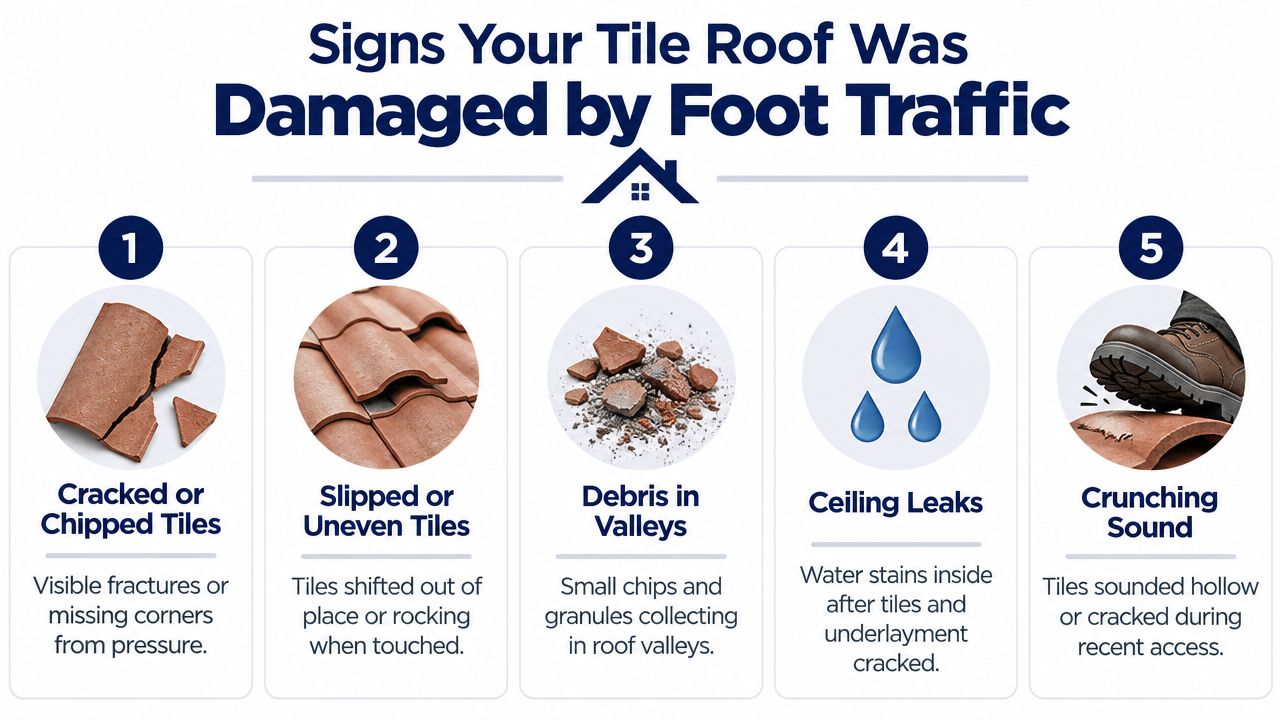
A ground-level inspection can identify warning signs without adding more risk. Binoculars can help a homeowner or property manager examine roof slopes, ridges, hips, valleys, and areas recently accessed. The inspection should focus on changes that weren't present before the visit, such as a tile sitting lower, a new gap, or fragments near the eaves.
Visible damage doesn't always identify the full problem. A cracked tile may be the only obvious defect, while the underlayment, flashing, or adjacent tiles also need review. Guidance on tile maintenance warns that micro-fractures can remain hidden and later become leak paths after rain.
What to look for from the ground
- Cracked or chipped tiles: Look for lines, missing corners, fresh breaks, or light-colored fracture surfaces.
- Slipped or uneven tiles: A tile that no longer aligns with neighboring courses may have shifted under pressure, wind, or failed fastening.
- Fragments in valleys or gutters: Small pieces can indicate breakage higher on the slope, even when the damaged tile isn't easy to see.
- Displaced ridge or hip pieces: Gaps or movement along these areas deserve professional attention because cut tiles and related components can be difficult to replace.
- New interior stains: Attic staining, damp insulation, or ceiling marks after rain can point to a breach above.
A recent roof visit followed by a leak should be treated as a reason to stop further access. Professionals may use walk boards, foam pads, or roof ladders to distribute weight rather than stepping directly on exposed tile. A homeowner shouldn't test a suspected fracture by touching or walking on the tile.
Safer Ways to Access Your Roof and Prevent Tile Damage
The safest access plan is the one that keeps unnecessary foot traffic off the tiles. A homeowner checking for storm damage can start from the yard, inspect visible slopes with binoculars, examine gutters from a safe ladder position, and check the attic for stains. A property manager can document the location of a concern and arrange a controlled inspection instead of sending several tradespeople onto the roof.
Professional access still requires planning. Walk boards, foam pads, and roof ladders help distribute weight, but they must be placed correctly and used with appropriate fall protection. A person who isn't trained in tile access can slip, step outside the supported zone, or disturb adjacent tiles while trying to reach a problem area.
A practical access checklist
- Stay on the ground for routine checks: Use visual inspection methods rather than climbing for a first look.
- Stop after suspected damage: Don't walk farther to investigate a crack, shifted tile, or leak.
- Use controlled routes: Commercial managers should identify safe access paths and communicate them to maintenance contractors.
- Protect recurring access points: Tasks such as gutter work, inspections, and rooftop service should use planned load-spreading equipment.
- Schedule before storm exposure: A pre-monsoon inspection can identify loose or damaged components before wind-driven rain tests them.
Holiday lights, satellite work, and gutter cleaning all create a temptation to cross the roof. Those tasks should be reassigned to a qualified roofing professional when access requires stepping on tile. If a building needs frequent rooftop movement, owners can review rooftop walk deck considerations before creating a permanent access solution.
Access decision: If the task can be completed from the ground, keep it on the ground. If the task requires tile contact, use a professional access plan.
Flat roofs, foam roofs, and coated systems have different access considerations from tile roofs. They still aren't automatically safe for casual traffic. Drains, seams, parapets, penetrations, coatings, and membrane surfaces can be damaged by improper access, so a flat-roof inspection should also follow the system's maintenance requirements.
Repair Inspection and Next Steps for Arizona Tile Roofs
A single visibly broken tile may need a focused repair, but the inspection should still check surrounding tiles and the water-shedding path. If water reached the underlayment, flashing, valley, or roof deck, replacing the tile alone may not resolve the leak. Roof age, prior repairs, drainage, and exposure to Phoenix or Tucson monsoon wind can change the repair-versus-replacement decision.
A professional assessment should document cracked or shifted tiles, likely entry points, underlayment condition where accessible, flashing details, and signs of interior moisture. Building owners who manage multiple properties can also use a roofing lead generation platform as a separate resource when organizing roofing inquiries and vendor outreach, but the roof itself still requires an on-site technical evaluation.
Homeowners seeking a roof inspection in Arizona should ask what the inspection will cover and whether the report distinguishes visible tile damage from concealed system concerns. A repair plan should prioritize active leaks, open areas, displaced components, and vulnerable flashing before cosmetic work.
America Roofing serves Phoenix and Tucson with residential and commercial roof repair, tile roofing, flat roofing, foam roofing, coatings, leak repair, storm damage work, reroofing, and replacement options. Call 602-237-2478 or request a roofing estimate when roof access may have caused damage or a monsoon leak needs evaluation.
America Roofing can inspect tile condition alongside the underlayment, flashing, valleys, and drainage details that determine whether a simple repair is enough. Visit America Roofing to arrange service in Phoenix or Tucson, and keep people off the tile until the roof has been assessed.