
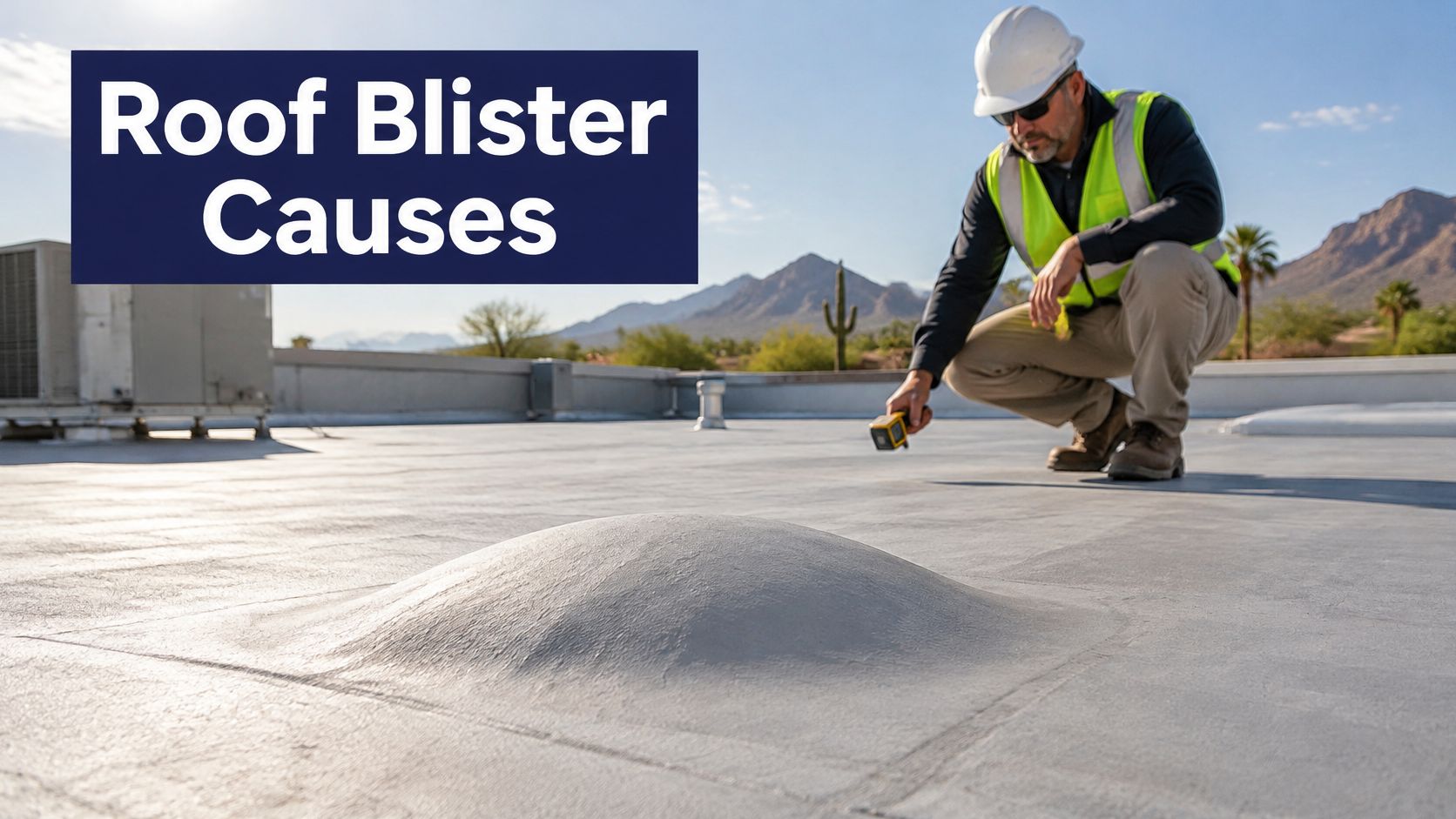
Commercial roof blisters form when air, water vapor, or both become trapped beneath a membrane that's no longer fully bonded, and daytime heat pushes the pocket upward; common causes include installation gaps, moisture in the assembly, and heat cycling. Cutting every bubble isn't the answer: an intact blister may warrant monitoring, while a similar-looking defect with wet insulation or failing seams needs a different response.
Commercial Roof Blistering Causes at a Glance
Commercial roof blistering causes usually involve both a pocket where pressure can collect and a bond that can't resist it. The visible shape identifies a suspect area, not necessarily the source of the problem.
| Cause | How It Forms | Typical Clues |
|---|---|---|
| Trapped air from installation | Skipped adhesive, uneven substrate, or debris leaves pockets between layers | Rounded blisters noticed early in roof life |
| Trapped moisture in the assembly | Wet insulation, deck, or felts release vapor as the roof heats | Afternoon enlargement; damp materials confirmed nearby |
| Weak adhesion or incompatible materials | An inadequate bond or unsuitable adhesive or coating permits separation | Loose edges or blistering spread across roof fields |
| Curled felts or unbonded laps | A curled ply or open lap traps air along a seam | Elongated blisters following lap lines |
| Solar heating and thermal cycling | Heating expands trapped gas; repeated movement stretches the pocket | Raised areas that change with daytime exposure |
| Edge, seam, or flashing damage | Water enters through a damaged detail and reaches confined layers | Blisters near parapets, drains, curbs, or penetrations |
| Humid interior air or air leakage | Moist indoor air reaches the roof assembly from below | Defects above occupied areas with humidity or ceiling staining |
Most blisters have more than one contributing cause. For example, an installation void may remain inconspicuous until moisture enters and summer heating increases pressure.
Built-up roofing and modified bitumen can separate between bonded plies. Adhered single-ply membranes can separate from their substrate, while coated roofs can develop bubbles within the coating rather than beneath the waterproofing membrane. Those distinctions must be confirmed before selecting a repair.
How Pressure Builds in Arizona Roof Systems
Where pressure collects
A blister often starts as a small void between surfaces intended to stay bonded. The National Research Council Canada technical paper identifies skipped bitumen, trapped debris, curled felts, irregular substrates, and damp installation materials as contributors to these voids.
The location matters as much as the visible dome. Separation within a membrane calls for a different assessment than separation above deteriorated insulation.
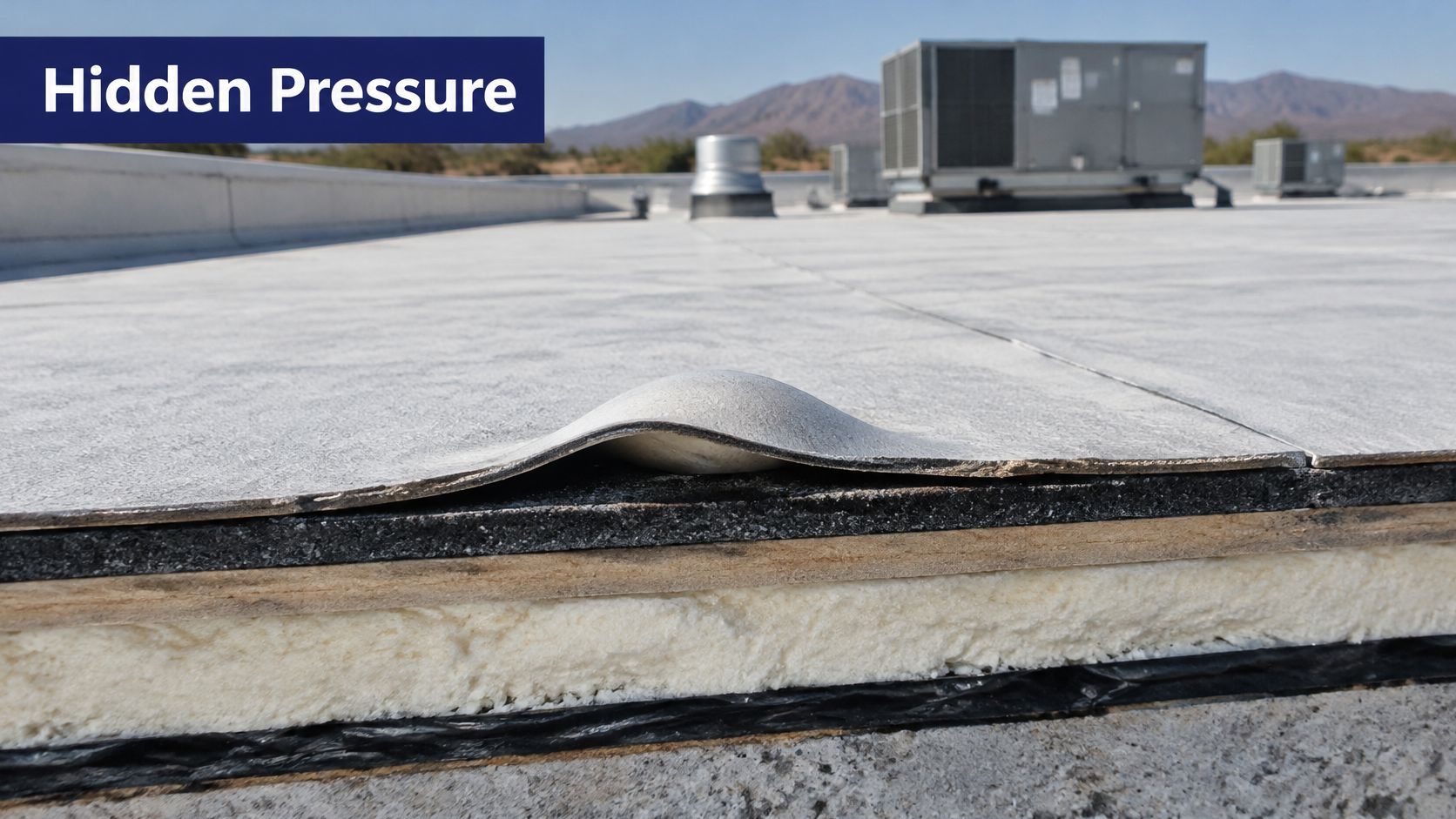
A simplified cross-section shows the possible pressure zones. Actual assemblies don't necessarily contain every layer shown.
SUN AND SURFACE HEATING ↓ Coating, where present Possible separation beneath coating film ────────────────────────────────────────── Waterproof membrane or layered roofing plies Possible trapped pocket between plies ────────────────────────────────────────── Adhesive or bitumen Possible void beneath bonded membrane ────────────────────────────────────────── Cover board or roofing felts, where specified ────────────────────────────────────────── Insulation Moisture reservoir if materials become wet ────────────────────────────────────────── Vapor retarder, where specified Restricted drying path above this layer ────────────────────────────────────────── Structural deck ↑ Possible moisture movement from building belowWet insulation supplies moisture; the resulting pressure acts at a confined void or weak bond. A vapor retarder's presence alone doesn't establish a defect, and its absence doesn't prove why blistering occurred.
Why heat enlarges the pocket
During solar heating, trapped gas expands while asphalt becomes softer and interlayer adhesion weakens. Night cooling stiffens the assembly, which may not return completely to its earlier shape. Repeated cycles can gradually enlarge the separation.
A 1995 Oak Ridge National Laboratory roofing paper reported blistering in 24% of surveyed roofs and blisters representing 24% of built-up roofing problems; its technical discussion also describes liquid water expanding approximately 1,250 times when becoming vapor and SBS blister humidity ranging from 50% to 75%. The analyzed blister gas consisted mainly of air and water vapor, with negligible volatile organic compounds.
Those findings don't establish the condition of any particular Arizona roof. They explain why a seemingly minor installation void deserves moisture investigation rather than an automatic solvent-related diagnosis.
Different systems, different weak points
Built-up and modified-bitumen roofs can develop interply pockets where bitumen coverage or felt bonding is incomplete. On adhered TPO, PVC, or EPDM, the investigation instead needs to establish whether separation involves the sheet, adhesive, or cover board. A peak at a mechanically attached membrane's restraint point shouldn't automatically be labeled a blister.
Foam and coated roofs need another distinction: a coating-film bubble isn't necessarily a defect throughout the foam beneath it. Product-specific application and compatibility requirements must be reviewed before recommending another coating.
Phoenix and Tucson add intense solar exposure, UV weathering, dust accumulation, and monsoon storms. Dust can obstruct drainage, while stormwater entering a damaged detail can leave concealed materials wet after the exposed roof looks dry. A commercial flat roof assessment therefore needs to identify the complete assembly, not just its surface material.
A dry-looking roof surface doesn't establish that the layers beneath it are dry.
Blisters, Wrinkles, and Other Defects Compared
A rounded pocket, a membrane fold, and a coating bubble can look similar from across a roof. The initial comparison should use visible appearance and existing observations, not pressing, probing, or walking on the defect.
| Defect | What It Looks Like | Usual Cause | First Check |
|---|---|---|---|
| Blister | Raised, rounded pocket that may appear taut or slack | Trapped air or moisture beneath a separated layer | Record dimensions and change; arrange seam and moisture checks |
| Wrinkle | Linear ridge or fold, sometimes changing with temperature | Installation slack, membrane stress, or thermal movement | Note direction, edge relationships, and temperature pattern |
| Tenting | Sheet stretched into a peak over a fixed point | Attachment issue, projecting fastener, or restrained movement | Have fasteners, terminations, and flashing assessed |
| Soft spot | Depression or area previously noticed giving underfoot; possible staining | Wet insulation, deteriorated deck, or failed substrate | Don't walk on it to test it; restrict access |
| Puncture | Hole, cut, or tear with displaced edges | Impact, tools, traffic, fasteners, or debris | Record its location; assess the possible water path |
| Coating bubble | Raised area within the film, sometimes followed by peeling | Moisture, poor preparation, or unsuitable application conditions | Review product defect guidance and test moisture and adhesion |
A wrinkle that follows a line and changes with temperature may reflect slack or restraint rather than moisture pressure. That distinction still requires checking the surrounding attachment and seams.
A coating bubble on foam or another coated surface calls for the coating manufacturer's defect guidance before restoration is selected. Film thickness, substrate preparation, and moisture beneath the film are investigation points, not conclusions available from appearance alone.
The repair must follow the actual defect. Treating tenting as a moisture blister, for example, can leave the attachment problem unresolved.
Why Cutting a Blister Can Make Things Worse
A facility team may want to slit a raised pocket to release pressure or see whether water comes out. That approach can turn an intact waterproof surface into a leak without answering why the pocket formed.
An opening creates a new repair obligation
Cut edges require a system-compatible repair, not an assumption that the original adhesive will stick again. A general-purpose sealant or coating may not restore continuity or bond reliably to the exposed materials.
Opening the pocket also doesn't remove moisture held in insulation, felts, or decking. The NRCA guidance on SBS modified-bitumen blistering connects moisture, temperature, and membrane condition to repair decisions rather than treating blister size as the deciding factor.
Pressure release isn't a diagnosis
A pocket containing humid air can release pressure without revealing the extent of wet material. A dry opening at one location also can't establish that the surrounding assembly is dry.
Raised or soft areas introduce access risks as well. Foot pressure can rupture a vulnerable membrane, and a soft substrate may conceal deterioration that makes walking unsafe.
No-touch rule: Owners and maintenance staff shouldn't puncture, slit, press, or walk on suspect blisters.
Suspect areas should remain clear of routine roof traffic. Roof access also needs to account for edges, skylights, equipment routes, and weather, not merely the shortest path to the bubble.
Planning Arizona commercial roof repair should start with identifying the system and establishing moisture conditions. Any necessary invasive investigation belongs within a professional assessment with suitable weather protection and a compatible closure plan.
A No-Touch Worksheet for Tracking Blisters
Useful documentation starts with safe observation. Staff shouldn't step onto a suspect area, reach across an unprotected edge, or press the membrane to complete a maintenance record.
A dated worksheet helps distinguish a changing defect from one that merely looks different under stronger sunlight. It also gives the roofing professional a better starting point than an undated description of bubbles.
| Field | What to Record | Why It Matters |
|---|---|---|
| Size | Estimated length and width in inches, dated; measure only where safe without touching the defect | Establishes whether the footprint changes |
| Location | Roof zone and relationship to parapets, drains, penetrations, curbs, and seams | Separates field defects from detail-related patterns |
| Temperature and time pattern | Time, sun or shade, and a noncontact surface-temperature reading from a safe position if available | Shows whether visible changes track heating |
| Growth or change | Repeat observations on a consistent schedule; note cracking or splitting | Distinguishes a stable shape from deterioration |
| Nearby seams and flashings | Visible condition of laps, terminations, walls, and curbs nearby | Identifies possible water-entry details |
| Interior moisture | Dated ceiling stains, unusual humidity, odors, or reported dripping below | Helps relate roof observations to indoor symptoms |
| Drainage | Standing water, blocked drainage paths, or debris after rain | Identifies exposure that may affect repair planning |
| Prior work | Patch and coating locations, repair dates, and available product records | Helps investigate adhesion and compatibility |
Keep the record comparable
Use the same roof-zone names and observation positions on repeat entries. Note whether a visit followed a monsoon storm, a windy period, or prolonged dry weather, rather than assuming every change came from age.
The record belongs in the owner's maintenance files and can be shared with the contractor during inspection. It supports documentation, but it doesn't establish an insurance cause or coverage determination.
The Arizona commercial roof inspection guide provides related inspection context. Repeated, dated observations are more useful than approaching the defect for a closer look.
How Moisture Is Confirmed Before Any Repair
A blister's appearance can't establish whether it contains dry air, moisture, or a combination. NRCA moisture guidance identifies interacting vaporization, diffusion, and capillary mechanisms, supporting an investigation that considers both the assembly and moisture movement.
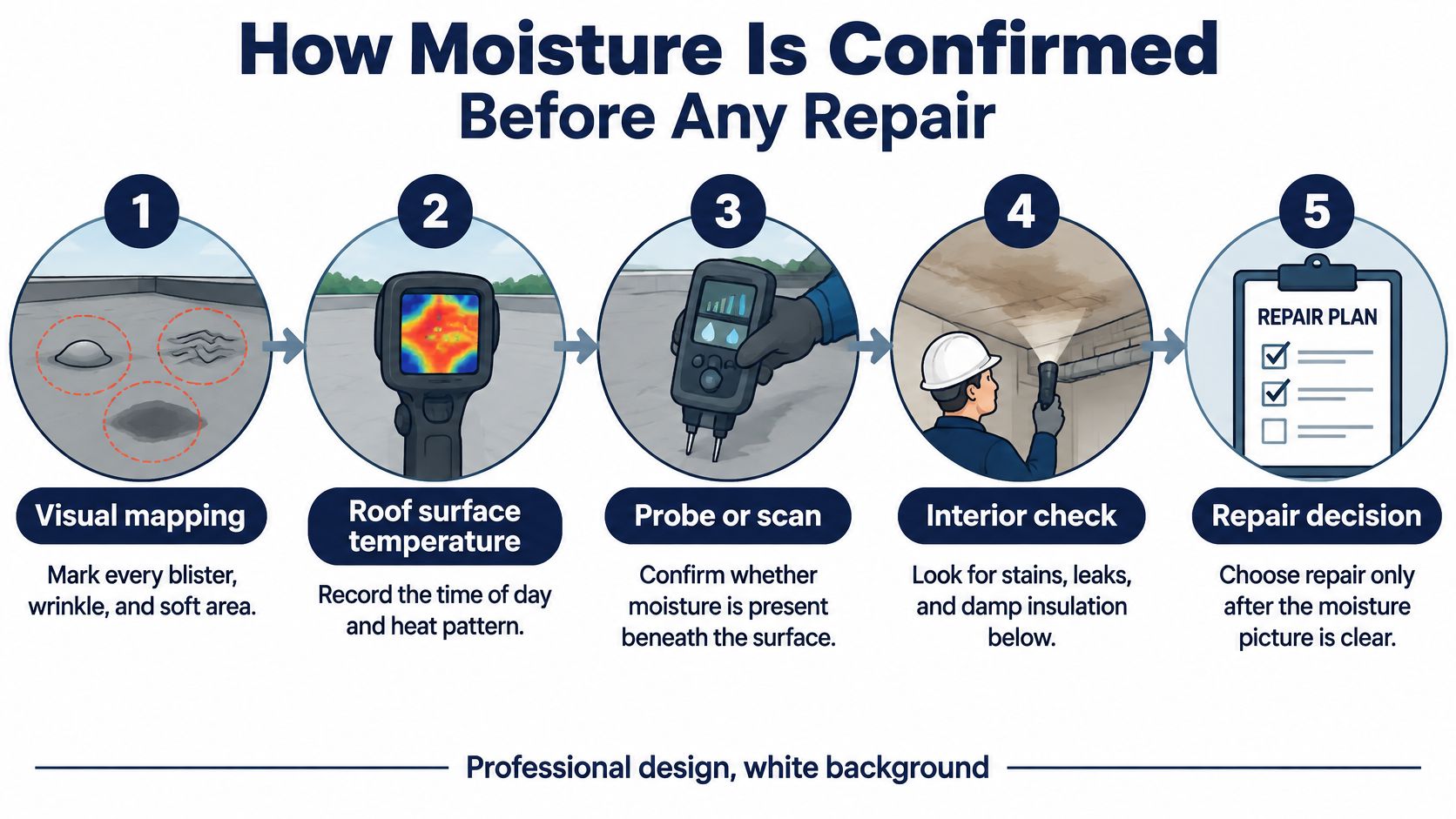
A professional investigation sequence
- Map the defects. Mark blisters, wrinkles, suspect soft areas, repairs, and drainage features on a roof plan. Include the owner's dated observations and surface-temperature pattern.
- Survey for moisture. Infrared or capacitance methods can identify suspect areas. Results need qualified interpretation because assembly materials and test conditions affect readings; a scan isn't a complete diagnosis.
- Evaluate selected locations. Where indicated, a qualified roofing professional can perform selective sampling under applicable system and NRCA guidance. Owners shouldn't cut blisters themselves.
- Review the history. Construction records, weather exposure during installation, previous leaks, and repair materials can help distinguish original trapped moisture from later entry.
- Check below the roof. Compare interior staining and humidity with the roof map. Interior symptoms may not sit directly beneath the entry point.
- Document the conclusion. The written assessment should separate confirmed wet materials and failed bonds from suspected causes that remain uncertain.
What sampling adds
Checking insulation with roof core sampling can help identify actual layers and material condition where nondestructive findings need confirmation. It represents the sampled location, not automatic proof of the entire roof's condition.
A useful assessment states both what is confirmed and what remains uncertain.
The combined findings establish whether observation, localized work, restoration evaluation, or replacement planning is justified. No single instrument replaces that combined judgment.
Choosing Between Monitoring, Repair, Restoration and Replacement
A stable, dry blister away from vulnerable seams and drainage routes may qualify for scheduled monitoring. Cracking, continued enlargement, wet insulation, delamination, or interrupted drainage shifts the decision toward corrective work.
The National Research Council Canada blister investigation indicates that intact blisters don't automatically mean lost membrane strength. Appearance alone isn't a defensible reason to replace an otherwise serviceable roof.
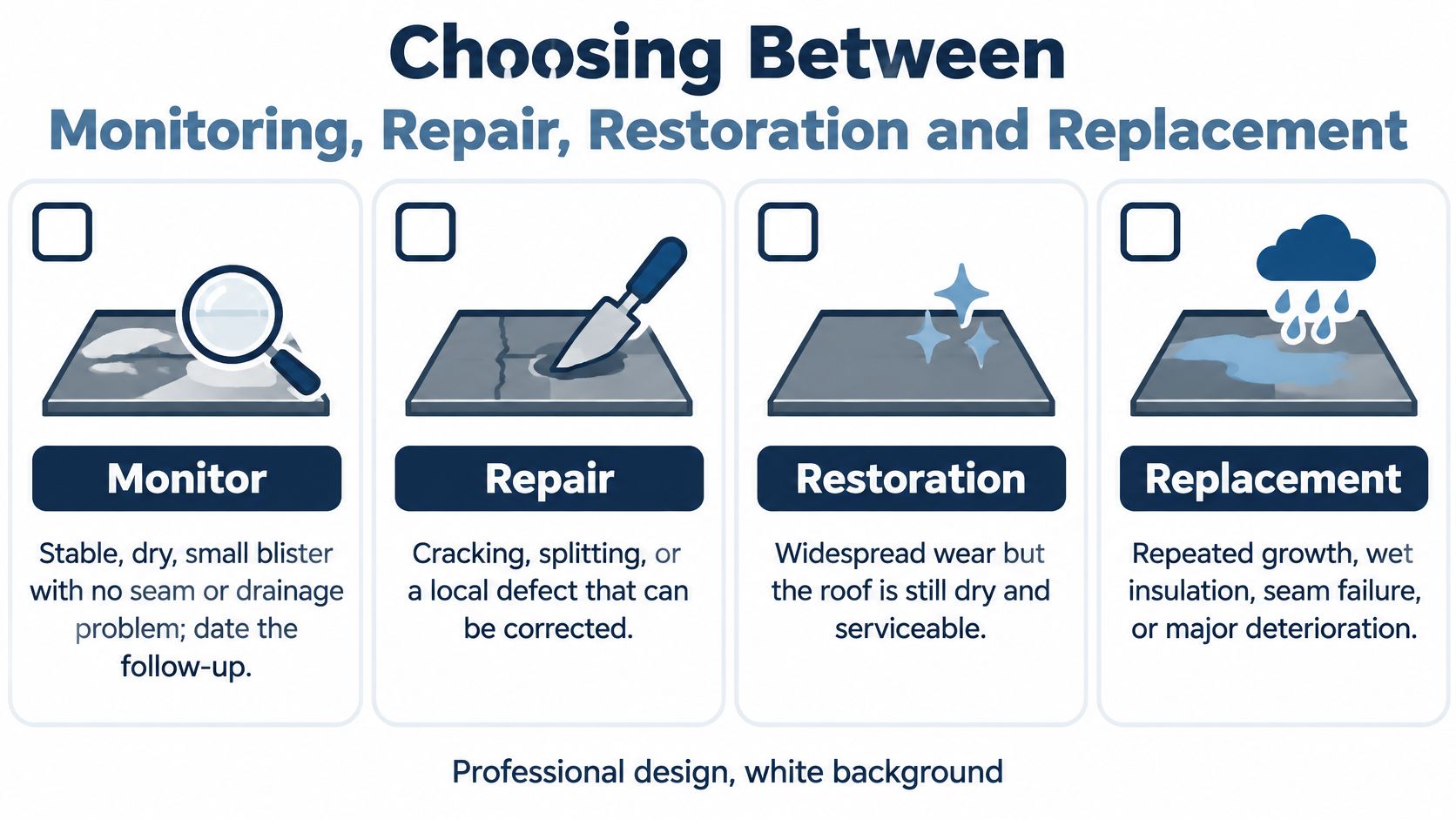
Match the scope to the findings
Monitoring fits a professionally assessed, intact, dry, stable condition. It needs a dated follow-up plan rather than indefinite neglect.
Localized repair makes sense when the affected area and water path can be corrected. Covering the nearest visible bubble while leaving wet materials or damaged flashing unresolved isn't equivalent work.
Restoration requires a serviceable underlying assembly and confirmed compatibility with the proposed coating system. A coating shouldn't be used to conceal uncertain moisture conditions.
Replacement becomes more defensible when wet materials or membrane failures are widespread, or when repeated repairs no longer provide a practical approach. The discussion of commercial roof tear-off requirements in Tucson can help frame recover-versus-removal planning without assuming every roof qualifies for either option.
The decision file should address:
- Change: Blister growth, cracking, and splitting.
- Moisture: Wet insulation and interior staining.
- Details: Drainage and seam condition.
- History: Previous repairs and coating compatibility.
Any soft area, active interior water, or defect near an edge or penetration warrants professional attention. Budget and insurance decisions also benefit from a documented assessment rather than a surface-only estimate.
America Roofing inspects the roof, explains the options, and identifies a practical next step, including what could change after concealed materials are exposed. Occupied buildings can often remain open with planned access, staging, noise, dust, debris, temporary protection, and communication. America Roofing can document conditions and proposed work for insurance purposes, but coverage belongs to the carrier and policy.
America Roofing can assess commercial roof blisters in Phoenix and Tucson and explain whether monitoring, repair, or a larger roofing scope fits the findings. Owners can request a roofing estimate or call 602-237-2478 to arrange an assessment before cutting, coating, or committing to replacement.