
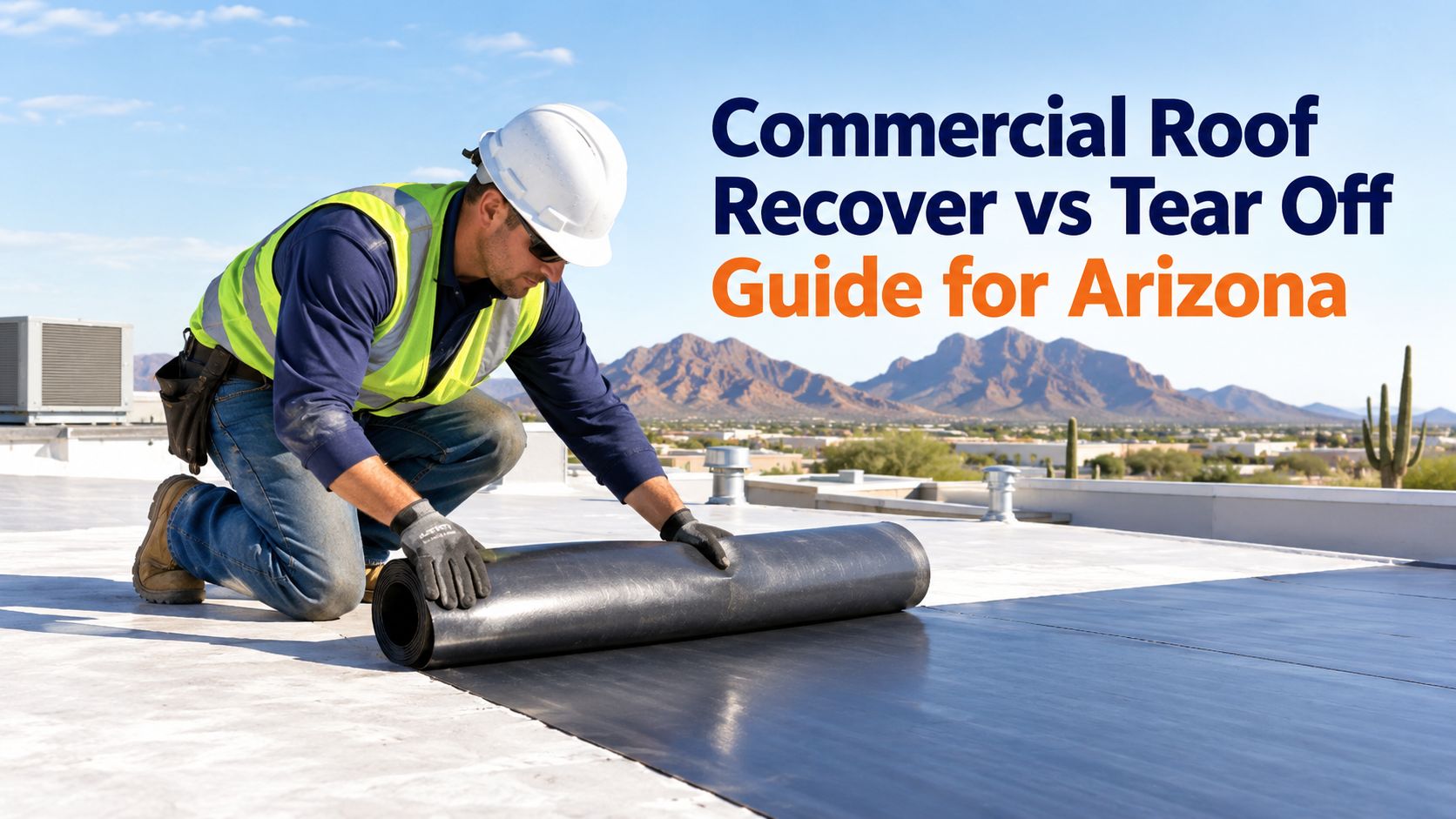
An occupied Phoenix warehouse has a roof problem, but shutting down operations for a full demolition may create problems of its own. The commercial roof recover vs tear off decision isn't just a price comparison. Arizona heat, ultraviolet exposure, monsoon drainage, rooftop equipment, wet insulation, and the condition of the structural deck all affect which scope makes sense.
Introduction to Commercial Roof Recover vs Tear Off in Arizona
The short answer is direct. A recover may be appropriate when the existing commercial roof is dry, stable, within applicable code limits, and compatible with the proposed system. A tear-off is required when the assembly is wet, deteriorated, unstable, improperly layered, or unsuitable for the new roof. Commercial roof planning guidance defines recover as installing a new covering over the existing one, while replacement removes the existing roofing down to the structural deck. Commercial roofing guidance on recover and replacement
For a Phoenix or Tucson property manager, the practical question isn't only about which option has the lower proposal total. A recover can limit demolition, noise, debris, and exposure inside an occupied building. A tear-off can reveal wet insulation, failed attachment, damaged decking, blocked drainage paths, and details that a new layer would otherwise conceal.
Arizona conditions change the decision
Phoenix roofs absorb intense heat and UV exposure for long periods. Tucson roofs face the same heat load, along with dust, large temperature swings, and monsoon rain that can expose weak drainage, open seams, and low areas. Flat commercial roofs also have penetrations, parapets, drains, scuppers, curbs, and rooftop equipment that must work with the finished roof height.
America Roofing serves owners and managers looking for practical commercial roofing in Arizona. The right scope starts with proving eligibility, not selecting the cheapest-looking line item.
What Recover and Full Tear Off Actually Mean
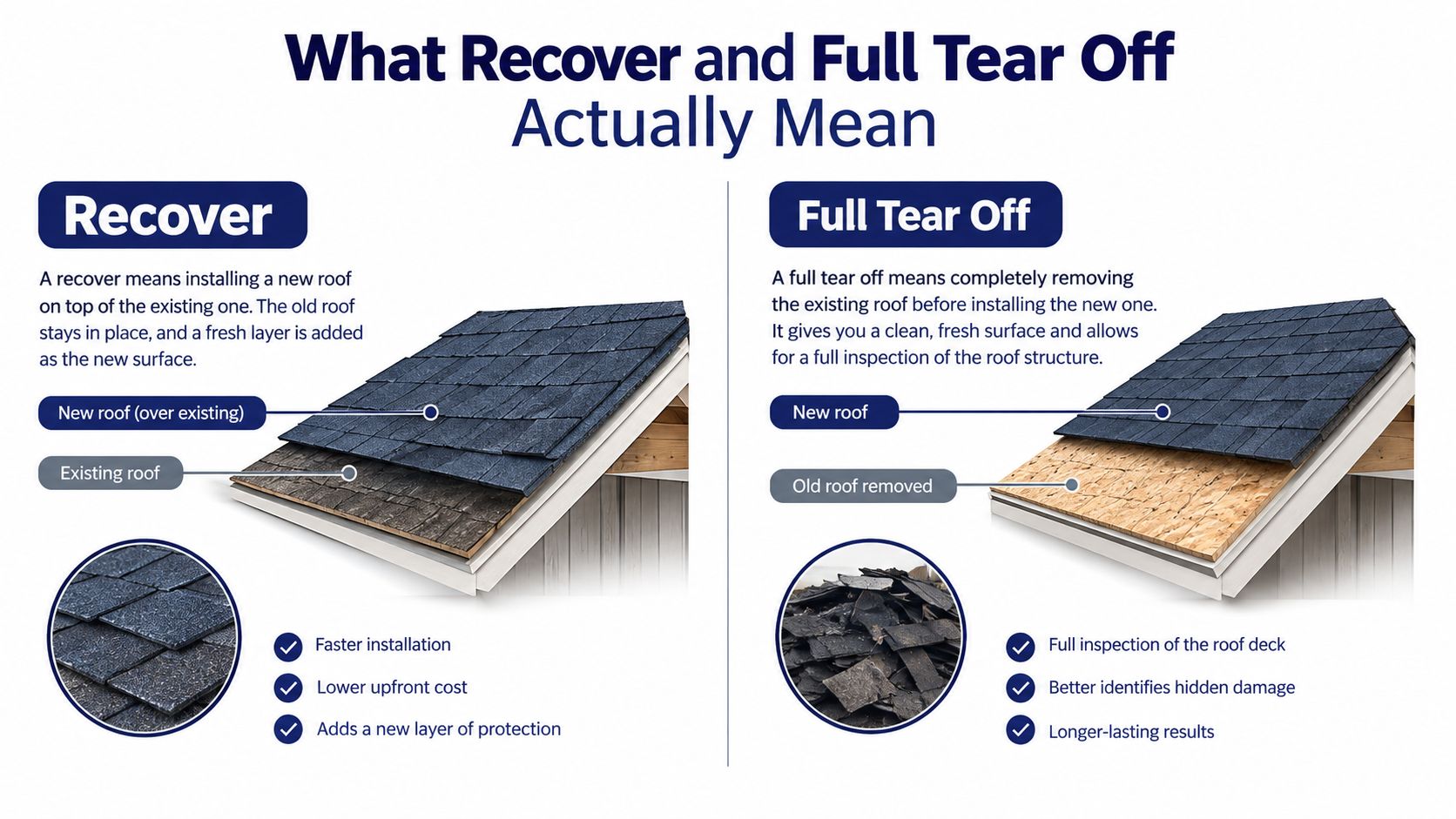
A commercial roof recover installs a new approved roof covering over the existing roof assembly. The old membrane or coating remains in place, along with much of the existing insulation, cover board, attachment system, and concealed deck. Contractors still need to repair identified defects and adapt the new system around drains, parapets, edge metal, penetrations, and equipment curbs.
A full tear-off and replacement removes the existing roofing to the structural deck, or to another specifically defined layer when the design permits it. That process exposes conditions that a recover leaves hidden. The crew can remove wet insulation, replace damaged materials, repair or document the deck, adjust slope, and rebuild flashing details before installing the new system.
What stays in place
Recover preserves the existing assembly as part of the new roof's base. That can reduce removal work, but it also means the contractor must understand what remains underneath. A new membrane or coating can't correct widespread wet insulation, a deteriorated deck, poor attachment, or a drainage layout that already causes ponding.
This is especially important on low-slope membrane roofs, foam roofs, and coating projects. A recover may involve a new membrane, cover board, or approved restoration system. The final assembly must still meet applicable code, structural, attachment, drainage, and manufacturer requirements.
What tear-off exposes
Tear-off resets the roof system at the deck. It creates more work and requires careful control of debris, weather, roof access, and building exposure, but it gives the owner direct information about concealed conditions.
Property managers comparing options often ask, “Should I re roof or replace?” The useful answer depends on the verified assembly, not the label used in a proposal. Guidance on whether to re-roof or replace can help frame that discussion, but the roof's actual moisture and deck conditions control the final decision.
When Recover Is Allowed and When It Is Not
A recover should start with a go or no-go screening exercise, not a price comparison. In Arizona, the existing roof must be dry, structurally sound, compatible with the proposed system, and suitable for added thickness. If moisture, deck damage, failed attachment, or layer count cannot be verified, tear-off is usually the safer scope. Commercial roof substrate and tear-off guidance
| Eligibility factor | Recover go condition | Tear-off required condition |
|---|---|---|
| Moisture | Testing supports a dry, stable assembly | Water-soaked, widespread, or uncertain wet materials |
| Attachment | Existing conditions and proposed attachment can be verified | Attachment is failed, unknown, or unsuitable for the new system |
| Deck | Deck condition is reasonably established and sound | Deck damage is suspected or the base cannot be verified |
| Existing layers | A single compatible layer is documented | Two or more coverings are present, or layers are unknown |
| Drainage and slope | Drains, scuppers, and slope can function with added thickness | Ponding, blocked drainage, or limited detail height prevents sound design |
| Covering compatibility | The proposed system is approved for the existing base | Manufacturer requirements do not approve the assembly |
| Warranty path | Written system and warranty requirements can be satisfied | Recover conflicts with product specifications or warranty conditions |
Moisture is a decision gate
A roof can look acceptable while wet insulation remains below a membrane, foam, or coating. Arizona monsoon water often enters at penetrations, seams, and drains, then becomes concealed after the surface dries. A recover can leave that moisture trapped, allowing deterioration to continue beneath the new work.
The eligibility decision should also account for the deck, attachment, and drainage together. A sound surface does not prove that the deck will hold fasteners. Added roof thickness can reduce drain clearance, raise transitions, and affect parapet flashing or equipment curbs. If these conditions cannot be verified, the recover has already failed the screening test.
Layers and coverings matter
IRC Section R908 restricts recover when the existing roof is water-soaked or deteriorated, when it is installed over clay, cement, or asbestos-cement tile, or when two or more roof layers already exist. The cited reroofing rule does not allow adding another application where two or more layers are present. The two-layer reroofing limit
Drainage and attachment can disqualify a recover
A new layer must be attached to a suitable substrate and designed for the existing roof conditions. Wind attachment requires verified substrate conditions and an approved assembly. Drains, scuppers, slope, flashing heights, and equipment curb details must still work after the added thickness.
A lower initial scope does not make recover economical if it leaves ponding, weak attachment, concealed wet materials, or warranty conflicts in place. In those conditions, tear-off provides the access needed to correct the base rather than covering an unverified problem.
How to Prove the Roof Is Dry and Sound Before Choosing
The phrase “dry and sound” needs evidence behind it. A visual walkover can identify open seams, damaged flashings, ponding, cracked coatings, and obvious deterioration, but it can't establish the condition of every concealed roof area.
A professional investigation may combine moisture testing, representative core cuts, deck verification, and attachment review. The purpose isn't to create unnecessary openings. It's to test whether the existing assembly can serve as a reliable base for another roof system.
What moisture testing can and can't prove
Moisture surveys help locate areas that deserve closer verification. Results still have limits, especially around rooftop equipment, penetrations, drains, repairs, and changes in roof construction. Selected core cuts can confirm the layers, insulation condition, and substrate at representative locations.
Neutral commercial roofing guidance emphasizes moisture testing, core cuts, and deck verification because wet insulation, deterioration, or multiple existing layers can make recover a poor choice or prevent approval. Commercial roof replacement and inspection considerations
What the inspection report should document
A useful report should identify:
- Existing layers: The number and type of roof coverings, insulation, cover boards, and known repairs.
- Moisture findings: Survey areas, verification openings, limitations, and assumptions about wet materials.
- Deck condition: Observed or verified deck conditions, suspected damage, and how concealed repairs will be handled.
- Attachment basis: How the new roof will connect to a suitable substrate and meet the proposed design.
- Drainage details: Drains, scuppers, low areas, overflow paths, and any ponding observed after rain.
- Scope allowances: What happens if tear-off exposes damaged deck, wet insulation, or incompatible materials.
Practical rule: A recover proposal should explain how the existing roof was verified, not just state that it appears sound.
Building owners shouldn't cut inspection openings or walk unsafe roof areas without qualified supervision. A professional roof inspection in Arizona can help document conditions without treating an unseen assembly as already diagnosed.
Scope Disruption and Long Term Maintenance Compared
Recover can reduce disruption when the roof qualifies, particularly at an occupied warehouse, retail facility, office, or industrial building. Tear-off requires debris removal, staging, daily weather protection, and more coordination around workers, deliveries, roof access, and interior operations.
A benchmark report cited in industry guidance found restoration-style projects averaged about 8 crew days for a 30,000 SF roof, compared with 13 days for recovery and up to 30 days for tear-off. Those figures aren't a promise for a specific Phoenix or Tucson project, but they show why a feasible overlay or restoration scope can turn over materially faster. Industry comparison of recovery and replacement project duration
| Scope item | Recover | Tear-off replacement |
|---|---|---|
| Building disruption | Usually less demolition, noise, and debris when the assembly qualifies | More noise, debris handling, staging, and weather protection |
| Unknown-condition exposure | More existing materials remain concealed | Existing roofing and much of the assembly can be exposed and evaluated |
| Waste and disposal | Less removal and fewer disposal requirements | More demolition waste, dumpsters, and tipping fees |
| Drains and parapets | Details must be adapted to added thickness | Details can be rebuilt from the deck or redesigned layer by layer |
| Equipment curbs and penetrations | Existing heights and transitions need careful coordination | Curbs and penetrations can be reset as part of the replacement scope |
| Maintenance access | Existing weaknesses may remain beneath the new system | New assembly and details provide a cleaner maintenance baseline |
| Occupied operations | Often easier to phase around tenants and business hours | Requires stronger access, dust, debris, and dry-in controls |
Disruption isn't the same as risk
A recover may keep a building operating with fewer interruptions, but it doesn't remove technical risk. If moisture or deck damage remains hidden, future maintenance can become harder because the new roof covers the evidence. Tear-off creates more immediate disruption, yet it can reduce uncertainty and correct drainage or detail problems that would otherwise continue.
Property managers should compare complete scopes, including access plans, cleanup, detail work, and concealed-condition allowances. A maintenance program after installation also matters. A documented commercial roof maintenance plan can help protect drains, seams, flashings, coatings, and penetrations from small failures that become interior leaks.
Cost Drivers Timeline Permits and Warranty Implications
Recover's financial advantage comes mainly from avoiding demolition, dumpsters, and tipping fees. One industry comparison places tear-off-related costs at roughly $1 to $3 per square foot above the new roof system, and describes recover as about a quarter less expensive overall when the existing roof is sound and code-compliant. Commercial roof tear-off and recover cost comparison
Those figures are comparison points, not a project quote. Actual scope depends on roof access, existing layers, wet-area removal, insulation, cover board, deck repairs, attachment, drainage corrections, penetrations, equipment curbs, parapets, and edge conditions.
Timeline and permit review
A recover can shorten the work period because the crew removes less material. Tear-off adds demolition and disposal, while concealed deck or insulation repairs can expand the scope after exposure. Both options still require planning for monsoon weather, roof access, deliveries, rooftop equipment, occupant protection, and daily dry-in.
Permit requirements depend on the locally adopted code and the actual scope. The owner and roofing contractor should confirm the applicable requirements with the responsible jurisdiction rather than assuming a recover or replacement follows the same review path everywhere.
Owners arranging capital for breaking ground on your project should include inspection allowances, drainage work, concealed conditions, and operational controls in the planning conversation.
Manufacturer and warranty conditions
A recover isn't automatically eligible for every membrane, coating, foam, or insulation assembly. Product specifications, approved substrates, attachment requirements, compatibility, detail construction, and warranty documents govern the proposed system.
Some recent code discussions also describe qualifying protective coatings over existing spray polyurethane foam roofing without tear-off. That possibility doesn't make every foam roof a recover candidate. The existing foam, moisture condition, drainage, adhesion, repairs, and approved product system still need verification.
Owners can also review broader roof financing options while comparing complete scopes, but financing shouldn't replace a technical go or no-go decision.
Choosing the Right Option for Your Arizona Building
Arizona buildings need a go or no-go decision before anyone prices a recover. Approve a recover only when the inspection proves one dry, stable, compatible roof layer, an acceptable deck and attachment basis, working drainage, and a manufacturer-supported system. That option can reduce demolition and business interruption in an occupied building.
Use tear-off when moisture is widespread or uncertain, deterioration prevents reliable repairs, the deck requires direct evaluation, attachment cannot be verified, or drainage must be corrected. Crowded rooftop details also make another layer a poor choice, especially where heat and monsoon water will expose weak transitions.
If inspection confirms existing conditions that make recover ineligible, budget tear-off from the start. Do not carry a recover allowance into plan review when the documented scope already requires removal to the deck.
Owners planning a larger commercial replacement can review commercial new roof planning after the inspection defines the scope. America Roofing evaluates commercial flat roofs, foam systems, coatings, leaks, storm damage, and replacement conditions in Phoenix and Tucson. Call 602-237-2478 or request a roofing estimate for a documented recommendation.
Verify moisture, layers, deck, attachment, drainage, and warranty compatibility before approving work. If each condition passes, recover may reduce disruption. If one fails, tear-off provides access to build a sound replacement.
America Roofing helps Phoenix and Tucson building owners evaluate recover, repair, coating, and full replacement options from actual roof conditions. Call 602-237-2478 or visit America Roofing to arrange an inspection and estimate before concealed moisture or deck problems make a recover more expensive.