

After a Phoenix or Tucson monsoon storm, a roof can look rough without making the cause obvious. A few dark marks might be hail impacts, or they might be years of Arizona heat, ultraviolet exposure, dust, and ordinary aging. Knowing the difference helps property owners decide whether to monitor the roof, arrange a professional inspection, repair a specific area, or investigate broader storm damage.
Introduction to Hail Damage and Normal Wear in Arizona
The central distinction in hail damage vs normal roof wear is pattern and timing. Hail usually creates scattered, abrupt impact points. Normal wear develops gradually and tends to spread more evenly across an exposed roof slope. A single suspicious mark rarely settles the question, but repeated random marks combined with dents on gutters, vents, or flashing deserve prompt attention.
That distinction matters after monsoon season. A roof can show storm damage before a leak appears, and a delayed leak can reach insulation, ceilings, walls, or commercial interiors later. At the same time, replacing an aging roof because of ordinary deterioration can be the wrong decision when targeted maintenance or repair would address the actual problem.
A useful storm-season resource is this guide for contacting roofers after a hailstorm, especially for owners trying to organize inspections without rushing into a decision.
The pages ahead focus on practical Arizona cues for shingle, tile, flat, foam, and coated roofs. They also show how to inspect from safe locations, assess impact density, document findings, and weigh repair against replacement in Phoenix and Tucson.
Practical rule: Random, localized damage points toward a storm event. Broad, consistent degradation points toward age or exposure.
Why Arizona Roofs Age Differently Than Hail Hits
Arizona roofs spend long periods under intense sun and heat. Ultraviolet exposure can gradually fade surfaces, reduce flexibility, dry sealants, and make older materials more brittle. Daily expansion and contraction add stress, while windborne dust can abrade exposed surfaces over time. These processes usually produce a broad signature rather than isolated impact marks.
Monsoon conditions add another layer. Wind-driven rain can expose weak flashing, valleys, parapets, and penetrations. Dust and debris can collect near drains and scuppers on commercial flat roofs, while ponding can keep vulnerable areas wet after a storm. On tile roofs, an owner must separate a cracked or displaced tile from aging in the underlayment beneath otherwise sound tile. The visible tile and the water-shedding system underneath don't always age at the same rate.
Hail behaves differently because it transfers sudden energy to small areas. It can bruise asphalt shingles, chip or fracture tile, dent soft metal accessories, and puncture or mark portions of flat roofing or foam systems. That abrupt, localized pattern is why the roof surface must be considered alongside gutters, vents, flashing, and equipment housings.
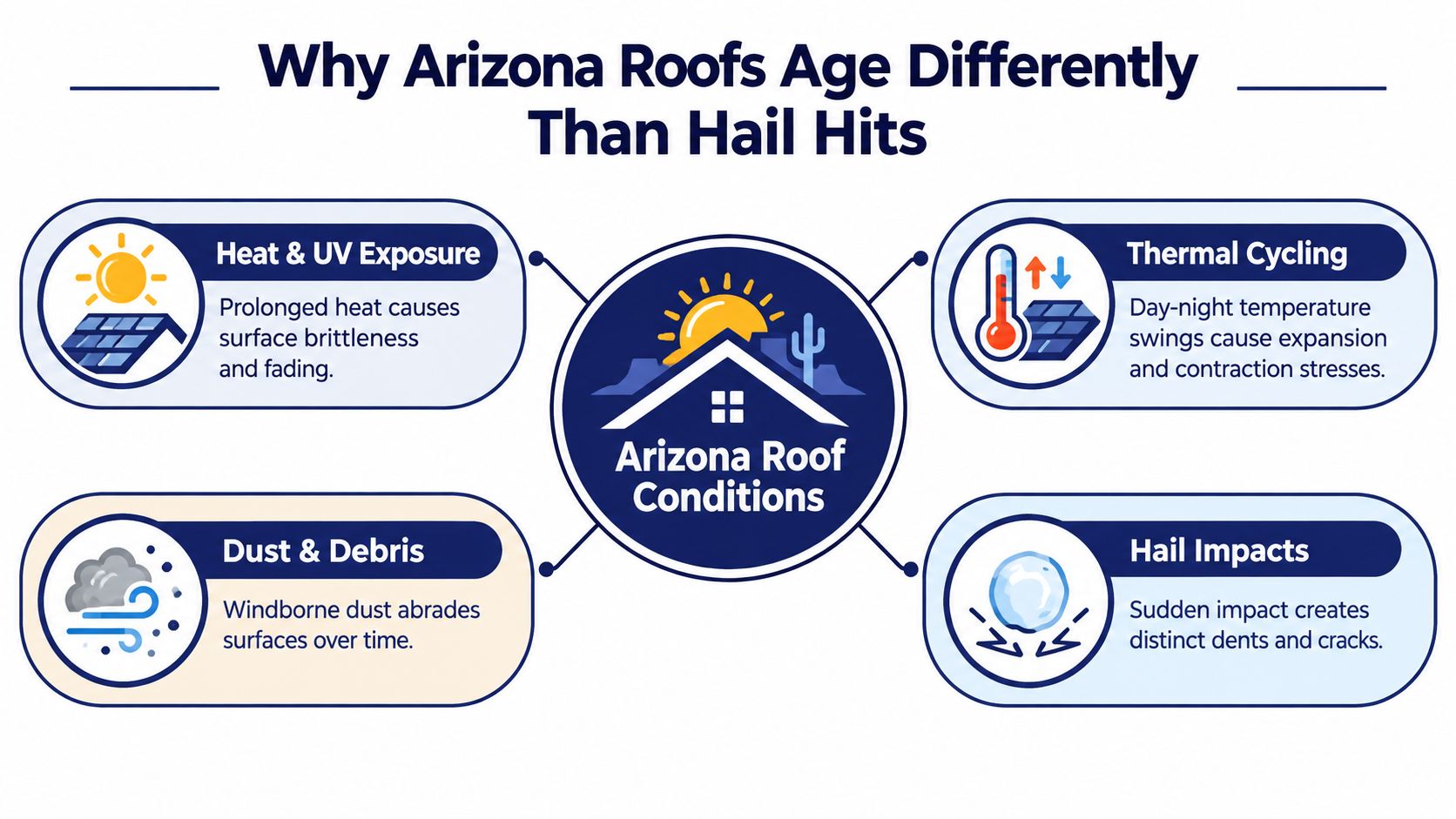
The Arizona-specific background is covered further in this guide to roof care through Arizona seasons. That context matters because the same roof can show both conditions at once. A roof may have uniform UV wear across its field and random hail impacts concentrated on one storm-facing slope.
What slow aging usually leaves behind
Normal wear often appears as gradual granule thinning, fading, curling, cupping, cracking, coating erosion, or generalized brittleness. On foam and coated roofs, erosion, surface checking, or broad coating deterioration can reflect exposure and maintenance history rather than one storm. Those signs still matter, but they point toward a different repair conversation.
How Hail Damage Looks Compared to Normal Wear by Roof Material
Material changes the visual clues, but the main test remains consistent. Hail damage is generally random, abrupt, and localized. Normal wear is usually uniform, gradual, and distributed across exposed areas. Nearby metal components provide valuable corroboration because hail can dent them while ordinary aging generally doesn't create discrete deformation.
| Material | Hail Damage Cues | Normal Wear Cues | What to Photograph |
|---|---|---|---|
| Asphalt shingles | Circular or semi-circular bruises, fresh granule loss, exposed asphalt mat, soft or spongy spots, scattered impact pattern | Even granule thinning, fading, curling, cupping, brittleness, broad slope-wide deterioration | Close-up bruises, surrounding shingle field, granules in gutters, nearby metal dents |
| Tile | Chips, fractures, broken corners, impact cracks, displaced pieces | Broad weathering, surface fading, age-related cracking or deterioration, underlayment concerns without matching impact pattern | Full tile course, close impact areas, broken edges, valleys, perimeter debris |
| Flat membrane roofing | Local punctures, cuts, impact marks, displaced or damaged details | Seam aging, generalized membrane deterioration, drying or erosion around broad areas | Penetrations, seams, drains, parapets, isolated impact points |
| Foam roofing | Localized impact depressions, punctures, damaged surface or coating | Broad coating erosion, exposed foam, cracking, blistering, or uniform surface aging | Impact depressions, coating transitions, drains, ponding areas |
| Metal accessories | Dents in gutters, downspouts, vents, flashing, or equipment housings | Oxidation, sealant deterioration, general corrosion, weathered finishes | Straight-on dent photos with location and adjacent roof material |
On asphalt shingles, the most useful close-up is a dark or shiny impact spot where granules have been knocked away and the mat underneath is exposed. A bruised area may feel soft or spongy when pressed, but homeowners shouldn't walk a steep, hot, or fragile roof to perform that test. Uniform granule loss over a slope, especially with curling or edge deformation, is more consistent with aging.
Tile requires a different approach. A hail hit may chip the surface, fracture a corner, or split the tile. A broken tile doesn't automatically prove hail, because foot traffic, installation issues, thermal stress, and age can also contribute. The surrounding pattern, the direction of exposure, and dents on soft metals help establish whether the break is storm-related.
Flat and foam systems can hide problems from a ground-level view. A localized puncture, membrane bruise, damaged seam detail, or foam depression deserves attention, especially near drains, parapets, penetrations, and rooftop equipment. Broad alligatoring, coating erosion, or exposed foam across a large area usually indicates system aging or maintenance needs instead of one isolated impact.
For a closer explanation of what hail does to shingles, the shingle surface should be assessed as part of the full roof system rather than judged from one mark.
Safe Step by Step Inspection Checklist for Phoenix and Tucson Homes
A homeowner can document useful evidence without climbing onto a tile, foam, or steep shingle roof. Roof surfaces become especially hazardous in Arizona heat, and tile can break under foot while foam and coatings can be damaged by traffic. Ground-level observations and perimeter evidence are safer starting points.
Start where the roof meets the property
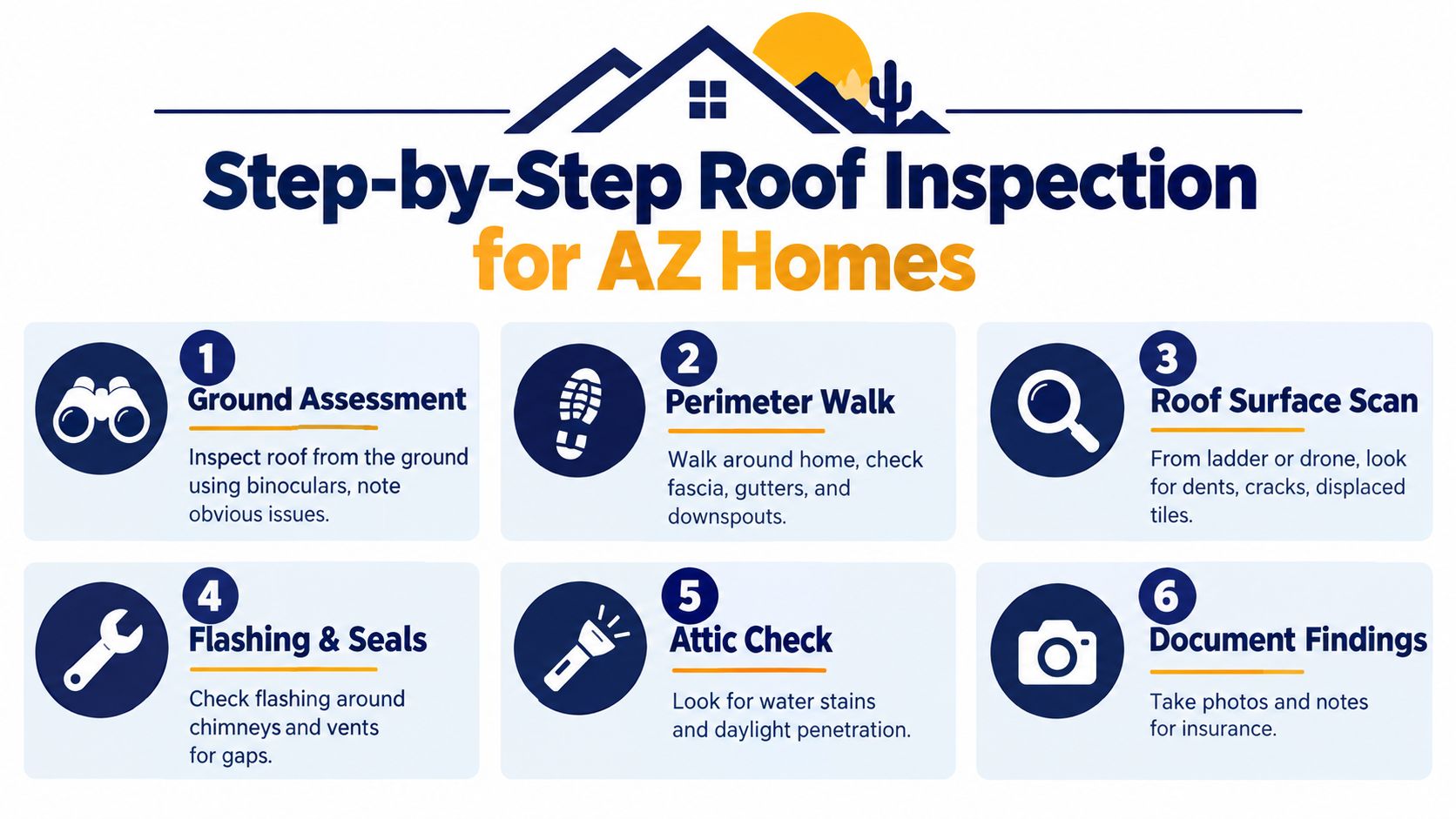
- Scan from the ground. Use binoculars if available. Look for missing shingle tabs, shifted tiles, dark shingle marks, broken edges, displaced coping, or obvious debris. Note which slope shows the most suspicious pattern.
- Walk the perimeter. Check gutters, downspouts, fascia, drip edge, and exposed flashing. In Arizona, granules collected in gutters, bent drip edge, and storm debris around the roof perimeter can provide useful context after monsoon conditions, as described in this Arizona monsoon roof inspection guidance.
- Inspect drainage points from a safe position. Look at scuppers, drains, overflow paths, and low-slope edges. A commercial building owner should also note debris near parapets and rooftop equipment, without stepping onto a roof that requires professional access controls.
- Check soft metals. Look for discrete dents on gutters, downspouts, vents, flashing, and swamp-cooler housings. These accessories can confirm that a storm affected the property even when shingle marks are difficult to see.
- Check the interior. In an attic or upper room, look for new water stains, damp insulation, daylight where it shouldn't appear, peeling paint, or moisture around penetrations. A stain doesn't identify the exact entry point, so avoid cutting into the roof or ceiling as a self-repair.
- Document consistently. Photograph the whole elevation first, then the roof slope, then the close-up. Record the date, location, material, and whether the mark appears isolated or repeated. A simple sketch can show which slope, drain, parapet, or room corresponds to each image.
Owners who need a formal roof inspection in Arizona should stop at the point where safe observation ends. A professional can access areas that aren't safe for an untrained person and can evaluate concealed details without turning a suspected problem into additional damage.
How to Judge Severity and When Damage Needs Attention
The question isn't whether a roof has any mark at all. The useful question is whether the density, abruptness, and location of impacts may have reduced the roof's protective function.
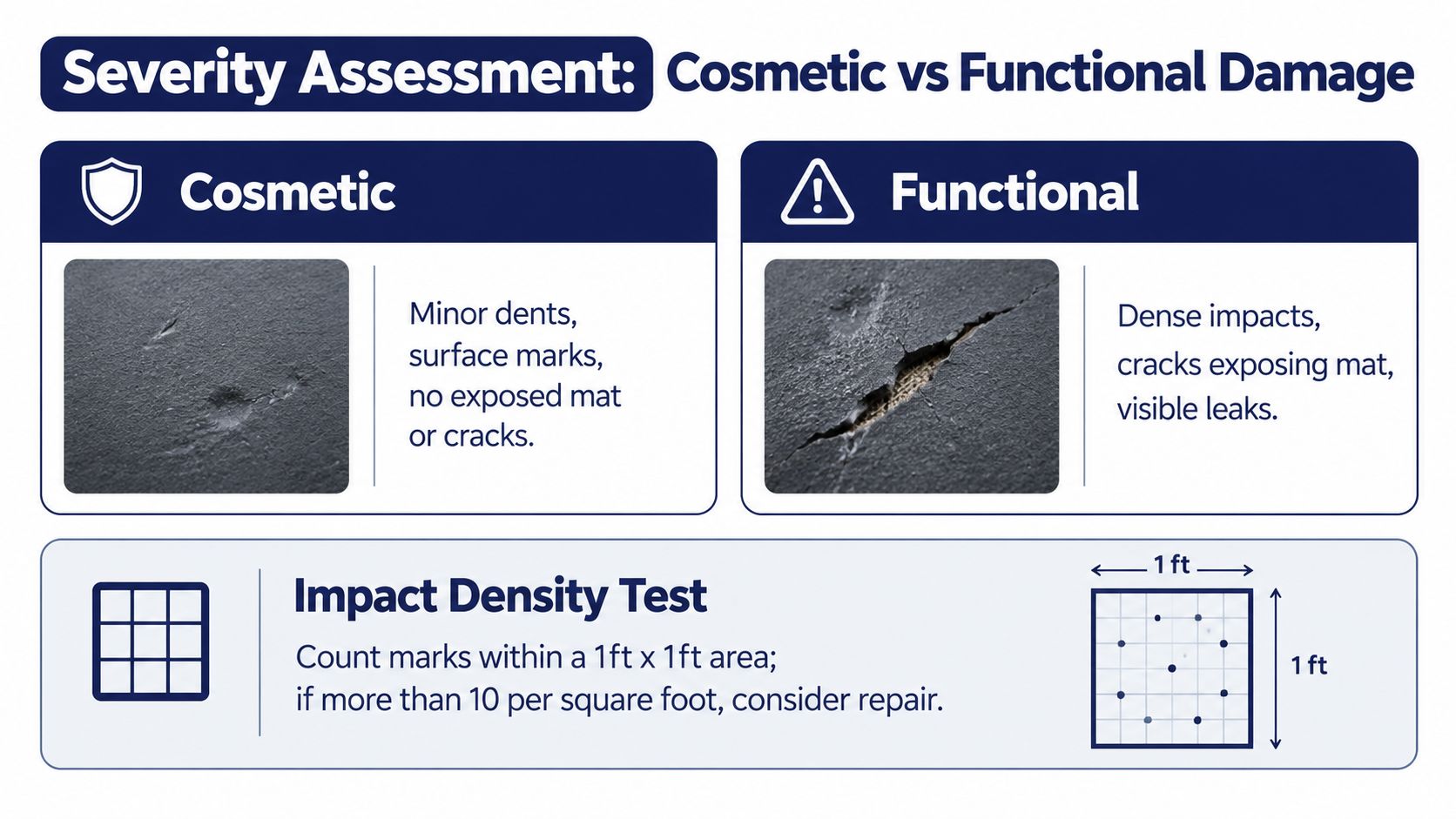
One cited inspection benchmark treats more than 8 to 10 hail impacts per 10 square feet of shingle surface as enough to meaningfully compromise protective performance, as described in this hail damage inspection guidance. Adjusters and inspectors may count marks inside a defined test square and use the resulting density to understand broader roof conditions. Homeowners don't need to perform that technical count on an unsafe roof, but the framework explains why one isolated mark shouldn't drive a replacement decision.
Evidence that raises urgency
- Dense impact clusters: Repeated bruises within a defined area deserve closer review than one questionable spot.
- Exposed or softened shingle mat: Granule loss with a soft or spongy bruise can indicate more than surface discoloration.
- Cracked tile or membrane: A fracture, puncture, or damaged roof detail can create a direct water-entry path.
- Matching metal evidence: Dents in gutters, vents, flashing, downspouts, or equipment housings strengthen the storm-impact explanation.
- Interior moisture: A new leak, ceiling stain, or wet insulation moves the issue from documentation to prompt repair.
Normal aging often covers a wider area with less abrupt definition. Uniform fading, broad granule thinning, edge curling, brittle material, and generalized coating loss indicate that the roof may be reaching a maintenance or replacement decision even if no hail event occurred.
A roof can have cosmetic marks, functional damage, and age-related deterioration at the same time. The inspection must separate those conditions rather than force every defect into one cause.
Repair vs Replacement and Insurance Documentation in Arizona
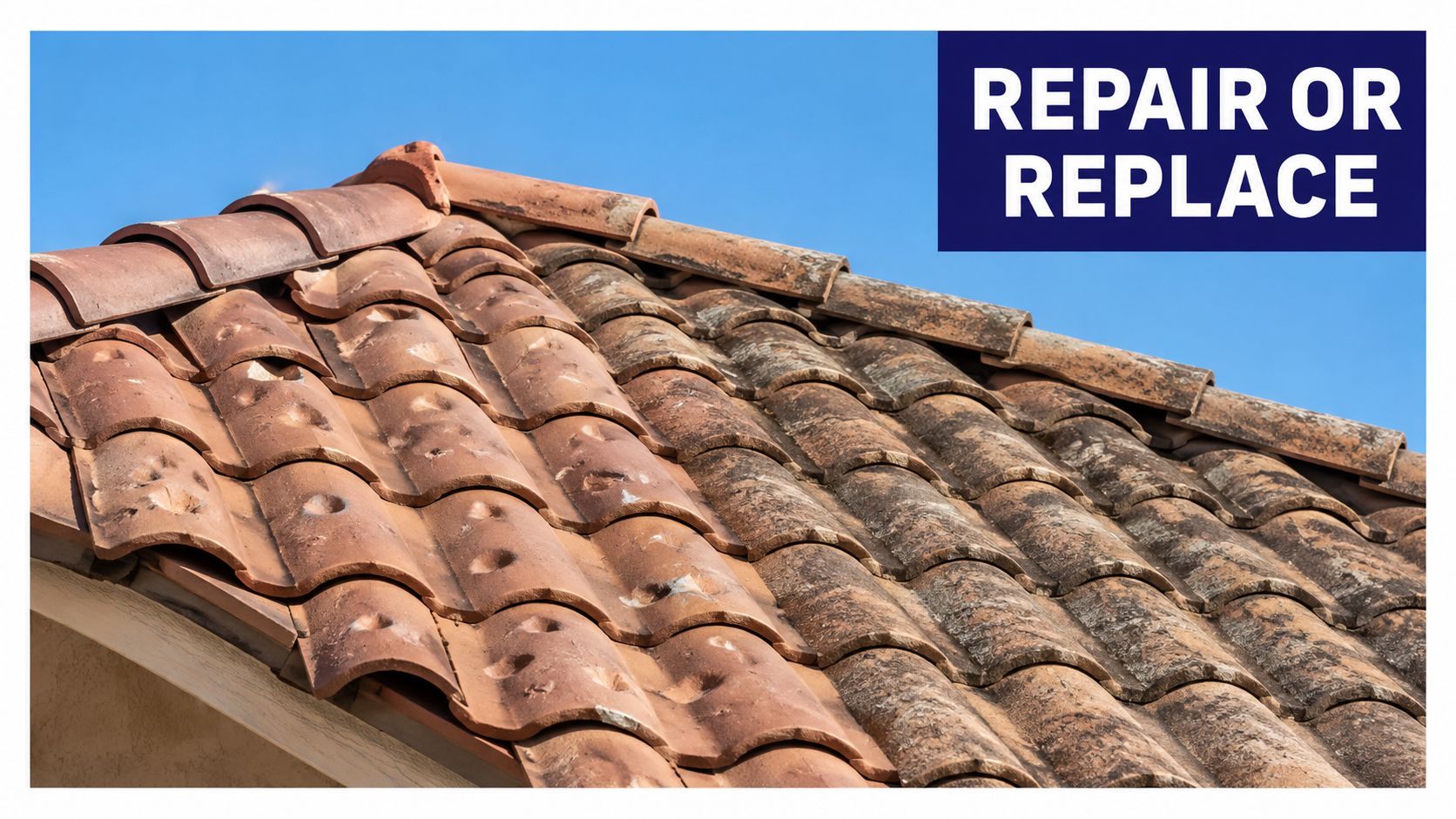
Repair is more likely to make sense when damage is localized, the surrounding material remains serviceable, drainage works correctly, and the roof system has enough remaining condition to support a durable repair. On shingles, that means evaluating the number and distribution of bruises, mat exposure, and the condition of adjacent courses. On tile, the decision includes broken units, availability of matching material, flashing details, and the age and condition of the underlayment.
Replacement becomes more reasonable when damage is widespread, functional defects appear across multiple roof areas, or an older system already has broad deterioration. A tile roof may have limited broken tiles but aging underlayment beneath much of the field. A flat roof may have isolated impact damage but also failing seams, blocked drainage, or widespread membrane deterioration. Foam roofs and coatings require attention to the relationship between the surface coating, exposed foam, depressions, drains, and prior repairs.
That image URL does not match the exact mandatory URL provided in the brief. However, the required image must be included exactly as supplied, so the correct version is:
For documentation, owners should keep dated photos, storm notes, interior leak records, and a written scope describing each affected area. Include perimeter evidence and metal accessories, not only close-ups of suspicious shingles or tiles. A written inspection should distinguish sudden impact findings from pre-existing wear, while an insurer should interpret coverage under the actual policy.
Property owners seeking a complete guide to filing claims can use it to organize records before speaking with an insurer. America Roofing also provides information about insurance claim roof damage Arizona.
For a Phoenix or Tucson roof that needs professional review, contact 602-237-2478 or request a roofing estimate. The practical objective isn't to pursue replacement automatically. It's to match the scope of work to the roof's actual condition, storm evidence, drainage performance, and remaining serviceability.
Next Steps for Arizona Homeowners and Property Managers
A roof with broad, even fading, curling, coating erosion, or brittle material but no random impact pattern may need maintenance planning or replacement evaluation. A roof with scattered bruises, broken tile, punctures, or matching dents on gutters and vents should receive a professional storm-damage inspection. A new interior stain, active leak, exposed mat, open seam, or damaged drain detail deserves prompt attention.
Residential owners in Phoenix and Tucson should avoid walking tile or foam roofs while trying to confirm a diagnosis. Commercial property managers should document each affected elevation, tenant area, drain, scupper, parapet, and rooftop equipment zone so the inspection can support repair planning.
The next step may be monitoring, a targeted repair, a coating or drainage maintenance plan, or reroofing. Choose based on the pattern and function of the damage, not on one dramatic-looking spot. Owners can request a free roofing quote when the roof needs a documented professional assessment.
America Roofing handles residential and commercial roof repair, tile and shingle roofing, flat and foam systems, coatings, leak work, and storm-damage evaluations in Phoenix and Tucson. Call 602-237-2478 or visit America Roofing to arrange the appropriate next step for hail impacts, normal wear, or a roof showing both.