
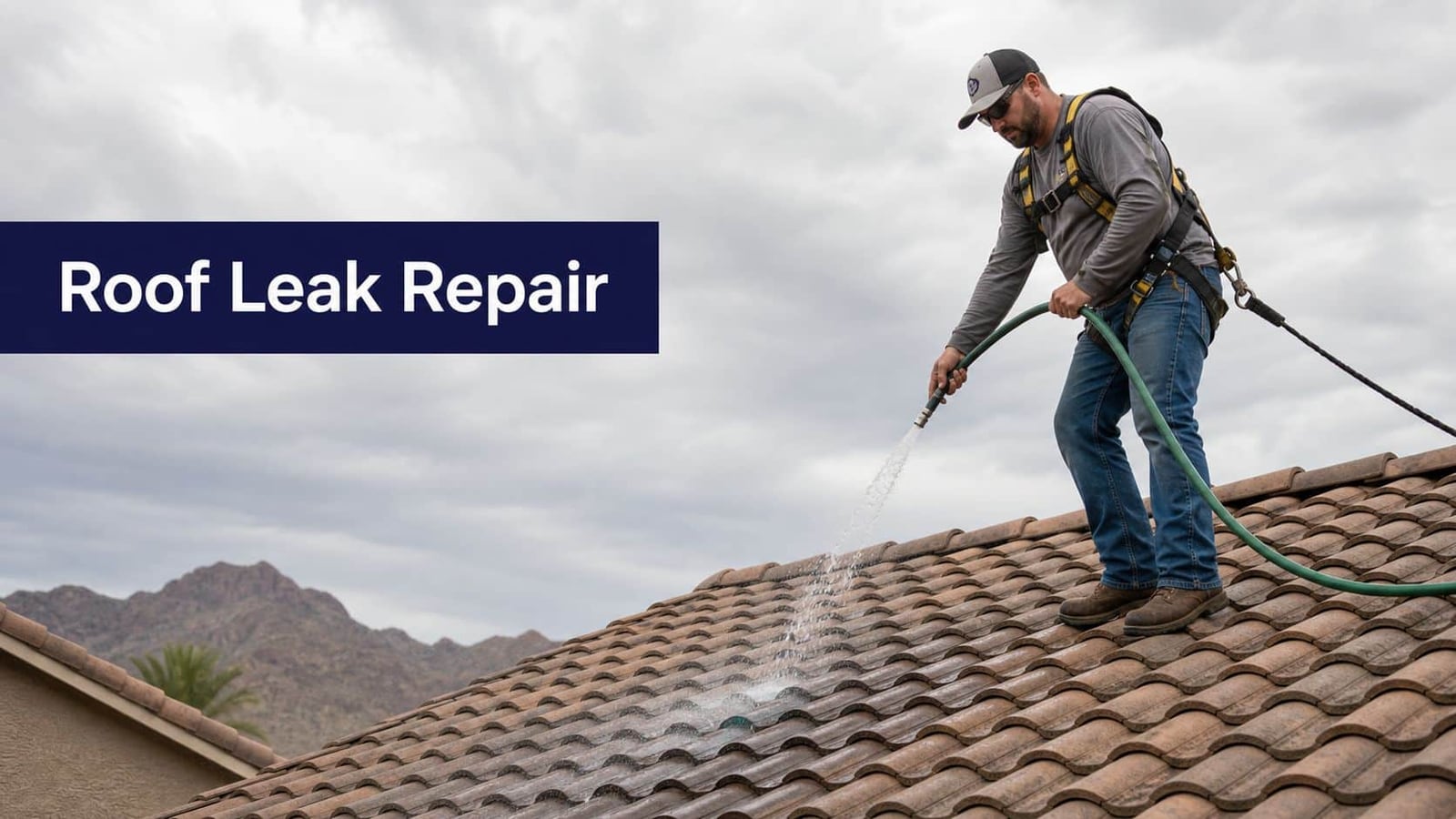
A lot of roof leak repair calls in Phoenix and Tucson start the same way. A stain shows up after a monsoon storm, the drip seems small, and then the water turns out to be entering somewhere else entirely. Arizona roofs fail differently than roofs in milder climates because heat, UV, dust, and wind-driven rain work together, not one at a time.
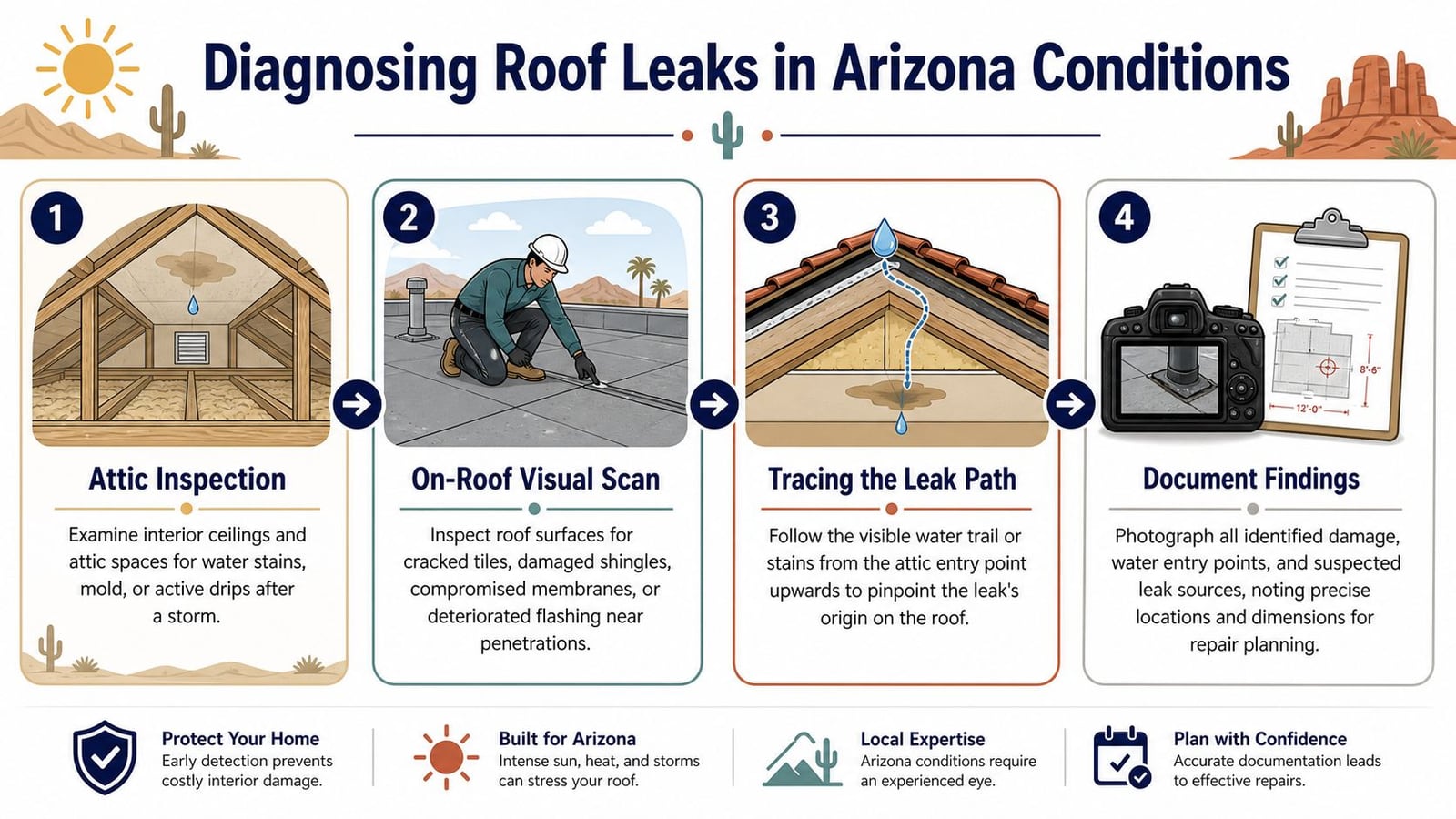
Diagnosing Roof Leaks in Arizona Conditions
A ceiling stain after a summer storm doesn't automatically mark the leak source. On tile, shingle, flat, and foam roofs, water often travels before it drops into the attic or living space. That's why a good diagnosis starts inside, then moves outside in a controlled way.
Start in the attic and map the leak
The first job is to locate the highest visible sign of water inside the attic or ceiling cavity. Look for darkened decking, damp insulation, active drips, and staining around penetrations such as vents, skylights, or chimney framing. In Arizona homes, wind-driven monsoon rain can push water sideways, so the entry point may be uphill or lateral from the stain.
A practical way to tighten the search area is to measure the wet mark from two fixed exterior reference points, usually the ridge and a gable wall. Those measurements can then be transferred to the roof exterior to create a target area before any materials are disturbed. Homeowners who want a deeper walkthrough can also review how to find hidden water leaks in Arizona.
The inspection flow is easier to follow when it's documented clearly:
Use a controlled water test, not random spraying
The most reliable method for irregular leaks is the controlled garden-hose test. According to this roof leak testing method, the process starts at the eaves and moves upslope in strict five-minute intervals while an assistant watches the attic for the first drip. Done correctly, it can isolate the leak to within a single shingle course or two.
Practical rule: Randomly soaking the whole roof wastes time and hides the leak path. Controlled testing narrows the problem instead of smearing water across every possible entry point.
On tile roofs, the visible tile may not be the failed component. The trouble is often underlayment at a valley, flashing at a wall, or a penetration above the stain. On shingles, look for lifted tabs, exposed fasteners, and transitions where roof planes meet vertical walls. On foam and low-slope roofs, scan seams, drains, parapet intersections, and patched areas where dust or standing dirt may have masked a split.
For homeowners who want another plain-language walkthrough, this guide to finding roof leaks for homeowners helps explain how leak paths can drift away from the interior stain.
- Check transitions first: Flashings at chimneys, skylights, walls, and vents are common failure points.
- Watch wind direction: If the storm pushed rain against one elevation, inspect that side harder.
- Don't tear off broad areas early: Arizona roofs often have one failed detail causing a much larger stain pattern.
- Document everything: Photos, measurements, and timestamps make later repair decisions cleaner.
Performing Temporary and Emergency Repairs
When water is actively entering the house, the goal changes. Temporary work is about limiting interior damage until the roof can be dried, inspected fully, and repaired the right way.
What a short-term patch can do
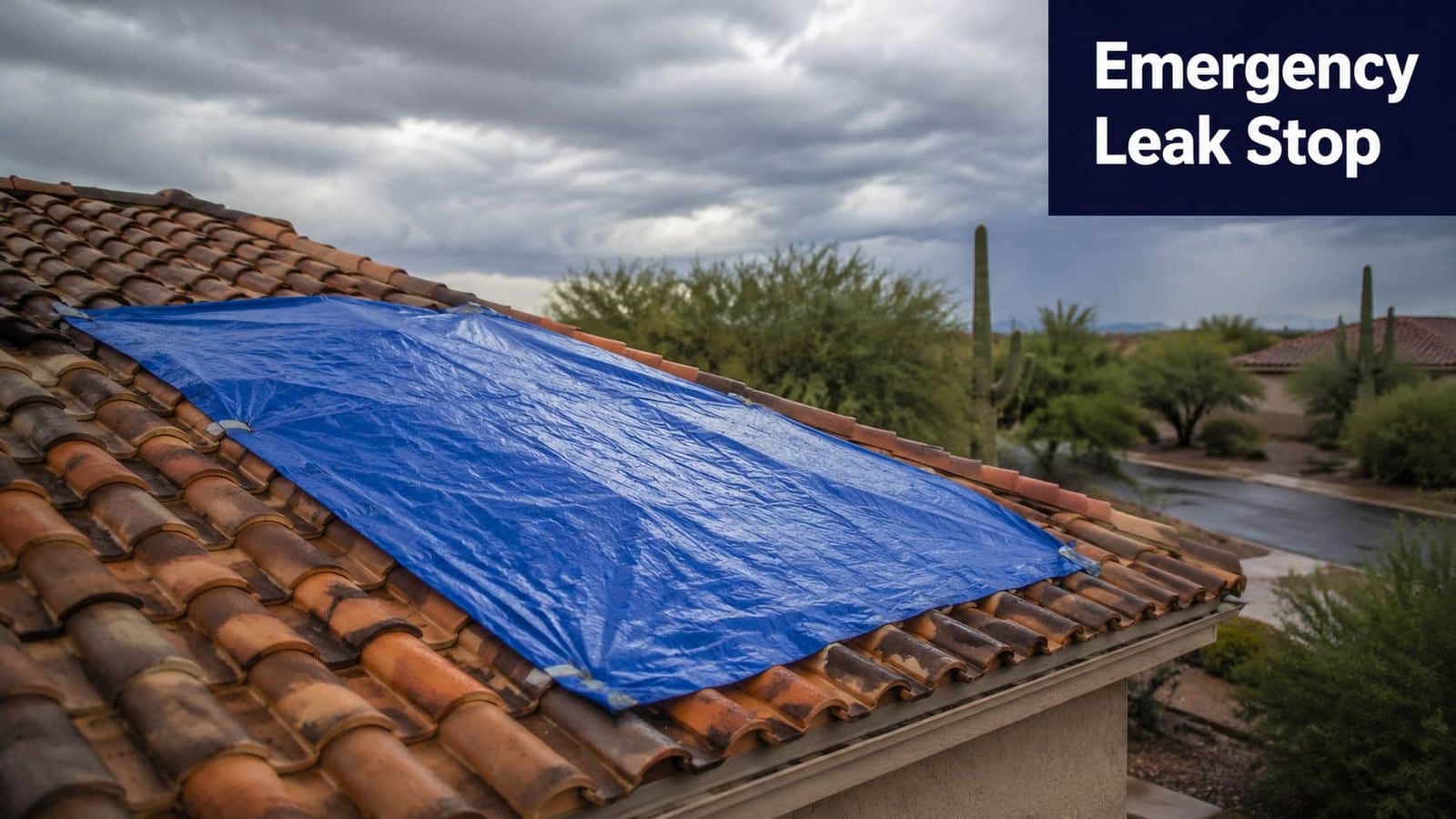
A tarp over a damaged slope can divert water for the moment. On flat and foam sections, a limited patch may slow intrusion around a split or puncture. Inside the building, buckets, towels, and moving furniture out of the drip path matter just as much as what happens on the roof.
The key limit is simple. A temporary patch isn't a permanent roof leak repair. Arizona sun breaks down quick fixes fast, and monsoon winds can pull loose materials back open.
A patch that survives one storm may still fail on the next hot afternoon if the surface was dirty, chalky, or unstable.
What homeowners can do safely
Some steps are reasonable if the roof can be reached safely and the weather has calmed:
- Use a tarp on sloped roofs: Cover the suspected entry area and extend past it so water sheds over the patch, not under it.
- Protect flat sections carefully: If a flat roof has a small obvious opening, a short-term patch can help, but the area has to be stable and dry enough to hold it.
- Work with a second person: One person handles materials while the other watches footing and ladder position.
- Avoid creating new holes: Fastening methods that add penetrations can turn one leak into several.
For low-slope trouble spots, this America Roofing flat roof advice gives practical direction on what can wait and what needs immediate professional attention.
What doesn't work
Emergency leak calls often involve failed shortcuts:
- Smearing product over wet surfaces: Bonding fails quickly when moisture is trapped.
- Patching without cleaning: Dust, granules, and debris keep materials from sealing.
- Standing on fragile tile fields: One misplaced step can crack surrounding tiles and widen the repair area.
- Ignoring interior drying: Roof leaks don't stop at the ceiling stain. Wet insulation and framing need attention too.
Permanent Repair Techniques for Common Roof Types
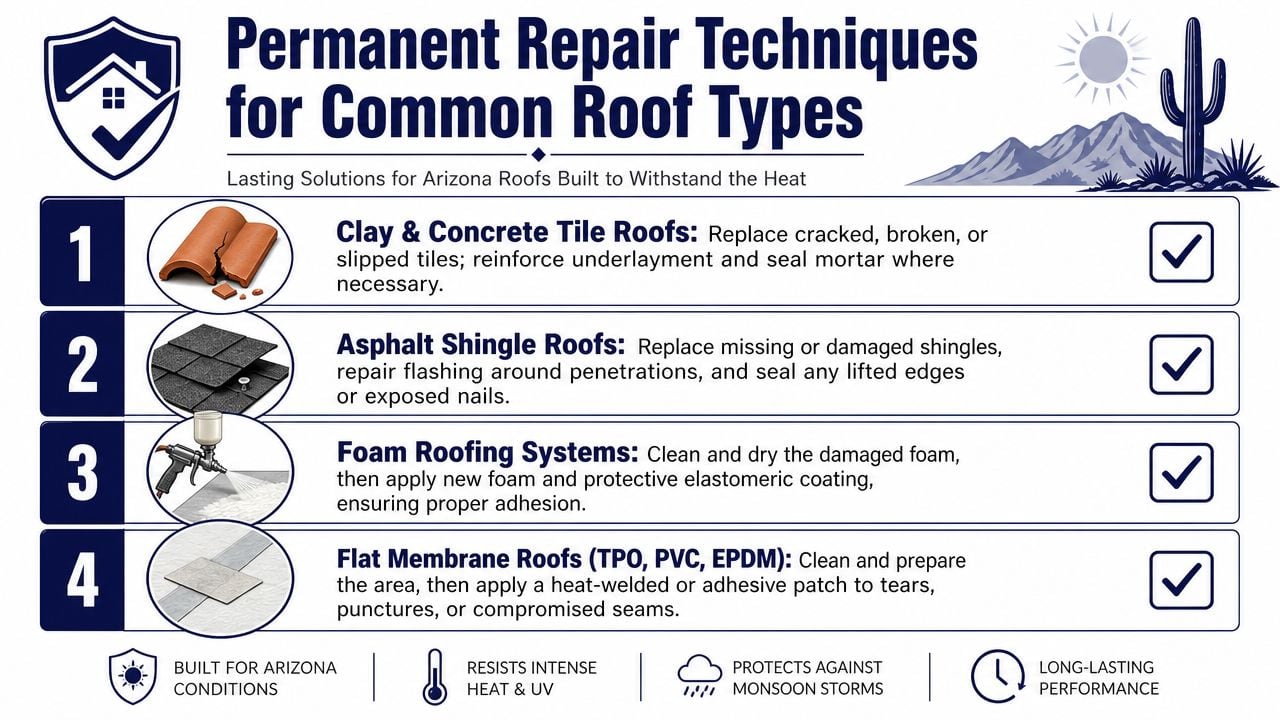
Permanent roof leak repair depends on the roof system, not just the visible symptom. Arizona roofs see prolonged UV exposure, thermal movement, dust buildup, and sudden storm loads. That means the lasting fix usually involves rebuilding the failed detail, not coating over it.
Tile and shingle repairs
Tile roofs need careful sequencing. The broken or slipped tile is removed without damaging adjacent pieces, then the underlayment, batten area, and flashing below are checked before the tile is reset or replaced. If the leak came from a wall intersection or penetration, the tile may be fine and the underlying repair may sit underneath it.
Shingle roofs are more direct, but they still punish rushed work. Lifted or damaged shingles need replacement, exposed nail heads need protection, and any failed flashing detail has to be corrected at the same time. If the repair only addresses the field shingle and ignores the transition metal, water usually returns.
According to this repair guidance on lasting leak fixes, permanent repairs need a 24-to-48-hour verification window after application, and a major failure point is incomplete flashing re-caulking around penetrations like chimneys and dormers. Hardened or cracked caulk needs to be fully removed and replaced with new silicone caulk for a lasting seal.
Foam and flat roof repairs
Foam roofs need a clean, dry substrate before patching. The damaged area is trimmed back to sound material, the surface is dried, and the patch is built so the repaired area sheds water instead of creating a lip that catches it. In Arizona, UV exposure can leave old foam brittle or chalky, so edge preparation matters as much as the patch material.
On flat membrane roofs, the first question is whether the issue is a puncture, seam failure, perimeter flashing problem, or drainage-related stress. Commercial property managers in Phoenix and Tucson see this often around parapets, rooftop equipment, and transition details. A clean patch on the membrane alone won't hold if water is backing up at a drain or entering at the wall line.
Field note: On low-slope roofs, the repair has to match the way water actually moves across the roof, not the way the stain appears inside the unit.
The repair sequence that holds up better
Different systems require different materials, but the basic sequence is consistent:
- Expose the true failure area: Remove only what's needed to reach sound material.
- Dry and clean the substrate: Dust, moisture, and residue shorten repair life.
- Rebuild the transition detail: Underlayment, flashing, sealant, and surface material have to work together.
- Verify after curing: A repair that looks sealed on day one still needs follow-up confirmation.
This is also where one service option may matter. For homeowners or property managers who need help with residential or commercial leak response in Phoenix or Tucson, America Roofing handles roof repair, flat roofing, foam roofing, coatings, and leak-related service work within those Arizona conditions.
When to Call a Professional and Insurance Tips
Some leaks are manageable for short-term mitigation. Others need a licensed roofer immediately because the problem isn't one cracked tile or one split seam. Arizona storms can expose multiple weak points in the same event, especially at perimeters, penetrations, and aging transitions.
Signs the repair is beyond DIY
A professional should step in when the leak path is unclear, the roof is steep, the surface is fragile, or the failure may involve underlayment, flashing, decking, or widespread low-slope issues. Commercial roofs also deserve faster escalation because one leak can spread across insulation, tenants, inventory, or equipment before it becomes visible below.
The contractor itself matters. For Arizona roofing work, contractors must hold an active Arizona Registrar of Contractors license, and manufacturer certifications can support stronger warranty coverage on repairs and replacements.
DIY vs Professional Repair Criteria
Keep the claim file simple. Date-stamped photos, written notes on where the water appeared, and photos of damaged contents are more useful than a pile of vague pictures with no context.
Documentation that helps claims move
Homeowners and building managers should photograph the stain, attic or ceiling evidence, the exterior area if visible, and anything affected below the leak. Save notes on when the leak appeared, whether wind-driven rain was involved, and whether the water returned in later storms. If claim help is needed, this resource from America Roofing for roof insurance claims explains the documentation side in practical terms.
Cost and Timeline Expectations for Leak Repairs
Arizona owners usually want two answers right away. How much is this likely to cost, and how fast can it be handled before the next storm arrives.
What can be priced clearly
For immediate leak response, there is at least one local benchmark. In Phoenix, emergency roof leak repair typically ranges from $250 to $600. That range usually reflects access, roof type, the size of the visible issue, and whether the job is a short-term emergency response or part of a larger permanent repair plan.
That number shouldn't be stretched into a universal repair price. A simple patch on an accessible surface is one thing. A leak tied to tile underlayment, parapet flashing, foam deterioration, or commercial drainage conditions is a different scope entirely.
What affects the timeline
Scheduling moves faster when the leak is isolated, the roof can be accessed safely, and materials are straightforward. It slows down when storms stack up, multiple units are affected, or the first visible leak turns out to be one of several failure points. During monsoon season, even a small repair can take longer if wet conditions prevent proper drying and verification.
A few factors usually control the timeline more than owners expect:
- Roof type: Tile and low-slope systems often require more careful diagnostics than a simple exposed shingle issue.
- Surface condition: Dust, residual moisture, and UV-brittle materials can delay proper adhesion.
- Access constraints: Multi-story buildings, parapets, and occupied commercial spaces slow setup and safety planning.
- Scope discovery: Once the area is opened, hidden damage may expand the repair plan.
For a broader breakdown of pricing variables and scope decisions, these tips to save on roof repair are useful before approving the work.
Prevention Maintenance and Next Steps
The cheapest leak is the one that never starts. Arizona roofs age under constant sun, thermal cycling, dust, and sudden storm pressure, so waiting for an interior stain is the expensive way to manage them.
A maintenance rhythm that fits Arizona
Arizona homeowners should schedule roof inspections twice yearly, once before monsoon season in May and again after it ends in October, to catch UV damage, thermal cracks, and wind-lifted shingles before they turn into leaks, as noted in this Arizona inspection schedule. That schedule makes sense for homes and for commercial properties with flat roofs, foam systems, coatings, parapets, and drains that take a beating in summer.
Routine maintenance should stay practical:
- Clear drainage paths: Leaves, dust, and roof debris can slow runoff and hold water where it shouldn't sit.
- Inspect flashings and penetrations: Walls, vent pipes, skylights, and equipment curbs deserve close attention.
- Watch coating and foam surfaces: Cracking, wear, or surface degradation should be reviewed before storm season.
- Check interior signs early: A faint stain, odor, or damp insulation is easier to solve than a saturated ceiling.
Owners who want a usable checklist can review these Arizona roof maintenance tips.
How to decide the next move
If the leak is recent, isolated, and safely reachable, a short-term patch may buy time. If the roof has multiple suspected entry points, recurring leaks, flashing trouble, low-slope drainage issues, or storm-related damage across a wider area, it's time to stop experimenting and get the roof inspected properly.
Preventive home maintenance doesn't stop at the roof. Indoor moisture control matters too, especially after a leak, so homeowners may also find this HVAC advice from Diamond AC & Heating useful for keeping indoor systems from adding to humidity-related problems after water intrusion.
Arizona roof leak repair works best when the sequence is right. Diagnose carefully, protect the interior fast, make only safe temporary moves, and rebuild the failed detail once the roof is dry and the full problem is clear.
If a roof leak has shown up in Phoenix or Tucson, the next step is to get the source pinned down before another storm spreads the damage. America Roofing provides residential and commercial roofing help across Arizona, including leak repair, flat roof work, foam roofing, tile roofing, and storm-related service. Call 602-237-2478 or request a roofing estimate to review the leak, the likely repair path, and whether a targeted fix or broader roof work makes more sense.