
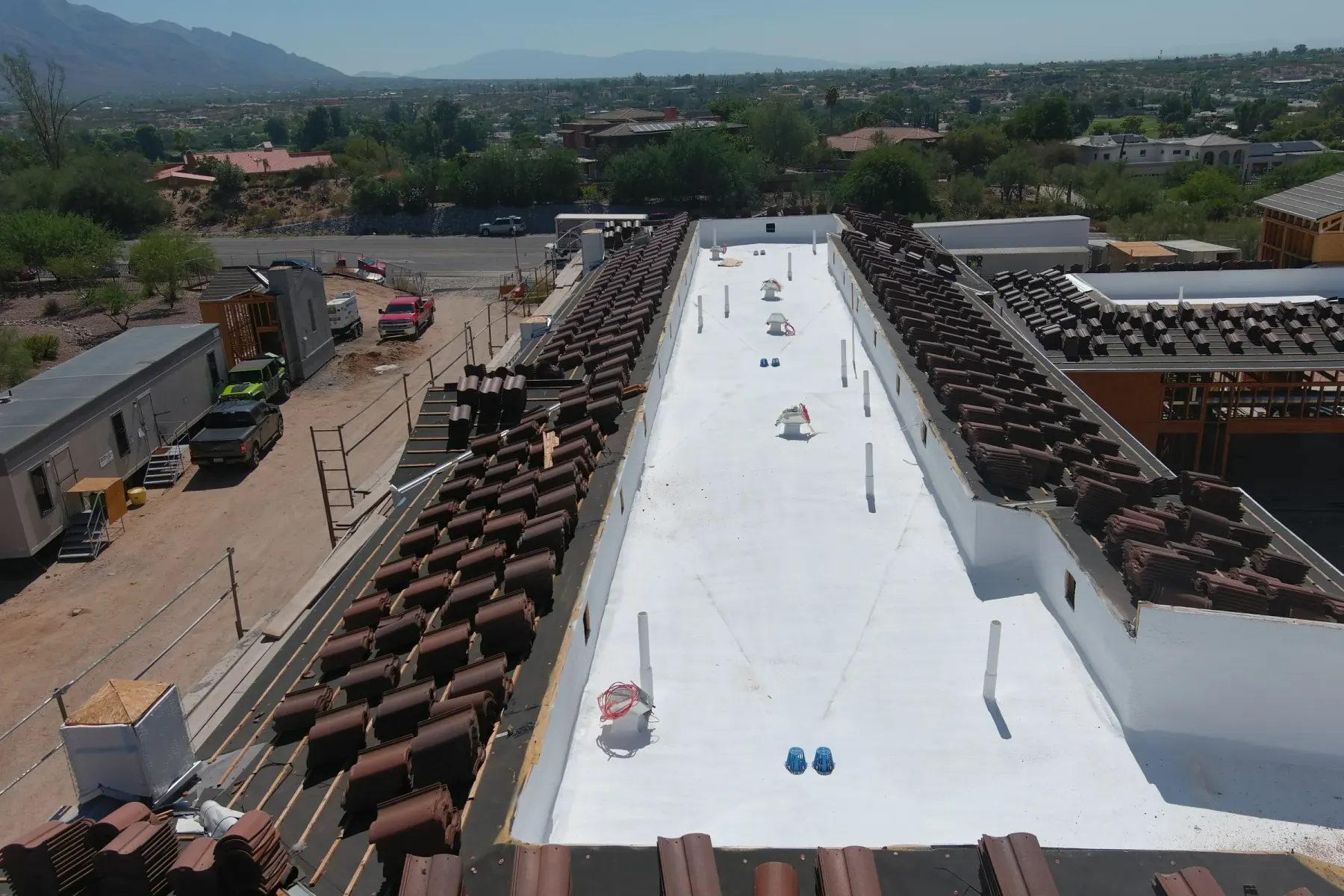
Single-ply is a family, not one product
Single-ply roofing uses membrane sheets as the waterproof covering of a designed low-slope assembly. TPO, PVC and EPDM are different material families, not interchangeable names for the same roof. The insulation, cover board, deck and details still affect the complete system.
These comparisons explain the material families; they do not establish that every product is suitable for, or offered on, every project. Ask which system can be evaluated and quoted for your actual building.
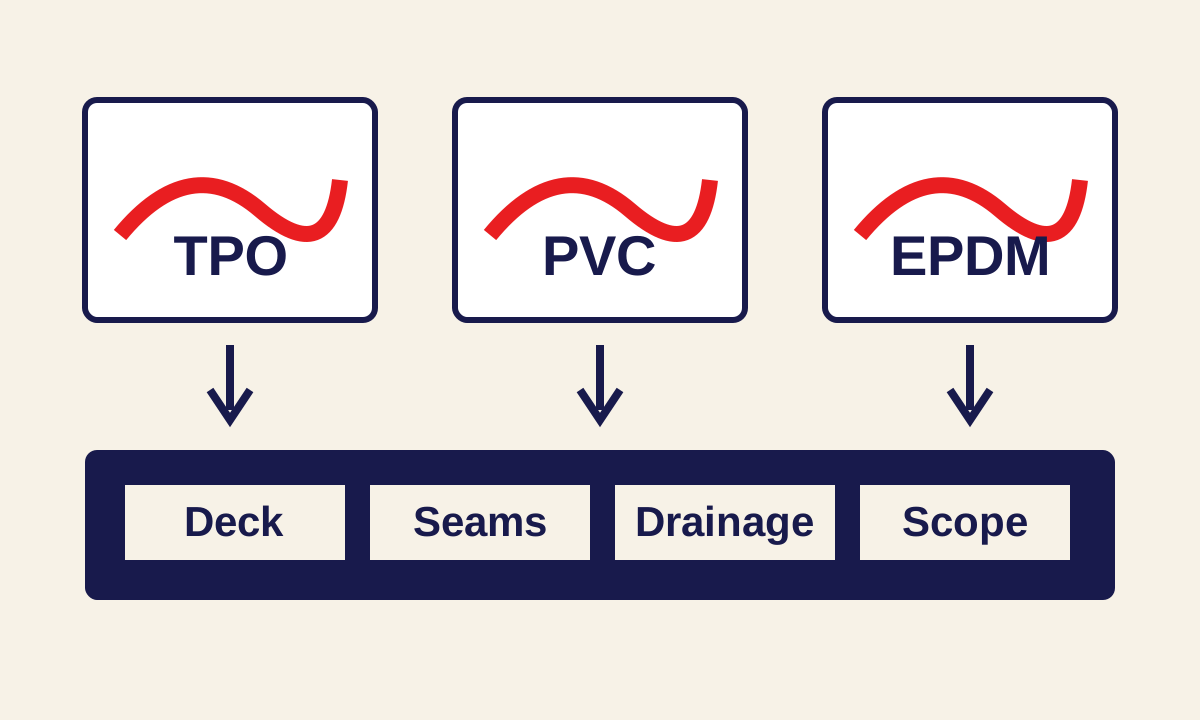
- TPO, PVC and EPDM are distinct material families.
- Each choice needs appropriate seam, flashing and attachment details.
- The complete design must also address the supporting assembly, moisture and drainage.
TPO and PVC thermoplastic membranes
TPO and PVC are thermoplastic membrane families. Their seams are commonly heat-welded using system-specific materials and installation requirements. That does not make one manufacturer’s accessories or repair method suitable for another assembly.
Compare the complete specification: membrane, reinforcement where applicable, attachment, insulation, cover board, flashing components and edge details. Product color or a membrane thickness by itself is not a complete roof design.
EPDM rubber membranes
EPDM is an elastomeric rubber membrane family. Seaming and flashing methods differ from thermoplastic welding and depend on the selected system, approved accessories and preparation. A generic coating or patch is not automatically a compatible repair.
Identify the existing membrane before deciding what can be repaired or recovered. A building may have mixed roof sections or multiple generations of material, and the visible finish can conceal important differences.
Attachment, drainage and roof details
Single-ply assemblies may use adhered, mechanically attached or other approved attachment designs. The deck, wind design, insulation, perimeter, penetrations and building conditions determine the specification. Do not choose an attachment approach from a generic online checklist.
Drains, scuppers, overflow paths, walls, curbs and penetrations are part of the scope. A sound field membrane does not compensate for failed transitions or unresolved drainage. Have structural and design questions addressed by the appropriate qualified professionals.
Comparing repair and replacement proposals
Ask how moisture, insulation condition and prior repairs were evaluated. A repair needs sound surrounding material and compatible components; a recover or restoration proposal needs evidence that the existing assembly is a suitable base.
Compare preparation, removal assumptions, insulation, flashings, edges, drainage, access, protection, discoveries and written warranty terms. Avoid blanket lifespan, seam-warranty or lowest-price claims that ignore the exact assembly and its maintenance requirements.