
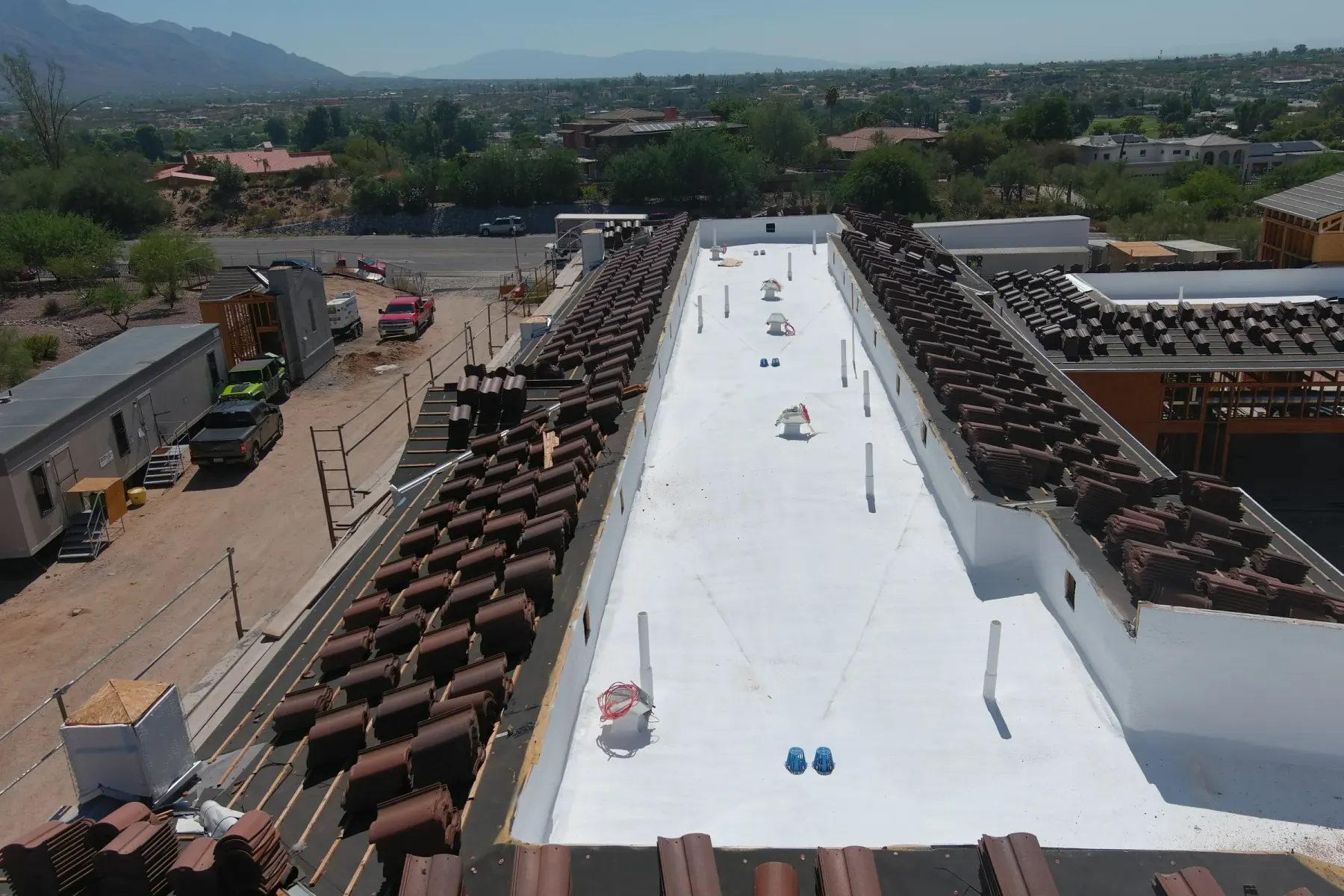
Start with building use and the existing roof
Commercial material selection begins with the assembly, roof geometry and the way the building operates. Retail, office, hospitality and other occupied properties can have different access, protection and scheduling needs even when they share a visible roof material.
Review the existing covering, underlayment, deck, flashings and transitions. A new surface material should not be used to hide unresolved moisture or deterioration below it.
Compare tile, shingles and metal by assembly
Shingles, tile and metal each describe broad groups of products. Compare their actual installation systems, attachment, underlayment, flashings, drainage and maintenance access rather than ranking them by an unsupported universal lifespan.
A covering change can affect structural loading, appearance and junctions with adjacent roof sections. Use an appropriate structural or design review where required; do not presume that a building can accept a heavier material.
Plan around occupants and operations
Ask how the work will protect entrances, vehicles, equipment, pedestrian paths and occupied interiors. Define working areas, access, delivery and staging expectations with the property team before a schedule is agreed.
Noise, weather exposure and any material-specific installation impacts belong in the project plan. Confirm requirements for the proposed system rather than assuming every reroof can proceed with identical disruption or access.
Repair, replace and coordinate adjacent systems
A pitched section may meet low-slope membranes, parapets, walls or rooftop equipment. The proposal should identify who owns those transitions and how water will be directed through the finished assembly.
A repair may be reasonable when the surrounding system remains serviceable. Replacement planning becomes more important when failures are broad or the assembly cannot be integrated dependably. Ask what evidence supports each option.
Evaluate lifecycle cost without a sales promise
Compare the complete initial scope with inspection needs, future access and realistic maintenance planning. A cheaper covering with missing detail work is not directly comparable to a complete system proposal.
Use the selected product’s current written terms, documented preparation and a clear discovery process. Do not rely on archived return-on-investment percentages, blanket warranty claims or a single cost-per-area estimate.