
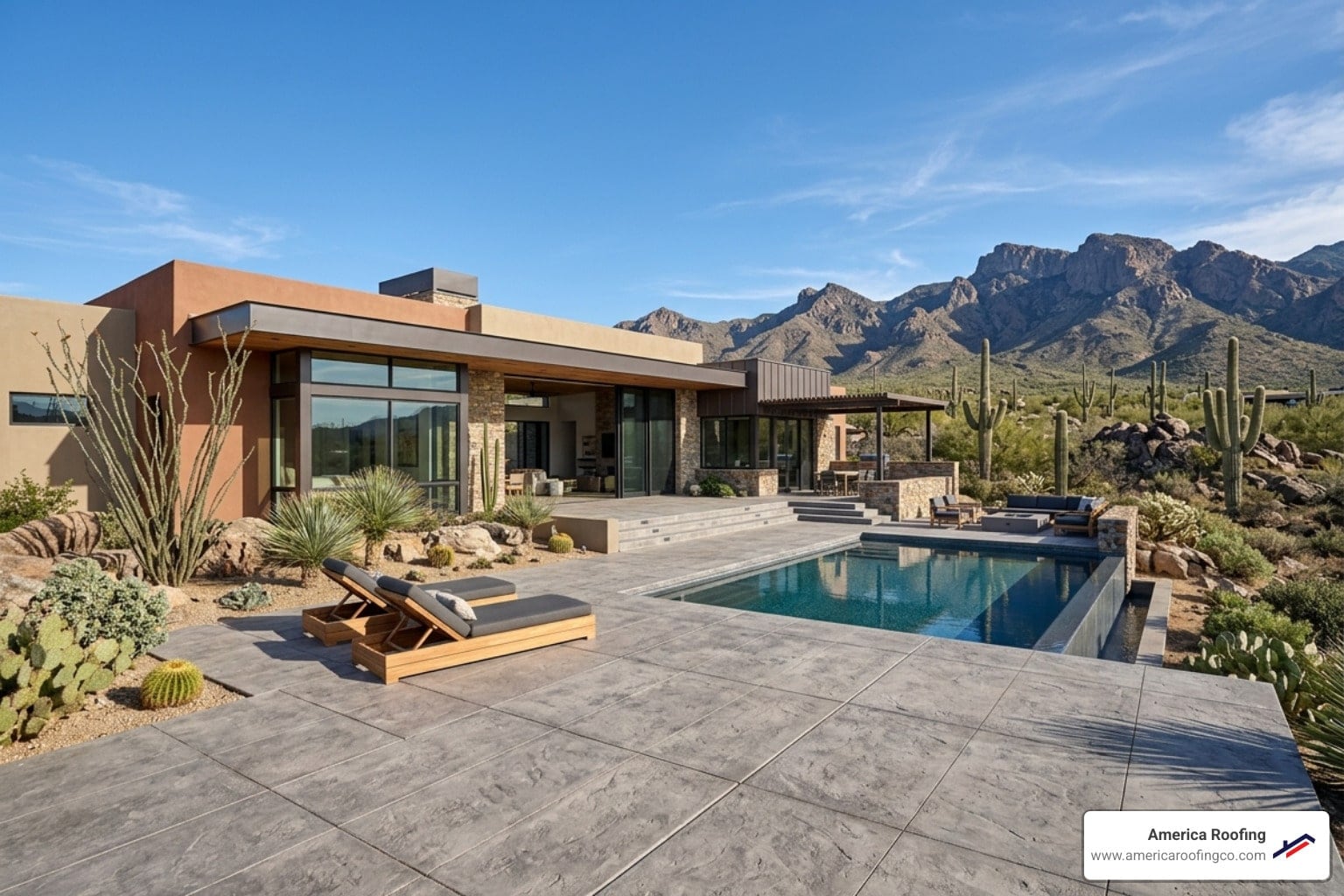
Have you ever wondered why Arizona concrete tile is becoming the go-to choice for homeowners who want to stay cool while maintaining a modern aesthetic? Finding the perfect balance between desert durability and design can be a challenge, but this material offers a rugged solution that stands up to the intense heat. Honestly, it’s the ultimate way to protect your investment while elevating your home's curb appeal.
Introduction
Arizona concrete tile is having a moment — and it's easy to see why. The look is bold, modern, and built for the desert. Whether you want it on your floors, your patio, or your roof, this style delivers serious curb appeal with real-world durability.
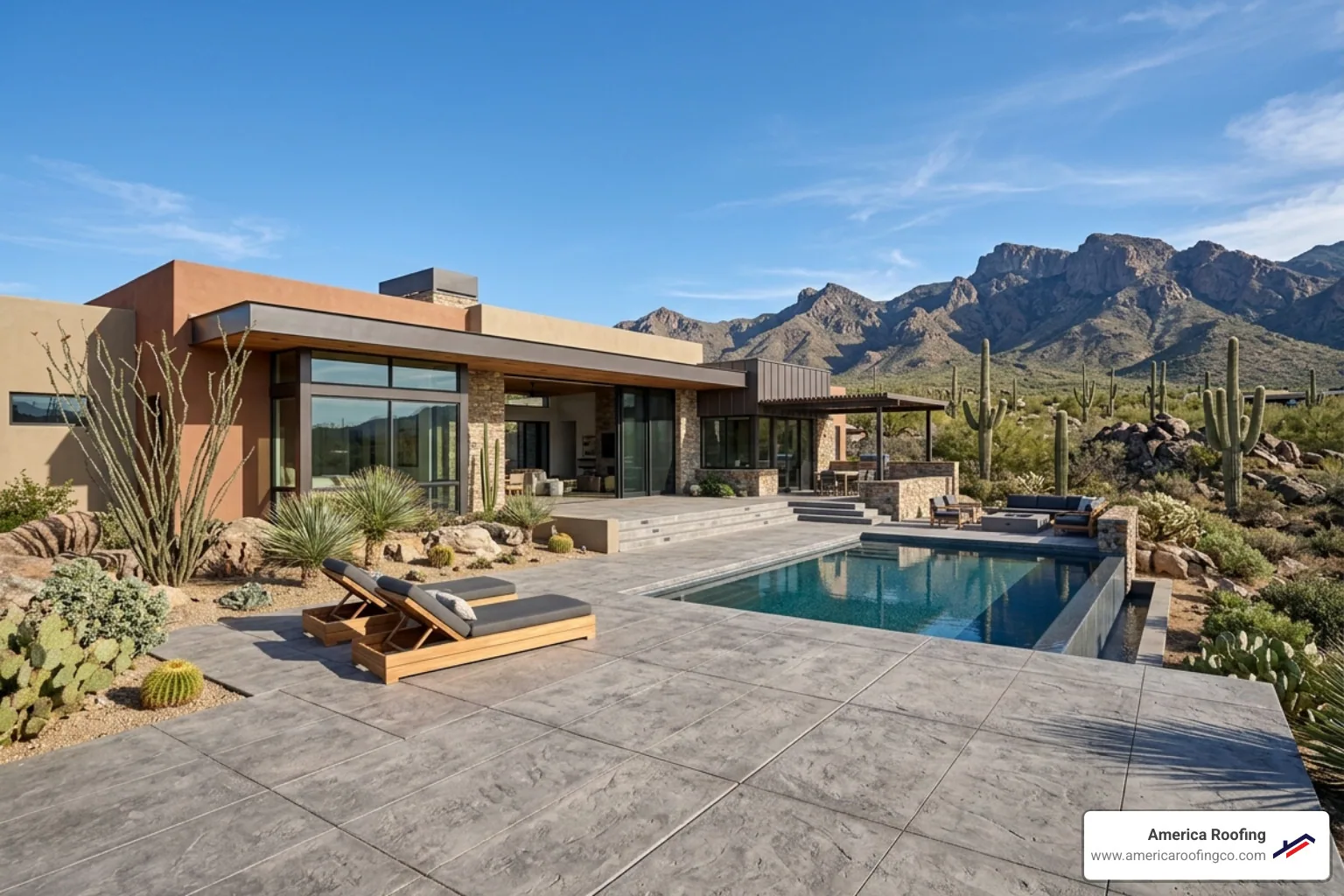
Here's a quick answer to what "Arizona concrete tile" actually covers:
| Type | What It Is | Best For |
|---|---|---|
| Concrete-look porcelain tile | Porcelain made to mimic concrete (e.g., Konkrete, Cemento Cassero) | Floors, showers, patios, pools |
| Concrete roof tile | Actual cement-and-sand tiles for roofing | Residential and commercial roofs |
| Concrete pavers | Durable outdoor paving units | Driveways, walkways, patios |
Both uses share the same rugged aesthetic — but they serve very different purposes and come with different specs, costs, and installation requirements.
Here's the thing: a lot of Arizona homeowners search for "concrete tile" thinking they want one thing, and discover they actually need something else entirely. Someone pinning ideas on Pinterest might fall in love with the industrial-grey floor look, while a homeowner after a monsoon is really looking for a roof that won't crack or fade in 110°F heat.
This guide covers both worlds — the design side and the roofing side — so you can make a confident, informed decision for your home.
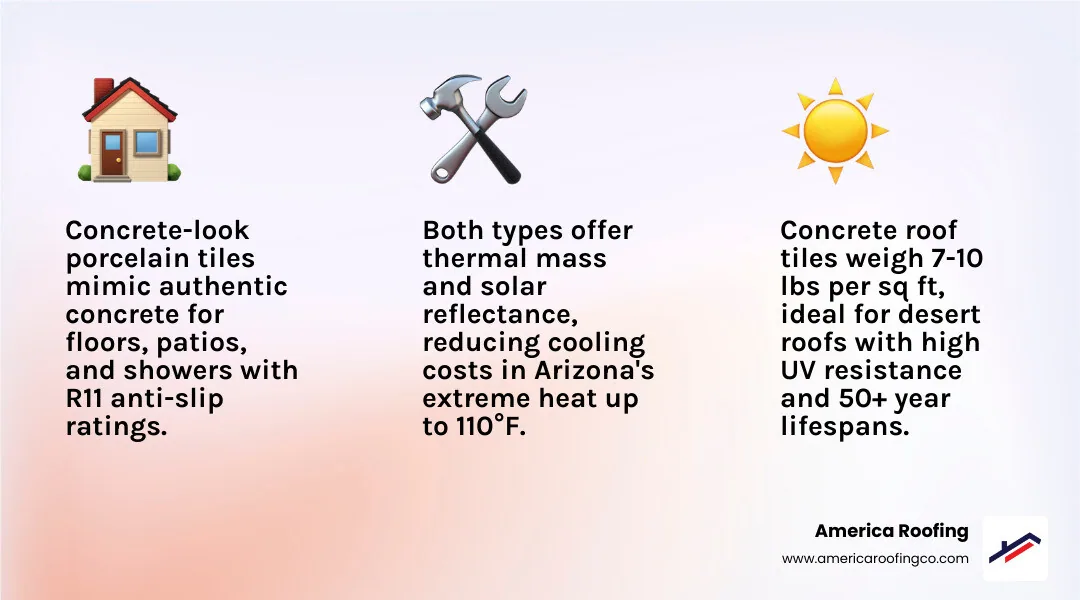
Similar topics to Arizona concrete tile:
When you walk through a custom home in Scottsdale or a modern renovation in Tempe, you’ll likely notice a recurring theme: the "Desert Modern" aesthetic. This style relies heavily on neutral tones, raw textures, and materials that look like they belong in the Sonoran landscape. Arizona concrete tile is the backbone of this movement.
But why concrete? Honestly, it’s about survival as much as it is about style. In Maricopa County, our homes are under constant siege from UV radiation and extreme thermal expansion. Traditional materials like wood or cheap shingles just don't stand a chance over the long haul. Concrete, whether it's in the form of a high-tech porcelain floor tile or a heavy-duty roofing shingle, provides a "thermal mass" that helps regulate temperature.
Let me explain. Thermal mass is the ability of a material to absorb and store heat energy. During a 115°F July day in Phoenix, a concrete tile roof absorbs that heat slowly, preventing it from immediately baking your attic. At night, it releases that heat back into the air rather than into your living room. This same principle applies to your indoor flooring; a concrete-look tile feels cooler underfoot during the day, which is a godsend when you're walking around the house in the middle of summer.
Exploring the Versatility of Arizona concrete tile for Your Home
When we talk about the "versatility" of Arizona concrete tile, we aren't just talking about different shades of grey. We’re talking about a material that has evolved through technology to fit almost any surface in your home. From the sleek, large-format slabs used in minimalist kitchens to the rugged, slip-resistant pavers surrounding a backyard pool in Gilbert, the options are nearly endless.
One of the biggest trends we’ve seen recently is the "indoor-outdoor flow." Homeowners want their living room floor to transition seamlessly onto their back patio. This is where concrete-look porcelain becomes a superstar. Unlike actual poured concrete, which can crack or stain easily, these specialized tiles offer the same industrial look with none of the maintenance headaches.
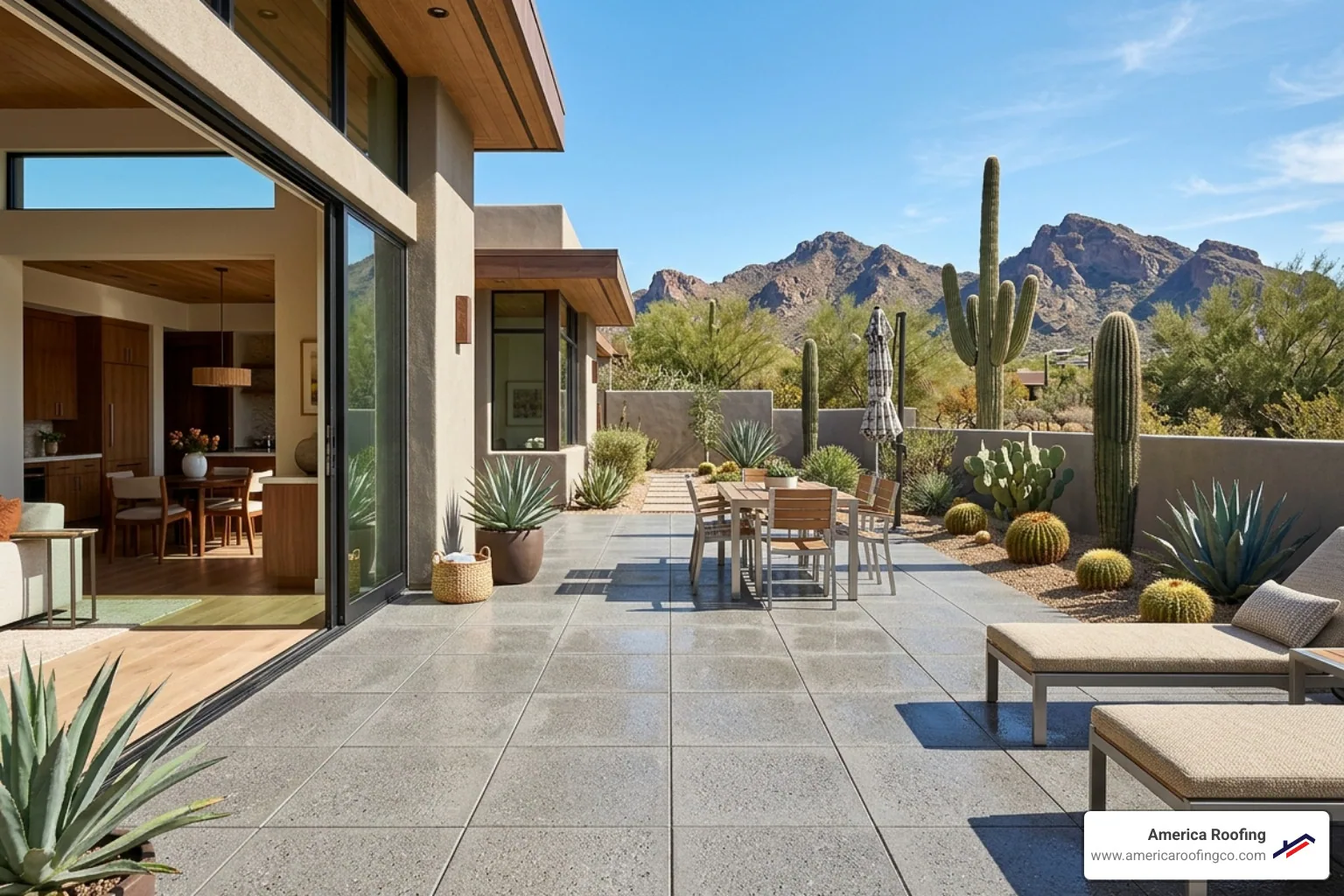
If you are looking for that specific aesthetic, you’ll likely come across products like the Konkrete series. This is an Italian-made rectified color body porcelain that uses digital print technology to mimic aggregate concrete. It’s a mouthful, but here’s what it means for you: you get the beautiful, organic variation of real cement with the indestructible nature of porcelain.
For those who want something even more unique, the Cemento Cassero line mimics the look of "formwork" concrete—the kind where you can see the faint impressions of the wooden boards used to hold the wet cement in place. It’s a high-end architectural look that’s becoming incredibly popular in urban lofts and modern desert builds.
If you are more concerned about the exterior of your home, especially the part that keeps the rain out, you should check out more info about concrete tile roofs to see how the material transitions from a design element to a structural powerhouse.
The Aesthetic Appeal of Arizona concrete tile Floors
You know what? Most people can’t tell the difference between real concrete and high-end concrete-look porcelain anymore. That’s thanks to digital print technology. Manufacturers can now scan actual slabs of weathered cement and print those high-resolution images directly onto tile surfaces. This results in a "piece-to-piece variation" that looks natural rather than repetitive.
When choosing your Arizona concrete tile look for floors, you need to consider the finish.
- Matte Finish: Great for indoor areas like kitchens and hallways. It’s smooth but not glossy.
- R11 Anti-Slip Finish: This is a meaningful advantage for Arizona. The R11 finish is specifically designed for wet areas. If you have a pool in Chandler or a walk-in shower in Peoria, this finish provides the grip you need to avoid a nasty fall. It has a Dynamic Coefficient of Friction (DCOF) rating of ≥0.42 when wet, which is the industry gold standard for safety.
Another thing to consider is the size. Large-format tiles (like 24" x 48") are huge right now. They minimize grout lines, which makes a room feel larger and cleaner. However, if you are looking at actual roofing tiles, the "look" is achieved through different coloring methods. You have "Color-thru" tiles, where the pigment is mixed into the wet concrete before it's molded, and "Slurry-kote," which is essentially a baked-on paint. In the Arizona sun, we always recommend Color-thru because if a tile chips, the color underneath is the same. For more on this, look into scientific research on Konkrete porcelain or read more info about tile replacement to see how these materials handle the elements.
Performance and Durability in the Desert Heat
Let’s talk numbers. Arizona is a "High UV" environment. This means that materials that work in Ohio or Oregon will literally crumble here within a few years. Arizona concrete tile is built differently. Whether it's a floor tile or a roof tile, it's designed to be frost-resistant (for those random Tucson freezes) and heat-resistant.
In terms of roofing, concrete tiles are a heavy-duty solution. They weigh between 900 and 1,200 lbs per square (a 10x10 foot area). That is significantly heavier than asphalt shingles, which usually weigh around 200-400 lbs. This weight is actually a benefit during our monsoon season—it makes the tiles much harder for high winds to lift.
Here is a quick breakdown of how concrete stacks up against its main rival, clay:
| Feature | Concrete Tile | Clay Tile |
|---|---|---|
| Lifespan | 30 - 70 Years | 100+ Years |
| Weight (per square) | 900 - 1,200 lbs | 600 - 1,100 lbs |
| Cost (per 100 sq ft) | $400 - $900 | $700 - $1,000 |
| Water Absorption | Up to 13% | ~6% |
| Impact Resistance | High (Great for hail) | Lower (Brittle) |
| Color Retention | Can fade over decades | Excellent (Lifelong) |
As you can see, concrete is the more budget-friendly option, and in many ways, it's more durable against physical impact like hail or falling branches. The trade-off is that it can absorb more water than clay, which is why proper installation and high-quality underlayment are non-negotiable in the Southwest.
Protecting Your Investment with Arizona Concrete Tile Roofing
Transitioning from the floor to the roof, Arizona concrete tile becomes your home's primary shield. If you've lived in the Valley for more than a year, you know that our monsoons are no joke. We get "haboobs" (massive dust storms) followed by torrential downpours and microbursts.
When we install a concrete tile roof, we aren't just laying down tiles. We are building a system. Because of the weight—up to 12 tons for a standard home—we have to ensure the structure can handle the load. Honestly, if you are switching from shingles to tile, you almost certainly need a structural engineer to sign off on your roof's framing.
One of the coolest things about concrete roof tiles is the "air gap." Many concrete tiles are curved (S-tiles). This shape creates a natural ventilation channel between the tile and the roof deck. As the sun beats down, hot air rises through these gaps and escapes at the ridge, providing a layer of "convective cooling" that can significantly lower your AC bills. If you're curious about the technical requirements for these installs, check out more info about roof pitch.
Maintenance and Longevity of Arizona concrete tile
Here is a secret that most roofing companies won't tell you: the tiles themselves are rarely the problem. A well-made Arizona concrete tile can easily last 50 years. The weak link is the underlayment—the waterproof felt or synthetic layer underneath the tiles. In the Arizona heat, underlayment typically lasts 20 to 30 years (though some older organic felts only last 13-16 years).
This means that even if your tiles look perfect, you might need a "Tile Lift" or "R&R" (Remove and Replace) where we carefully take the tiles off, install new underlayment, and put the original tiles back on.
To keep your concrete tile roof in top shape, here are a few expert tips:
- Don't Walk on It: Concrete tiles are strong, but they can crack under the weight of an inexperienced person walking on them incorrectly. Always hire a professional for inspections.
- Check for Cracked Tiles: A single cracked tile allows UV rays to hit the underlayment. UV is the "underlayment killer." Replacing a $5 tile today can save you a $15,000 roof replacement tomorrow.
- Seal the Penetrations: Areas around chimneys and vents are where leaks start. Periodic sealing is essential.
- Clear Debris: If leaves or dust build up in the "valleys" of your roof, they can trap water and cause it to back up under the tiles.
For a deeper dive into keeping your roof healthy, see our more info about tile repair.
Why Local Expertise Matters for Your Tile Project
At America Roofing, we’ve been the Maricopa County roofing authority since 1999. We are a third-generation, family-owned business, and we’ve seen every roofing disaster the desert can throw at a house. Being veteran-owned and fully licensed (ROC#186438), we take a "mission-first" approach to every project.
Why does "local" matter? Because a roofer from out of state doesn't understand that a Phoenix roof has to breathe differently than a roof in Seattle. We use premium materials specifically engineered for 115-degree days and 60-mph monsoon winds. We serve the entire Phoenix-metro area, from the luxury builds in Scottsdale and Paradise Valley to the growing communities in San Tan Valley and Queen Creek.
Whether you are visiting the Scottsdale showroom to pick out a new interior floor or you’ve noticed a leak after a haboob, you need a team that provides honest, no-pressure advice. We don't believe in "sales pitches"—we believe in transparency and flawless craftsmanship.
Honestly, choosing the right material for your home is about more than just looks—it's about long-term peace of mind. Whether you're falling in love with the "Konkrete" floor aesthetic or need a roof that can handle a haboob, our team is here to provide the honest, no-pressure advice you deserve. Ready to start your project? Request a Free Quote or call us today at 602-237-2478.