
There's no universal winner in acrylic vs silicone roof coating in Arizona. Acrylic is generally suited to roofs that drain within about 48 hours, while silicone is the stronger choice for standing water, but the right decision still depends on drainage, substrate condition, and the planned maintenance cycle.
A property manager in Phoenix or Tucson may be looking at a roof that appears serviceable from the parking lot, yet holds shallow puddles after a monsoon storm, shows exposed seams around rooftop equipment, or has an older foam or membrane surface beneath the existing coating. The coating chemistry matters, but it comes after the roof's condition, moisture, and drainage have been documented.
The comparison below gives the practical starting point.
| Property | Acrylic | Silicone |
|---|---|---|
| Best drainage profile | Well-drained roofs that dry within about 48 hours | Roofs with recurring standing water |
| Water behavior | Water-based and semi-permeable, less tolerant of prolonged ponding | Non-porous and hydrophobic, designed to remain stable in standing water |
| Upfront material position | Usually the lower-cost option | Usually the premium-cost option |
| Arizona UV behavior | Strong initial reflectance, with more weathering and chalking over time | Retains UV performance and reflectivity longer, though it can collect dust |
| Recoat planning | Often considered on a shorter maintenance cycle | Often planned for a longer service interval |
| Main risk | Adhesion loss or film deterioration where water remains | Dirt pickup, substrate moisture, and compatibility with future coatings |
Technical comparisons from Arizona roof coating guidance and silicone and acrylic cost guidance support that basic distinction. The useful question isn't which product sounds more durable. It's whether the existing roof gives either product a sound surface and a realistic path to perform.
Why Roof Condition Comes Before Coating Choice
A Phoenix warehouse roof can look ready for restoration while wet insulation, failed flashing, or blocked drains remains hidden below the surface. Coating can protect a sound assembly, but it cannot repair a deteriorated deck, open seams, active leaks, or a drainage layout that repeatedly leaves water in one low area. The inspection should establish whether restoration is practical before anyone compares coating chemistry or bids.
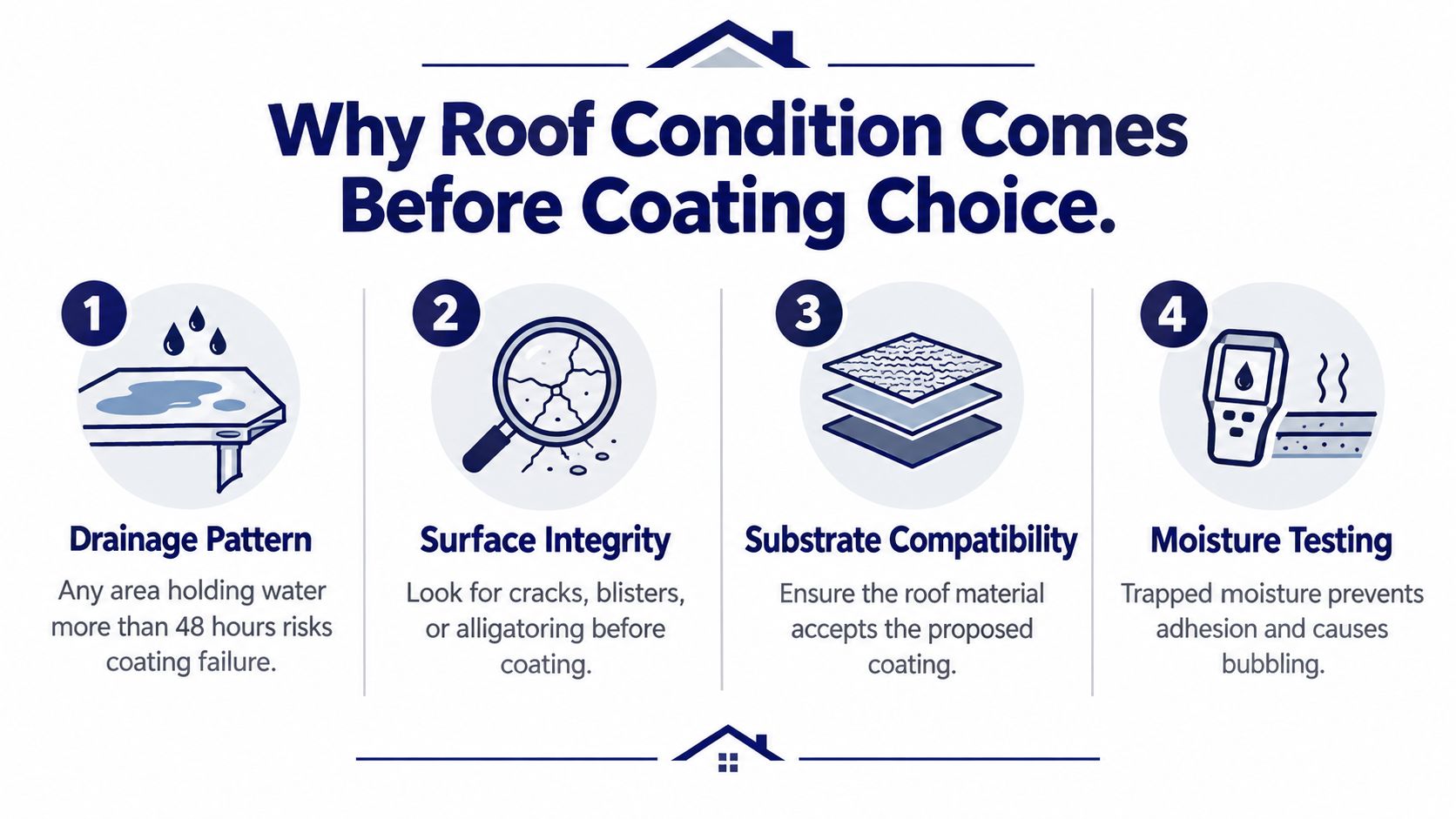
Start with the roof's water behavior. Any area holding water for more than 48 hours is a coating concern, not a cosmetic defect. That condition affects whether an acrylic system has a realistic service path and whether a silicone system is being considered for the right reason. Record where water collects after storms, including low-slope areas around drains and penetrations.
Document five conditions:
- Drainage pattern: Identify recurring ponding, blocked drains, inadequate slopes, and areas that do not dry.
- Substrate type and age: Foam, modified bitumen, TPO, and built-up roofing require different cleaning, preparation, and adhesion procedures.
- Existing leaks: Trace and repair active leaks before applying field coating.
- Seams and details: Inspect edges, penetrations, curbs, drains, and membrane seams for reinforcement or separate detailing.
- Moisture below the surface: Trapped moisture can cause bubbling, blistering, and adhesion failure after installation.
What changes by roof system
An SPF roof may need repairs at exposed foam, eroded surfaces, impact damage, and low areas. Modified bitumen and built-up roofs may require seam work, crack treatment, or fabric reinforcement. TPO often needs careful cleaning, adhesion testing, and a compatible primer rather than the preparation used on an asphaltic roof.
Age matters, but condition matters more. A coating can suit a roof with dry insulation, a sound deck, and a membrane that still has useful integrity. If moisture testing or a core sample shows widespread saturation, coating over the assembly can conceal the problem instead of solving it.
A qualified inspection may include a moisture survey, selective core cuts, and an adhesion pull test. A certified roof inspection helps establish whether restoration is reasonable before an owner compares acrylic and silicone proposals.
Practical rule: Check drainage and substrate condition first. Choose coating chemistry second.
How Acrylic and Silicone Behave Under Arizona Sun
Phoenix and Tucson roofs take intense ultraviolet exposure, high surface temperatures, dust, and sharp weather changes. Both coating families can reflect sunlight, but they differ in how their films age and respond to moisture.
Acrylic coatings are water-based. As they dry, they form a film that can deliver strong initial solar reflectance. One published acrylic data sheet reported 0.85 initial solar reflectance and 0.75 after weathering, while industry comparisons place white silicone near 0.88 initial solar reflectance and describe stronger resistance to UV-related chalking. The reported reflectance comparison shows why an installation-day reading is only part of the decision. Ask for the weathered reflectance value after 12 months of exposure, not only the initial ASTM E1918 number.
Silicone cures into a hydrophobic, non-porous film and generally handles prolonged water exposure better. Its value lies in maintaining waterproofing when drainage remains imperfect, rather than producing a brighter-looking surface on installation day.
| Property | Acrylic | Silicone |
|---|---|---|
| Film character | Water-based, semi-permeable film | Hydrophobic, non-porous film |
| UV response | Can weather, chalk, or lose reflectance over time | Generally stronger resistance to UV degradation and chalking |
| Ponding response | Long-term standing water can weaken adhesion | Designed to remain stable in standing water |
| Surface maintenance | Often presents a cleaner initial appearance | Can retain dust more readily |
| Service-life expectation | Commonly about 5 to 10 years in comparisons, depending on drainage and maintenance | Commonly about 10 to 25 years in comparisons, depending on system design and maintenance |
Those ranges come from the cited technical comparison, not a guarantee for a particular building. Roof access, substrate movement, application thickness, repairs, and maintenance can change the result. A Phoenix warehouse with heavy dust exposure may need a different maintenance plan from a cleaner Tucson commercial property, even when both use the same chemistry.
The proposal should list tensile strength, elongation, dry film thickness, and solids content. These values show whether the coating can accommodate thermal cycling and whether the installed film will match the specification. Confirm the required primer, application temperature, cure conditions, and recoat window as well. A product that performs on a clean, dry substrate may be the wrong choice for a dusty roof with recurring water exposure.
Owners can find the right roof coating for monsoons by reviewing those requirements alongside the inspection findings and manufacturer data sheet. The roof condition and drainage plan should decide the chemistry, not the lowest initial proposal.
Ponding, Dirt Pickup, and Monsoon Performance
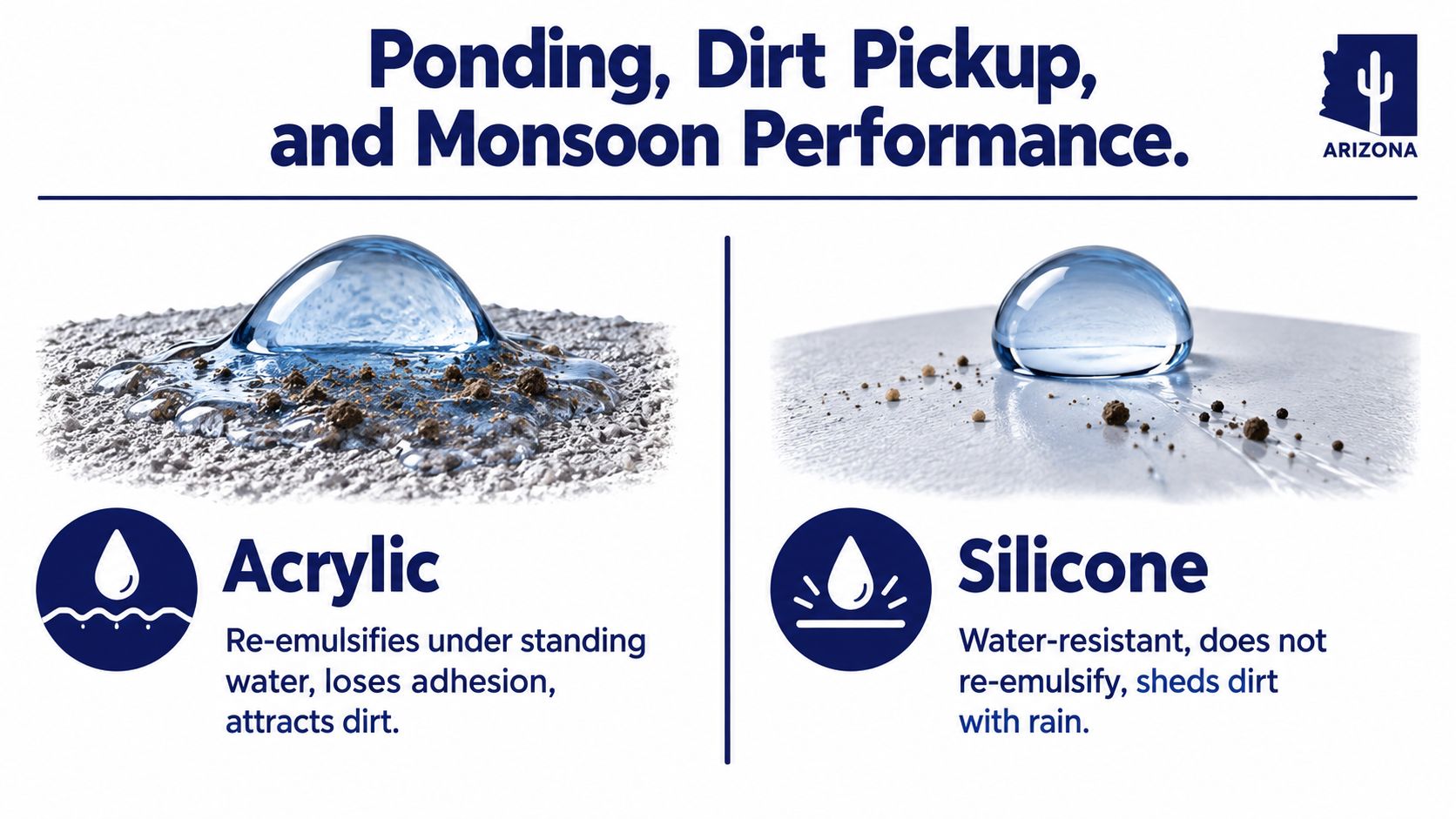
A Phoenix warehouse that still holds water after a monsoon needs a drainage review before anyone selects a coating. Acrylic is generally suited to roofs that drain within about 48 hours. Extended ponding can soften or weaken its water-based film, while Arizona technical guidance describes silicone as non-porous and hydrophobic, with stronger resistance to blistering, bubbling, and peeling in standing water.
Silicone tolerates ponding better, but it does not correct the cause. It cannot rebuild a collapsed cricket, clear a blocked drain, stabilize a moving curb, or restore a failing roof assembly. Inspect the low area first. The repair may require tapered drainage work, a new drain or scupper, detail repair, or a different roof system.
A roof that ponds after every monsoon storm should not be assigned an acrylic specification because acrylic has a lower starting cost.
The trade-off many proposals skip
Silicone's water resistance can bring more dirt pickup. Dust, airborne debris, and monsoon residue may settle on its surface, reducing its clean appearance and potentially affecting reflectivity over time. Acrylic can look cleaner longer in some Phoenix or Tucson settings, but appearance does not make it suitable for persistent ponding.
Application conditions belong in the scope, not just the product name. Acrylic usually needs a suitable temperature window and enough drying time for water to leave the film. Some silicone systems handle a wider range of conditions, yet moisture in the substrate, dew, and rain can still interfere with adhesion or cure.
Plan the work around Arizona's storm pattern. The crew needs a dry, stable window, a clean substrate, and enough time for detail work and field coats to cure before rain reaches the roof. A property manager should also confirm how the surface will be cleaned during maintenance, especially on dusty warehouse roofs.
For owners reviewing drains, low-slope areas, and post-storm water retention, this flat roof drainage checklist in Arizona offers a practical inspection framework. Use those findings to set the drainage and recoat plan before comparing coating chemistry or proposal totals.
Reading the Manufacturer Spec Sheet
Two bids quoting the same chemistry can require different preparation, primers, and cure windows. Pull eight items from each proposal before comparing costs, and match the written scope to the roof condition.
The numbers that need comparison
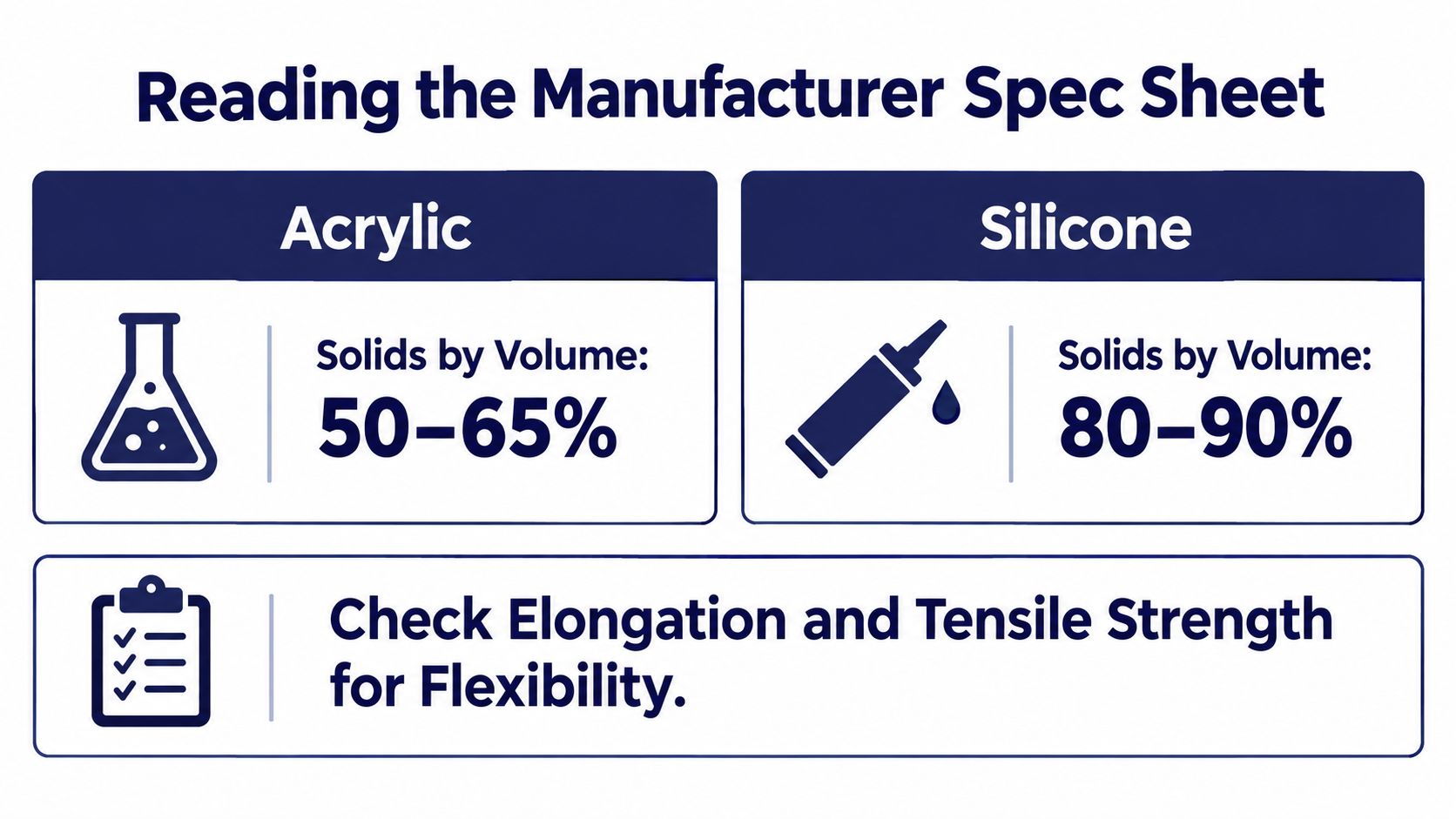
Solids by volume indicate how much applied material remains after the carrier leaves. Acrylic products commonly fall around 50% to 65% solids, while the supplied comparison identifies 80% to 90% for silicone. The technical comparison explains how solids affect the material required to reach the specified dry film thickness. Review the comparison chart showing solids by volume for acrylic and silicone roof coatings alongside the product data sheet, not as a substitute for it.
Pull these items from every data sheet and proposal:
- Solids by volume, to compare coverage estimates on the same basis.
- Recommended wet and dry film thickness, including whether the system requires one coat or multiple coats.
- Application rate, stated by the manufacturer rather than inferred from the bid total.
- Approved substrates, such as SPF, TPO, EPDM, modified bitumen, or built-up roofing.
- Primer requirements, particularly for aged membranes, metal, and single-ply surfaces.
- Temperature and humidity limits, including the minimum temperature for cure.
- Recoat instructions, including cleaning requirements and any tie coat.
- Ponding-water language, including exclusions and conditions that void coverage.
Compatibility is not interchangeable
A coating that bonds to foam may require different preparation on TPO or an asphaltic roof. Existing silicone can restrict a future acrylic recoat unless the manufacturer approves the tie coat and preparation method. The contract should name the primer, detail materials, target thickness, and testing method before work starts.
Review tensile strength, elongation, permeability, and cure time together. High elongation can help accommodate movement, but it cannot correct wet insulation or an unstable substrate. Manufacturer instructions and trade guidance from the Roof Coatings Manufacturers Association should govern the decision rather than assumptions based on a product label. In Phoenix and Tucson, the recoat plan should also state what cleaning and surface preparation are required before the next application.
Cost, Service Life, and Recoat Economics
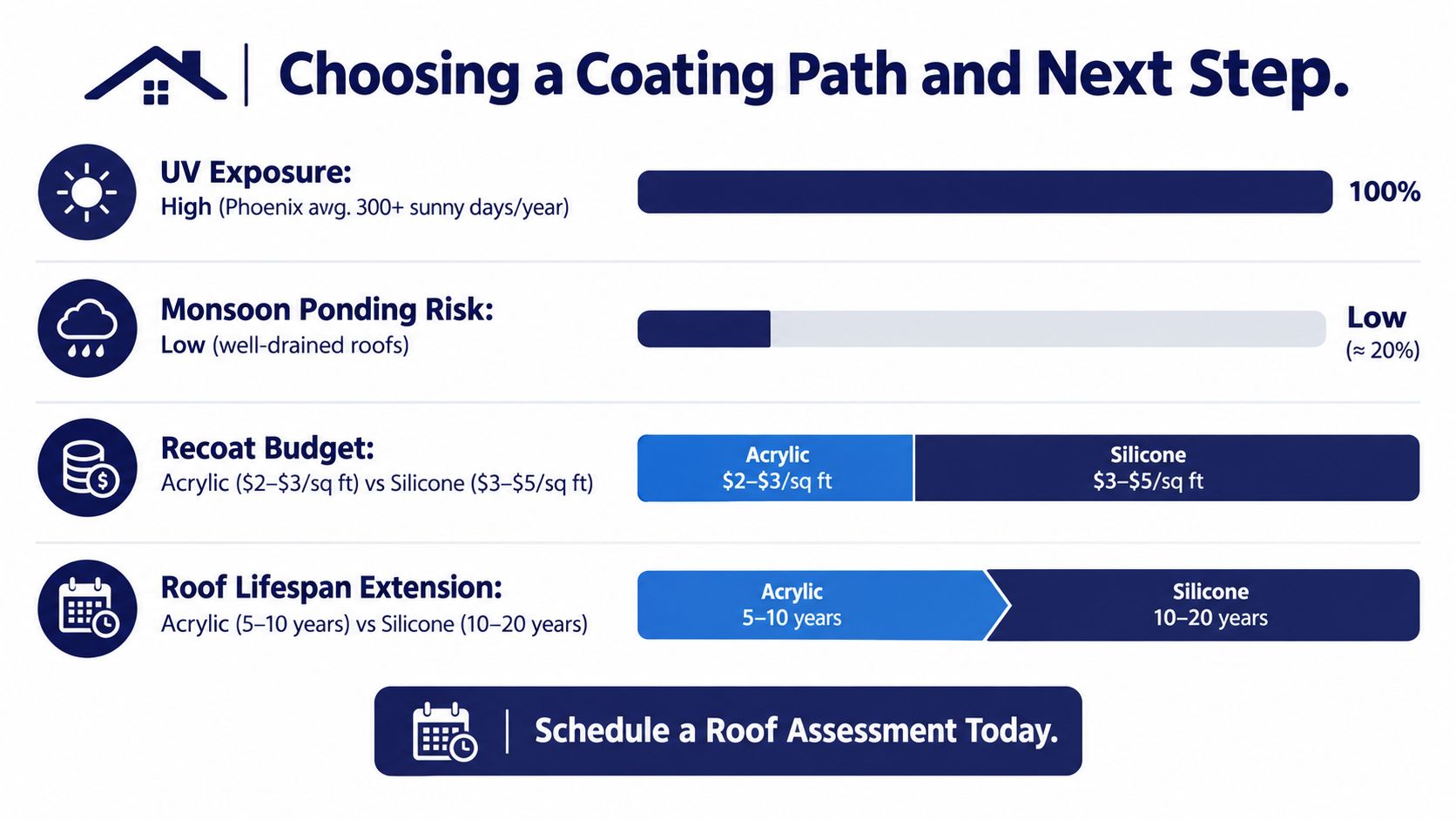
Acrylic usually enters the conversation as the budget option. Technical and supply-chain guidance reports that silicone can cost about 1.5 to 2 times as much per gallon as acrylic, while installed elastomeric or silicone recoating projects in Arizona are often discussed around $1.50 to $3.50 per square foot, depending on roof condition, access, preparation, and system requirements. Arizona roof coating cost guidance also gives a Tucson example of roughly $2,500 to $6,000 for an average flat roof.
Those figures aren't a quote for a particular property. A roof with extensive seam repair, moisture removal, difficult access, or drainage corrections can require a substantially different scope than a clean, serviceable roof ready for a maintenance coating.
| Cost Item | Acrylic System | Silicone System |
|---|---|---|
| Material position | Lower initial material cost | Higher initial material cost |
| Common service-life discussion | About 10 to 15 years before recoating, depending on condition and maintenance | Longer expectations are commonly discussed where ponding and UV exposure favor silicone |
| Main lifecycle concern | Earlier maintenance may be needed if reflectance or film thickness declines | Dirt pickup and substrate compatibility need active management |
| Best financial fit | Well-drained roof with a controlled maintenance plan | Ponding-prone roof where premature failure would be costly |
The service-life figures above are planning ranges, not guarantees. The owner should calculate the total cost of preparation, repairs, coating, inspections, cleaning, and future recoating rather than dividing the first invoice by a hopeful lifespan.
Warranty language deserves equal attention. Many acrylic warranties exclude ponded areas, while silicone warranties and product systems may include specific conditions around ponding, thickness, approved substrate, maintenance, and application. A warranty that sounds long but excludes the roof's actual problem areas doesn't provide useful protection.
Before accepting a low bid, property managers should review whether the proposal includes moisture testing, seam treatment, primer, drains, penetrations, final thickness verification, and written maintenance requirements. The question of whether roof coating is worth it depends on that complete scope, not on the coating price alone.
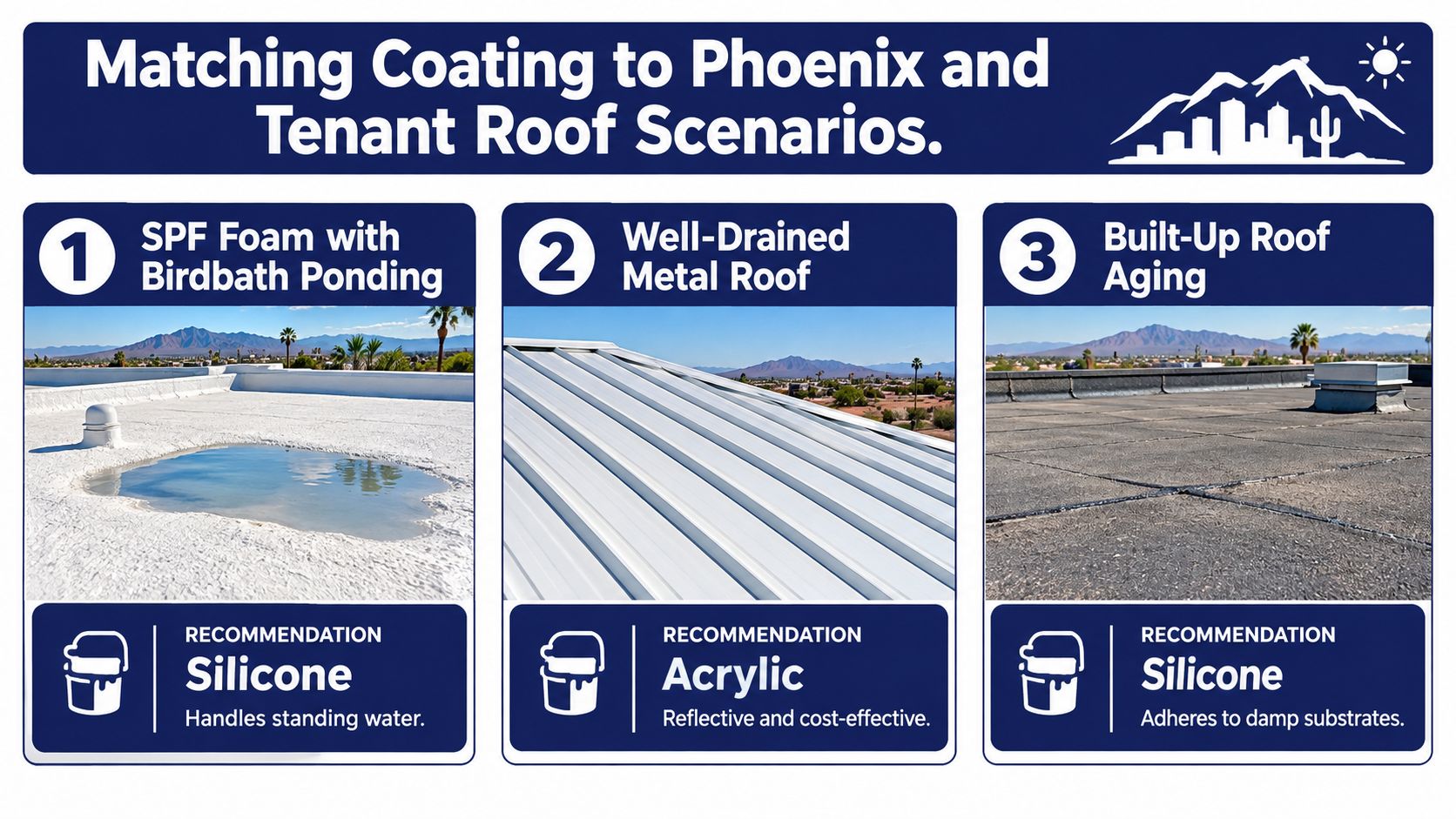
Matching Coating to Phoenix and Tenant Roof Scenarios
A coating choice becomes clearer when the roof is described by condition rather than by product preference. The following scenarios show how drainage, substrate, and maintenance planning change the recommendation.
An SPF foam roof in Mesa has birdbath ponding after monsoon storms. Silicone is usually the more suitable coating family because it remains stable in standing water. The roof still needs inspection for eroded foam, exposed areas, impact damage, and moisture. The specification should identify whether the surface needs primer, the required dry film thickness, and the planned inspection or recoat cycle.
A well-drained TPO retail roof in north Phoenix sends water to internal drains without recurring low spots. Acrylic may fit if the manufacturer approves the substrate and the adhesion test supports the system. Preparation can include cleaning, surface testing, and a specified primer. The owner should compare the target thickness and future recoat process rather than assuming a reflective coating can be applied directly.
An aged built-up roof in Tucson has hairline surface cracking but no documented ponding. Acrylic can be reasonable after the roof is confirmed dry and sound, with seams and cracks detailed according to the selected manufacturer's instructions. Fabric reinforcement may be required at vulnerable areas, and the recoat plan should be placed on the maintenance calendar from the beginning.
A multifamily flat roof in Glendale holds puddles around HVAC curbs. Silicone may be the better coating family after the drainage and curb details are corrected. The coating won't replace a damaged cricket or repair a failed curb flashing, so the proposal should separate drainage work, repairs, primer, field application, and warranty requirements.
For a broader review of local roof types and repair paths, owners can explore roofing services in Phoenix. The same condition-first approach applies in Tucson, where older commercial roofs, dust, heat, and stormwater exposure can create different preparation needs within the same coating category.
Choosing a Coating Path and Next Step
The decision can be reduced to five signals: substrate, drainage, UV exposure, monsoon water behavior, and future maintenance budget.
- Well-drained single-ply or metal roof: Acrylic can be a sensible lower-cost, reflective option when the approved-substrate and adhesion requirements are met.
- SPF, built-up, or modified bitumen roof: Either chemistry may fit, but the system must be selected around substrate preparation, seams, moisture, and the manufacturer's warranty requirements.
- Recurring ponding: Silicone generally deserves priority when water remains in place, especially after monsoon storms. The roof still needs drainage review before coating.
- Dust-heavy environment: Silicone's dirt pickup should be included in the maintenance plan, including safe cleaning access and inspection responsibilities.
- Future recoats: The first coating can affect the next one. The owner should document the product, primer, thickness, repairs, and approved recoat method.
A hybrid specification can make sense on a large roof with distinct drainage zones. For example, a contractor may use silicone in persistent low areas and acrylic on well-drained sections if both systems are compatible with the existing substrate and the warranty documents clearly define the boundaries. That approach should never be improvised in the field. It needs written manufacturer approval and a coordinated detail plan.
Vetting the proposal
Phoenix and Tucson owners should verify the contractor's Arizona Registrar of Contractors status, request references for similar substrates, confirm any manufacturer-approved applicator claims directly, and require an adhesion test patch where compatibility is uncertain. The written warranty should distinguish material coverage from workmanship and list exclusions for ponding, maintenance, thickness, and substrate condition.
Two inspections can be more valuable than two square-foot prices. The bids should be compared line by line for moisture testing, repairs, drainage corrections, primer, application rate, dry film thickness, cure conditions, cleanup, final inspection, and warranty scope. Property managers who also need a clearer online way to present roofing services can review this resource on roofing website for trades, but the roof decision itself still belongs in the inspection report and manufacturer documentation.
America Roofing handles roof inspections, repairs, flat and foam roofing, roof coatings, commercial roof repair, and reroofing for properties in Phoenix and Tucson. To compare acrylic and silicone on the actual substrate, drainage pattern, and maintenance plan, visit America Roofing, call 602-237-2478, or request a roofing estimate with the roof's condition and coating requirements documented in writing.