
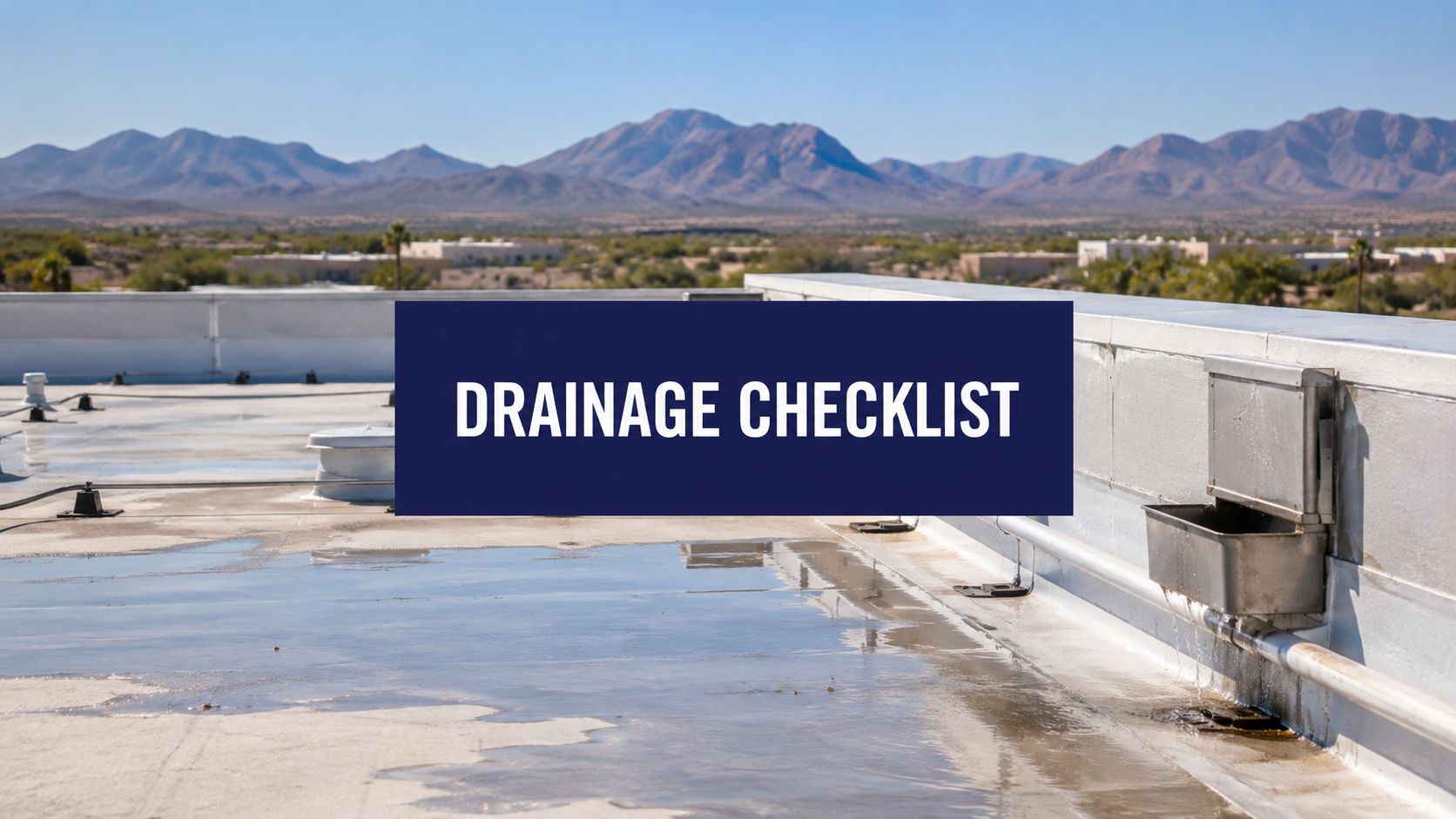
The most popular advice about flat roofs is to wait for visible leaks. In Arizona, that's too late. An effective flat roof drainage checklist for Arizona starts before monsoon rain exposes blocked drains, low spots, failed seams, or damaged flashing. Routine observations can help Phoenix and Tucson homeowners, property managers, and building owners, but unsafe roof access, storm conditions, structural concerns, and repairs belong with a qualified roofing professional. The eight checks below cover seasonal timing, debris, drains, scuppers, ponding, membranes, foam and coatings, emergency documentation, safety, and the point at which America Roofing should evaluate repair or replacement options. Property owners looking for broader site drainage context can also review how to fix drainage in Peoria.
1. Clear Debris from Roof Surface and Drain Areas, First Step in Your Flat Roof Drainage Checklist Arizona
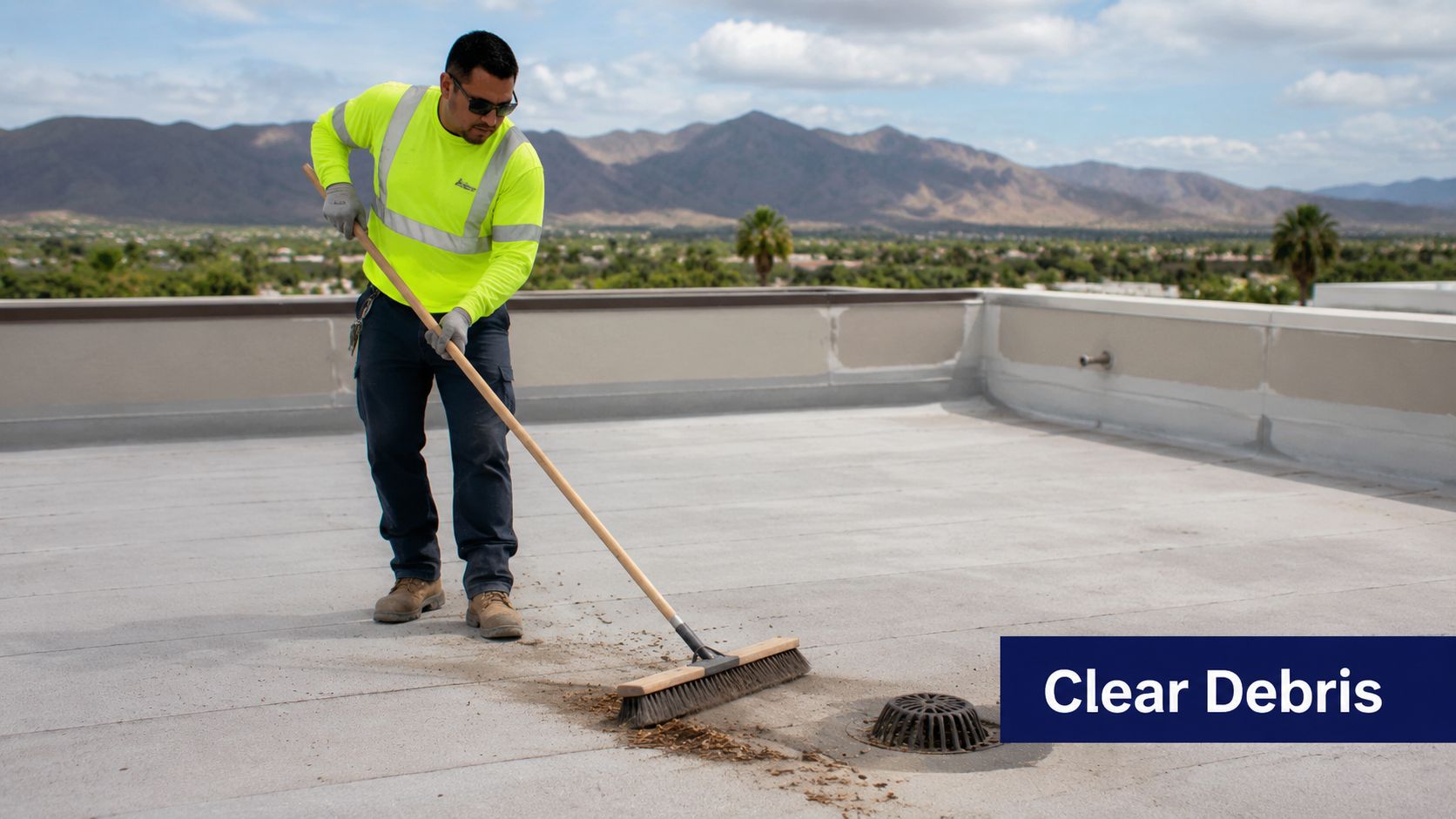
Blocked outlets are often the first drainage failure property owners can observe. Dust, sand, leaves, branches, bird nesting material, and monsoon debris collect around low-slope roof drains and scuppers. On a Phoenix commercial roof, that material can restrict the inlet, hold moisture against the membrane, and redirect runoff toward seams or parapet walls. Tucson properties face similar exposure where wind carries desert dust and vegetation onto the roof.
Schedule a visual debris check before monsoon season and repeat it after significant storms, only when conditions are safe. Arizona-focused preparation guidance recommends completing roof work before June 15, while Phoenix monsoon guidance advises cleaning roof drains and scuppers to reduce rainwater accumulation. Dusty sites, tree-lined properties, and buildings with nearby vegetation may need more frequent checks during peak monsoon months.
Remove debris without damaging the roof
Property owners can often document buildup from the ground or a safe roof-access point. Roof cleaning itself requires caution. A soft brush or low-pressure method may suit some membrane surfaces, while pressure washing, harsh scrubbing, and careless tools can damage foam roofs or recent coatings. Do not enter the roof during storms, where access is unsafe, or where the surface shows structural concerns.
Use this sequence:
- Collect debris separately: Do not sweep sand, leaves, or loose material into a drain opening. Bag or remove it so the blockage is not pushed farther into the drainage path.
- Look for patterns: A recurring pile near one drain, scupper, curb, or flashing transition may point to wind flow, a surface obstruction, or a nearby roof-system problem.
- Protect the membrane: Keep sharp tools, heavy containers, and dragged equipment away from the roof surface.
- Record the condition: Photograph the roof area, drain opening, and debris type before and after clearing. Note the location and date for the maintenance record.
A clear inlet only restores a path for water. It does not correct a low spot, damaged membrane, failed flashing, or drainage system that cannot handle runoff.
America Roofing's flat roof repair Arizona guide can help separate routine maintenance observations from conditions requiring repair decisions or a professional inspection.
2. Inspect and Test Roof Drains for Proper Function, Part of Your Flat Roof Drainage Checklist Arizona
An open drain inlet does not prove that the drainage path works. Water may be restricted below the strainer or inside the outlet. Inspect each drain for cracks, loose components, damaged strainers, and debris that remains after surface clearing. On commercial roofs, confirm that the drainage plan accounts for every primary drain, internal outlet, scupper, and overflow route.
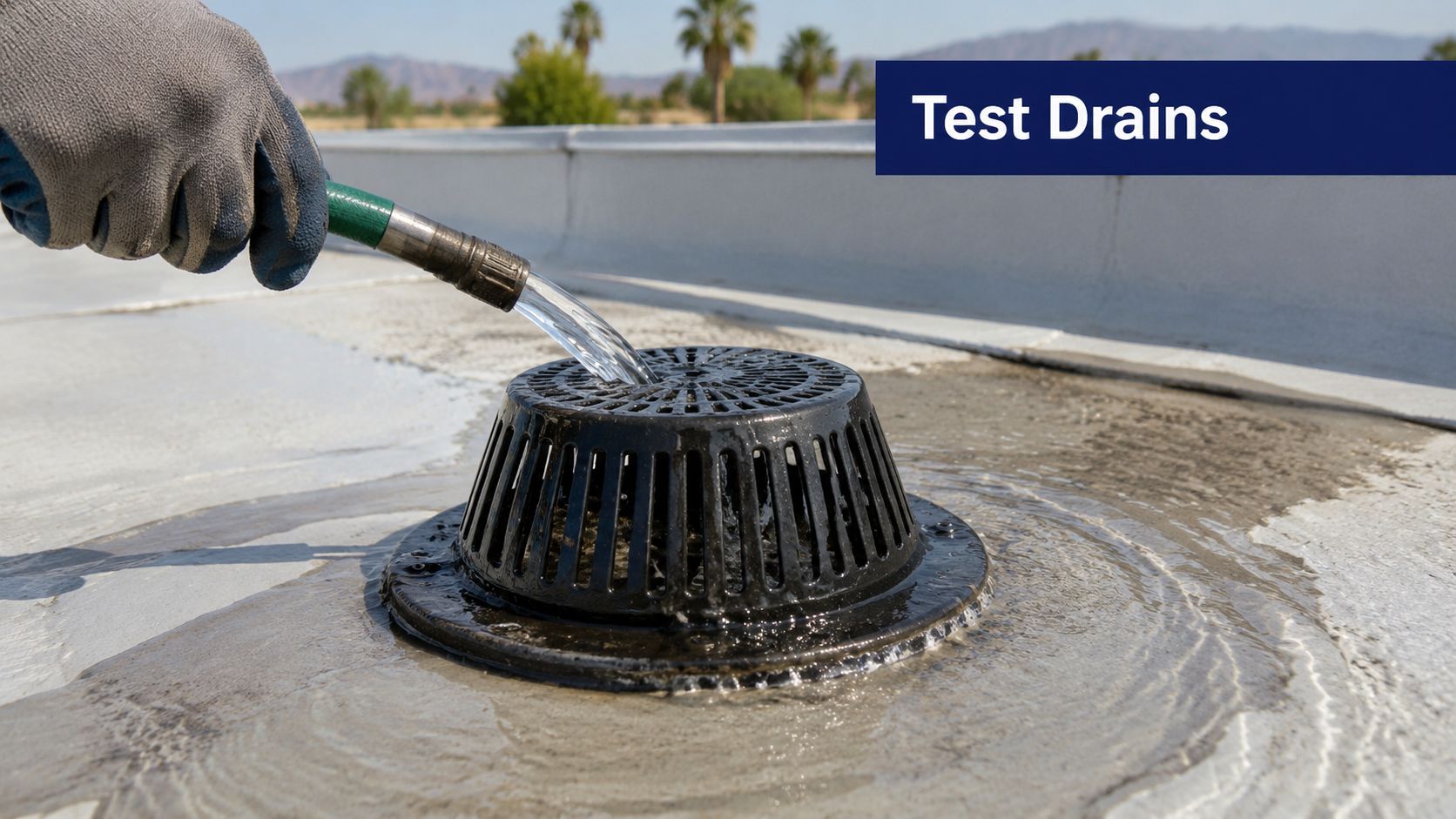
A controlled hose test can expose slow discharge. Keep people off a wet roof, avoid opening concealed plumbing, and stop if access is unsafe. Before storm season, run the hose for 60 seconds at each drain to confirm that water exits fully through the intended outlet. Backups, water moving toward a wall, or flow disappearing without an observable outlet indicate a condition that needs further diagnosis. Phoenix roof leak detection may help when testing suggests a concealed leak.
Follow the water beyond the inlet
The test continues at the downstream outlet. Observe where the water emerges, particularly at a Tucson warehouse or Phoenix strip mall where internal downspouts may pass through walls or occupied areas. Slow flow, staining, wet masonry, or discharge at an unexpected location should be documented and referred to a qualified roofing professional.
Record the result while the evidence is clear. Photograph the drain, outlet, and any wet or stained area from a safe position. Note the roof section, date, weather conditions, and whether water backed up or drained as intended. This record helps separate a localized drain issue from a wider roof-system concern.
After rainfall, inspect only when the roof is stable and access is safe. Arizona leak-repair guidance uses ponding deeper than 1/2 inch after 24 hours as a condition requiring attention and identifies an intended slope of about 1/4 inch per foot toward outlets. These figures do not replace a design review where tapered insulation has settled or the deck may have deflected.
For homes, a ground-level check can identify overflowing gutters, scuppers, or downspouts without exposing the owner to roof hazards. Concealed drain diagnosis, blocked internal lines, unsafe access, and repairs belong with a qualified roofer. The guide to residential roof checkups can help organize observations without treating a visual review as a complete inspection.
3. Check for Pooling Water and Low-Spot Areas, Flat Roof Drainage Checklist Arizona
After a June monsoon, Phoenix property managers may find standing water trapped in depressed areas of a commercial roof. Tucson properties can show the same pattern after heavy rainfall. Check from a safe access point, and do not walk through deep water or approach unstable areas.
A low spot can result from settled tapered insulation, deck movement, a blocked outlet, deteriorated roofing layers, or an original layout that no longer drains effectively. Repeated ponding keeps seams wet, speeds membrane wear, and adds load to the roof assembly. Arizona's minimum workmanship standards provide context for evaluating limited ponding, but recurring water still requires investigation rather than dismissal as normal desert wear.
Map the pattern instead of guessing
Inspect after rainfall while the evidence remains visible. Photograph the affected area from a stable position, mark it on a roof plan, and record whether water remains after 24 hours. The pattern helps distinguish a temporary blockage from a persistent depression, failed slope, or damaged outlet.
Record:
- Location: Identify the roof section, drain, scupper, parapet, curb, or interior room below.
- Persistence: Note whether water stays in the same place and returns after later storms.
- Extent: Include nearby roof features in photographs to show scale and context.
- Interior evidence: Record ceiling staining, damp insulation concerns, peeling finishes, or musty areas below the pond.
- Likely cause: Separate debris-related backup from structural movement, poor drainage, or roof-system damage.
A ruler or depth measurement can support the record, but owners should not cut the membrane, probe soft areas, or step into deep water. Residential owners can report visible symptoms from the ground, while commercial managers should coordinate safe access, tenant communication, and follow-up. To organize those observations, find commercial inspection tips before deciding whether the next step is routine maintenance, a targeted repair, or a professional roof-system inspection.
4. Examine Membrane Seams, Penetrations, and Flashing for Separation or Damage
Drainage problems and waterproofing failures often meet at transitions. Seams, roof edges, parapet flashings, penetrations, equipment curbs, and pipe bases are exposed to heat, wind movement, maintenance traffic, and standing water. A leak may begin at one of these points while appearing inside a room several feet away.
Bright Arizona sunlight can make hairline cracks and small gaps difficult to see. A visual inspection should focus on lifted edges, open seams, brittle sealant, pulled fasteners, wrinkled membrane, exposed substrate, and coating that stops short of a transition. Flashing on the south or west side of a Phoenix building may show faster weathering because of intense sun exposure, while rooftop equipment movement can stress nearby details in either Phoenix or Tucson.
Keep inspection non-destructive
A flashlight or headlamp can help reveal separation at a safe, stable access point. Property owners shouldn't pry at seams, press hard on suspect areas, cut the membrane, or use tools to test sealant. A crumbling or detached sealant bead is useful evidence, but the repair requires compatible materials and proper preparation.
For coated roofs, the coating should cover the intended seams and transitions continuously. Exposed, thin, blistered, or incompletely coated areas can leave the underlying system vulnerable. Foam roofing deserves particular care because the protective coating is part of the system's weather barrier. The roof shouldn't be treated like a surface that can be aggressively scrubbed or patched with an unverified product.
A roof diagram helps prioritize repairs. Mark each defect, photograph it from a wide view and a close view, and connect the exterior location to interior staining where possible. America Roofing's guidance on finding hidden leaks from America Roofing can help property owners understand why the visible ceiling mark may not align with the roof entry point.
Water often follows the roof assembly before it reaches the ceiling. Repairing the stain alone won't correct the entry point.
5. Assess Membrane Condition, Weathering, and Remaining Lifespan for a Flat Roof Drainage Checklist Arizona
Drainage performance depends on the roof system's condition, not only on clear outlets. In Phoenix and Tucson, heat, ultraviolet exposure, roof traffic, wind, and earlier ponding can weaken a membrane even when water appears to leave the roof. Record fading, brittleness, cracking, chalking, exposed reinforcement, blisters, surface erosion, and coating that has thinned or separated.
Record the installation date in the property file. Many Arizona flat-roof systems are commonly associated with a 15 to 20 year lifespan range, although cooler climates may support longer service. Treat that range as a planning reference, not a guarantee. System type, installation quality, drainage history, maintenance, foot traffic, and concealed conditions all affect whether targeted repair, recoating, or replacement makes sense.
Match the treatment to the system
Foam roofs depend on an intact protective coating. Worn or cracked coating may support recoating after professional assessment, but applying new coating over wet or failing foam will not correct the underlying defect. Single-ply membranes, modified bitumen, and built-up systems need compatible repair and coating methods. Generic sealant or a household patch can interfere with adhesion and make later repairs harder.
Inspect south-facing areas closely because direct Arizona sun accelerates weathering. Localized wear with sound materials underneath may support targeted repair or coating. Widespread cracking, saturation, recurring leaks, or deteriorated edges points toward a broader repair plan, and possibly reroofing. Do not scrape, cut, or probe the membrane during a routine check.
For residential tile or sloped roofs, drainage evidence still matters. Broken tiles, failed flashing, and blocked paths can send water into the underlayment. Owners comparing roof systems can review how long tile roofs last in Arizona, but observed condition, leak history, and repair records should carry more weight than age alone. Photographs, marked roof plans, and interior moisture notes give a licensed roofing contractor better information for a repair-versus-replacement recommendation.
6. Verify Downspout Routing in Your Flat Roof Drainage Checklist Arizona
A roof drain or scupper may work properly while its downspout sends runoff toward the building. At Phoenix and Tucson properties, compacted desert soil can slow absorption and make outlet placement, slope, and erosion visible at ground level. Water discharged beside a foundation can wash out soil, collect against walls, stain masonry, or reach doorways and occupied areas.
Start at each visible roof connection and follow the full route to the discharge point. Check for loose joints, dents, crushed sections, debris, disconnected extensions, and water marks that suggest overflow. After rainfall, observe the outlet from a safe ground-level position. Confirm that water leaves freely and that the receiving surface carries it away from the structure.
Check each runoff route separately
Commercial roofs may have several drains, scuppers, and downspouts. Treat every route as its own drainage path. Cross-connected or poorly routed lines can concentrate flow through one outlet when another drain is blocked, increasing overflow at a wall or roof edge.
Use these ground-level checks:
- Outlet direction: Confirm that discharge does not point toward the foundation, doorway, wall, or occupied patio.
- Soil condition: Look for washout, channels, soft ground, or sediment beneath the outlet.
- Receiving surface: Where appropriate, a splash block, gravel bed, or suitable extension can limit erosion.
- Connection security: Check whether wind, impact, or maintenance work has separated any joints.
- Post-storm flow: Slow discharge can indicate an obstruction inside the downspout or at the outlet.
Do not enter a roof drainage line or alter a downspout connection during a routine check. Record the location and visible condition, then have a qualified professional assess repairs that require roof access, cutting, excavation, or changes to the drainage design.
Parapet buildings also need a secondary drainage plan. Phoenix plumbing code requires scuppers used for primary or emergency overflow drainage to be located and sized so water depth stays within the roof's design limit. The code specifies scupper openings at least 4 inches high, with width at least equal to the circumference of a roof drain sized for the same roof area, as detailed in the Phoenix storm drainage code. Property owners should not modify these openings without a roofing and code review.
7. Document Inspection Findings and Create a Maintenance Schedule for Your Flat Roof Drainage Checklist Arizona
A dated photograph after a storm provides more useful evidence than a note saying “roof checked.” Record where water stood, which outlet was blocked, visible membrane or flashing changes, and what needs another look. This record helps Phoenix and Tucson owners compare repair choices without relying on memory.
Include the installation date if known, roof-system type, a roof plan, drain and scupper locations, known low spots, prior repairs, coating work, interior leak locations, and follow-up dates. Use wide-angle photos to establish location and close-ups to show cracks, debris, failed sealant, coating wear, or damaged flashing. Mark each image with the inspection date and a precise location.
Build the schedule around Arizona weather
Arrange flat-roof reviews at least twice each year, clearing drains and scuppers before monsoon season. Plan a pre-monsoon review in spring or early summer, a post-storm check when conditions are safe, and a post-monsoon review in fall. Buildings exposed to dust or vegetation may require weekly checks during peak monsoon months, consistent with Arizona-focused guidance published in 2026 by KY-KO Roofing.
Assign each task to a specific person:
- Property staff: Record ground-level conditions, interior staining, access concerns, and storm dates.
- Maintenance personnel: Coordinate safe access and report blocked outlets without attempting hazardous roof work.
- Roofing contractors: Diagnose membrane, flashing, slope, saturation, and drainage-design problems.
- Building owners: Approve prioritized repairs and maintain the property record.
Keep reports, photographs, invoices, and contractor recommendations together. A consistent history can separate a one-time blockage from recurring ponding. It also gives a qualified contractor better evidence when deciding whether localized repair, coating, foam application, or replacement fits the roof's condition. For residential and commercial properties, routine records should support decisions, not replace a professional assessment when defects or water intrusion require roof access.
8. Schedule Professional Inspection by a Licensed Roofing Contractor When Needed, Based on Your Flat Roof Drainage Checklist Arizona
A checklist identifies warning signs. It does not replace a roof inspection. Arrange professional evaluation after major storm damage, during an active or recurring leak, when ponding returns, or when seams, flashing, or roof edges separate. Wet insulation, damaged decking, an aging system, or changed drainage after construction or equipment work also justify a closer review. Commercial property managers should act when tenants report repeated ceiling stains or drainage performance changes.
A licensed roofing contractor can assess conditions that are not visible from the ground. The scope may include membrane condition and attachment, flashing, parapets, drains, scuppers, overflow paths, tapered insulation, coating adhesion, and concealed moisture. A post-storm documentation visit answers a different question from a leak investigation or a repair-versus-replacement assessment.
Use the drainage findings to define the appointment. If the Arizona ponding reminder from Section 3 applies, give the contractor dates, locations, photographs, and water-depth observations rather than relying on a general complaint. Do not enter an unsafe roof area to collect evidence.
Request a report that supports the next decision
Ask for a written report that ties photographs to roof and interior locations, describes each defect, and ranks the recommended work. It should explain whether the appropriate response is localized repair, drainage correction, coating, foam work, partial replacement, or full replacement, and connect that recommendation to membrane condition, moisture, serviceability, and repair history.
Before authorizing work, confirm:
- Arizona experience: Ask about Phoenix or Tucson heat, UV exposure, dust, monsoon rain, and the specific roof system.
- Licensing and insurance: Verify the contractor's license and liability coverage.
- Defined scope: State whether the visit covers a leak, storm damage, drainage, general condition, or replacement planning.
- Photo documentation: Require roof and interior images tied to property locations.
- Second opinion: Seek another professional assessment before approving full replacement.
For commercial owners, America Roofing's commercial roofing services can be reviewed alongside its guidance for commercial flat roofs in Arizona and commercial roof repair in Arizona. Residential and commercial decisions should reflect the roof material, drainage design, moisture condition, remaining serviceability, and documented maintenance history.
Arizona Flat Roof Drainage: 8-Point Checklist Comparison
| Item | Implementation Complexity | Resource Requirements | Expected Outcomes | Ideal Use Cases | Key Advantages |
|---|---|---|---|---|---|
| Clear Debris from Roof Surface and Drain Areas | Low–Medium, straightforward but requires roof access and time on large roofs | Soft-bristle brooms, refuse collection, PPE, optional mechanical cleaners, fall protection | Restored water flow, reduced pooling, slower membrane deterioration | Pre-monsoon routine maintenance, periodic upkeep on commercial flat roofs | Lowest-cost prevention, immediate drainage improvement, extends membrane life |
| Inspect and Test Roof Drains for Proper Function | Low, visual inspection and simple flow tests; higher if interior lines inspected | Hose or water source, flashlight, basic tools, optional camera for interior drain lines | Detection of clogs/cracks, confirmation of proper routing, early repair needs identified | Pre-storm checks, suspected drainage problems, periodic verification | Low-cost early detection, validates drain performance, prevents pooling |
| Check for Pooling Water and Low-Spot Areas | Low, requires timing after rain and systematic roof walk | Measuring stick or depth gauge, roof diagram, camera, PPE | Map of low spots, assessment of slope/settling, prioritization for slope correction | Post-storm inspections, recurring or visible standing water | Visible evidence to guide cost-effective corrective strategy, prevents structural load issues |
| Examine Membrane Seams, Penetrations, and Flashing for Separation or Damage | Medium, systematic, detailed inspection often requiring close access | Flashlight/headlamp, hand tools, sealants for temporary repairs, PPE, possible professional help | Identification of seam/fashing failures, targeted resealing or repair recommendations | Routine roof walks, after thermal cycles or wind events, before storms | Non-invasive detection, enables inexpensive resealing, extends membrane life |
| Assess Membrane Condition, Weathering, and Remaining Lifespan | Medium, requires experience to evaluate degradation vs normal wear | Experienced inspector, documentation tools, knowledge of membrane types | Estimated remaining useful life, maintenance vs. coating vs. reroof recommendation | Aging roofs, capital planning, pre-sale or insurance assessments | Informs budgeting and proactive replacement decisions, supports long-term planning |
| Verify Downspout Routing and Ensure Water Exits Away from Building Foundation | Low–Medium, visual tracing may reveal grading or routing complications | Ladders, inspection tools, downspout extensions/splash blocks, PPE | Confirmed outlet locations, reduced foundation runoff, identification of erosion risks | Buildings with nearby foundations, visible erosion, or suspect outlet locations | Low-cost corrective options, protects foundation and landscaping, prevents moisture intrusion |
| Document Inspection Findings and Create a Maintenance Schedule | Low–Medium, process and record-keeping effort; scalable by property size | Camera/device, cloud or PMS, spreadsheets/apps, time for logs and diagrams | Traceable maintenance history, prioritized schedule, evidence for insurers | Property managers, multi-site portfolios, buildings with prior issues | Demonstrates due diligence, supports claims, enables proactive maintenance planning |
| Schedule Professional Inspection by a Licensed Roofing Contractor When Needed | Low for client to arrange, Medium for execution, comprehensive and technical | Budget for inspection, licensed contractor, access coordination, written report | Detailed condition report, liability-backed recommendations, prioritized repairs | After major storms, for aging roofs, suspected saturation or complex drainage issues | Expert assessment accepted by insurers, safer access, warranty and liability coverage |
Turn Roof Notes Into the Right Next Step
A useful flat roof drainage checklist for Arizona should produce a decision, not just a longer maintenance file. If access is safe, property staff can document debris, visible drain obstructions, downspout discharge, interior staining, and post-storm conditions. They shouldn't climb onto a wet or unstable roof, walk through active ponding, test questionable seams with tools, operate near exposed hazards, or attempt repairs during monsoon weather.
Routine debris and outlet observations can usually be handled through a safe visual process. Recurring ponding needs more than another cleaning. The contractor must determine whether the cause is a blocked drain, inadequate slope, settled tapered insulation, structural movement, damaged membrane, or a missing or ineffective overflow route. Arizona guidance emphasizes positive drainage, and the state workmanship standard treats ponding beyond the limited 1/2-inch tolerance in small areas as a maintenance or defect signal, not a normal condition. The Arizona workmanship standard should be considered alongside the roof's design and actual condition.
The decision path can stay practical:
- Clear and document: Use safe ground-level or approved-access observations for dust, leaves, visible outlet debris, and interior signs.
- Arrange prompt evaluation: Contact a roofing professional for recurring ponding, blocked internal drains, separated seams, damaged flashing, active leaks, suspected saturation, or storm damage.
- Compare repair options: Localized repairs may address isolated failures when the surrounding roof remains serviceable.
- Consider coating or foam work: These options may fit systems with suitable substrate and coating condition, but they won't correct concealed moisture or widespread structural deterioration.
- Plan replacement: Reroofing may be the responsible choice when the membrane is broadly weathered, repeatedly failing, saturated, or no longer compatible with drainage corrections.
A commercial building owner may need a phased capital plan rather than an emergency project. A homeowner with a flat or foam roof may need leak diagnosis first, followed by a repair or coating assessment. A tile-roof homeowner may need flashing or underlayment evaluation rather than a flat-roof solution. Material, age, drainage layout, access, interior impact, and storm history all affect the recommendation.
America Roofing serves Phoenix and Tucson with residential and commercial roof repair, flat roofing, foam roofing, roof coatings, leak repair, storm damage work, reroofing, and roof replacement. For a professional review of drains, ponding, seams, flashing, foam, coatings, or replacement timing, call 602-237-2478 or request a roofing estimate.
America Roofing evaluates flat and low-slope roofs for drainage failures, leak sources, membrane wear, foam and coating condition, storm damage, repair needs, and replacement planning in Phoenix and Tucson. Property owners can visit America Roofing to arrange the next safe, documented step for a residential or commercial roof.