
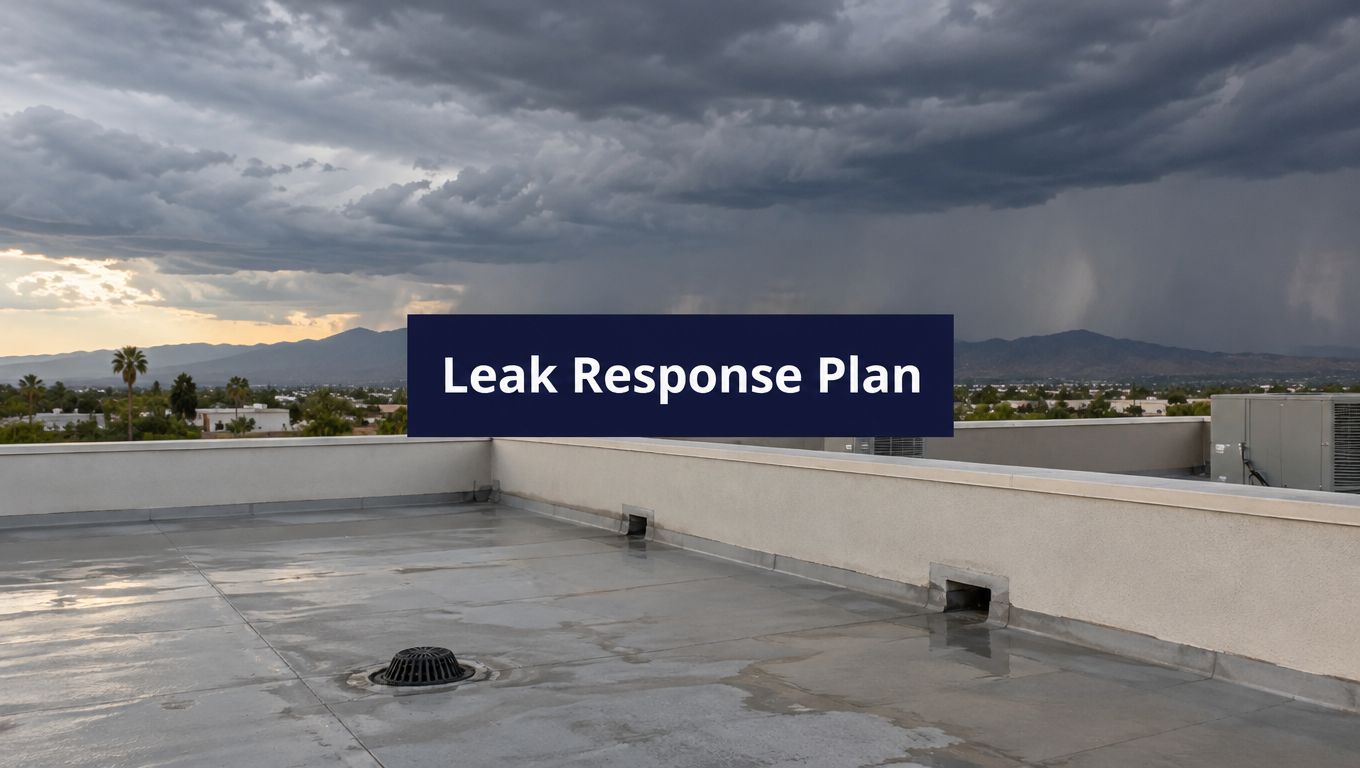
A commercial roof leak response plan is a written, repeatable procedure that protects occupants first, contains interior water second, documents the event third, and only then brings in the roofer for permanent repair. In Phoenix and Tucson, that matters because monsoon water, flat-roof drainage, and occupied buildings turn a small leak into a building-wide problem fast.
What a Commercial Roof Leak Response Plan Actually Is
A real commercial roof leak response plan is not a phone call, and it is not a bucket under a ceiling drip. It is a written procedure that tells facility staff what to do when water enters the building, who has authority to act, and when the issue stops being a maintenance nuisance and becomes a life-safety event.
In Arizona, that distinction matters. A leak can start at a flashing, seam, drain, curb, or perimeter detail and show up somewhere else entirely inside the building, especially on flat roofs with hidden pathways. Roof systems are only a small part of a building's construction cost, yet the NIST report says they account for about 50% of building-related lawsuits cited in the report, and low-slope roofs fail early often enough that the report treats leaky roofs as a major operational problem. That is why the plan has to cover rapid escalation, interior protection, documentation, and permanent corrective action, not just a temporary patch. NIST technical report
What the plan has to do
The plan should answer four questions without hesitation:
- Who makes the first call? The facility incident lead, not the tenant, not the roofer, and not the most junior employee on site.
- What gets protected first? People, then electrical and mechanical hazards, then inventory, contents, and records.
- What gets documented? Time, weather, affected areas, photos, and what the staff touched before help arrived.
- Who closes the file? The roofer, after the source is found and corrected, not when the ceiling stain dries.
Practical rule: if the building team can't say who shuts down access, who isolates hazards, and who records the event, there is no response plan yet. There's only a hope that someone reacts well under pressure.
Phoenix and Tucson facilities need this because monsoon storms expose weak drainage, old repairs, and fragile details on flat roofs, foam roofs, coatings, tile transitions, and parapet edges. A generic checklist misses those system differences. A strong plan is written for the roof on the building, the tenants inside it, and the storm pattern outside it.
A useful internal reference point is commercial roofing in Arizona, because the leak plan should sit inside the building's broader roof maintenance workflow, not stand alone.
The First Ten Minutes Life-Safety and Stop-Work Rules
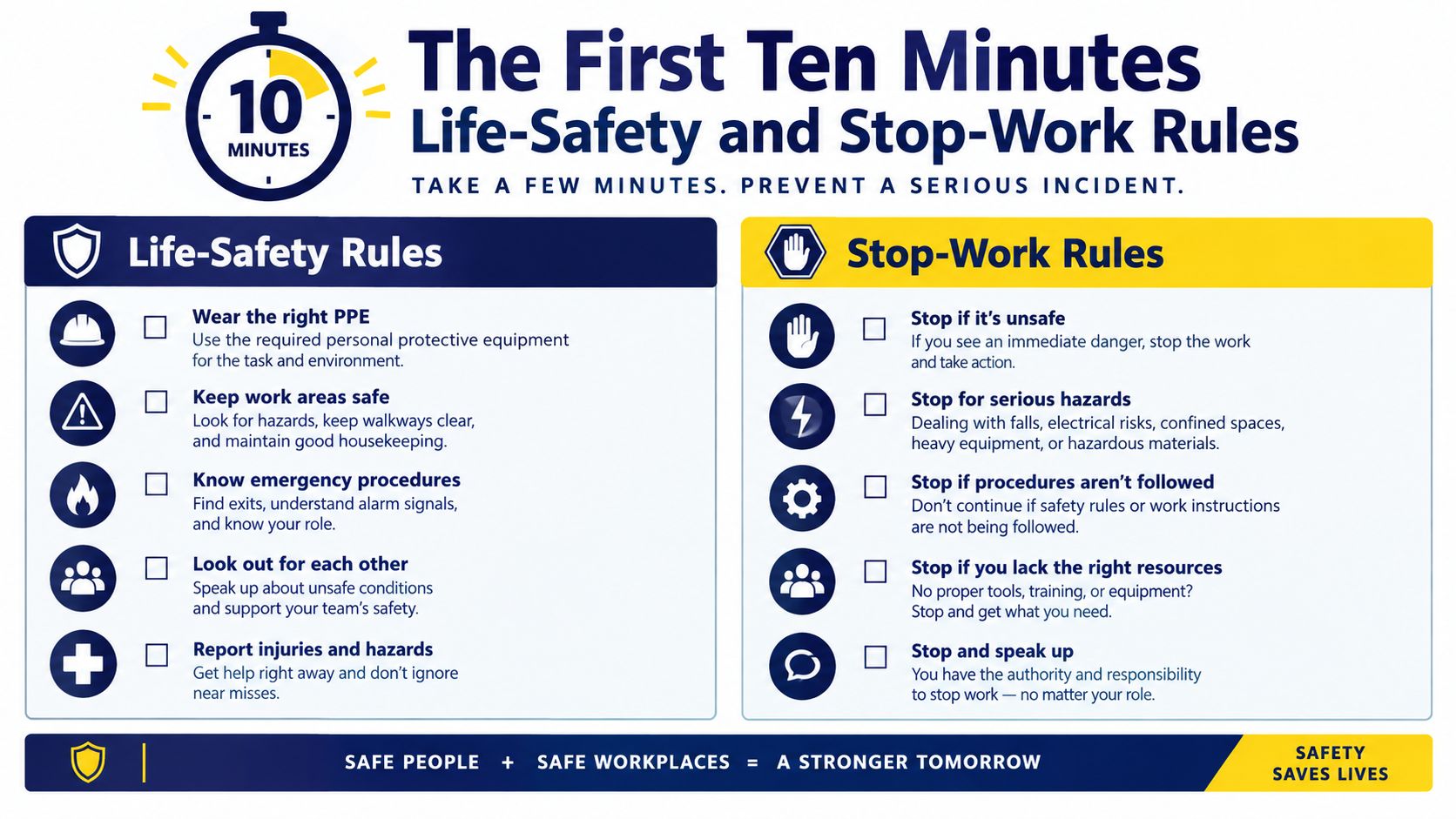
The first ten minutes are about keeping people out of trouble, not getting to the roof. If there's active water inside, the facility team should move occupants away from sagging ceilings, bucket or pan the drip if it can be done safely, and keep people clear of anything wet that could carry electrical risk. If a ceiling is bulging, nobody should stand beneath it.
Electrical isolation comes early. OSHA says that if wiring has been under water, insulation is burning, wires are frayed, or sparks are present, the building electrical system should be turned off and lockout/tagout procedures followed before work begins, and power should not be restored until a qualified electrician has inspected the equipment. OSHA storm cleanup guidance
Monsoon stop-work rules
Phoenix and Tucson roofs are not work sites during lightning or flash flooding. The National Weather Service says lightning is dangerous whenever thunder can be heard, and people should remain sheltered for 30 minutes after the last thunder. It also says flash floods can develop rapidly and that people should move to higher ground immediately rather than spend time saving property. Tucson monsoon safety Arizona flash flood guidance
That means no ladder climb, no rooftop walk, no drain check from the membrane, and no crossing a flooded parking area to “just take a look.” Staff can still do useful work inside. They can receive tenant reports, mark the affected rooms, protect contents, and keep people away from wet ceilings and puddled floor areas.
Use this rule: if thunder is audible, the roof is off limits. If water is near electrical gear, the circuit gets isolated by the person named in the plan, and the electrician is called. If the ceiling looks unstable, the area gets cleared.
A useful Arizona-specific reference is the roof leak monsoon response steps, because monsoon safety should be built into the building's response playbook, not improvised after the drip starts.
Matching Leak Severity to the Right Response
A leak is not one thing. A single drip in an office and standing water over electrical equipment are different events and should not be treated the same way. A severity matrix removes the guesswork and keeps staff from underreacting or overreaching.
| Leak Scenario | First Responder | Staff Action | Escalate When |
|---|---|---|---|
| Active electrical hazard or standing water on equipment | Facility incident lead and electrician | Clear the area, isolate the space, shut down affected circuits if authorized | Immediately, before any cleanup |
| Ceiling saturation with sagging material | Facility staff, then qualified roofer if needed | Restrict access, keep people away from the sagging area, document conditions | At once, if collapse risk is visible |
| Isolated drip in a non-critical room | Facility staff | Place containers, protect contents, photograph the area, log weather | If the drip repeats or spreads |
| Recurring leak at the same interior location | Facility lead and qualified roofer | Record prior repairs, map the repeat location, stop temporary-only thinking | After the second repeat event or sooner if damage grows |
| Widespread storm entry across multiple rooms or suites | Facility lead, property owner, roofer, insurer | Protect occupants and contents, document the event, preserve access control | Immediately after interior stabilization |
The right responder matters because the source isn't always under the drip. Roof leaks often begin at details, not broad membrane field areas, so the building team should not assume the ceiling stain points to the problem spot. One Arizona repair move that may follow is commercial roof repair, but only after the building has been stabilized and documented.
A recurring leak is not a cleanup problem anymore. It is a diagnosis problem, and diagnosis should be assigned to the roofer, not guessed by staff with a mop.
The decision standard is simple. If the event threatens people, electricity, or the structure, it escalates fast. If it's an isolated drip with no hazard, staff can contain and log it while a roofer is scheduled.
Building the Incident Log and Role Matrix
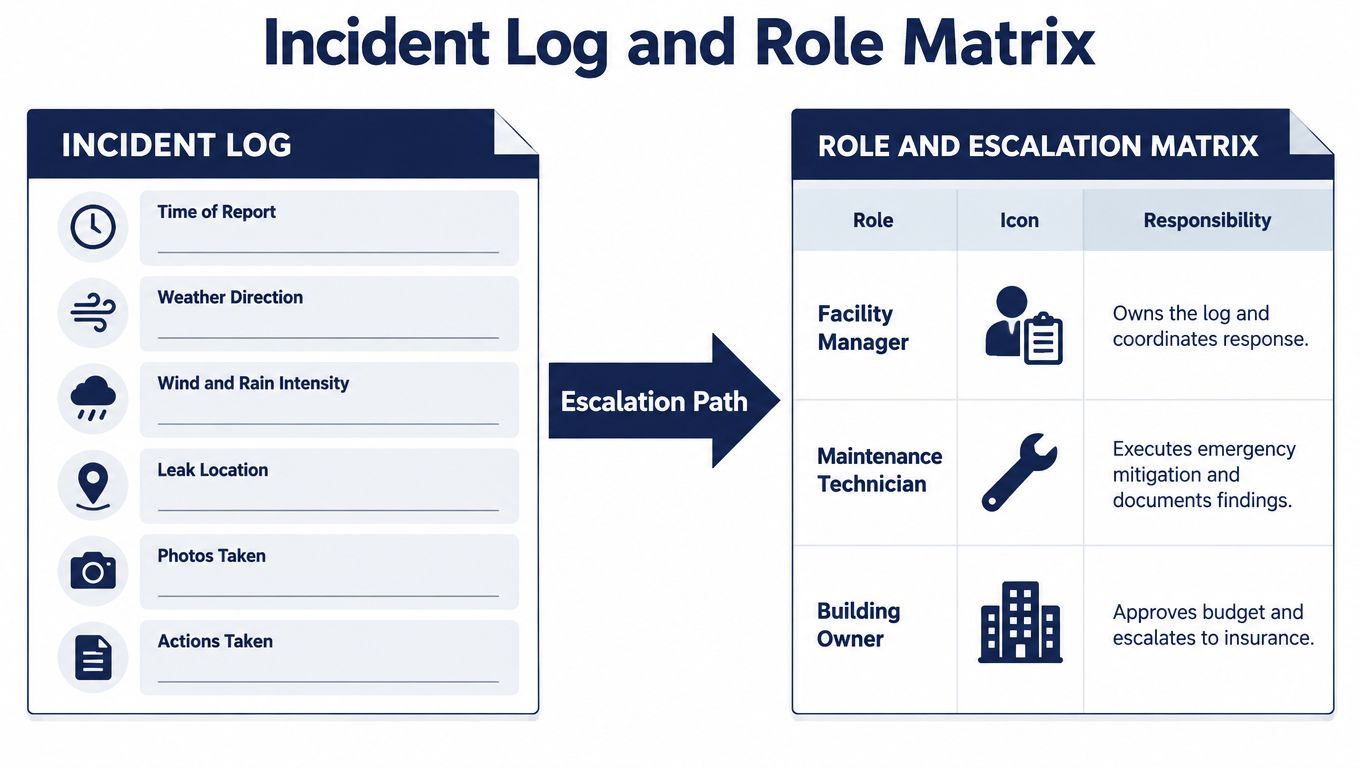
A leak response fails when nobody owns the record. Put a one-page incident log and a role-and-escalation matrix in the plan, on the wall, and in the hands of the facility team. Those two documents keep the event grounded in facts instead of memory.
What the incident log should capture
The log should capture the time of report, weather direction, wind and rain intensity, interior grid location, affected suites or equipment, photos from multiple angles, and any recent rooftop work or contractor activity. That last field matters because a fresh repair, service visit, or rooftop access event can change the investigation.
A practical log also includes:
- Room or suite ID: Match the affected area to tenants and assets.
- Drip map location: Identify repeat leaks fast.
- Immediate actions taken: Buckets, barriers, shutoffs, protective moves, and who did them.
- Source suspicion: Drain, flashing, seam, curb, roof edge, or unknown.
- Contact chain: Who was called, when, and in what order.
Keep the language tight. If the roof leak reaches the log as a vague note, the next shift will inherit a guessing game.
Who owns the role matrix
The role matrix should list occupants who report leaks, the facility incident lead, a backup contact, the electrician, the qualified roofer, the insurer contact, and the property owner or asset manager. It should also show who can restrict access, approve temporary mitigation, and release the area after repairs.
That matrix belongs with a facility map showing roof hatches, drains, electrical rooms, fire-alarm panels, sprinkler controls, shutoffs, and emergency contacts. Staff need those locations in one place, not scattered across drawers and inboxes. Plan post-storm evaluation in advance so the inspection workflow is organized before a crisis, not invented in the moment.
Monsoon season needs a stop-work rule. If the roof is taking active weather, keep nonessential staff off the roof and keep the response focused on containment, access control, and documentation. The goal is to prevent a water event from becoming a secondary hazard problem, not to force a quick patch that no one can safely verify.
Roofer Workflow, Documentation, and Temporary Repairs
Once the roofer arrives, the inspection has to start at the roof system, not the stained tile below it. That means checking drains, scuppers, parapets, seams, penetrations, rooftop equipment curbs, and prior repair areas. The visible drip often trails the source by a surprising distance.
Temporary work and permanent repair are not the same thing. A temporary fix may be a patch, sealant at a flashing, or a drain protection measure to stop immediate entry. A permanent repair may require flashing rebuild, seam replacement, or a section reroof, depending on what failed and how the roof system is built.
What to expect from a qualified roofer
A proper roofer should give written findings, photos, and a clear description of what is temporary versus permanent. The inspection scope should stay tight enough that the documentation supports a later insurance review and doesn't blur emergency mitigation with final repair.
During monsoon season, the roofer should be asked to stabilize, document, and close the water entry point safely, not to rush into a broad repair that can't be verified in unsafe weather. The building team should keep the file clean, preserve the inspection photos, and avoid letting temporary measures get mislabeled as final work. For short-duration mitigation, a practical starting point is temporary flat roof patch solutions.
Clear boundary: staff contain the interior problem. The roofer locates and corrects the roof problem. Mixing those jobs creates sloppy records and longer downtime.
For Arizona buildings, the right question is not “How fast can someone smear sealant on it?” It's “Did the inspection identify the failed detail, and did the repair match the failure?” That is the standard that protects the building and keeps repeat leaks from becoming a pattern.
Insurance Claim Readiness and Evidence Preservation
Documentation belongs in the response file the same day the leak is found. FEMA's business-interruption guidance points to the records that matter, including insurance documents, business plans, licenses or compliance documents with service addresses, contracts, tax statements, and profit-and-loss statements. For a commercial roof leak, add dated photos or video of ceiling stains, active dripping, damaged contents, roof surfaces, drains, and the temporary protection used to control the water. FEMA business interruption documentation
Keep the file tied to facts the insurer can verify. Record weather alerts, the time the leak was discovered, tenant notifications, mitigation invoices, and the roofer's findings. In a multi-tenant building, identify the suite, room, asset, and responsible tenant every time. If the damage cannot be tied to a location and occupant, the claim file is weak.
Do not throw away the wrong evidence
Wet ceiling tiles, insulation, carpet, and packaging should stay in place until the roofer and insurer have documented them, unless safety or sanitation forces immediate disposal. Those materials show how far the water traveled and how severe the event was. Quick cleanup can make the space look better while damaging the record.
A strong evidence file answers three questions: what was damaged, when it happened, and what the building team did before permanent repair began. It also keeps emergency mitigation separate from permanent repair, which is how the claim should read during review.
A storm damage roof inspection from a qualified professional helps anchor that file to the actual roof condition, not guesswork. A useful internal reference is storm damage roof inspection, because the post-event record should be built around what the roof showed, not what someone assumed from the ceiling alone.
Turning the Plan Into a Maintenance and Training Program
A leak plan works only if the building uses it before the next storm. The simplest way to do that is to fold it into a maintenance cycle: inspect twice a year, trigger a documented post-storm check within 48 hours of major hail or high winds, and run the response log in a short staff drill so new people know their role.
The point is not paperwork for its own sake. It is pattern recognition. Recurring leak locations tell the facility team where the roof is aging out, where drainage is weak, and where a spot repair is becoming a bigger capital decision. On flat or foam roofs, repeated leak points deserve serious attention because a patch-only approach can drag out the problem and complicate closeout.
What the next 90 days should include
- Print the three core forms: incident log, role matrix, and severity matrix.
- Post the facility map: roof access points, drains, electrical rooms, fire controls, and shutoffs.
- Assign backups: so one absent employee doesn't break the response chain.
- Schedule the next inspection: before and after monsoon season.
- Train the team: use a simple drill that walks through report, containment, logging, and handoff.
For a commercial property in Phoenix or Tucson, that routine is the difference between a manageable event and a recurring building problem. It also gives ownership a real basis for repair-versus-replacement decisions when a roof keeps coming back with the same complaint.
If your Phoenix or Tucson property needs a clearer leak-response workflow, America Roofing handles commercial roof repair, leak response, and roof inspections for Arizona buildings. Call 602-237-2478 or request a roofing estimate through America Roofing to get the roof checked, documented, and corrected before the next storm turns a small leak into a larger shutdown.