
A commercial roof warranty stays valid only when the owner follows that warranty's written maintenance duties, including documented inspections, prompt written leak notice, approved repairs, and written approval before alterations. Twice-yearly inspections are a practical baseline, but maintenance without dated evidence can still leave an owner facing a preventable coverage dispute.
What Your Warranty Requires and Who Owes Each Duty
Commercial roof warranty maintenance requirements start with the contract, not a general checklist. A roof can have active coverage without every leak qualifying for a covered repair.
The NRCA consumer advisory on roof system warranties explains that warranties generally cover leaks only when they result from causes identified in the document. Owners therefore need to separate their maintenance obligations from the installer's workmanship obligations and the manufacturer's coverage.
Separate the documents before assigning work
A manufacturer material warranty generally addresses defects in the roofing product. A manufacturer system warranty may address a broader assembly, subject to its listed components, covered causes, and exclusions. A contractor workmanship warranty addresses installation-related failures, such as improperly completed seams, flashings, or terminations.
Those documents can name different responsible parties and impose different conditions. A maintenance contractor's invoice doesn't establish that the manufacturer authorized the repair.
Warranty-document crosswalk: who owes each maintenance duty
| Duty area | Owner duty | Contractor workmanship term | Manufacturer system term |
|---|---|---|---|
| Inspection and maintenance | Schedule and pay for documented inspections and keep dated reports | Covers installation defects for the period the contract states | Lists required maintenance conditions; confirm the inspection interval |
| Drains and debris | Clear drains, scuppers, and debris on the required schedule | Addresses drain and flashing details the installer built, within its terms | Covered material defects are distinct from ponding or debris damage, which may be excluded |
| Rooftop traffic and alterations | Obtain written approval before new penetrations, equipment, or heavy traffic | Addresses the installer's own penetrations and details | Check exclusions for unapproved penetrations and traffic damage |
| Leak reporting | Give written notice within the required period | Identifies workmanship leaks the contractor must investigate | Identifies covered causes and the required claim recipient |
| Repairs and materials | Use approved methods, materials, and qualified personnel | Confirm how repairs by others affect the term before work | Confirm material compatibility and repair authorization requirements |
| Records | Retain inspections, photographs, invoices, and approvals for the full term | Preserve project closeout and workmanship records | Preserve product data and approved system documentation |
Every cell should be confirmed against the executed warranty. The table organizes the review; it doesn't expand coverage.
Assign responsibility rather than assuming it
The owner or facility manager should identify who schedules inspections, who authorizes repairs, and who submits claims. The maintenance agreement should also identify who escalates a defect that threatens the building interior.
America Roofing explains roof warranties as a starting point for understanding the documents, but the roof's actual contracts control.
File test: A complete warranty file shows when the roof was inspected, where the defect was found, and who approved the corrective work.
Routine Inspection Duties Your Warranty Expects
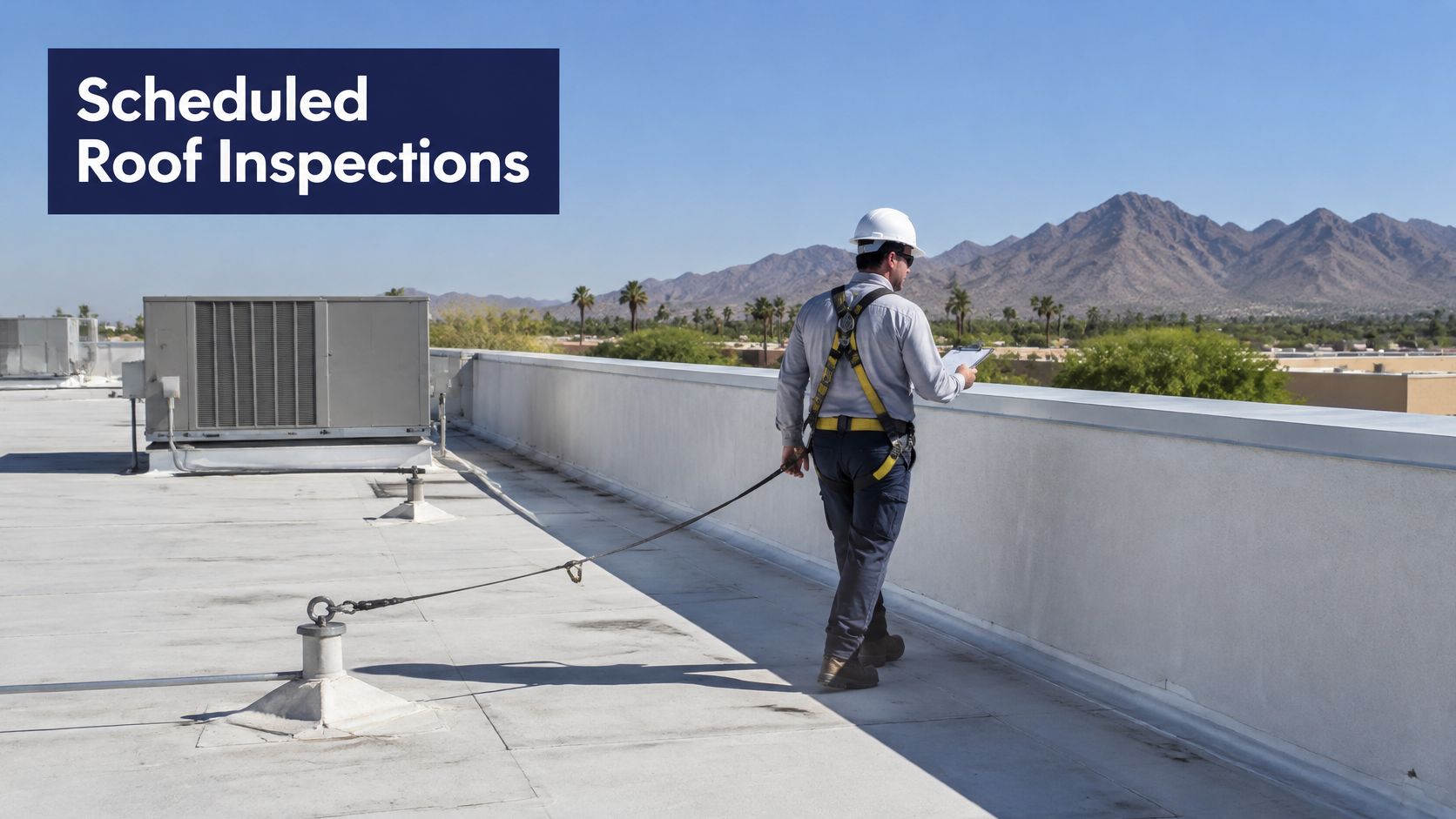
The NRCA maintenance guidance identifies twice-yearly inspections, preferably in spring and fall, as a baseline, with additional inspections after severe weather, before and after roof-adjacent construction, and when building conditions change. The exact warranty may prescribe a different schedule or inspection provider.
Match the inspection to the roof system
- Low-slope membrane roofs: Examine the covering, seams, flashings, penetrations, edge metal, parapets, adjacent walls, drainage components, and equipment bases. The report should identify punctures, loose details, and inaccessible areas.
- Foam and coated roofs: Check for cracks, blisters, bare areas, chalking, and worn topcoat. Record the affected locations rather than treating every surface change as proof that recoating is appropriate.
- Tile and sloped roofs: Check displaced or cracked pieces, valley metal, and penetration flashings. State clearly that concealed underlayment wasn't inspected unless tile was lifted through an authorized investigation.
Insulation usually isn't visible during a surface walk. A credible report distinguishes observed conditions from concealed conditions instead of declaring the whole assembly sound.
Require an actionable report
Each finding needs a roof-plan location, photograph, severity, proposed action, and closeout status. Commercial roofing condition assessments can help distinguish a localized repair need from a broader investigation or reroofing decision.
Roof access belongs with personnel using appropriate fall protection and designated walking routes. Wet coatings, fragile surfaces, unsafe access, or uncertain footing are reasons to postpone a roof walk, not improvise one.
Drain, Ponding and Debris Care Through Monsoon Season
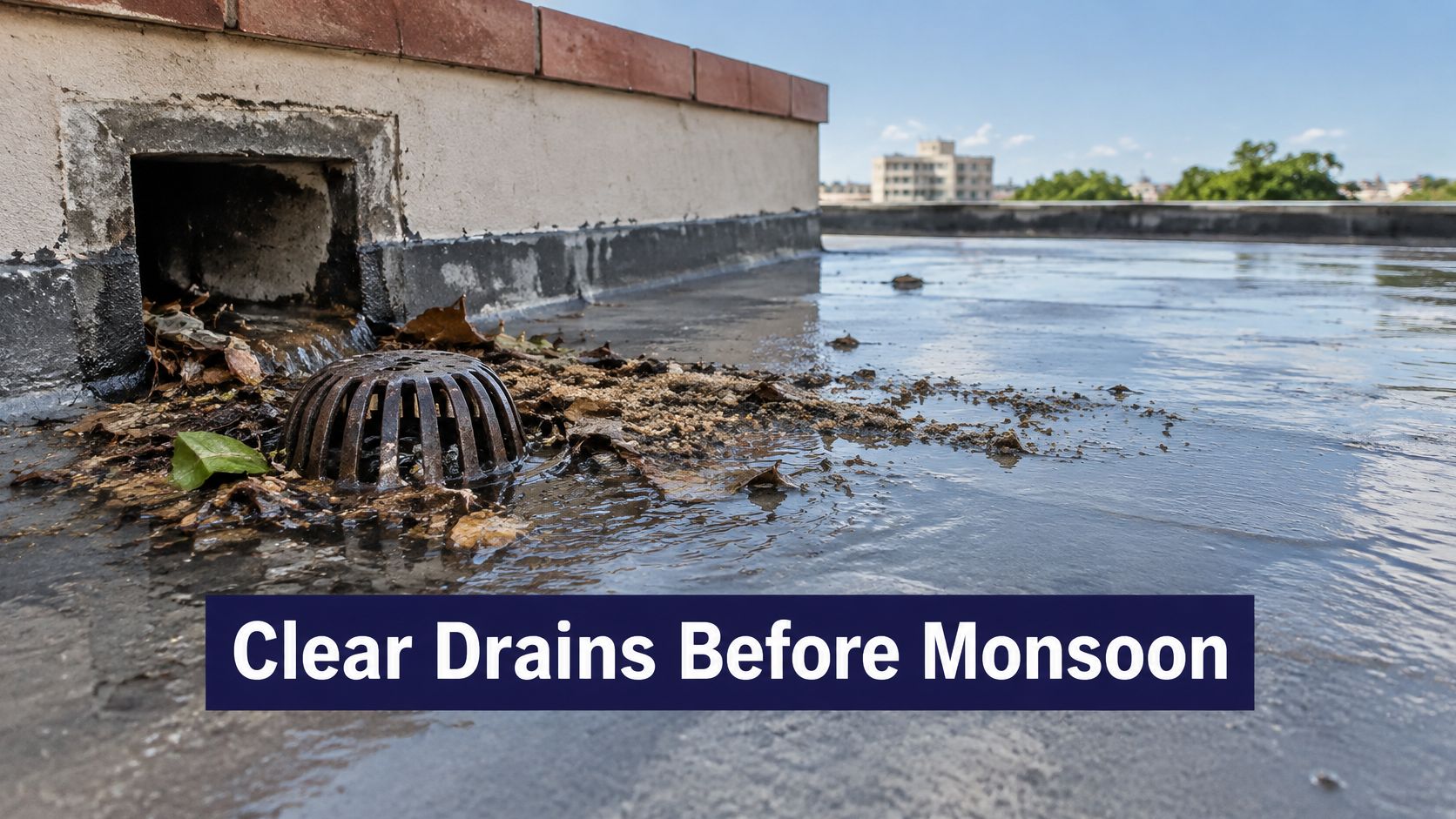
On Phoenix and Tucson low-slope roofs, windblown dust, sand, leaves, and loose debris can collect at drains and scuppers. Monsoon rain can then push that material into the outlets when the roof most needs unrestricted drainage.
Ponding means standing water remaining after the roof should have drained. The warranty's definition and exclusions control; a property manager shouldn't borrow a drainage threshold from another roof's contract.
Use a repeatable pre-monsoon routine
- Clear roof drains, scuppers, and overflow outlets.
- Check strainers and remove material from drain bowls without pushing it into the piping.
- Inspect sealant, flashing, and coating around drain bases and edges.
- After major storms, have a qualified crew document known low points, including a measuring stick in photographs where safe.
- Remove accumulations against parapets and walls.
- Record weather, findings, cleaning, and remaining corrective work together.
A clogged outlet behaves like a blocked kitchen sink: sound surrounding materials don't make the obstruction disappear. Guidance on spotting ponding and blocked roof drains helps owners recognize conditions that need professional attention.
Arizona heat and UV exposure also make surface condition important. Cracked sealant, exposed foam, or a worn coating near an outlet warrants evaluation against the installed system's maintenance instructions.
Cleaning restores an obstructed outlet. It doesn't correct a low area caused by roof configuration or an underlying building problem.
Crews shouldn't clear drains during lightning or while standing in accumulated water. Persistent ponding after cleaning calls for investigation, not repeated surface patches or an unapproved coating.
Rooftop Work, Repairs and Leak Notice Rules
A service trade can finish its equipment work while leaving the roof owner with a warranty problem. New supports, mounting brackets, conduit, pipes, and signage attachments can introduce penetrations or damage existing details.
The mistake is treating roofing approval as paperwork that can wait until after installation. Written authorization needs to precede work whenever the warranty requires it.
Control the work before and after access
- Before access: Send the proposed scope and roof-plan location to the required approving party. Establish walking paths, staging areas, surface protection, and responsibility for roofing details.
- After completion: Have the affected areas inspected. Confirm approved flashing and repair materials were used, photograph the finished details, and retain the trade's work order.
- For temporary patches: Identify their locations, materials, purpose, and installation date. A temporary measure shouldn't become an undocumented permanent repair.
The IBHS commercial roof inspection and maintenance guide supports keeping thorough inspection, maintenance, and repair records for warranty and insurance purposes. Those records are particularly useful when storm damage and later trade activity overlap.
Treat notice as a separate task
Leak notice must reach the recipient named in the warranty through the required method and within its stated deadline. Calling the installer alone may not satisfy a manufacturer's notice requirement.
Notice should identify discovery date, roof location, photographs, interior effects, and temporary protective measures. Keep proof of delivery with the claim file.
Arrange commercial roof leak repair through the appropriate authorization process. Protecting an occupied space matters, but a bucket and an undocumented patch leave little evidence for a later coverage review.
Maintenance Record Template for Warranty Files
Maintenance record template for each visit
| Field | What to record | Why it matters |
|---|---|---|
| Date | Visit date, start and end time, and visiting company | Shows whether the maintenance interval was kept |
| Weather | Recent rain, wind, hail, and temperature, including the preceding forty-eight hours as a useful log field | Helps distinguish storm-related observations from existing conditions |
| Roof area | Roof identifier, zone, and roof-plan reference | Locates findings on large or multilevel roofs |
| Finding | Condition, severity, measurements, and observed ponding depth | Documents what was observed and when |
| Photos | Wide and close views, labeled and dated, from consistent reference points | Shows location and change over time |
| Repair authorization | Approver name, written approval date, and approved scope | Demonstrates authorization before work |
| Closeout proof | Invoice, completion photographs, materials used, and technician name | Shows completion and identifies the stated repair materials |
The weather lookback is a practical recordkeeping choice, not a universal warranty deadline. Every entry should distinguish known facts from estimates or information reported by others.
Make each entry traceable
For a defect near a drain, “south roof leak” isn't enough. Record the roof-plan zone, drain identifier, observed condition, and photograph labels so another contractor can locate the same detail.
Wide photographs establish location; close photographs establish condition. A completed invoice should match the authorized scope and include completion evidence, not merely say “roof repaired.”
Evidence standard: A repair isn't administratively closed until the file shows what was authorized, what was completed, and what remains unresolved.
Keep a separate file for each roof with a backup copy. Store the executed warranty, roof plan, product information, approvals, inspection reports, and claim correspondence together, and transfer the file whenever ownership or management changes.
Confirm the Written Warranty Before You Schedule Work
The cheapest maintenance proposal isn't necessarily the least expensive choice. A cleaning-only visit may leave the owner without inspection evidence, authorized repairs, or a usable report.
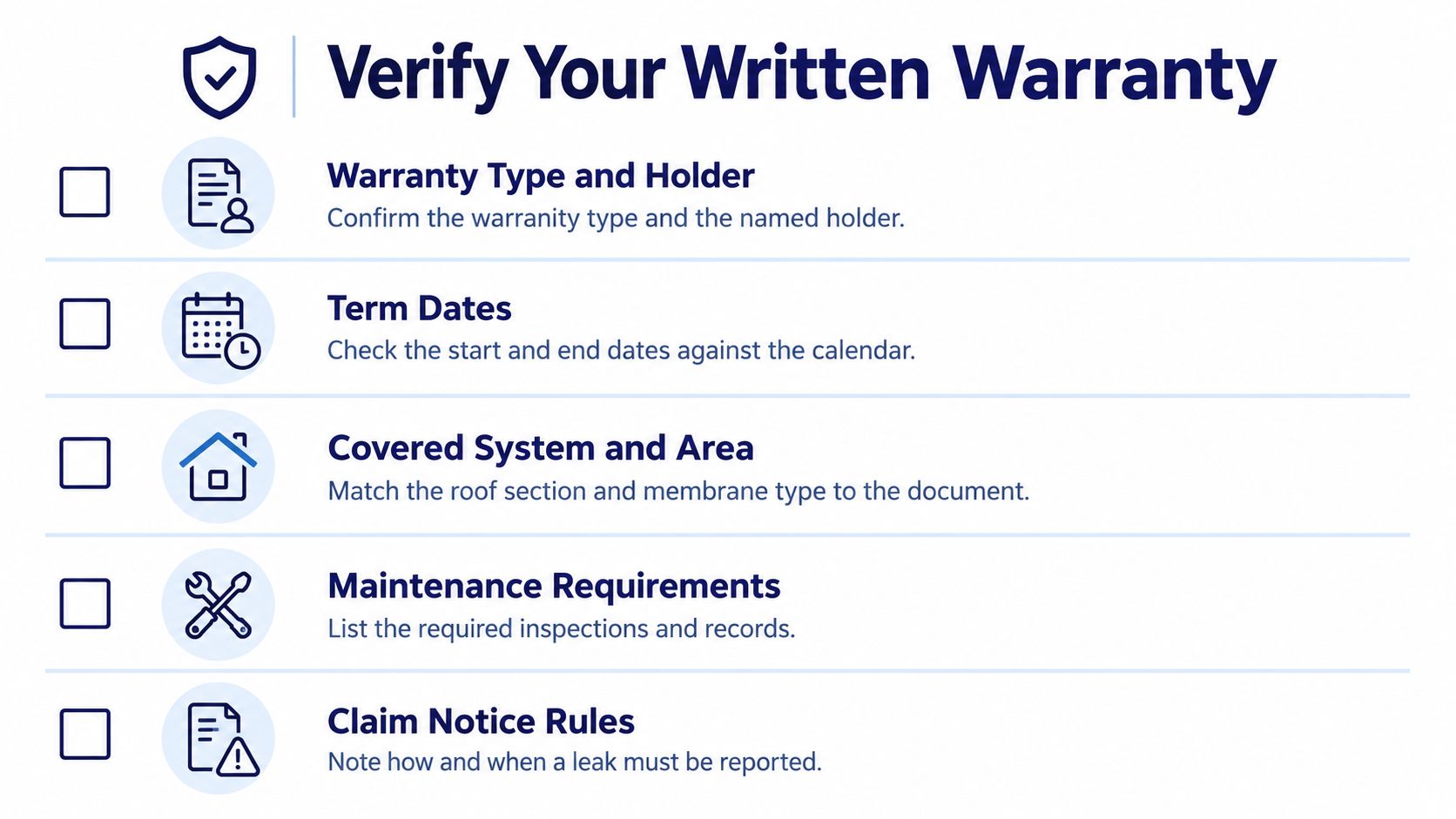
Before scheduling work, the facility manager should verify the following against the executed documents.
- Coverage identity: Warranty type, named holder, covered system, and covered roof area.
- Effective period: Start and end dates, registration status, and transfer requirements.
- Maintenance conditions: Inspection interval, required tasks, and any approved-contractor requirement.
- Alteration rules: Authorization requirements for penetrations, equipment, coatings, and repairs.
- Claim administration: Notice deadline, recipient, delivery method, required evidence, and claim process.
- Exclusions: Ponding, traffic, storm damage, and other listed limitations.
Turn those conditions into the maintenance agreement
The agreement should require dated reports, photographs tied to the roof plan, scheduled drain and scupper cleaning, rooftop housekeeping, and traffic-control procedures. It should also identify who approves repairs and how urgent defects reach the person authorized to act.
For an aging roof, require a distinction between maintenance, repair, and replacement recommendations. A coating shouldn't be proposed solely because the surface looks old, and an active warranty shouldn't substitute for investigating repeated leaks.
A recurring commercial maintenance program can organize these responsibilities, but its scope must match the roof's documents. If the file is incomplete or the warranty can't be located, the owner can request a roofing estimate or call 602-237-2478 to discuss an inspection.
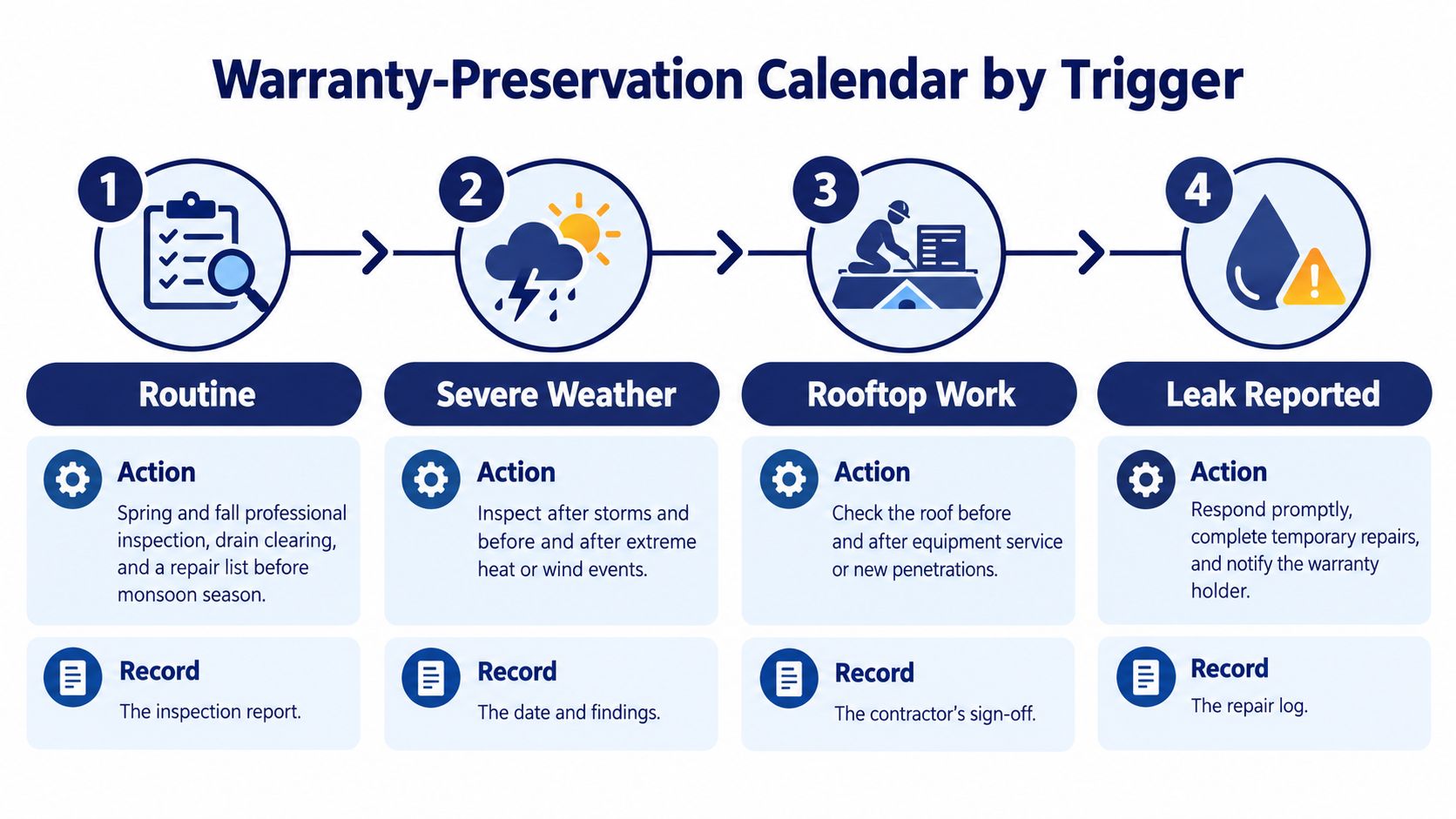
Warranty-Preservation Calendar by Trigger
Warranty-preservation calendar for commercial roofs
| Trigger | When it applies | Required action | Records to file |
|---|---|---|---|
| Routine | Spring and fall, with pre-monsoon preparation aligned to the warranty schedule | Professional inspection, drain and scupper clearing, debris removal, repair list | Dated report, roof-plan photographs, repair list |
| Post-storm | After high wind, heavy rain, or hail | Check drains, low spots, edges, and flashing; initiate required notice if a leak appears | Photo log, weather notes, written notice when needed |
| Post-rooftop-work | After equipment, solar, signage, or other trade work | Verify prior approval, inspect penetrations, and confirm walking routes were restored | Approval, work order, post-work photographs, closeout |
| Annual document check | Yearly and at ownership or management changes | Confirm term, registration, maintenance interval, contractor rules, notice address, and claim process | Updated file index, registration evidence, contact list |
This is a planning template, not an independent set of warranty conditions. The NRCA roofing resources recommend inspections twice annually, in spring and fall, with additional inspections after major weather events; the executed warranty determines contractual obligations.
Give each trigger an accountable owner
The shared building calendar should identify the responsible person, service provider, expected report, and follow-up date. A scheduled visit without someone responsible for closing the repair list leaves the process unfinished.
For portfolios, the same template can support roof upkeep for Tucson businesses and Phoenix properties while preserving separate requirements for each roof. Different systems on the same building may need separate approvals and records.
When a leak is discovered, the notice deadline should become a dated task immediately. Staff shouldn't wait for a routine inspection or the annual file review to begin claim administration.
Recap and Next Step
The strongest warranty-preservation process joins physical maintenance with evidence that another person can verify. Neither a clean roof without records nor a complete file with unresolved defects is enough.
- Pull the executed warranty for every roof system and confirm the holder, coverage, dates, maintenance conditions, notice rules, and alteration requirements.
- Assign inspection and event-triggered tasks in the building calendar, using the document's intervals and named responsible people.
- Confirm written approvals before penetrations, equipment installation, significant traffic, or repair work begins.
- Close each visit with located findings, labeled photographs, authorization, and completion evidence.
- Review the file during the annual administrative check and whenever ownership or management changes.
If documents are missing, start by identifying the system and recovering the warranty before authorizing elective work. If active damage is present, arrange professional evaluation and preserve evidence while the required parties determine the appropriate repair and claim process.
America Roofing offers commercial roof inspections, maintenance, repairs, coatings, and reroofing for Phoenix and Tucson properties. Visit America Roofing to discuss roof condition, documentation gaps, and the appropriate next step without assuming a repair will qualify for warranty coverage.