
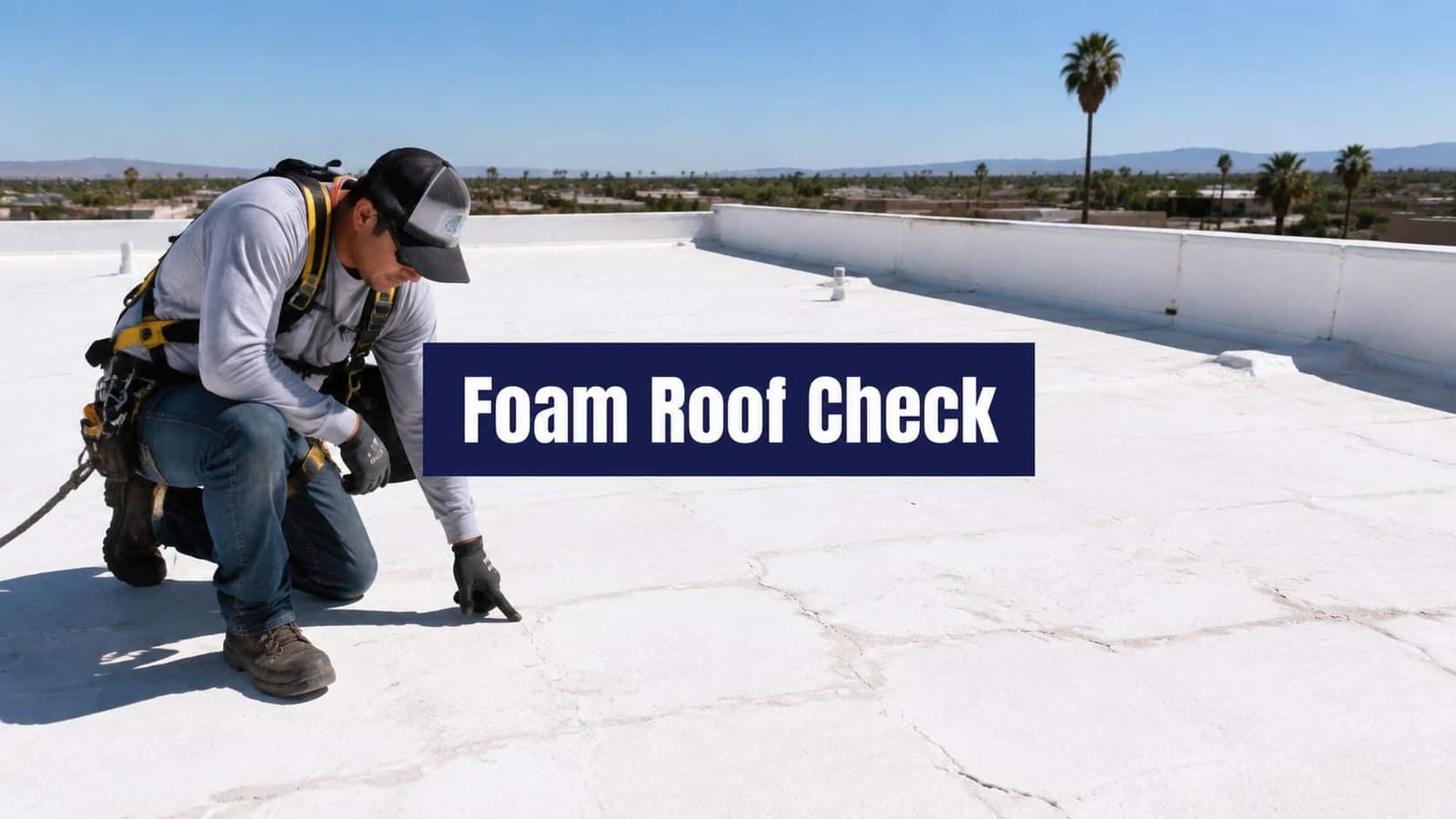
Chalking, cracking, blistering, open seams, ponding, soft foam, and failed flashing are the main signs a foam roof needs recoating, while softness, active leaks, and widespread blistering require prompt professional assessment. A typical recoat interval is about 10 to 20 years, although some systems need attention sooner depending on coating thickness, sun exposure, climate, and wear.
A foam roof in Phoenix or Tucson often gives visible warnings before the foam core fails. That doesn't mean every worn-looking area needs a complete replacement. It means the protective coating, drainage, seams, or penetrations need a closer evaluation before Arizona UV exposure and monsoon rain turn manageable maintenance into deeper roof damage.
The safest starting point is a view from the ground, a nearby upper window, or another secure location. A visual check can identify surface changes, but it can't confirm hidden moisture, adhesion loss, or deteriorated foam. The decision may involve targeted repair, recoating, localized foam restoration, or replacement.
1. Loss of Reflectivity and Chalk Buildup on the Coating Surface
A bright white foam roof that becomes dull, gray, beige, or uneven may be losing the protective quality of its topcoat. Chalking is more specific than ordinary dirt. The coating turns powdery as it oxidizes and thins, leaving white or gray residue when rubbed.
That matters in Phoenix and Tucson because the coating is the foam's primary barrier against ultraviolet exposure. As the surface loses reflectivity, it may absorb more heat and provide less protection to the foam beneath. Property owners who want to reduce heat with cool roofs should treat reflectivity loss as a maintenance signal, not just a color problem.
A simple observation can help identify chalking, but it shouldn't involve climbing onto an unsafe roof. Binoculars, photographs from a secure location, or a professional inspection can show whether the change is isolated or widespread.
What property owners can look for
- Powdery residue: A gloved, light-colored hand may pick up white or gray dust from the coating. Avoid testing areas that are steep, wet, soft, or otherwise unsafe.
- Uneven color: South- and west-facing roof sections often show more weathering than shaded areas because they receive stronger sun exposure.
- Loss of shine: A surface that once looked uniformly bright may appear flat, weathered, or visibly thinner.
- Exposed substrate: Brown or yellow foam showing through means the protective layer has already been lost in that location.
Practical rule: Chalking is an early warning sign. Exposed foam is more urgent and needs prompt evaluation rather than routine monitoring.
Isolated chalking may justify documentation and targeted maintenance. Widespread chalking, visible thinning, or color change around drains and penetrations usually means the contractor should assess coating thickness, adhesion, and repairs before applying a new coat.
2. Visible Cracks, Splits, or Crazing in the Coating
Fine surface crazing can look minor from a distance, but it shows that the coating is losing its ability to move with the roof system. Larger splits, open cracks, or an alligator-like pattern indicate more advanced surface deterioration.
Arizona roofs experience strong heat, intense UV exposure, dust, and sudden weather changes. Coatings expand and contract with the roof assembly, and repeated movement can eventually leave cracks at penetrations, transitions, seams, and areas exposed to foot traffic. Once a crack reaches through the protective layer, monsoon water has a path into the foam.
A cracked coating doesn't automatically mean the entire roof needs replacement. A professional may be able to repair isolated cracks, correct the underlying detail, and recoat the system. The decision changes when cracks cover broad areas, return after spot repairs, or appear alongside moisture, soft foam, blisters, or open seams.
Safe observation and professional limits
Property owners can photograph cracks from a safe location and note whether they're concentrated near a drain, parapet, penetration, or low spot. A contractor can then determine whether the cracks are superficial, connected to failed flashing, or evidence of broader adhesion and moisture problems.
The roof shouldn't be pressure-washed or hose-tested by a homeowner. Water forced into a crack can worsen intrusion, and walking across a damaged foam surface can enlarge the failure.
A crack is not just a line in the coating. It's a possible break in the roof's UV and moisture barrier.
A Phoenix homeowner may see fine crazing across an exposed roof field, while a Tucson warehouse may show deeper cracking near a parapet transition. Those situations need different preparation and repair decisions. Before recoating, the contractor should identify the cause, remove loose material, repair damaged foam or flashing, and confirm that the remaining coating can accept the new system. Proper long-term care for foam roofs depends on repairing the substrate first, not sealing defects underneath a fresh finish.
3. Blistering, Bubbling, or Delamination of the Coating
Blisters are raised bubbles in the coating. Delamination occurs when the coating separates from the foam or another coating layer, sometimes peeling in patches. Both indicate that the surface is no longer bonded continuously to the roof below.
Moisture can enter through cracks, failed flashing, open seams, or ponding areas. Arizona heat then warms the trapped moisture, creating vapor pressure beneath the coating. The result may be a hollow bubble, a soft raised area, or a section that peels away from the foam.
Blistering deserves more caution than ordinary chalking. A small, isolated blister may be repairable if the underlying foam is dry and sound. Widespread blistering, ruptured bubbles, darkened foam, or delamination around low spots can indicate that moisture has moved beyond the surface.
What not to do
- Don't pop blisters: Opening a bubble creates another path for rain and dust to enter.
- Don't cover them immediately: New coating over a loose or wet section can trap the problem beneath the surface.
- Don't rely on appearance alone: A blister can conceal moisture or adhesion loss that isn't visible from above.
- Don't walk across clustered damage: Foot traffic can rupture the coating and compress weakened foam.
A professional may use moisture-meter readings, non-destructive moisture surveys, or core and slit sampling where suspect areas require confirmation. Those tests help determine whether the roof is still a candidate for recoating or whether damaged foam must be removed and restored first. Owners comparing options should ask for both a restoration scope and a replacement-related scope when blistering is extensive. That comparison is especially important for commercial buildings, where hidden damage around equipment curbs and drains can affect the entire work plan.
For commercial owners, these commercial foam roof repair tips are most useful when paired with an on-roof assessment. A coating contractor needs to verify the condition beneath the visible bubble before recommending a finish-only solution.
4. Seam Separation, Open Joints, or Adhesive Failure at Foam Transitions
Open seams and separated joints can turn a small coating defect into direct water entry. These failures commonly occur where foam sections meet, at parapets and roof edges, or around penetrations and transitions.
Temperature movement, UV exposure, vibration, and repeated foot traffic can stress sealants and adhesives. Dust can also collect in open joints, making it harder for a new coating to bond unless the area is cleaned and prepared correctly. During a Phoenix or Tucson monsoon, an open joint can take in water quickly, especially when wind pushes rain across a flat roof.
The key distinction is whether the separation is isolated or repeated across the system. One failed transition may need localized repair and resealing. Separation across numerous areas suggests that the protective coating and joint treatment have reached a broader maintenance stage.
Where to focus the inspection
- Roof edges and parapets: Movement and flashing transitions make these areas more vulnerable.
- Penetrations and curbs: Sealant failure can allow water to bypass the coating entirely.
- Application or board joints: Repeated separation in a pattern may point to system-wide wear.
- Traffic paths: Service access can abrade the coating and loosen sealants.
Property owners shouldn't pry open joints, measure them from an unstable roof, or run a hose over them. A roofer can document the separation, evaluate adhesion, check nearby foam for moisture, and determine whether spot repairs will hold.
A new coating can help restore continuity where the existing roof remains sound, but it won't correct a failed transition, wet foam, or damaged flashing by itself. If seams are separating throughout a commercial roof, a full preparation and recoating project may be more practical than repeatedly sealing individual joints. The written scope should identify seam repairs separately so the owner knows whether the proposal addresses the cause or only covers the symptom.
5. Ponding Water or Drainage Failure in Low Spots and Around the Perimeter
Ponding water is one of the clearest signs that a foam roof needs more than a surface review. Standing water may result from clogged drains, blocked scuppers, debris, uneven foam, settling, or structural movement. A new coating won't create slope or correct a drainage obstruction.
Phoenix and Tucson roofs face a particular test during monsoon storms. Dust, leaves, and debris can block drainage paths, while heavy rain can quickly expose low areas that remain unnoticed during dry weather. Water that repeatedly collects near a drain, parapet, or roof edge keeps the coating wet and increases the chance of intrusion through cracks and seams.
Separate drainage work from coating work
A commercial building owner should ask whether the proposal includes:
- Drain and scupper review: The contractor should identify blockages, damaged components, and poor discharge paths.
- Low-spot assessment: The roof may need moisture testing and a review of the underlying foam or structure.
- Ponding-related repairs: Soft foam, damaged coating, and failed flashings around the low area may need separate treatment.
- Replacement evaluation: Structural settlement or widespread deterioration may make recoating alone unsuitable.
A property owner can observe where water remains after rain from a safe vantage point and photograph the area. Walking into a ponded section is unsafe, especially if the foam has softened. Pouring water onto a roof or attempting to clear a blocked drain from the roof can also create avoidable risk.
A flat commercial roof with recurring drainage issues should be assessed as a system. America Roofing's foam roof Arizona service information is relevant for owners who need to distinguish coating wear from drainage, flashing, or substrate problems. Recoating may remain appropriate after the cause is corrected, but ponding over deteriorated foam calls for a broader repair-versus-replacement discussion.
6. Areas of Softness, Indentation, or Compression in the Foam Substrate
Soft foam is a serious warning because it points below the coating. Healthy foam should feel firm enough to support normal service access, while waterlogged or deteriorated foam may feel spongy, compress under limited pressure, or retain an indentation.
Moisture can weaken the foam's cellular structure after entering through surface cracks, open seams, failed flashing, or ponding areas. Compression may also develop where repeated traffic or long-standing loads have damaged the surface. A coating can protect sound foam, but it can't restore foam that has already lost its integrity.
Softness often changes the recommendation from “recoat soon” to “inspect before any coating work.” A contractor may need to determine the extent of moisture, test adhesion, take core or slit samples, and identify whether the damaged area can be removed and restored. If the affected area extends across low spots or several roof sections, replacement may be more sensible than covering isolated symptoms.
Keep observation safe
Property owners shouldn't walk across a roof to search for soft spots. A safe ground-level view may reveal depressions, discoloration, or areas that look different from surrounding foam. Interior evidence, such as ceiling staining or recurring leaks below a roof section, should also be documented for the contractor.
Safety boundary: Soft, blistered, cracked, or ponded areas aren't suitable for casual foot traffic or homeowner testing.
The practical decision depends on more than the size of a visible indentation. Moisture location, foam condition, adhesion, drainage, access, and the number of damaged areas all affect the scope. A small repair followed by recoating may work when surrounding foam is dry and bonded. Widespread softness means the coating is no longer the main problem, so a restoration or reroofing estimate should be considered.
7. Flashing Deterioration, Rust Staining, or Sealant Failure at Roof Penetrations
Flashing around pipes, vents, curbs, equipment, and other penetrations is where many foam roof leaks begin. The coating field may look acceptable while a cracked sealant joint, deteriorated boot, or corroded metal flashing allows water directly into the building.
Rust staining is a useful visual clue. It can show that water is moving over or beneath metal and carrying corrosion onto the roof surface. In Tucson and Phoenix, UV exposure can also dry and crack sealants and rubber components, while monsoon rain tests every penetration and transition.
A recoat should never be treated as a substitute for flashing repair. The contractor should inspect each penetration, determine whether the flashing can be cleaned and resealed, and replace components that are pitted, split, loose, or otherwise unable to provide a durable connection.
Warning signs around penetrations
- Rust streaks: Staining below metal flashing suggests water movement and possible corrosion.
- Cracked sealant: Shrinkage, gaps, or hardened sealant can leave an open path for rain.
- Damaged boots: Rubber collars may split or pull away from the pipe.
- Interior staining: Ceiling or wall marks below a penetration indicate possible active intrusion.
A property owner can photograph penetrations from a safe location and compare the roof surface with interior staining. The owner shouldn't scrape rust, remove sealant, or climb around rooftop equipment. A detailed inspection can separate a repairable flashing issue from moisture damage in the surrounding foam.
When storm or wind damage is suspected, a documented storm damage roof inspection can help organize the condition evidence. The written estimate should list flashing work separately from coating application because the two scopes address different failure points.
7-Point Comparison: Foam Roof Recoating Signs
Choose the Next Roof Decision Before Monsoon Weather
The next step depends on how widespread the warning signs are and whether the foam remains dry, firm, and bonded. Isolated chalking or minor sealant wear may call for monitoring or targeted repair. Widespread coating failure, open seams, recurring ponding, soft foam, active leaks, or damaged flashing calls for a professional inspection before anyone recommends recoating.
A practical decision path starts from a safe location. Document visible discoloration, cracks, blisters, open joints, ponding, rust trails, and exposed foam. Check interior ceilings and walls for staining or active leak evidence, especially below drains, parapets, penetrations, and known low spots. Don't walk on soft, blistered, cracked, or ponded areas, and don't pop blisters or force water into suspected defects.
The roof's age matters, but the coating's condition matters more. Industry guidance places common recoat intervals around 10 to 20 years, while other documented service-life observations identify systems needing attention within the 8 to 15 year range depending on coating type, thickness, exposure, and climate. One technical example associates a 20 mil coating with about 10 years, a 25 mil coating with about 15 years, and a 30 mil coating with about 20 years. These figures are benchmarks, not promises, so the installed film, current thickness, adhesion, drainage, and moisture condition should be verified before work begins. (Roofing Brief)
Cost and timing should be confirmed in a written estimate rather than guessed from roof age. The scope can change with roof size, access, preparation, moisture damage, drainage corrections, flashing repairs, previous coatings, and whether foam replacement or full reroofing is required. A property manager overseeing several buildings may also need a phased maintenance plan instead of treating every roof as equally urgent.
America Roofing serves residential and commercial properties in Phoenix and Tucson. Building owners can review commercial roofing services, compare options for commercial flat roof work, or request targeted help through commercial roof repair services. The right next step is the one that identifies whether the roof needs monitoring, repair, recoating, foam restoration, or replacement before the next major storm exposes the problem.
Contact America Roofing at 602-237-2478 or use the request a roofing estimate form to arrange an evaluation for a Phoenix or Tucson foam roof.
America Roofing provides foam roof inspections, coating and recoating work, roof repair, flat-roof services, and commercial roofing support for Arizona properties. For help determining whether worn coating can be restored or the foam and flashing need more extensive work, visit America Roofing and submit the roof details for review.