
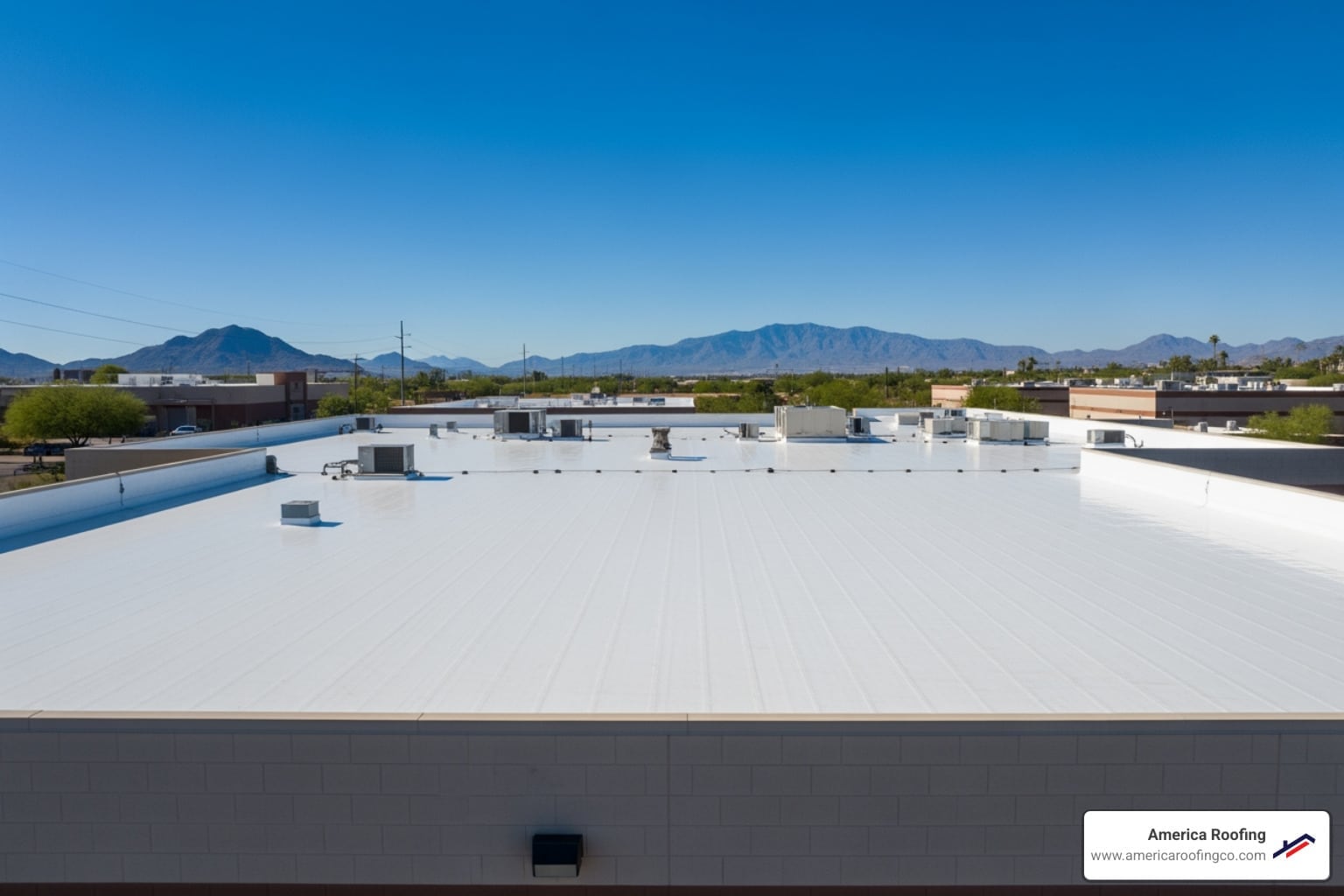
Finding a balance between long-term protection and upfront costs is the biggest challenge for any building owner, but TPO roofing offers a proven way to achieve both without compromise. Let me explain how this versatile material can transform your property's energy efficiency while standing up to the harshest weather conditions.
What Is TPO Roofing? (Quick Answer)
TPO roofing is the most popular single-ply membrane system for flat and low-slope commercial roofs in the U.S. — and for good reason. It offers a rare combination of affordability, energy efficiency, and durability that few other materials can match. But like any roofing system, it comes with trade-offs worth understanding before you commit.
TPO (Thermoplastic Polyolefin) is a single-ply, heat-weldable roofing membrane made from a blend of polypropylene and ethylene-propylene rubber. It is designed for flat and low-slope roofs on commercial and residential buildings.
Key points:
| Feature | Details |
|---|---|
| Material | Polypropylene + ethylene-propylene rubber |
| Structure | 3 layers: polymer base, polyester-reinforced scrim, TPO top ply |
| Common Thicknesses | 45-mil, 60-mil, 80-mil |
| Typical Lifespan | 20–30 years (quality-dependent) |
| Key Benefit | Reflective white surface reduces rooftop temps by up to 50°F |
| Cost vs. PVC | 25–35% less expensive |
| Installation Methods | Mechanically fastened, fully adhered, self-adhered, ballasted |
| Best For | Commercial flat roofs in hot, sunny climates like Arizona |
TPO has been manufactured in the U.S. since the early 1990s. Today it accounts for roughly 40% of all new single-ply commercial roof installations — making it the fastest-growing segment in the commercial roofing market.
Here's why that matters for you: whether you're managing a commercial property in Tempe, building new homes in Chandler, or looking to cut cooling costs on a flat-roofed home in Gilbert, TPO is likely one of the first options your contractor will recommend. Understanding what it is — and where it excels or falls short — can save you thousands of dollars and years of headaches.
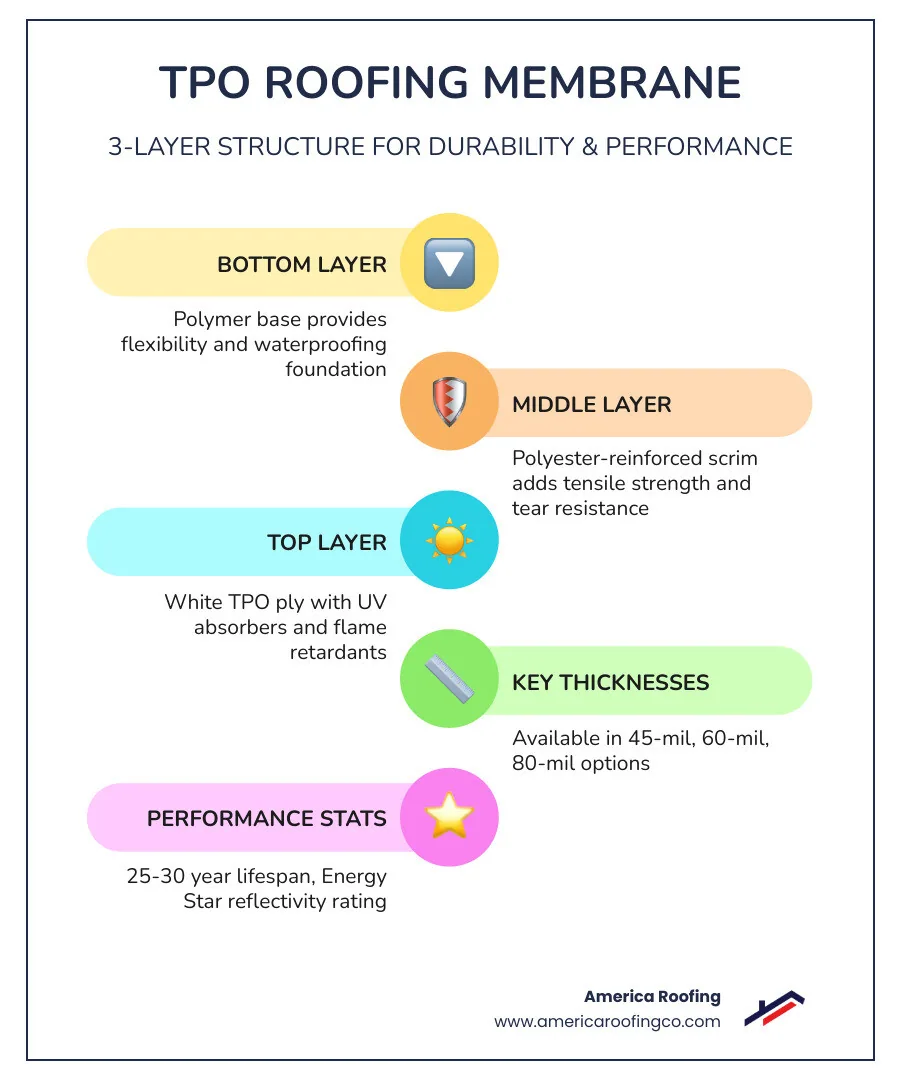
Quick look at TPO roofing:
Understanding TPO Roofing: Composition and Performance
To really understand why TPO roofing has taken over the market, we have to look at what’s happening inside the sheet. Let me explain how these layers work together. TPO isn't just a single slab of plastic; it’s a high-tech sandwich.
The bottom layer is a polymer base, the middle is a polyester-reinforced scrim (the "backbone" that provides tear strength), and the top ply is where the magic happens. This top layer is loaded with UV absorbers and flame retardants to help the roof survive the brutal sun and meet fire codes.
When we talk about TPO, we talk in "mils." A mil is one-thousandth of an inch. Don't confuse it with a millimeter! For perspective, a 40-mil membrane is about the thickness of a credit card.
| Thickness | Best Use Case | Performance Expectation |
|---|---|---|
| 45-mil | Budget-conscious recovers, short-term leases | 15–20 years; standard puncture resistance |
| 60-mil | Industry standard for new commercial construction | 20–25 years; balanced durability and cost |
| 80-mil+ | High-traffic roofs, solar ready, long-term ownership | 25–30+ years; superior puncture/hail resistance |
Manufacturers are constantly tweaking their "secret sauce" formulations to meet ASTM D6878 standards, which govern how TPO should handle heat aging and weather resistance. However, industry advisories have noted that not all TPO is created equal. In high-heat areas, some early formulations struggled with seam cracking. That’s why we only use membranes with proven track records in flat roofing solutions that can handle the thermal swings we see in the Southwest.
The Benefits of TPO Roofing Systems
Why is everyone choosing TPO? Honestly, it’s the price tag. TPO is generally 25-35% cheaper than PVC, its closest competitor. For a 20,000-square-foot warehouse, that’s a massive saving.
But it’s not just about the upfront cost. TPO is a "cool roof" champion. Because it is naturally reflective, it carries high Energy Star ratings and a high Solar Reflectance Index (SRI). This means it bounces heat away from your building rather than soaking it up like a sponge.
You know what? The seam strength is actually stronger than the membrane itself. Because the sheets are fused together using hot-air welding, the two pieces of TPO become one single, monolithic sheet. Unlike older "peel and stick" or glued systems, these seams don't just dry out and pop open over time. This makes commercial flat roof installation much more reliable than the old tar-and-gravel days.
Installation Methods and Essential Components
Installing a TPO roofing system is a bit like putting together a giant puzzle. There are three main ways we secure it to your building:
- Mechanically Fastened: We use heavy-duty screws and plates to pin the membrane to the roof deck. This is the most common and cost-effective method.
- Fully Adhered: We glue the entire membrane down using specialized adhesives. This is great for high-wind areas because there’s no "billowing" or fluttering of the sheet.
- Self-Adhered (SA): This is newer "peel-and-stick" technology. It’s incredibly fast to install and eliminates the smell of liquid adhesives—perfect for hospitals or schools.
We also use induction welding (often called the RhinoPlate system). This uses magnets and heat to bond the membrane to plates hidden underneath the sheet. It’s a meaningful advantage for wind uplift resistance.
Beyond the membrane, a complete system requires:
- Polyisocyanurate (Polyiso) Insulation: Provides the R-value to keep your building cool.
- Cover Boards: A hard layer (like DensDeck) that protects the insulation from hail and foot traffic.
- Flashings and Accessories: Pre-molded pipe boots, corner patches, and T-joint covers.
Getting the flat roof replacement cost right depends on choosing the right combination of these components.
Regional Challenges: TPO Performance in Arizona Heat
Here’s the thing: Arizona heat tests TPO like nowhere else on earth. While a roof in Michigan might never see 120°F, an Arizona roof surface can easily hit 160°F or higher.
At those temperatures, the chemical bonds in some roofing materials can start to break down. This leads to "accelerated weathering." We also have to deal with:
- Extreme UV: Our high-altitude areas (like parts of Tucson) see 10% more UV for every 3,000 feet of elevation.
- Thermal Swings: A 110°F day followed by a 70°F night causes the roof to expand and contract rapidly.
- Monsoons and Haboobs: Dust from haboobs settles on the white surface, turning it brown and killing your energy savings.
For Arizona flat roofs, we always recommend a thicker membrane (60-mil minimum) and a rigorous maintenance plan to combat these local "roof killers."
Comparing TPO to PVC and EPDM
Honestly, choosing between these three depends entirely on your building's specific needs.
- TPO vs. PVC: PVC is the "gold standard" for chemical resistance. If you own a restaurant with grease vents on the roof, you want PVC. Grease will eat TPO for lunch. However, for a standard office or retail space, TPO provides similar performance for a much lower price.
- TPO vs. EPDM: EPDM is "rubber roofing." It’s usually black, which is great for melting snow in flagstaff, but a nightmare for cooling bills in Phoenix. EPDM uses tape for seams, while TPO uses welds. In our experience, welds are almost always superior for preventing leaks.
If you're currently dealing with an old rubber roof, you might find our EPDM roof repair guide helpful, or if you're looking for an alternative that seals every nook and cranny, check out foam roofs in Arizona.
Longevity and Maintenance of TPO Roofing
A well-installed, high-quality TPO roof should last 25 to 30 years. But there’s a catch: it only stays "cool" if it stays clean.
Research shows that TPO can lose 30-50% of its reflectivity in just the first three years due to dirt accumulation. In the Valley, dust is a constant. Is it worth cleaning? Absolutely, if you want to keep those energy bills low. We recommend:
- Biannual Inspections: Checking seams and flashings twice a year (spring and fall).
- Cleaning: Using a soft-bristle broom and mild detergent to wash away desert dust.
- Seam Checks: Looking for any signs of "bridging" or splitting, especially after a heavy monsoon season.
Regular commercial roof inspections are the best way to catch a $500 repair before it becomes a $50,000 replacement. If you do find a leak, our flat roof repair guide can help you understand the next steps.
Sustainability and Manufacturer Warranties
TPO is a relatively "green" choice. It contains no chlorine or halogens, and the manufacturing process uses less energy than other systems. It’s also 100% recyclable at the end of its life, and its high reflectivity can help your building earn LEED credits.
When it comes to warranties, don't just look at the years. Look for an NDL (No Dollar Limit) warranty. This means if the roof fails due to a material defect or poor installation, the manufacturer covers the entire cost of the repair, not just a prorated amount. Some specialized TPO systems even offer guarantees against hail up to 4 inches!
When reviewing TPO roofing details, keep these warranty factors in mind:
- Is it a material-only or a full-system warranty?
- Does it cover "consequential damages" (like the computer equipment inside the building)?
- Is the contractor certified by the manufacturer to provide that warranty?
Conclusion and Expert Advice
At America Roofing, we’ve been the Phoenix-metro authority on flat roofing since 1999. As a third-generation, veteran-owned family business, we don't just sell roofs—we build long-term protections for our neighbors. Whether you're in Scottsdale, Mesa, or Peoria, we understand that your roof is the only thing standing between your business and the 120-degree Arizona sun.
We provide honest, no-pressure advice and fully transparent 2025 pricing. From Arizona commercial roof repair to full-scale TPO replacements, our team is ROC#186438 licensed and ready to help. You can explore more about our flat roof services on our website. Don't leave your property's protection to chance. If you are ready to protect your commercial investment with a high-performance system, call our experts at 602-237-2478 or Request a Free Quote today.