
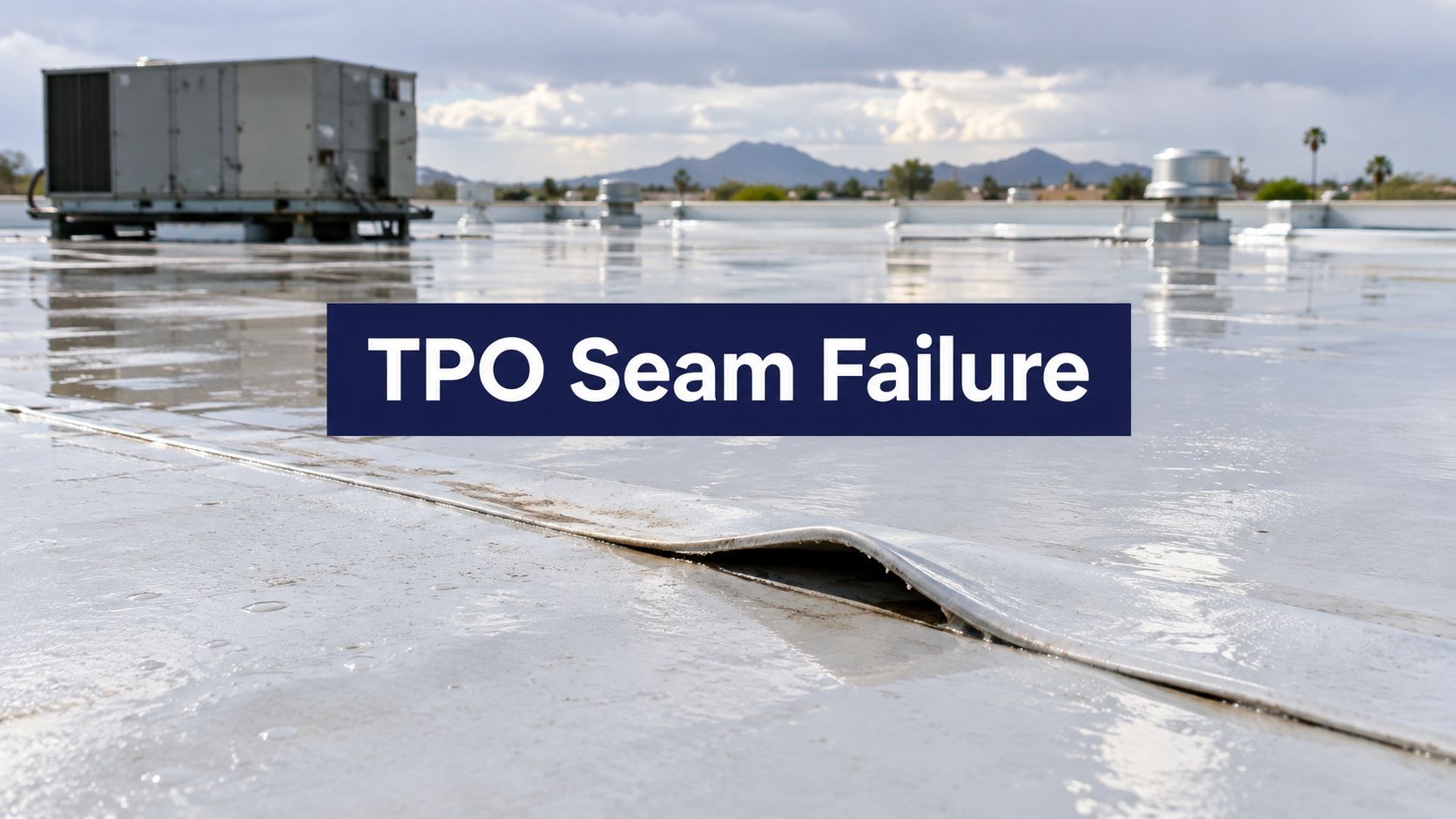
A ceiling stain after a monsoon storm doesn't prove a seam has failed. Knowing accurate TPO seam failure signs helps Phoenix and Tucson property managers separate an open lap from a drain, curb, or edge detail problem.
What Arizona Property Managers Should Know Before a Storm
A maintenance manager walks a Phoenix warehouse the morning after a monsoon cell and finds a brown ring on a ceiling tile. The first assumption is usually that a TPO seam blew open. That assumption can send a crew to the wrong part of the roof.
An interior stain is a location clue, not a diagnosis. Water can enter at a curb flashing, a drain, edge metal, a scupper, or a prior patch, then travel before it drips. Field membrane can be intact while a perimeter transition does the leaking. Phoenix-area guidance makes this point directly, noting that flashings and drainage details can be more vulnerable during a storm than an intact seam, as covered in Phoenix commercial TPO guidance on monsoon leak sources.
A leak during rain proves water got in. It doesn't prove where.
The useful first move is documentation. Photograph the stain, note the room below, record the storm date, and map the spot against the roof plan. That record matters when calls come in after hours, which is why some operators route tenant reports through 24/7 roofing phone answering from Mercateer so timing and location details aren't lost overnight.
From there, the work is systematic. Check what the seams show, check the details around them, and don't approve a seam repair until someone qualified has confirmed the weld itself is the problem.
How TPO Seams Work on a Flat Commercial Roof
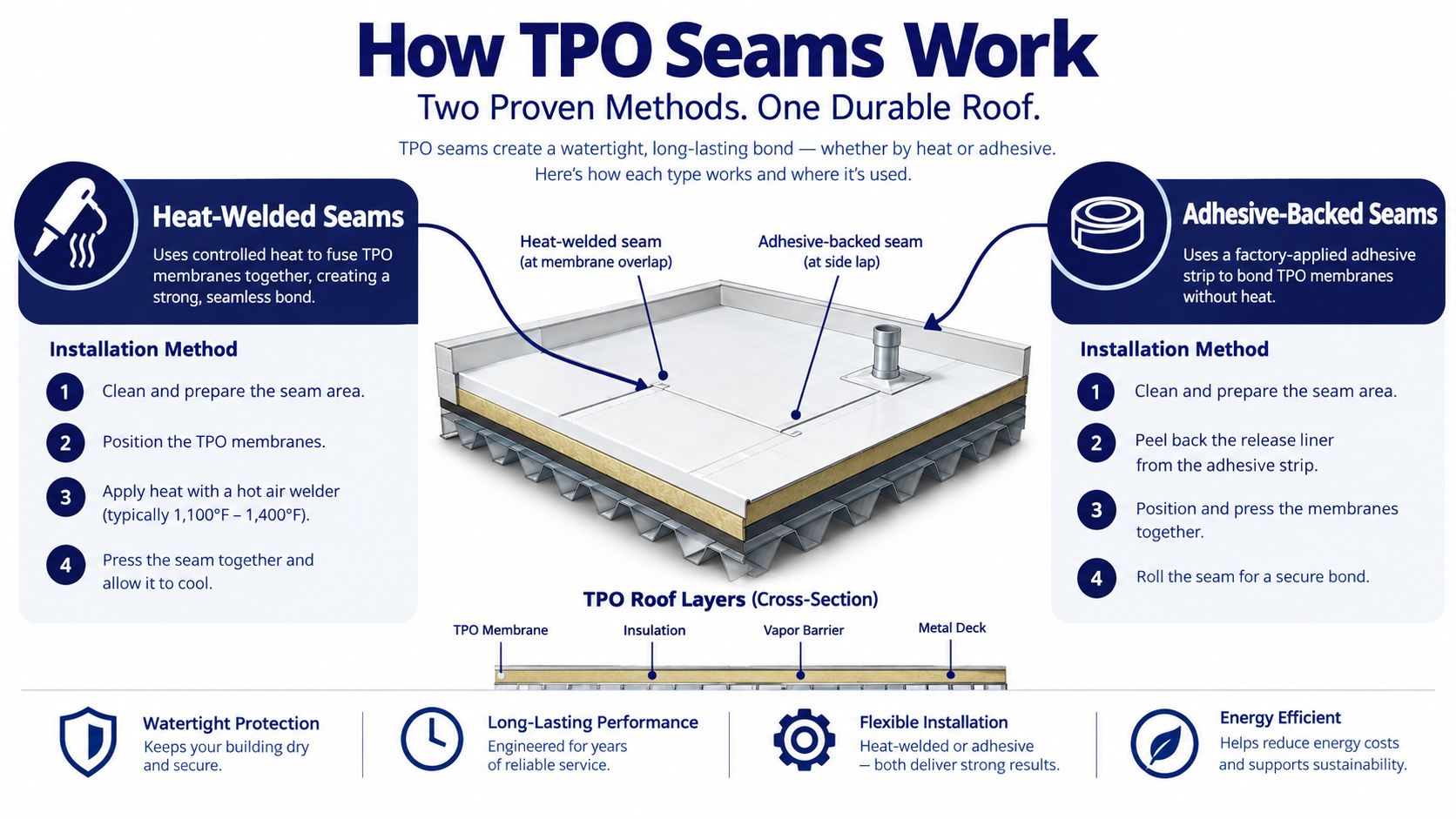
TPO sheets don't cover a commercial roof in one piece. Crews roll out membrane in widths, overlap the edges, and fuse those overlaps with hot air and roller pressure. That fused overlap is the seam, and it's only as good as the heat, pressure, and clean surface that created it.
The Two Basic Lap Types
- Field laps: The long side-by-side joints where two rolls run parallel across the open roof.
- End laps: The shorter joints where one roll ends and the next begins, often crossing field laps at T-joints.
Both rely on the same weld, but end laps and T-joints concentrate thickness changes, so they're harder to weld evenly and worth extra attention during any walk.
Where Seams Meet Details
The open field is rarely the whole story on TPO roofing Arizona projects. Seams terminate at corners, wrap curbs around rooftop equipment and pipes, tie into drains, and turn up at perimeter edge transitions. Each termination adds cuts, patches, and hand welding.
That's the mental map to keep. When a report says seam failure, the right follow-up question is which seam, in which zone, confirmed how. A field lap, a curb corner, and a drain target patch fail for different reasons and get repaired differently.
Visible and Indirect Signs of TPO Seam Failure
Some TPO seam failure signs show on the surface well before water reaches a ceiling. Others only appear inside, and those need careful tracing because water moves sideways under membrane and through insulation joints.
What Shows on the Roof
Lifted or curled lap edges, visible gaps, fishmouths, wrinkles near curbs, and dirt lines that follow a seam path all point to a lap that isn't fully bonded. Bubbling and soft, spongy areas suggest moisture has already entered the insulation, which is why how to spot wet TPO insulation matters alongside the seam itself.
Surface cracking near laps is a separate warning. Research on aged membranes identifies surface cracking as a sign that can accelerate deterioration, detailed in the IIBEC performance analysis of aged TPO membranes.
TPO Seam Symptom Guide for Arizona Roofs
| Sign Observed | Most Common Cause | Recommended Next Step |
|---|---|---|
| Open lap | Incomplete weld or contamination | Mark, photograph, schedule probe testing |
| Fishmouth | Wrinkled membrane welded under tension | Check for a channel that funnels water |
| Wrinkles or bridging | Poor fit at curbs and corners | Inspect adjoining flashing, not just the lap |
| Edge stress and lifting | Thermal movement, wind load at perimeter | Check edge securement and nearby laps |
| Recurring interior leak | Entry point uphill of the stain | Trace seams, drains, and penetrations together |
| Unrelated puncture | Dropped tool, debris, rooftop traffic | Patch evaluation, separate from seam scope |
What Shows Inside
Recurring stains below a lap line, stains that return after every storm, and musty odors in rooms under suspect areas are indirect signals. They justify investigation, but they don't confirm which component failed. Photograph, date, and map every sign instead of relying on memory between storms.
Why Arizona Seams Fail Before the Membrane Does
The sheet often outlasts the joints. Four failure families explain most of what shows up on Phoenix and Tucson roofs, and Arizona conditions feed all four.
Contamination and Bad Welds
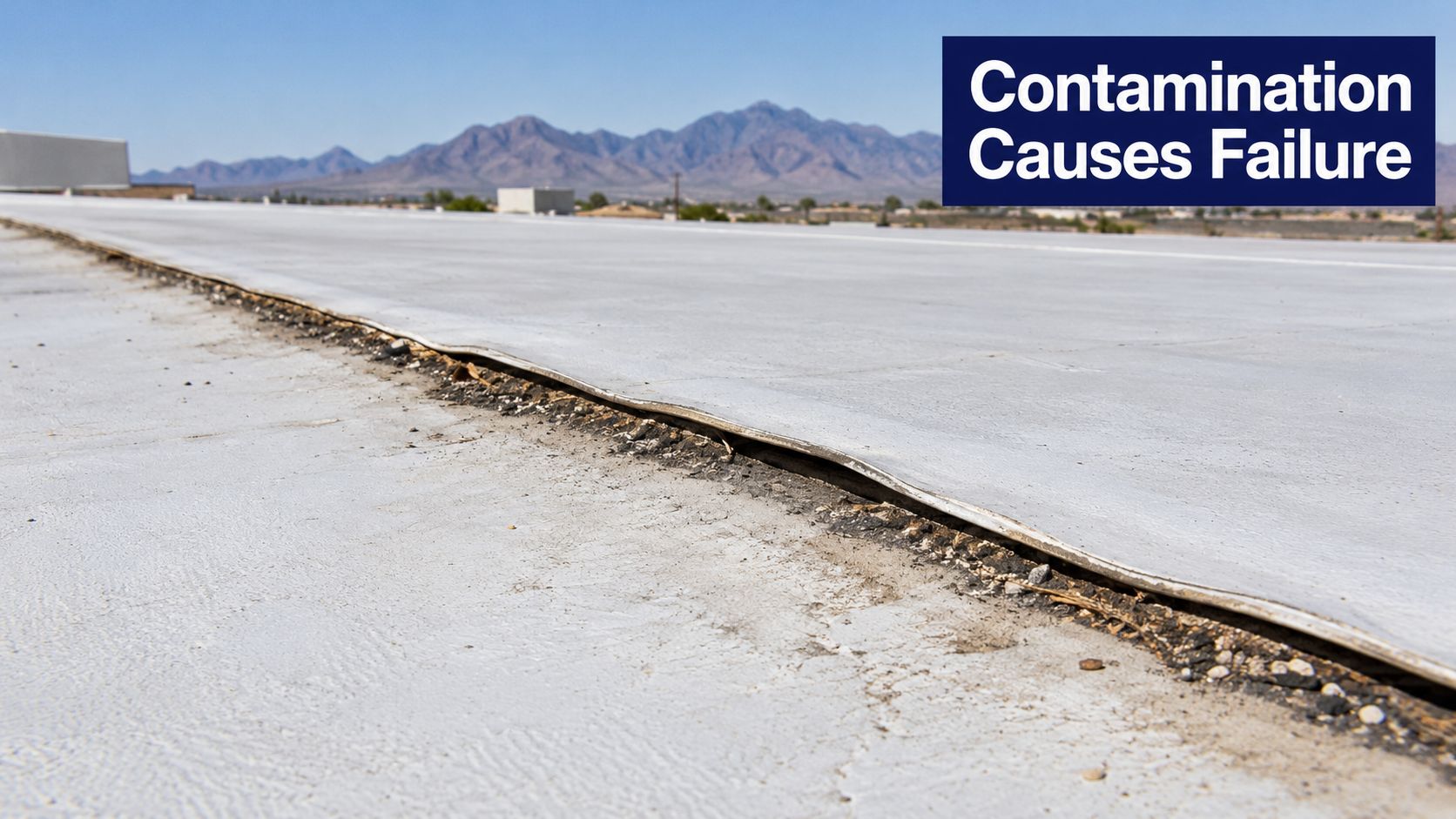
Wind-driven dust is a welding problem, not just a housekeeping issue. Dust, moisture, and aged or dirty surfaces block fusion, so the lap closes visually without bonding through its full width. Insufficient heat, fast travel speed, and uneven roller pressure produce the same cold weld.
Overheating is the opposite failure. Smoking, blackening, glossy or scorched polymer, and a thick irregular bead indicate thermal degradation, not extra strength, as described in the field guide to single-ply membrane seam quality checks.
Movement, Wind, and Aging
Daily expansion and contraction work the same lap edge thousands of times. Wind adds cyclic lifting, especially at perimeters and corners. A Canadian government study of mechanically attached TPO found wind fatigue reduced seam strength by about 30%, with reductions of 26% to 33% depending on configuration, reported in research on welding thermoplastic roofing membranes.
UV exposure then finishes the job on older roofs. Surface cracking and embrittlement turn a flexible lap edge brittle, so movement that a younger seam absorbed starts opening it instead.
Practical rule: Treat recurring lifted edges and open laps as waterproofing warnings, not cosmetic defects.
A Property Manager's Pre and Post Monsoon Inspection Checklist
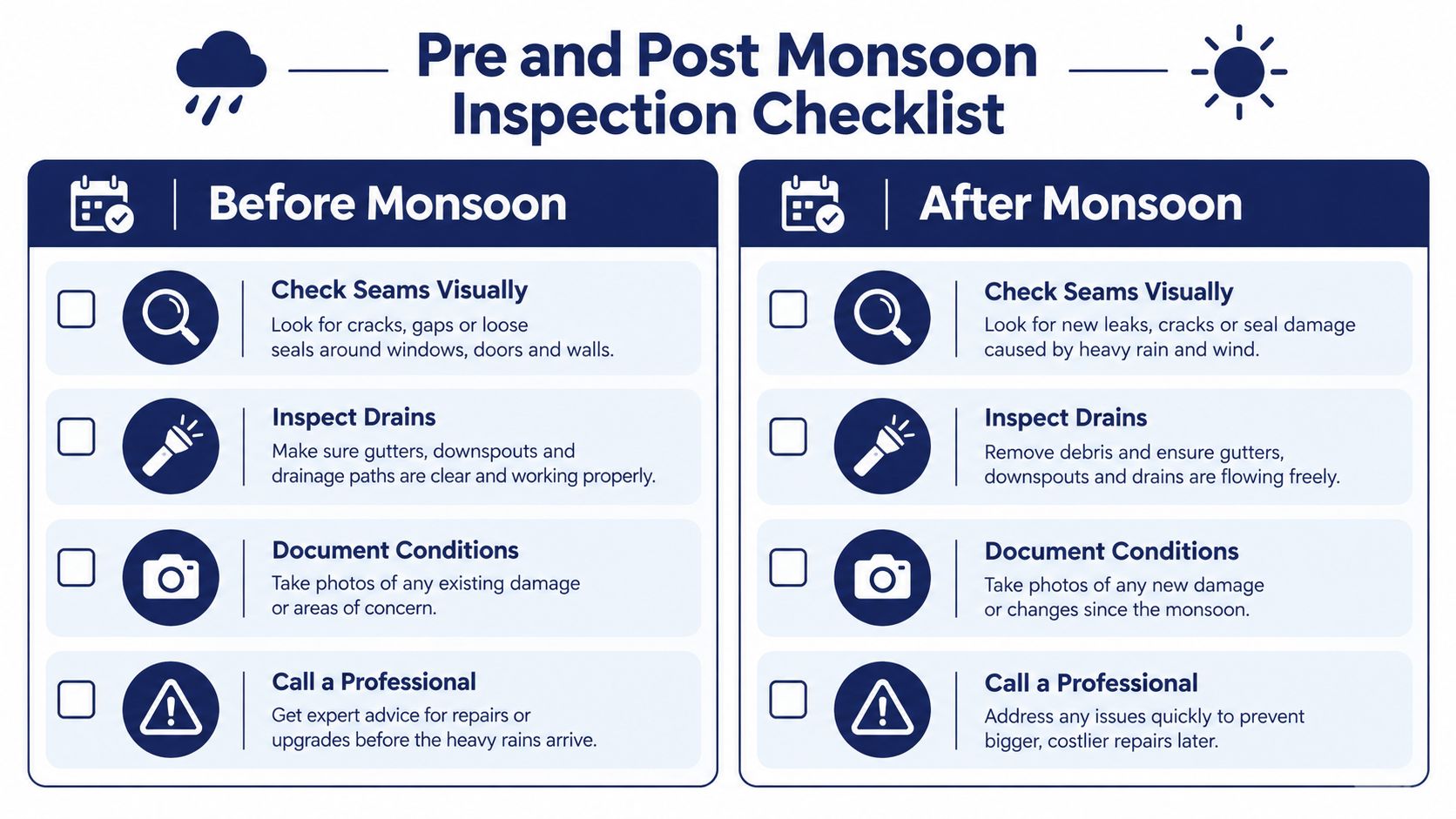
Maintenance teams can gather good evidence without touching a welder. The line is simple. Visual documentation is a property management task. Probing, test cuts, and hot-air welding are not, and no visual check alone proves weld integrity. Building these walks around pre-storm roof leak prevention tips keeps them consistent season to season.
Before Monsoon Season
- Photograph suspect laps: Shoot lifted edges, fishmouths, and prior patches with a location reference in frame.
- Clear drains and scuppers: Blocked drainage ponds water against seams that might otherwise stay dry.
- Note soft areas: Flag spongy spots from the walkway side without forcing traffic across them.
- Confirm safe access: Verify hatch, ladder, and fall protection arrangements before anyone goes up.
After a Storm
- Walk for new damage: Look for fresh lifting, displaced patches, debris punctures, and wind-scoured dirt lines.
- Match stains to zones: Plot each interior stain against seams, curbs, and drains uphill of it.
- Record recurrence: A stain that returns in the same room is a pattern, and patterns drive scope decisions.
- Stop at the evidence: Don't peel laps open by hand to test them. That can turn a weak weld into an open one.
What a Professional TPO Seam Evaluation Actually Involves
A professional evaluation converts photos and stain maps into confirmed findings. The sequence matters, and it starts with access and safety, not with a repair price.

Probe Testing Comes First
A roofer runs a rounded, blunt probe along the lap edge, commonly at approximately 1-foot intervals, checking whether it slips beneath the overlap. A sound weld resists the probe. A probeable void means incomplete fusion, even where the seam looks closed. Each failure gets marked and photographed so the repair scope reflects total linear feet, not a guess.
When Test Cuts Are Warranted
Where probing and leak history conflict, a certified roof inspection through HAAG certified inspection services may include a small destructive sample. Peel testing based on ASTM D1876 shows whether the weld fails at the interface or through the membrane itself. A film-tearing bond greater than 70% was treated as evidence of a proper weld in field-aged testing, explained in IIBEC testing of field-aged TPO roofs.
Clean separation at the interface is adhesive failure, and it fails regardless of surface appearance. Samples stay limited to representative locations and get repaired with compatible materials afterward.
Results always get compared against the specific membrane. One published 60-mil specification lists a minimum field seam strength of 25 lbf/in, with typical values of 50 lbf/in and 60 to 70 lbf/in under different tested conditions, per a published 60-mil TPO specification document. Product, thickness, and test method belong in every report.
When a Single Seam Repair Is Not Enough
One open lap on a dry, healthy roof is a repair. The same open lap surrounded by brittle membrane and wet insulation is a symptom. Four inputs separate those cases.
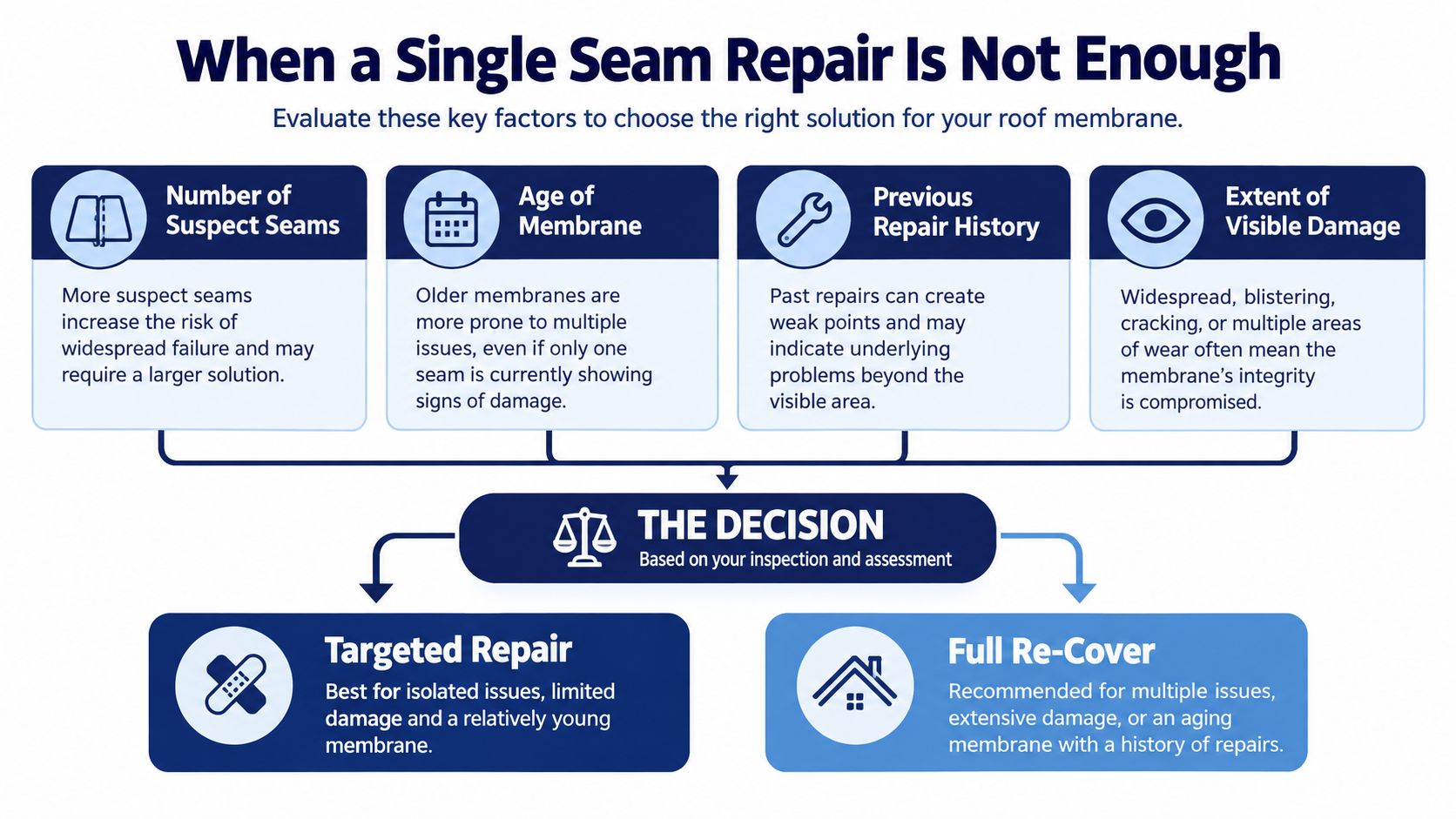
The Repair Versus Broader Evaluation Checklist
- Seam count: A single marked void supports targeted work. Failures scattered across multiple laps suggest a systemic weld or aging problem.
- Membrane condition: Flexible, uncracked sheet accepts new welding. Cracked, brittle laps may not hold a reweld.
- Moisture evidence: Soft areas or survey hits below laps mean the scope includes what's under the membrane, not just the seam.
- Recurrence: Leaks returning after prior patches point to a missed source or a detail problem, not bad luck.
An isolated defect with dry substrate and no recurrence is reasonable work for a commercial roofing repair company. Multiple suspect seams plus moisture evidence justify a broader evaluation before more patch money goes onto the roof. Either way, curb, drain, edge, and scupper details stay in the suspect pool until probing clears them.
Next Steps for Phoenix and Tucson Building Owners
Three points drive the decision. First, TPO seam failure signs need probe confirmation before anyone trusts them. Second, a monsoon leak doesn't automatically mean a seam failed. Third, repair scope depends on seam count, membrane condition, moisture evidence, and recurrence, not on the size of the ceiling stain.
Building owners with documented signs should get the roof probed before the next storm cycle rather than after it. That timing keeps a localized reweld from becoming wet insulation removal. Owners without current signs still benefit from the pre-monsoon walk, since lifted laps found in dry weather are cheaper to address than leaks found during rain.
America Roofing evaluates TPO seams, flashings, drains, and edge details together for commercial properties in Phoenix and Tucson, then scopes repair against broader reroofing options based on what's found. To start, request a roofing estimate or call 602-237-2478 and bring the stain photos and roof history to the conversation.
If your building shows lifted laps, fishmouths, or leaks that return every monsoon season, get the seams probed and the details checked before approving another patch. Visit America Roofing to arrange a commercial roof evaluation for your Phoenix or Tucson property.