
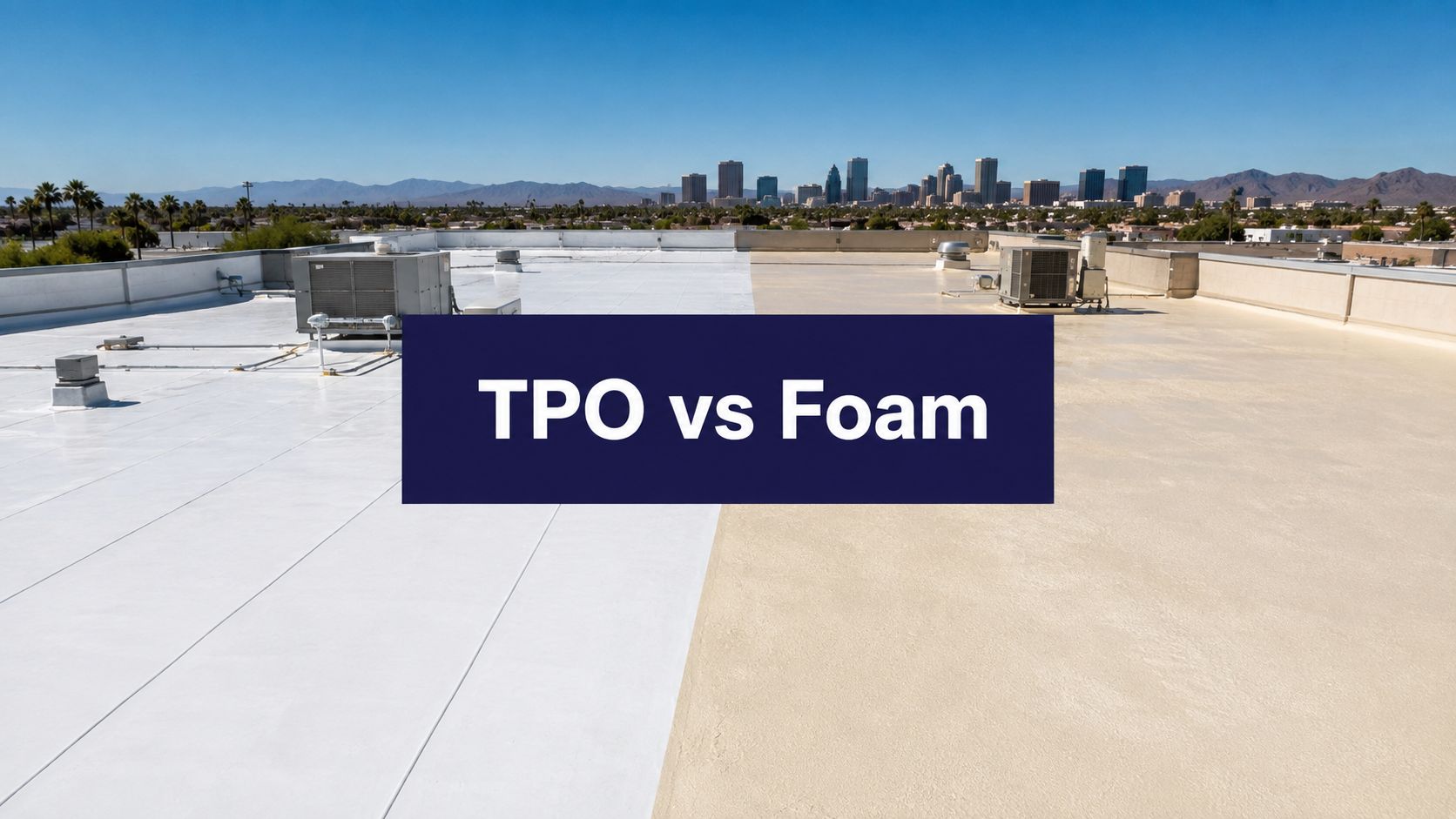
A Phoenix property manager gets two bids for the same aging flat roof, one for TPO, one for foam, and the problem isn't the paperwork. The roof has already lived through desert UV, dust, and monsoon stress, and the next move will shape the building's maintenance cycle for years.
For Arizona commercial buildings, TPO vs foam roof for Arizona commercial buildings isn't a simple material argument. It's a decision about insulation, drainage, recoating, and how much roof management the owner wants to carry over the next decade or two.
| Criterion | TPO Membrane | Spray Foam Roofing |
|---|---|---|
| Thermal strategy | Depends on insulation board beneath the sheet | Built-in insulation at the roof surface |
| Surface behavior | Reflective white membrane | Reflective only after coating, then maintained by recoats |
| Maintenance style | Inspect seams, fasteners, penetrations | Inspect coating, seams at details, and recoat on cycle |
| Monsoon response | Strong when seams and drainage are detailed correctly | Strong when slope, coating, and drainage are kept intact |
| Best fit | Simple, wide-open flat roofs | Complex roofs, retrofit projects, and integrated insulation needs |
Why Phoenix and Tucson Building Owners Are Comparing TPO and Foam Right Now
A Tucson property manager reviewing a worn-out 1990s foam roof is not choosing based on appearance. The decision is whether the building can remain watertight through future monsoon seasons while keeping maintenance predictable. That question puts TPO and foam on the same bid list.
The timing is practical. Older assemblies are reaching the point where repeated repairs no longer offer a dependable plan. Heat cycles expose weak areas, summer storms test drainage, and owners are looking beyond the installation invoice to the work required during the roof's service life. A roof therefore affects operating reserves as well as capital planning.
Practical rule: A roof that looks acceptable from the parking lot can still be expensive if it sheds water poorly or needs constant patching at seams and penetrations.
The useful comparison runs across the next decade or two. TPO gives an owner a membrane replacement path with defined field seams and details. Foam creates a maintained assembly whose surface coating must be inspected and renewed on its Arizona cycle. Those paths place different demands on the owner after installation.
Drainage deserves its own line in the evaluation. A foam system can be shaped to improve low-slope areas, but ponding still threatens the coating and requires corrective work. TPO can handle monsoon runoff well when drains, scuppers, penetrations, and welded seams are detailed correctly. Neither system excuses poor roof layout or deferred inspections.
The building's use also changes the choice. Offices, warehouses, and retail properties cannot treat recurring leaks as a minor inconvenience. Owners need to decide whether they prefer scheduled coating work and localized repairs or a membrane system managed through seam, flashing, and penetration inspections.
The best bid explains that maintenance path in writing. Compare the roof's drainage plan, insulation assembly, access for inspections, and expected recoating work before comparing material labels. A lower installation price can lose its appeal if the system demands unplanned service during the next monsoon cycle.
What TPO and Spray Foam Roofs Actually Are
TPO and foam are often spoken about as if they're equal products with different colors. They're not. A roof system has layers, and in Arizona that stack-up matters more than the marketing name.
TPO Is a Membrane System
TPO, thermoplastic polyolefin, is a single-ply sheet installed over insulation board. The seams are heat-welded, which creates a continuous waterproof field when the work is done correctly. On commercial flat roofs, that makes the membrane itself the visible weathering surface, while the insulation does the thermal work below.
That distinction matters because the sheet alone does not add meaningful insulation. A TPO roof can perform well in Arizona, but only when the full assembly includes enough insulation and the detailing is tight at drains, curbs, and terminations. America Roofing's TPO roofing Arizona page is a useful reference for the kind of flat-roof work that depends on the whole system, not just the top layer.
Foam Is a Roof and Insulation in One Assembly
Spray polyurethane foam is installed as a liquid, expands into a rigid layer, and then gets protected with a UV-stable coating. That means the roof is not “finished” at the foam stage. The coating is part of the system, and it has to stay on cycle if the roof is going to keep performing.
Key point: A foam roof isn't just foam, and a TPO roof isn't just the white sheet. In Arizona, the assembly is the product.
That's why foam is often treated as a renewable roof rather than a one-time membrane. The coating gets renewed over time, which keeps the roof serviceable without tearing out the foam substrate every time the surface ages. For a deeper practical look at how exposed foam has to be protected, the article on exposed spray foam protection is worth reading.
The assembly logic is also why warranties behave differently. TPO warranties usually track the membrane system and its installation details. Foam systems are tied to coating condition and maintenance discipline. If the topcoat is neglected, the roof's long-term value drops fast.
How TPO and Foam Compare in Arizona Conditions
Arizona punishes shortcuts. A roof that performs in a milder climate can struggle here because intense sun heats the deck, and monsoon water finds weak transitions quickly. The practical test is how each system manages heat, drainage, repairs, and maintenance across the next roof cycle.
| Criterion | TPO Membrane | Spray Polyurethane Foam |
|---|---|---|
| Energy performance | Reflective white surface helps control heat, while insulation comes from the board below | Continuous insulation sits at the roof surface, with reflectivity supplied by the coating |
| UV aging | Reflectivity helps, but clean details and intact seams still matter | The coating controls long-term UV protection |
| Ponding and monsoon water | Welded seams perform predictably when drainage is correct | Performs well when slope, drainage, and coating remain maintained |
| Lifespan | Usually managed as a replacement-cycle roof | Commonly managed as a renewable assembly with recoats |
| Repairs | Damage is patched and welded at specific points | Surface damage and details are repaired, then recoated |
| Warranty style | Often tied to the membrane and installation | Often tied to coating condition and maintenance intervals |
TPO's strongest Arizona advantage is its reflective white surface. On broad, simple low-slope roofs, that surface helps limit heat gain and supports a clean installation process. Its performance still depends on properly welded seams, secure edge details, and drainage that does not leave water standing after a storm.
Foam solves a different problem. Its insulation forms part of the roof assembly, slowing heat transfer before it reaches the deck. That can improve the building's thermal performance, especially where the existing roof needs more insulation. The coating remains part of the system, not an optional finish, so the owner must plan inspections and recoating as the surface ages.
Monsoon drainage exposes installation quality fast. TPO needs reliable seams and clear paths to drains. Foam needs sound slope, intact coating, and sealed penetrations. Neither system tolerates careless transitions around curbs, edges, equipment, or other roof openings.
The long-term choice follows the maintenance plan. TPO generally leads to a replacement event when the membrane reaches the end of its service life. Foam can remain in service through coating renewals, provided drainage and details stay sound. Over a decade or two, that difference affects budgeting more than the install-day comparison alone.
For a broader reference on how flat-roof assemblies behave in Arizona, see the flat roof information from America Roofing. The useful takeaway is simple: choose the system your team will inspect, drain, repair, and recoat properly.
Cost, Lifespan, and the Recoating Question
A lower installation price does not settle the roof decision. Phoenix and Tucson owners need to budget for the next decade or two of inspections, repairs, drainage work, and surface renewal. The right comparison is the full maintenance cycle, not the day the crew finishes installation.
TPO Is a Replacement Cycle
TPO follows a membrane replacement path. Once the membrane reaches the end of its service life, the owner usually plans another major roof project. That makes budgeting easier to understand, but it also means preparing for a future replacement rather than renewing the existing surface in place.
TPO suits owners who prefer a familiar membrane system and a defined replacement event. It can be the better choice when the building plan favors one substantial installation over recurring coating work.
Foam Is a Maintenance Cycle
Spray foam takes a different financial path. The coating protects the foam from Arizona sun exposure, so the roof remains serviceable when the owner inspects it, repairs damaged areas, and recoats before deterioration reaches the substrate. Coating work is part of ownership, not an optional upgrade.
Arizona's coating cycle must account for intense sun, dust, and monsoon runoff. A worn coating, blocked drain, or neglected penetration can turn a manageable maintenance task into broader roof damage. Owners should plan inspections around seasonal exposure and schedule a foam roof recoating with America before the coating fails through to the foam.
Budget rule: TPO is simpler for owners who want a single major project followed by eventual replacement. Foam is stronger for owners willing to maintain and renew the roof as an ongoing asset.
Foam-over-TPO overlays deserve consideration when an aging TPO roof still has a sound base. An overlay can add insulation and create a renewable surface without requiring a full tear-off, provided the existing assembly, drainage, and details can support the work. It is not a shortcut around inspection. The base must be evaluated first.
The lower-looking bid may not produce the lower long-term cost. Choose TPO for a clearer replacement cycle. Choose foam when the owner will fund inspections, drainage upkeep, repairs, and timely recoating. That decision matters more over ten or twenty years than the install-day price alone.
Common Myths About TPO and Foam in Desert Heat
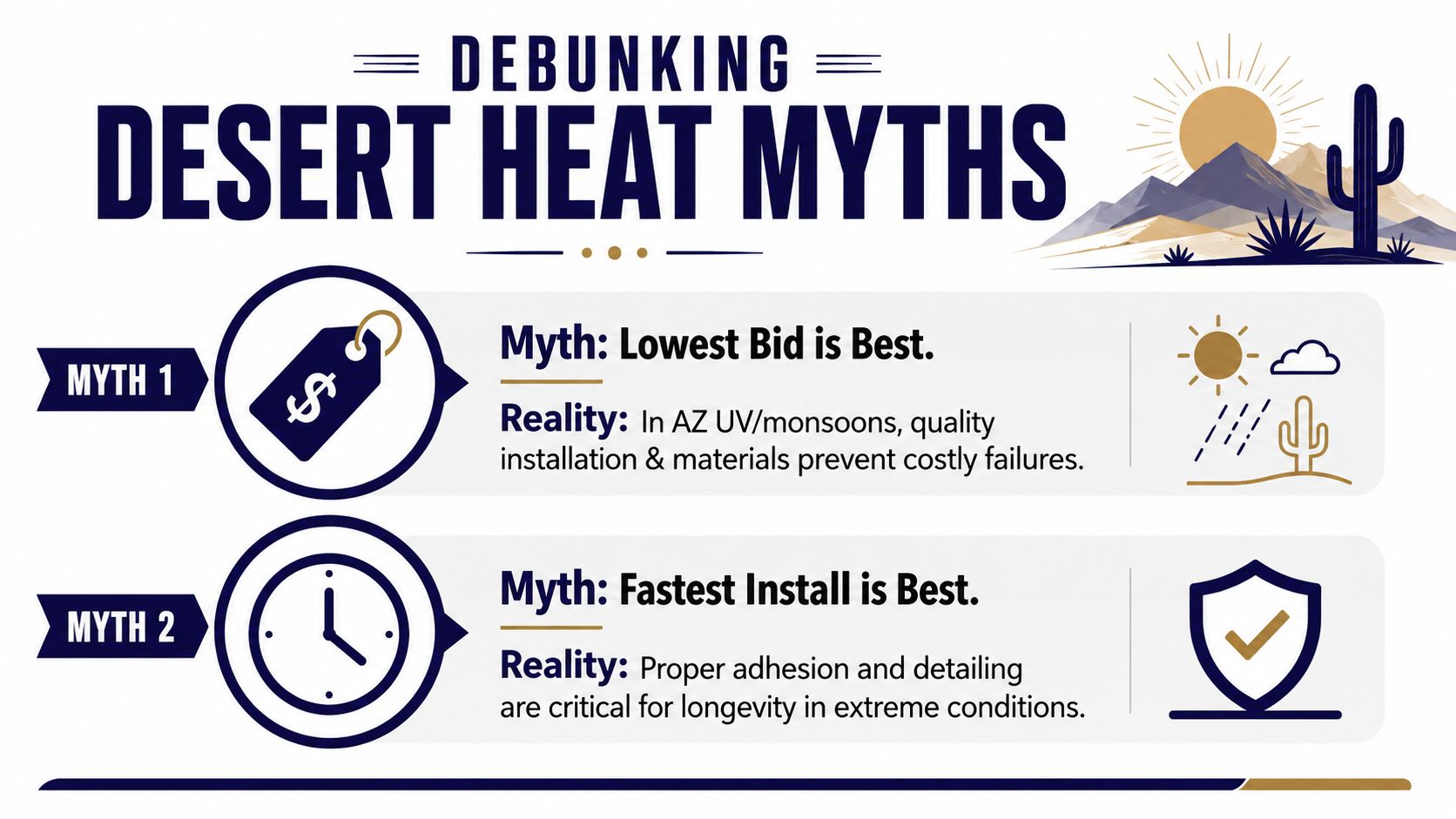
A Phoenix property owner can accept a low bid, rush the installation, and discover the weakness during the first monsoon storm. Desert heat, dust, and sudden runoff expose shortcuts faster than a proposal does.
The Lowest Bid Myth
The lowest bid often omits the work that protects a roof over its ownership cycle. Thin foam, limited coating coverage, weak seam welding, and incomplete flashing can create failures that cost more to correct later. Review the assembly, drainage plan, penetrations, and coating specifications, not only the total price.
The Fastest Install Myth
A quick installation does not guarantee a durable roof. TPO can be installed efficiently on broad, simple roofs, but welds, edges, penetrations, and terminations still require careful work. Foam can also be applied quickly, yet its performance depends on proper slope, transitions, and a coating schedule suited to Arizona exposure.
The install date is only the beginning. Over ten or twenty years, the owner must decide whether the system will follow a replacement cycle or receive inspections, repairs, and recoating as conditions demand.
A rushed roof in Arizona often reveals its weaknesses during the first heavy rain.
The No-Maintenance Myth
TPO needs inspections, seam checks, drain cleaning, and attention to foot traffic. Foam needs coating upkeep and repairs wherever the surface or details wear. Neither system is a set-it-and-forget-it purchase.
White material can reduce heat absorption, but color cannot correct poor drainage, weak detailing, or careless installation. A roof that handles Phoenix or Tucson weather is built as a complete assembly, with monsoon water management and future maintenance planned from the start.
Matching the Roof System to Your Building Type
The right roof matches the building's shape, traffic, and maintenance plan. In Phoenix and Tucson, that choice should be based on what the roof will face over its life, not what sounds good on install day.
Where TPO Makes Sense
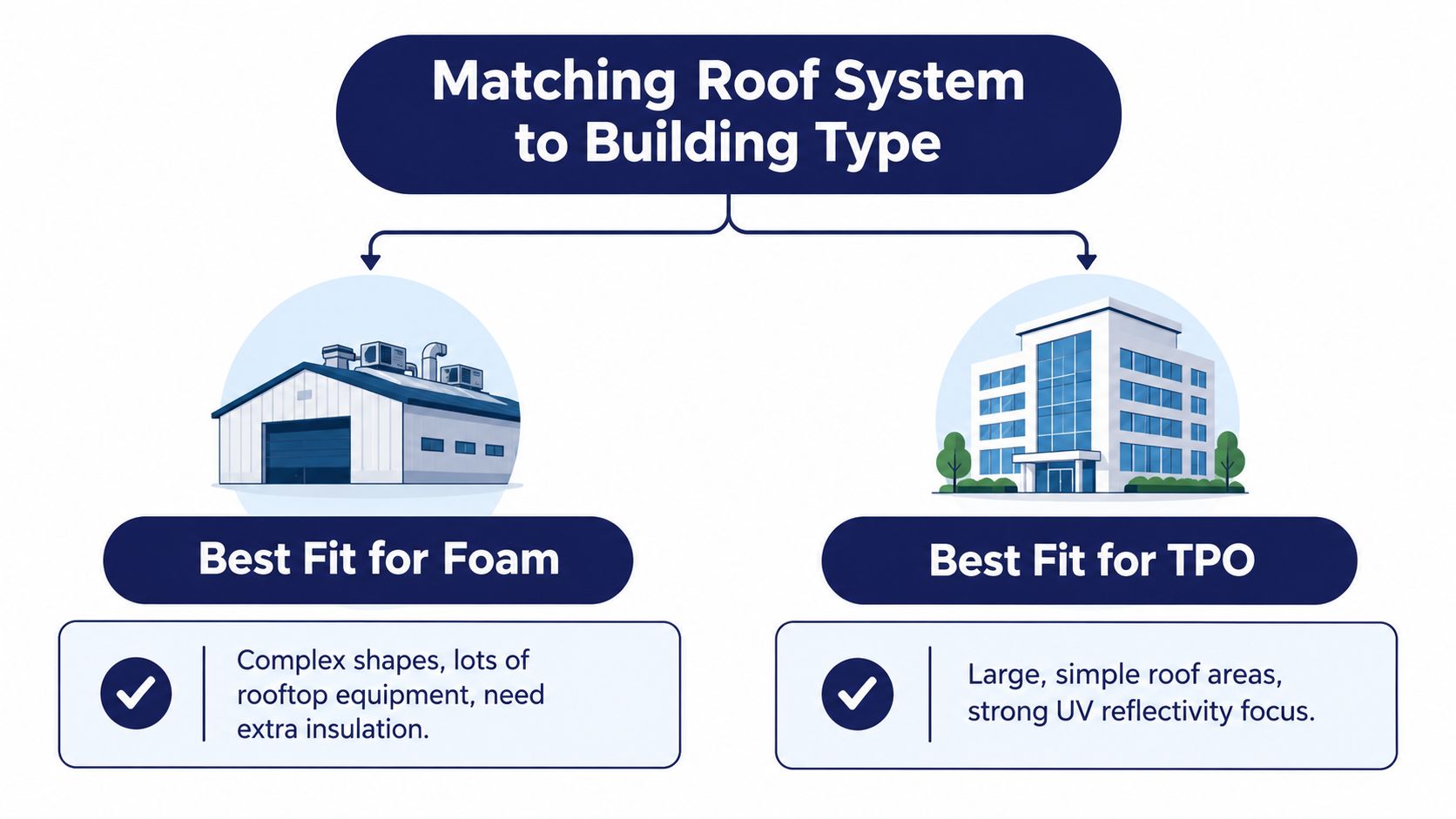
TPO fits broad roofs with simple layouts. Warehouses, retail boxes, and plain office buildings usually give the membrane the cleanest path because the field is open, the seams are easy to lay out, and the reflective surface works well under Arizona sun.
It also suits owners who want a straightforward replacement cycle. The membrane is visible, the seams are measurable, and inspections are easy to assign to a property team that handles multiple sites. For owners planning a full replacement path instead of long-term recoating, that clarity matters.
Where Foam Usually Wins
Foam does better on roofs with interruptions. Curbs, parapets, skylights, pipes, and odd drainage pockets all favor a system that can be built around the existing conditions. Foam also helps when the owner wants more insulation without rebuilding the whole assembly.
That makes foam a practical choice for retrofit work and for buildings where tear-off would create too much disruption. It also fits roofs that need better performance without a simple sheet-membrane layout.
If rooftop equipment changes are part of the plan, the roof should be reviewed with those changes in mind. A useful reference is Arizona rooftop unit replacement, because curbs and penetrations only perform as well as the details around them.
Owners who want to compare commercial roofing systems should use a simple filter. Flat, open roof shape and a clean replacement path point toward TPO. Complex shape, insulation needs, and a long-term recoating plan point toward foam.
Choosing a Phoenix or Tucson Commercial Roofer
A roof can have the right specification and still fail early if the contractor misses moisture, drainage, or detail work. In Phoenix and Tucson, the roofer must understand how monsoon water, intense heat, and coating cycles affect the system over the next decade or two, not just how to install it on day one. Judge the contractor by the inspection and maintenance plan, not by the lowest number on the proposal.
What to Verify Before Signing
- Licensing and Scope: Confirm that the Arizona license matches the proposed work. The scope should identify TPO, spray foam, coating, repairs, or reroofing instead of using vague “flat roof” wording.
- System-Specific Expertise: TPO installation and spray foam application require different training, equipment, and quality checks. Ask for relevant project experience.
- Moisture Survey: Any re-cover proposal should include moisture verification. Spraying foam over wet material conceals the problem and leaves the assembly at risk.
- Warranty Language: Identify who covers workmanship, who covers materials, and who responds when a monsoon exposes a weak seam, flashing, or penetration.
- Drainage Plan: If water ponds, the proposal should address tapered insulation, slope correction, drains, or other measures that improve runoff.
Rule of thumb: A bid that skips moisture, drainage, or warranty details is incomplete.
Ask the roofer to explain Arizona code, re-cover requirements, and existing-roof documentation in plain language. Those details affect whether the building can move from repeated patching to a sound TPO replacement or a foam system with planned recoating. They also determine how the roof will handle monsoon drainage after installation.
Use the commercial roofing contractor guide for Phoenix as a hiring checklist. The proposal should answer who inspects the roof, what assembly will be installed, how water will move, and what maintenance the owner should budget for during the roof's service life.
Clear measurements and defined assembly details make bids easier to compare. Exayard roofing estimating software is a practical reference for organizing measurements, repair scopes, and estimating information before work begins.
America Roofing handles commercial flat roofs, foam roofs, coatings, repairs, and reroofing across Phoenix and Tucson. The useful test is whether its proposal matches the roof's actual condition and explains the maintenance path. If the contractor cannot state when inspections, repairs, and Arizona-specific recoating should occur, the proposal is not ready.
The Bottom Line and Your Next Step
TPO and foam both work on Arizona commercial roofs, but they solve different problems over time. TPO is a membrane choice with a clearer replacement path. Foam is a maintenance choice, because it lives or dies on planned recoating.
Choose TPO for a simple roof, a straightforward membrane scope, and a building owner who wants a cleaner long-term replacement cycle. Choose foam for irregular decks, added insulation at the roof surface, and an assembly that can stay in service if recoating stays on schedule. In both cases, the installer matters more than the label on the bid.
Monsoon drainage should drive the decision. A roof that sheds water poorly will punish both systems, and a bad re-cover bid hides that risk.
Get the roof inspected, require a moisture check on any re-cover proposal, and compare both assemblies in writing before you sign. If the contractor cannot explain the maintenance path, the bid is incomplete.
America Roofing helps Phoenix and Tucson building owners sort out flat roof repairs, foam roof recoats, commercial reroofing, and TPO replacement with an inspection-first approach. If the roof is leaking, aging, or overdue for a real comparison, visit America Roofing to request a roofing estimate or call 602-237-2478 and get the roof evaluated before the next monsoon hits.