
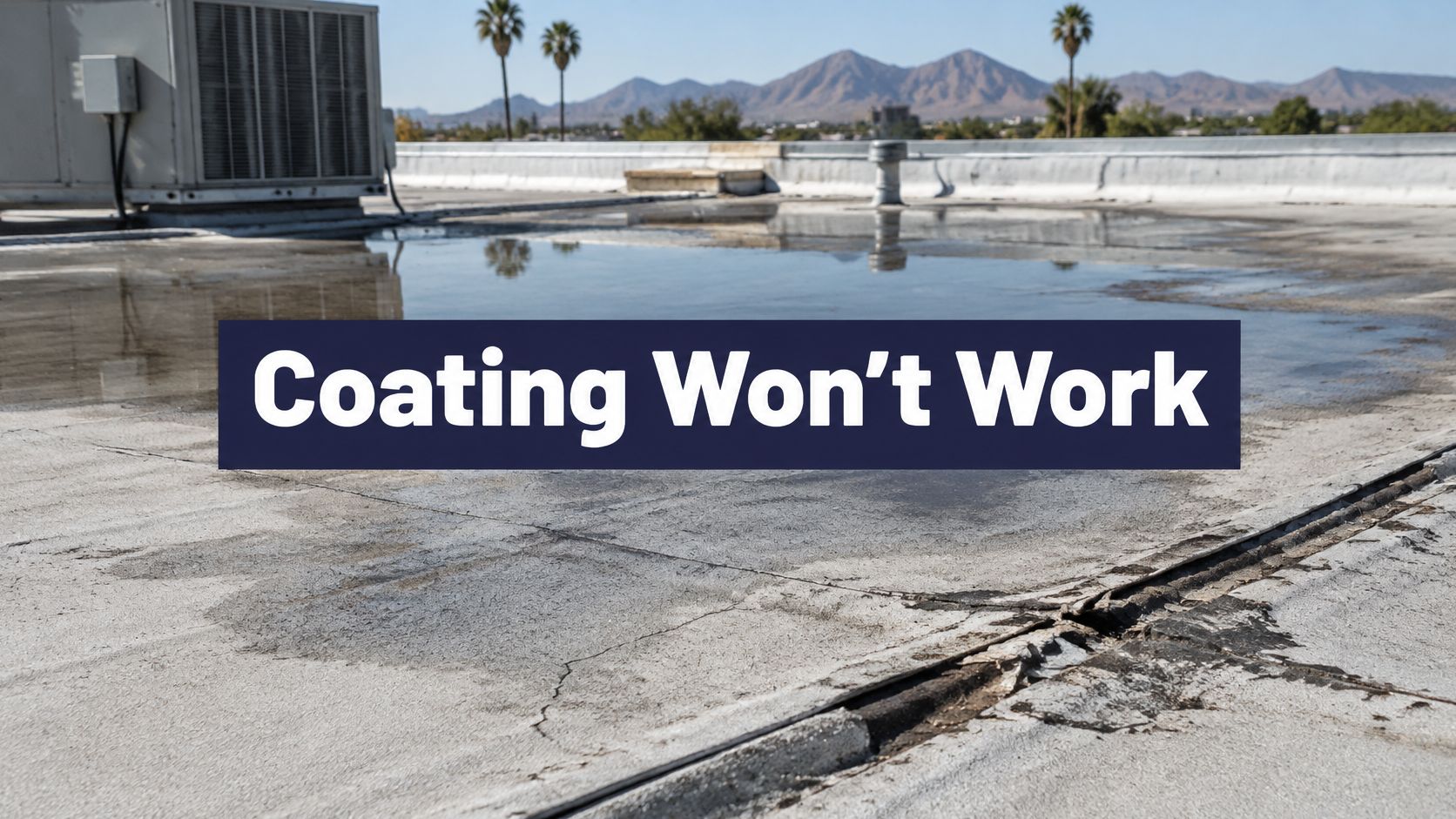
A roof coating is a maintenance or restoration layer, not a structural repair, and it won't work over wet insulation, widespread deterioration, unresolved leaks, chronic ponding, or an incompatible substrate. Those conditions need repair or replacement first, regardless of how attractive a coating proposal looks.
When a Roof Coating Will Not Work
The popular advice to coat an aging roof before spending money on replacement leaves out the most important question: Is the existing roof worth preserving? A fresh surface doesn't establish that the insulation is dry, the membrane is attached, or the deck is sound.
For commercial owners in Phoenix and Tucson, the eligibility screen should come before the material selection. Arizona sun, dust, and monsoon exposure make preparation and inspection important, but they don't change the underlying rule: coating cannot rebuild a failing assembly.
The roof underneath determines eligibility
Technical guidance on coating adhesion and moisture explains that a damp substrate can prevent proper bonding. Escaping moisture vapor can also break the bond before the coating develops adequate adhesion.
That means an application can look complete while never becoming reliably attached. The decision should start with the roof's mechanical condition, moisture investigation, and field testing, not the appearance of the finished surface.
- Unresolved leaks: Locate and repair the entry points before treating the surrounding roof.
- Loose or deteriorated materials: Establish a stable base rather than covering material that's already failing.
- Drainage defects: Correct the reason water stays on the roof instead of expecting another layer to remove it.
Practical rule: A coating proposal should explain what makes the existing roof suitable, not just what product will cover it.
For owners comparing painting labor with professional preparation, the DIY vs pro roof painting resource provides a separate perspective on that narrower decision. It isn't an eligibility standard for Arizona commercial roof restoration. Painting, cleaning, and roof-system rehabilitation are different scopes of work.
What Coatings Can and Cannot Solve
A coating can be a useful protective layer on a sound, dry, compatible roof after necessary repairs. It isn't a substitute for replacing failed insulation, stabilizing a loose membrane, or rebuilding defective flashing.
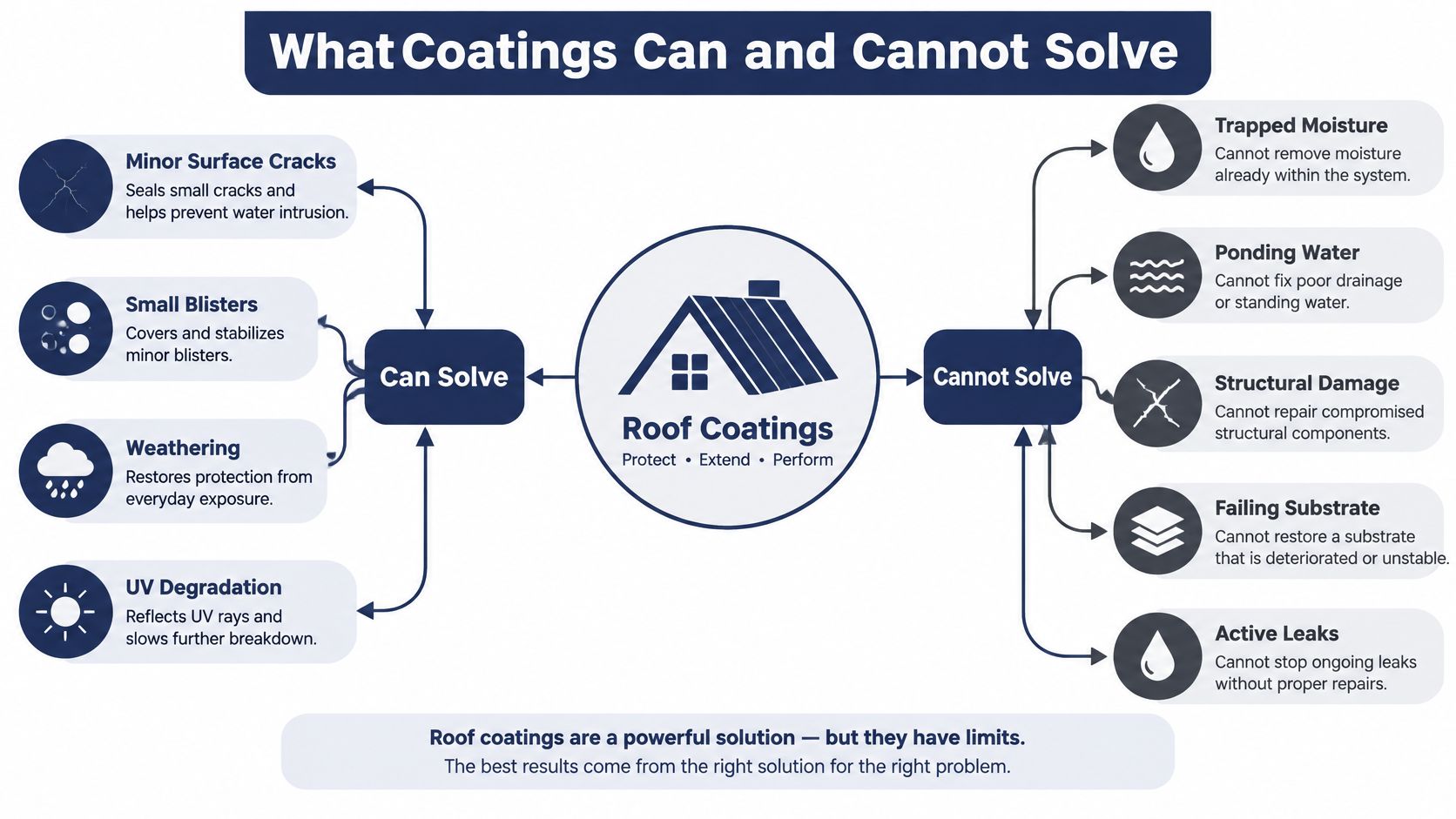
Surface restoration versus assembly repair
Weathered surfaces and limited defects may be compatible with restoration, but the defect has to be correctly identified. A blister, for example, shouldn't automatically be treated as a cosmetic flaw. The contractor needs to determine whether it involves trapped moisture, separation, or material that must be removed.
Manufacturer installation requirements for silicone restoration establish the importance of substrate condition, preparation, and adhesion verification. The practical distinction is straightforward: coating protects an acceptable base; repairs make an unacceptable base eligible.
The same distinction applies to seams and penetrations. A specified detail repair may prepare a localized defect for restoration, but rolling coating over an open joint isn't equivalent to rebuilding that joint.
Why covering a problem can make diagnosis harder
Trapped moisture can produce vapor pressure as the roof heats, contributing to blistering and delamination. Research available through the University of Milan also demonstrates the importance of substrate strength: adhesion differed sharply between a stable metal surface and a crumbly substrate.
The lesson isn't that one coating belongs on every metal roof. It's that the bond is only as dependable as the material supporting it.
- Coating can address an eligible surface: Only after preparation, repairs, and compatibility checks.
- Coating cannot restore the concealed assembly: Wet insulation, deteriorated decking, and unstable materials require their own corrective work.
- Material selection comes afterward: Comparing acrylic or silicone for Arizona roofs makes sense once the roof passes the condition screen.
Neither material category makes structural movement or inadequate drainage acceptable. A product choice cannot replace a repair scope.
The Coating Candidacy Scorecard
A useful scorecard records evidence, not optimistic impressions. Each category should receive a documented pass, a repair requirement, or a rejection pending broader investigation.
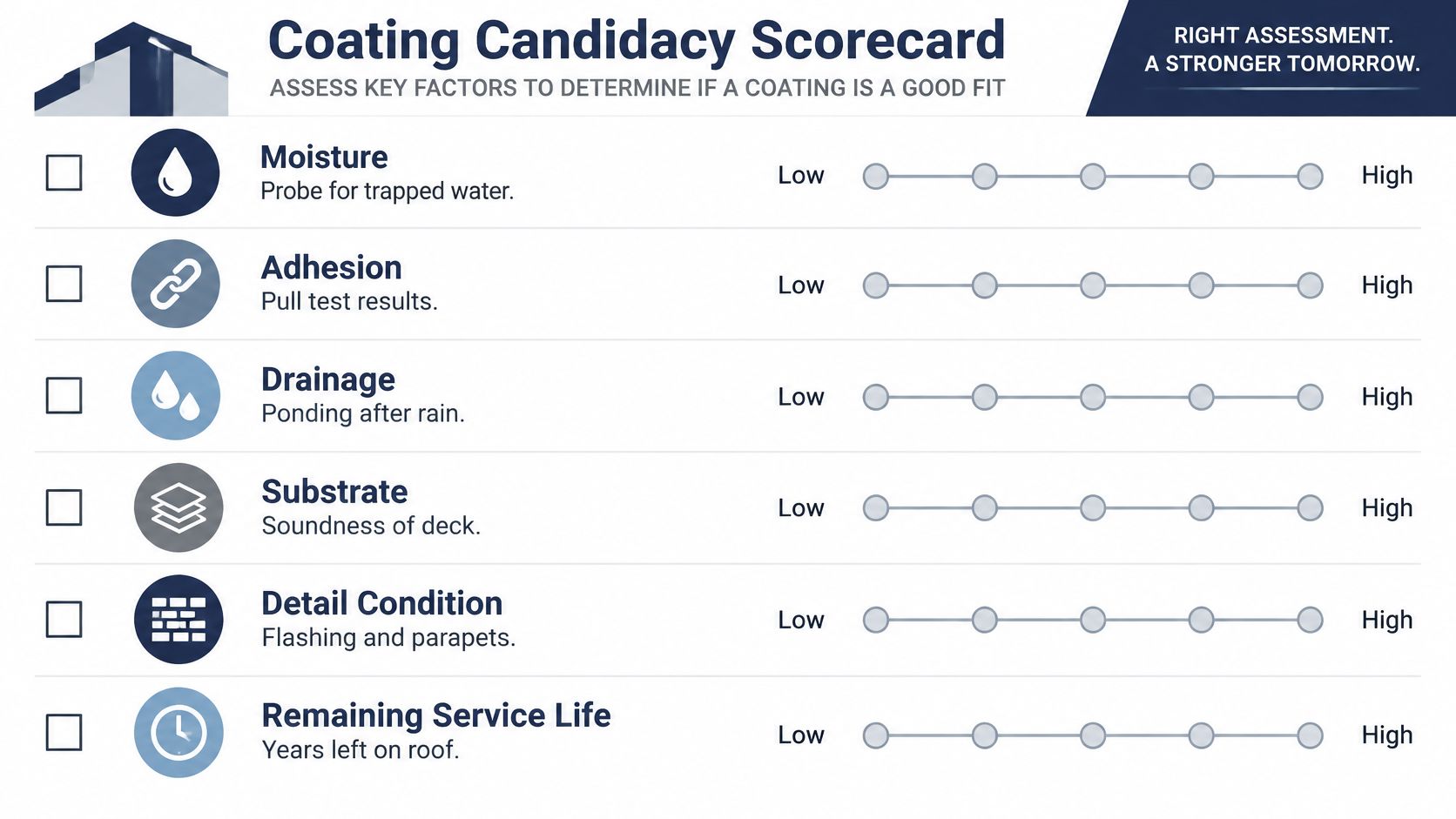
Evidence to collect before approval
| Criterion | Evidence needed | What prevents approval |
|---|---|---|
| Moisture | Moisture survey, mapped suspect areas, and verification where needed | Unresolved wet insulation or uncertain concealed conditions |
| Adhesion | Representative field tests on each relevant surface | Poor bonding or untested prior coatings |
| Drainage | Drain and scupper review, low-area map, and storm observations | Recurring water retention without a correction plan |
| Substrate | Inspection of membrane attachment, exposed deterioration, and deck concerns | Loose, friable, deteriorated, or unstable materials |
| Detail condition | Repair map for seams, penetrations, flashings, and parapets | Widespread failures or joints that continue moving |
| Remaining service life | Assessment of whether the assembly remains serviceable after repairs | A roof whose underlying components can't reasonably be retained |
Don't average away a failure. Strong results in other categories don't cancel wet insulation or an unstable deck.
A commercial coating specification addressing wet roofing materials strongly recommends a moisture survey and requires wet materials to be removed and replaced. Product-specific rejection thresholds also exist, so an owner shouldn't accept a universal allowable-moisture percentage.
The test-and-proof checklist
A professional roof inspection should produce more than a verbal recommendation. The proposal package should connect the findings to the work being purchased.
- Moisture survey: Identify the method, mapped findings, verification locations, and wet-material removal scope.
- Adhesion test: Record the substrate, preparation, primer if applicable, test locations, cure conditions, and acceptance result.
- Repair map: Mark every included seam, flashing, penetration, blister, and deteriorated area.
- Drainage review: Document blocked outlets, low spots, and the proposed correction rather than merely listing ponding as an exclusion.
- Product compatibility: Identify the existing roof and prior coating, then confirm the selected written system accepts them.
- Coverage documentation: State the specified application coverage, required film thickness, and how installation will be checked.
The manufacturer's general coating requirements illustrate why preparation and testing matter: surfaces must be sound and free of adhesion-interfering contaminants, and field adhesion testing requires a defined procedure.
Dust, untreated rust, grease, loose coating, and peeling material aren't minor housekeeping issues. They're reasons to withhold approval until preparation and retesting establish a dependable base.
Green, Yellow, and Red Roof Conditions
The scorecard findings should lead to a decision, not remain buried in an inspection report. Green means potentially eligible, yellow means repair and prove, and red means stop the coating proposal until broader work is resolved.
Roof Coating Candidacy Matrix
| Status | Roof Condition | Coating Decision |
|---|---|---|
| Green | Dry, sound, well-attached roof with functioning drainage, acceptable details, and demonstrated compatibility | Consider coating under the selected written system |
| Yellow | Localized wet areas scheduled for removal, repairable seams or flashing, removable contamination, or correctable drainage defects | Complete repairs, then verify eligibility again |
| Red | Widespread wet insulation, extensive membrane failure, unresolved structural movement, deteriorated decking, or uncorrectable drainage | Evaluate broader rehabilitation or replacement instead |
A yellow roof isn't approved because repairs appear in a proposal. The contractor needs to define what will be removed, rebuilt, cleaned, or tested and what happens if the repaired area still fails acceptance.
Likewise, an isolated flashing defect doesn't automatically require replacement of the entire roof. The distinction is whether the defect is localized and correctable or part of a broader failure pattern.
Drainage and concealed conditions can change the rating
The Department of Energy's cool-roof guidance explains that ponding can result from insufficient slope or blocked drainage. For screening purposes, water still present 48 hours after precipitation ends should be documented as a drainage concern, not treated as a request for thicker coating.
That observation doesn't establish the repair by itself. Clearing a blocked scupper is different from correcting a structural low spot or damaged insulation.
For concealed layers, America Roofing's roof core sample overview provides context for discussing verification with a contractor. Owners should leave sampling and access to roofing professionals, particularly where the deck's condition is uncertain.
A roof should move from yellow to green only after the corrective work passes inspection, not after the owner accepts the proposal.
For a separate northern Arizona maintenance perspective, Flagstaff roof maintenance tips may help frame routine upkeep questions. Maintenance guidance doesn't replace moisture testing or establish coating eligibility for a Phoenix or Tucson commercial roof.
How Arizona Heat and Monsoon Timing Affect Coating
An eligible roof can still be coated under unsuitable conditions. Roof condition and application weather are separate approvals, and both have to pass.
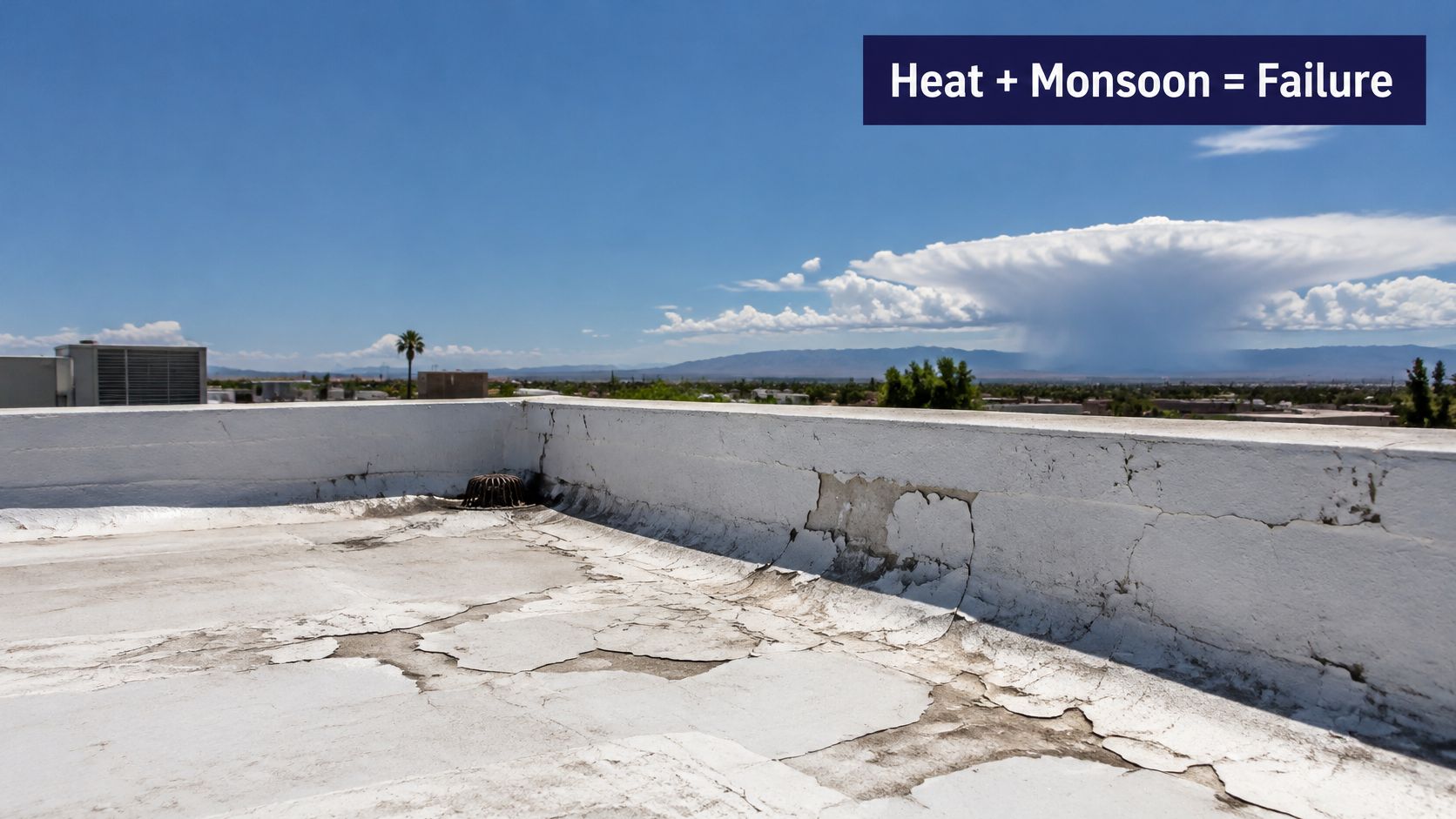
Surface temperature matters more than a casual forecast check
A manufacturer specification for a coating system over metal prohibits starting when precipitation is expected within 24 hours, sets a 50°F minimum, and limits air and substrate temperatures to 110°F. Those are system-specific requirements, not universal limits for every coating.
In Phoenix and Tucson, a dry forecast doesn't prove that a sun-exposed roof is within its application range. The installer needs actual roof-surface measurements and a plan for working within the selected product's limits.
Arizona UV exposure also makes the existing surface condition relevant. A weathered roof still needs inspection and preparation; bright sun isn't evidence that an older assembly is dry underneath.
The application-day go/no-go check
- Dry surface: No rainwater, wash water, or overnight condensation remaining where coating will be applied.
- Suitable temperatures: Measured air and substrate conditions within the selected system's requirements.
- Adequate weather window: Enough time for application and the required cure before rain.
- Clean work area: No new wind-blown dust or debris contaminating a prepared surface.
- Documented follow-up: A post-installation review, including drainage observations after the first major storm.
A separate acrylic coating technical specification reinforces the need to follow product-specific temperature and drying requirements. Generic claims that coating can be applied year-round leave too much unanswered.
Monsoon scheduling should allow postponement when conditions change. A rushed application between storms isn't a substitute for the required dry window, and switching coating categories doesn't remove the need to verify that window.
Coating, Repair, Recover, or Replacement
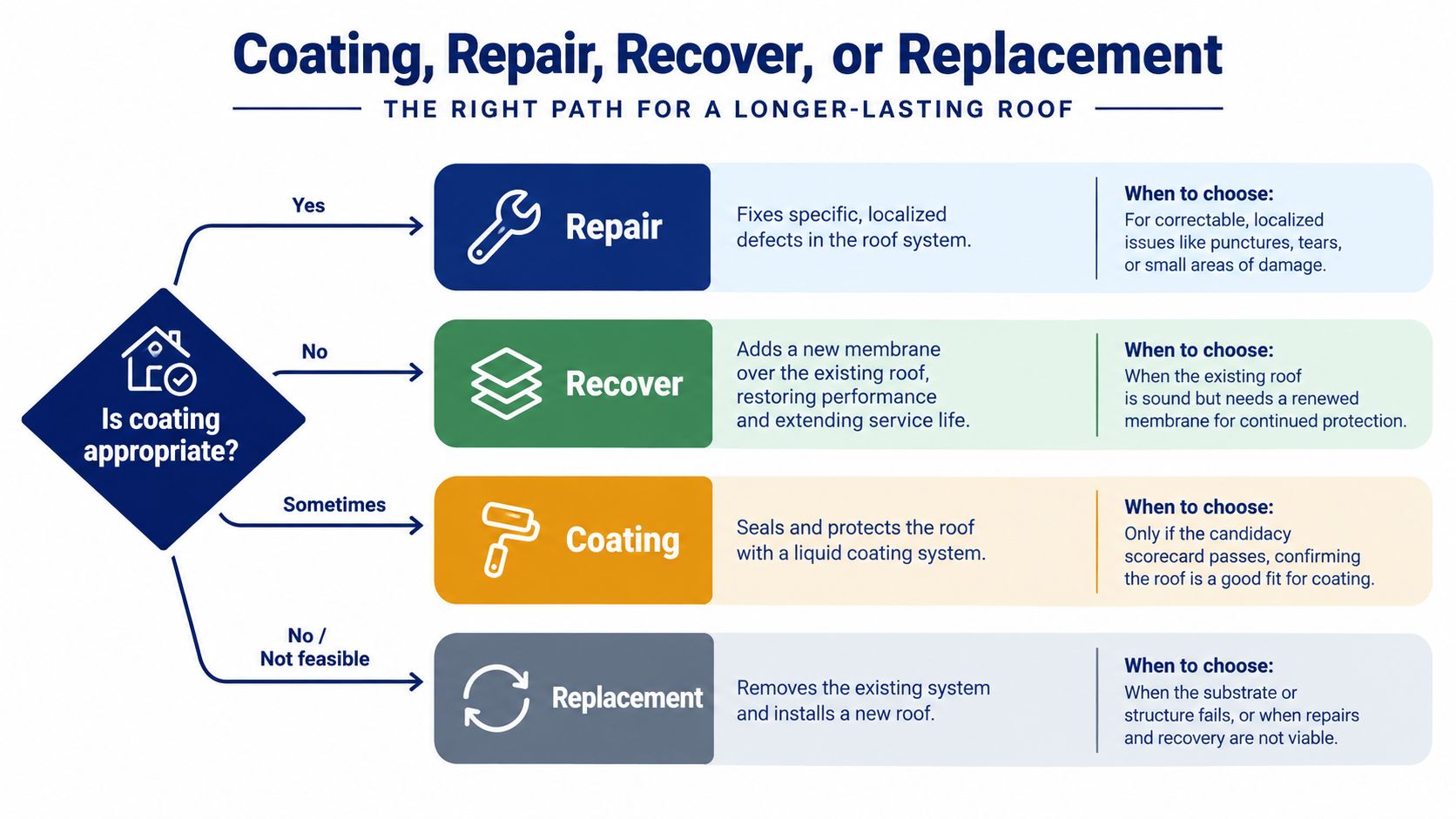
The correct pathway depends on what can remain, what must be removed, and what the finished assembly needs to accomplish. A coating-only price shouldn't be compared with a replacement scope as though both solve the same problems.
Match the work to the failure
- Repair: Appropriate for localized defects when the surrounding roof remains serviceable. Repair may be the complete scope or preparation for later coating.
- Coating: Consider after the candidacy evidence passes and all required preparation is included.
- Recover: A new membrane over an existing roof is a separate design decision requiring its own assessment. It isn't an automatic alternative when coating fails.
- Replacement: More appropriate when retaining the assembly would leave widespread wet, deteriorated, or unstable materials in place.
For a recover proposal, the owner should require written confirmation of the assembly's suitability and the applicable project requirements. A new membrane shouldn't become another way to conceal unresolved conditions.
Compare complete scopes, not attractive starting prices
Preparation, wet-material removal, detailing, access, drainage corrections, and verification all affect the practical value of a restoration proposal. If those items are excluded, the lower initial figure may describe less work rather than a more economical solution.
The advice from Ventura County Roof Cleaners offers a separate cleaning-versus-replacement perspective. For residential owners, roofing solutions for Arizona homes addresses another repair-or-replace context, but tile and sloped roofs require their own material and flashing assessment.
Commercial owners can review options for restoring an eligible commercial roof after inspection establishes what can be retained. No pathway should carry assumed energy savings, restoration eligibility, or warranty coverage without the exact roof condition and selected written system.
Your Next Step for a Phoenix or Tucson Roof
The useful question isn't whether a contractor can apply coating. It's whether the inspection evidence supports preserving the existing assembly.
A decision-ready proposal should explain the roof's condition, the required corrective work, and the tests that establish acceptance. It should also identify unresolved conditions that could change the recommendation once concealed areas are opened.
What an owner should have before signing
- A condition record: Photos, moisture findings, drainage observations, and a marked repair scope.
- An acceptance standard: Written compatibility and adhesion requirements for the selected system.
- A complete scope: Preparation, detail repairs, material application requirements, and installation documentation.
- A fallback decision: A clear process if investigation reveals more extensive deterioration.
Decision check: An inexpensive coating isn't economical if the proposal leaves the reason for roof failure untouched.
Coating makes sense when the evidence supports it. Correctable defects call for repair and verification; widespread assembly failure calls for a broader solution. That distinction is the most reliable way to determine when a roof coating will not work.
America Roofing offers commercial roof repair, coatings, and replacement services in Phoenix and Tucson, with the appropriate pathway depending on the existing roof's condition. Owners can visit America Roofing, call 602-237-2478, or request a free roofing quote to discuss the roof and necessary evaluation. For a coating proposal, request a roofing estimate that addresses moisture, adhesion, drainage, and repairs before application.