
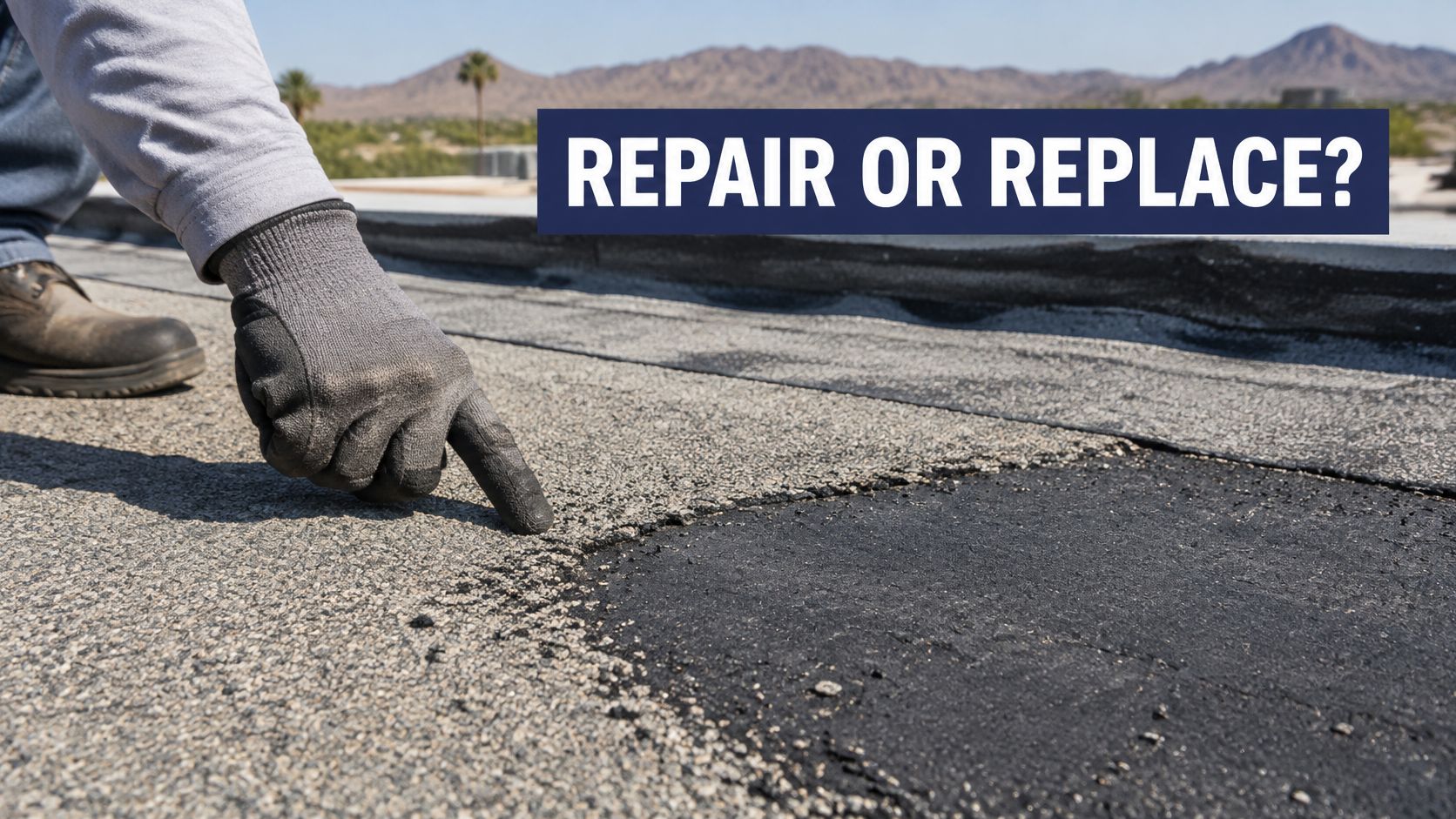
Loose granules in a drain line do not automatically mean a modified bitumen roof has failed. A laboratory granule-loss limit describes a new sheet tested under specified conditions, not the condition of an installed roof.
On low-slope roofs, the location and pattern of shedding matter more than a handful of granules alone. Sun, wind-driven rain, and foot traffic can wear a cap sheet differently across the roof. The surrounding membrane condition helps show whether the loss is ordinary surface wear or a reason to arrange a closer evaluation.
How Serious Is Granule Loss on Modified Bitumen
| Condition | What It Usually Means | Next Action | Urgency |
|---|---|---|---|
| Loose granules in drain lines | Normal shedding or light wear, often where water flows | Clean gently, photograph, recheck at the next inspection | Monitor |
| Localized scuffing on walk paths | Traffic or equipment wear, with bitumen still covered | Document, add protection, schedule a targeted repair | Schedule evaluation |
| Widespread bare asphalt | Surfacing has worn away across the field, leaving the bitumen exposed | Have the membrane and surfacing options evaluated | Prompt evaluation |
| Cracks through exposed bitumen | Membrane aging or movement may have created a path for water | Repair the membrane before considering a coating | High |
| Blisters on the surface | Possible trapped moisture or loss of adhesion | Find the cause before coating or repair | High |
| Active leak or ponding with bare areas | Possible membrane breach or drainage failure | Contact a roofing professional promptly and limit water entry as advised | Urgent |
The ASTM specification for APP modified bituminous sheet materials sets a maximum allowable granule loss of 2 grams for SBS and APP granule-surfaced products under the applicable laboratory method. The standards also assess granule embedment alongside properties such as peak load, elongation, tear strength, low-temperature flexibility, compound stability, and water absorption. These tests characterize new sheet material under laboratory conditions. They do not rate an installed roof after years of exposure.
Recurring granule piles alongside bald strips, cracks, or weak seams call for an assessment of the roof as a system, including whether to repair or consider when commercial roofs need tear-offs. Check the sheet manufacturer's maintenance bulletin before repair or resurfacing.
Practical rule: If asphalt shows across more than a small patch, or water is entering the building, schedule an evaluation before the next storm season.
Why Cap Sheets Depend on Their Granule Layer
Granules shield the modified bitumen coating from sunlight and surface wear. Wind-blown grit, heat, and foot traffic can disturb that layer, but an uneven surface alone does not establish a defect.
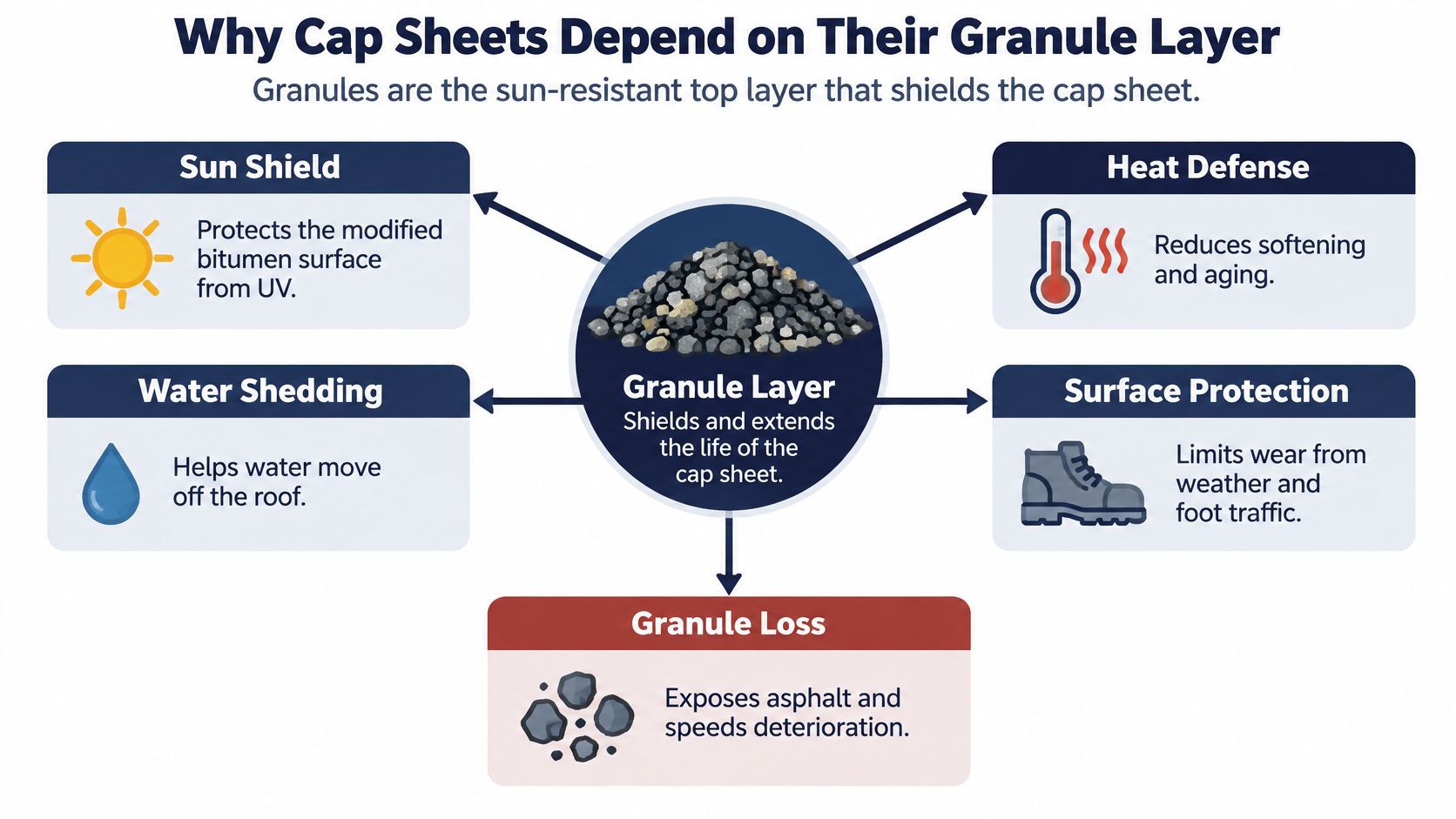
A factory cap sheet combines reinforcement, polymer-modified bitumen, and mineral surfacing pressed into the coating. Embedment is part of the product design, so judge the surface by whether the bitumen remains covered, not by uniform color alone.
National Research Council of Canada research describes bituminous surfaces becoming exposed through degradation, adhesion loss, and scouring from wind, water, and traffic. It also notes that larger granules generally come off first. ASTM D5147 includes granule embedment and coating thickness among the test properties for polymer-modified bituminous sheets. Those properties help characterize the sheet; a visual estimate of bare-spot area cannot establish them.
APP and SBS sheets use different polymers, so repair cement, primer, or coating must suit the sheet specified. A repair selected by color rather than product compatibility can soften a sound lap.
When granules no longer cover the bitumen, the coating is exposed to sunlight and can age faster. Owners considering modified bitumen for roof replacement should treat missing surfacing as a condition concern, not merely a cosmetic difference.
Why Shingle Granule Advice Does Not Transfer
Granule loss means different things on steep shingles and a low-slope modified bitumen roof. Shingle guidance often focuses on how much granule material appears in gutters. On a cap sheet, the practical question is whether loss exposes the bitumen or points to a problem with the membrane, laps, or adhesion. The comparison with normal shingle shedding versus storm damage helps clarify that difference.
| Factor | Asphalt Shingle Roof | Modified Bitumen Cap Sheet |
|---|---|---|
| Water behavior | Water runs off a steep slope quickly | Water can pool and sit longer on the roof |
| Traffic and equipment | Usually light, mostly from inspections and repairs | Service routes, walkways and rooftop equipment are common |
| Warning signs | Exposed mat, missing or lifted tabs | Exposed bitumen, splits, blisters, open laps |
| Repair logic | Repair or replace individual shingles | Check adhesion, reinforcement and membrane condition before choosing a surfacing or coating repair |
| Test reference | Shingle ratings vary by manufacturer | ASTM D6222 for APP sheets and ASTM D5147 for polymer-modified sheets |
What the table does not decide
Loose granules alone do not establish the right repair. A surfacing product must suit the sheet, and adhesion needs a sound, dry surface. Adding mineral to a bare spot does not restore the original embedment.
The table describes typical differences, not a diagnosis. A visual check can show exposed bitumen, splits, blisters, or open laps, but it cannot confirm every hidden condition in the assembly. Start repair decisions with the installed system and the condition of its membrane. A shingle repair may be isolated to one unit; a cap-sheet repair must address the affected membrane and compatible surfacing together.
What Drives Granule Loss in Arizona Heat and Storms
In Arizona, granule loss often has more than one cause. Sun and heat weaken the bond over time; wind and rain can then remove loose granules. Installation problems may start the process sooner.
Heat and UV. Repeated temperature swings and strong sun can stiffen bitumen and weaken the granule bond. Dark cap sheets with worn surfacing are especially exposed to UV.
Age and ordinary weathering. Granules can wear away gradually, leaving small bare areas even when the bitumen beneath remains continuous.
Monsoon wind and rain. Wind-driven dust and runoff can scour granules that have already loosened. Exposed roof edges and corners may take more direct impact than sheltered areas.
Hail. A bare spot by itself does not establish hail damage. A 2022 IIBEC technical assessment found that granules can weather away locally, while hail impacts on aged modified bitumen may leave damage that continues to expand.
In controlled tests, new granule-surfaced modified bitumen over an insulated, relatively soft substrate showed no displaced or crushed granules. Aged material over a firm substrate showed crushed and displaced granules. Field impacts from large hail on aged roofs produced more pronounced granule loss than the laboratory impacts.
ASTM D3746 addresses reinforcement impact damage, not granule surfacing specifically. Photograph the bare area alongside any crushed bitumen, damaged reinforcement, splits, dents or substrate deformation. Those details help distinguish surface wear from impact damage.
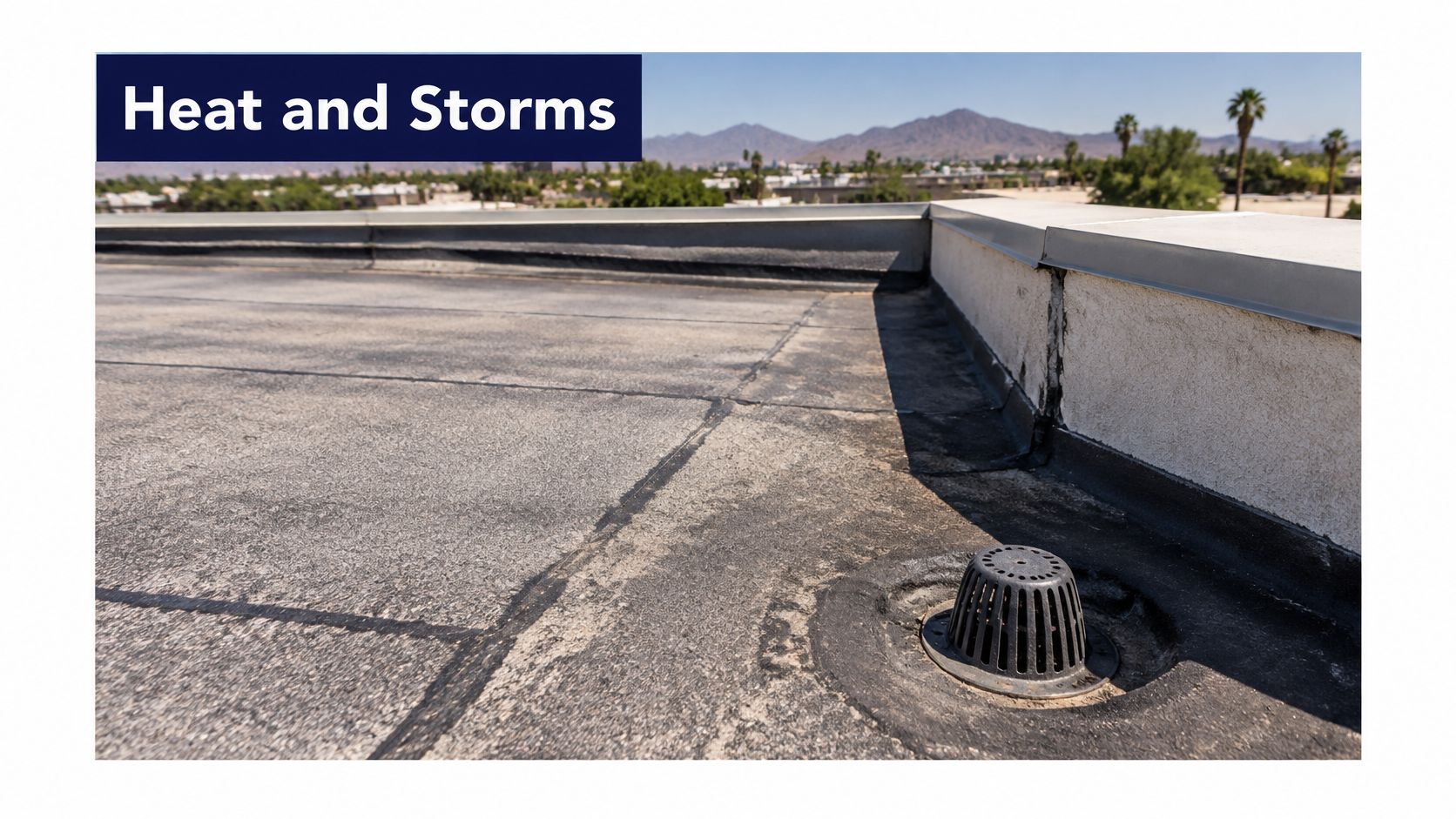
Installation and maintenance. NRCA roofing guidance warns that excessive or loose ceramic granules at laps can interfere with seaming. Check adhesive compatibility against the manufacturer's instructions, particularly where solvent-rich products may contact the sheet. Softening, blistering or heavy granule loss after a recent repair warrants a review of the product data and how trapped moisture causes roof blistering.
The roof image is illustrative, not a record of a completed project.
Where Loss Concentrates on a Low-Slope Roof
Location is often the clue. Map the zones before you judge how bad the loss is.
| Roof Zone | Why Loss Concentrates | What to Check | Concern Signal |
|---|---|---|---|
| Roof drains and scuppers | Water flows and debris collects, scouring granules | Drain lines, standing water, granule buildup | Ponding over bare asphalt |
| Walk paths and service routes | Foot traffic and equipment movement scuff the surface | Scuffed tracks, exposed asphalt in strips | Continuous bare path |
| Equipment pads and curbs | Vibration, dragging and stored gear wear the edges | Pad edges, curb corners, nearby fasteners | Splits or tears near equipment |
| Laps and seams | Loose granules can interfere with seaming | Lap edges, granule ridges, open seam lines | Open or lifting laps |
| Perimeters and parapets | Wind uplift and edge exposure | Edge metal, corners, wall base | Lifted edges with exposed sheet |
| High-UV field areas | Full sun exposure and heat cycling | Sun-facing field, bare patches, surface texture | Widespread bare asphalt |
Ponding raises the level
Water that stands near drains keeps granules wet and keeps scouring them. Bare asphalt inside a ponding area is a step more serious than the same bare patch on a dry, well-sloped field, because the coating stays wet after every storm.
Two patterns, two causes
Say a continuous scuffed track runs from a roof hatch to a curb around rooftop equipment. That pattern points to traffic. Scattered bare patches across the sun-facing field, with no path between them, point to UV and age.
Loose granule ridges along laps can hide the seam. Look at the lap edge itself, not only the mineral piled on it. Open or lifting laps outrank a tidy drain full of loose stone.
Map the zones first, then judge severity from what you see in each one.
How to Inspect Safely and Document Loss
Observe from the ground or a safe higher view. Leave roof walks to a qualified roofing professional with proper fall protection. A low-slope commercial roof is not a place for a quick look in street shoes.
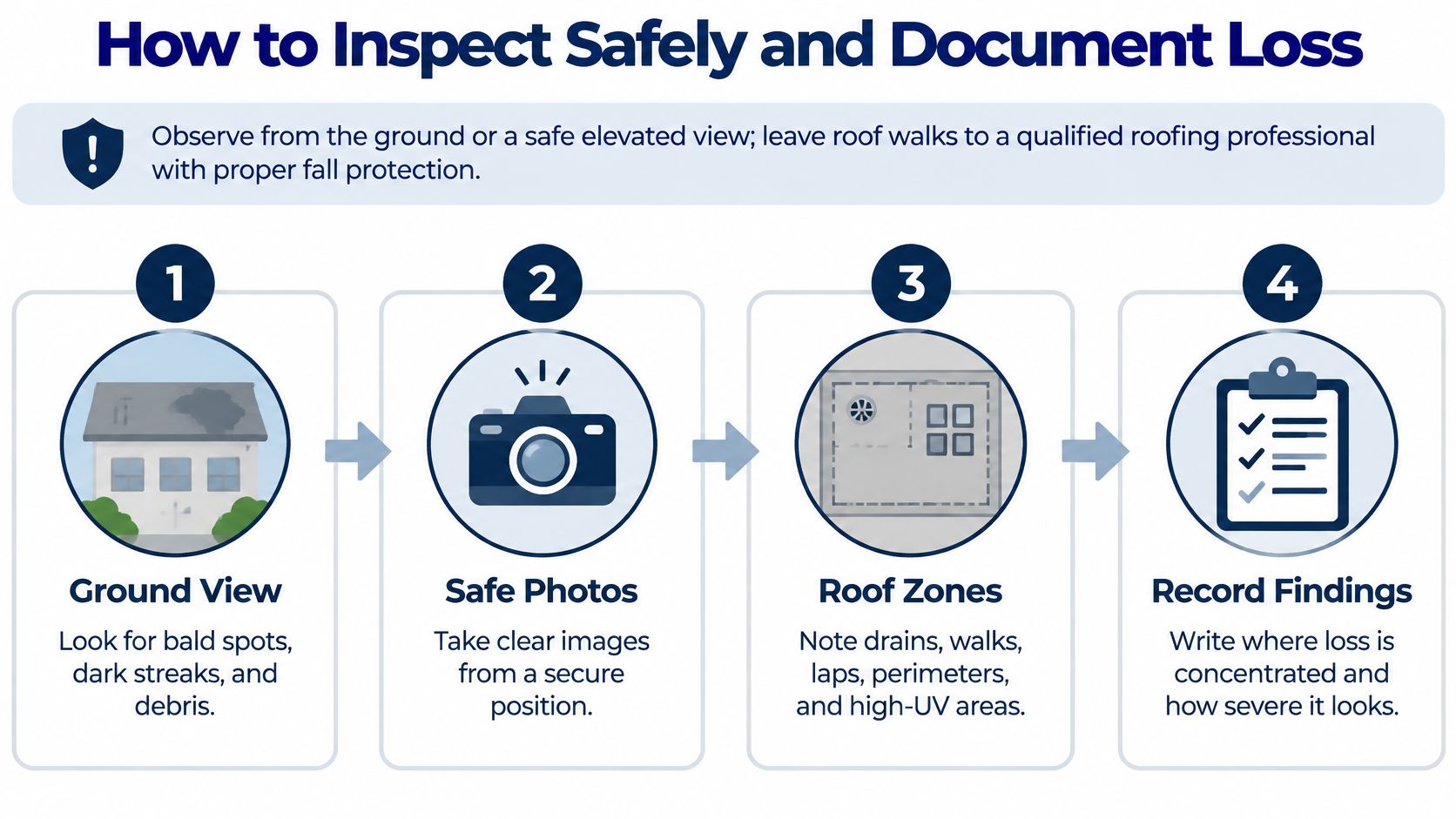
- Photograph the whole roof from a safe vantage so layout and sun exposure are clear.
- Photograph each zone with a scale, such as a tape measure in the frame.
- Mark and measure affected areas, and note whether asphalt is exposed, cracked, blistered, or ponding.
- Check drain lines and clear loose debris with a soft broom. Aggressive brushing and high-pressure washing pull off more granules.
- Log the date, zone, size, and condition on a simple roof sketch.
- Repeat after significant storms and compare the new photos with the earlier set.
Why a log beats one glance
A National Research Council of Canada study tested 13 representative samples of shingles and modified bituminous membranes surfaced with stone, slag, or slate. After wetting, samples took 50 strokes of a steel-wire brush, and five went on to 150 strokes. Loss varied widely. A fixed maximum did not fully describe retention, because the same absolute loss means different things depending on how much granule was applied at the start. The study recommended reading wet granule loss, initial coverage, and detachment under extended scrubbing together.
On a building, that translates to trend, not a single bare-spot count. A small amount of loose material can be manufacturing residue or ordinary wear. Progressive loss, thin coverage, or fast detachment points to weaker adhesion or faster aging. Owners planning inspection schedules for Tucson commercial roofs get more from repeat photos than from one gutter scoop.
For storm paperwork, post-storm roof checks for Utah homeowners show the kind of ground-level record that travels well: photos, dates, and where debris collected. Keep photos, logs, invoices, and maintenance records. Read the policy and the manufacturer terms. A documented condition does not establish coverage.
Decide Between Repair, Coating and Replacement
The right fix depends on whether the sheet remains sound and how far granule loss has exposed the asphalt.
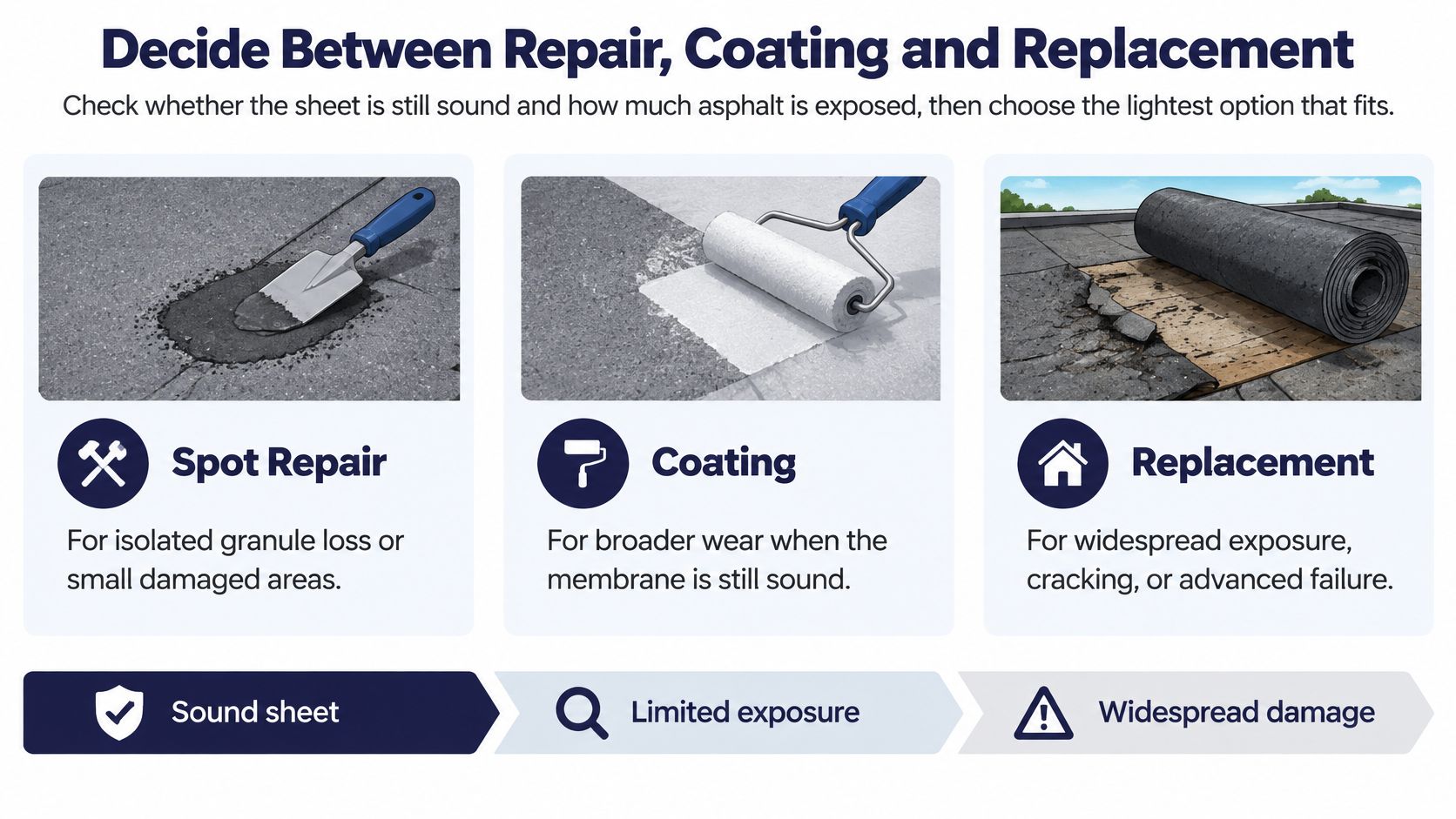
Spot repair suits isolated damage when the membrane, laps, and reinforcement remain intact. Protect walk paths to prevent the same scuffing from recurring.
Compatible surfacing can cover a localized bare area if the asphalt beneath it is sound. The surfacing must match the existing sheet. Loose granules tossed onto the roof do not provide that protection.
A reflective coating may work when the surface is dry, adhesion is good, and there is no underlying blistering or cracking. Coating will not correct loose or blistered material. Read Arizona coating advice from America Roofing before choosing a coating chemistry.
An overlay or recover may suit a sound but aged system if the written assembly allows it. Full replacement evaluation is appropriate for widespread granule loss accompanied by cracks, exposed reinforcement, open laps, or recurring leaks.
Low-slope membranes, coatings, and foams are not interchangeable. The written roof assembly determines the system, including insulation, attachment, flashing, drainage, and warranty. Polyglass system warranty eligibility depends on the specified system, inspection, registration, and written manufacturer terms. Project cost depends on the roof area, access, membrane condition, and system selected.
Summer heat and monsoon storms shorten the window before exposed asphalt becomes a more serious concern. Arizona flat roof guidance provides further context. Gather the roof-zone map, photos, and maintenance log before requesting a roofing estimate.
America Roofing works with commercial flat and low-slope systems, including modified bitumen. For an estimate, bring your photos and a simple zone log so the proposed work can account for the roof system and the areas of concern. Visit America Roofing to start a conversation.