
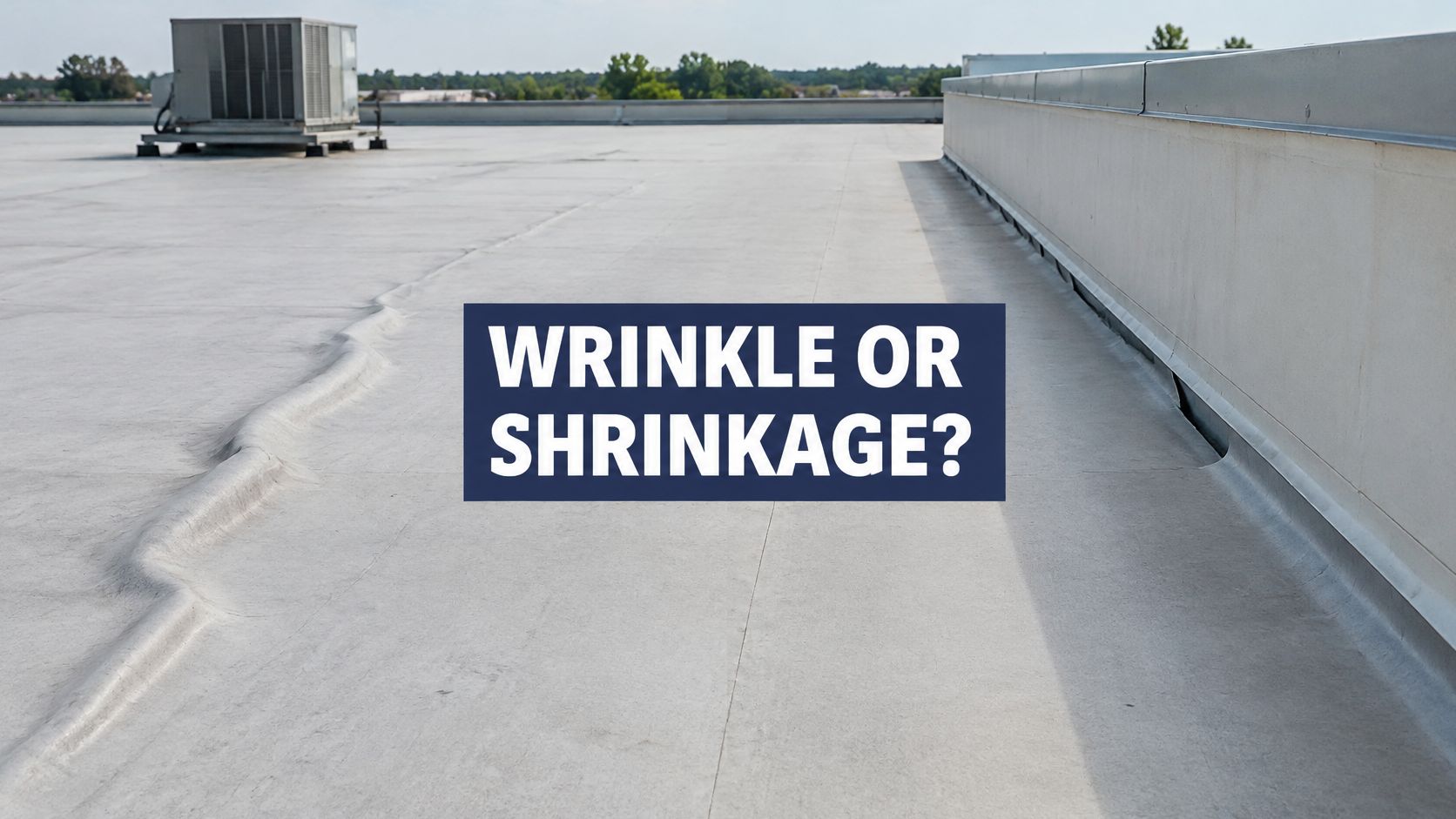
A wrinkle is a fold or ripple in the sheet, while shrinkage is the membrane pulling back and tightening toward an edge. Location and whether the change grows over time decide which matters more. For a Phoenix or Tucson building owner noticing ridges after a hot afternoon or monsoon storm, the useful first step is documenting movement, not assuming the roof needs replacement.
Five Raised Membrane Defects Compared at a Glance
Wrinkles and shrinkage can look similar, but they don't behave the same. This matrix helps compare the pattern before deciding on repair or evaluation.
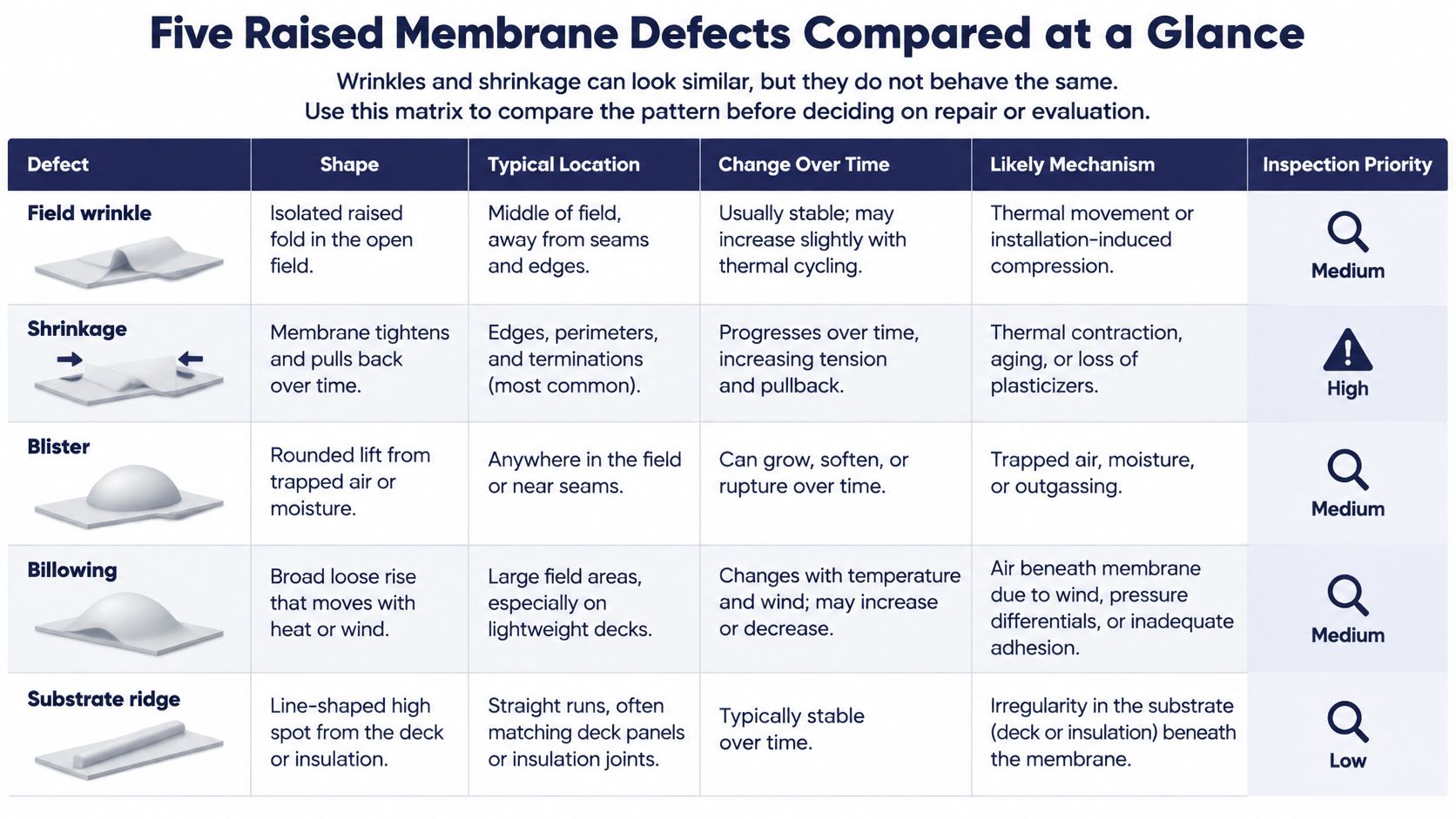
Visual symptom matrix for five raised membrane defects
| Defect | Shape | Typical location | Change over time | Likely mechanism | Inspection priority |
|---|---|---|---|---|---|
| Field wrinkle | Low linear fold or ripple | Open field, away from edges | Often stable; may flatten as temperatures ease | Installation slack, attachment or insulation movement, thermal cycling | Monitor; escalate at a seam or drain |
| Shrinkage | Tight sheet with visible pullback | Perimeters, curbs, parapets, drains, wall terminations | Progressive pullback measured over weeks | Contraction under restraint and locked-in tension | High when terminations or flashings are affected |
| Blister | Raised dome containing a pocket | Field or beneath the surface | May grow with heat; compare with moisture history | Trapped air or moisture | Follow the separate blister branch, not shrinkage repair |
| Billowing | Broad, soft lift | Over insulation or deck areas | Moves with wind or temperature | Air or moisture beneath, loose attachment | Medium to high; check attachment |
| Substrate ridge | Line following a board edge, joint or fastener | Substrate seams or insulation joints | Usually static | Substrate movement or unevenness | Medium; check substrate and drainage |
These are inspection hypotheses, not diagnoses. The same shape can have different causes, and no row confirms a defect from a photograph. Wind-responsive movement also needs interpretation against the attachment design, rather than an automatic conclusion that fastening has failed.
Arizona afternoon solar loading and monsoon wind can change how prominent a distortion looks. A shaded morning photograph and a sunlit afternoon photograph aren't directly comparable unless the observer records their timing and conditions.
America Roofing states that low-slope membranes, coatings and foams aren't interchangeable, and the written roof assembly controls the system. That distinction matters before anyone proposes flattening, coating or cutting a raised area.
Practical rule: Location and change over time usually determine priority more reliably than apparent size.
Defining Wrinkles, Shrinkage, Billows and Tenting
A wrinkle resembles a tablecloth that's too long for its table and bunches in the middle. It's a linear fold or ripple, but the extra material may reflect installation slack, attachment conditions or movement beneath the sheet.
Shrinkage resembles that cloth contracting in the wash until its hem lifts at the ends. The membrane shortens, leaving tension and displacement at restrained details; mechanical shortening can also occur as installation tension gradually relaxes.
Raised doesn't always mean loose
Billowing is a broad, soft lift across a larger area rather than a narrow fold. Its response to wind helps distinguish it from a fixed ridge, although the roof's attachment method must be established before judging the movement.
Tenting is a peaked or bridged membrane at a restraint, such as a pipe, curb or wall termination. Unlike an isolated loose fold, the raised material may be held under tension.
The National Institute of Standards and Technology field study of EPDM roofs at Air Force facilities found that wrinkles near seams could produce fishmouths and impose peel stress even when the seam remained sealed. A fishmouth is an opening at a lap edge, not a ridge elsewhere in the sheet.
A sealed seam can still be stressed. Absence of an immediate leak doesn't establish that the detail is sound.
A blister is a raised pocket that may contain air or moisture. Its investigation belongs to a different repair branch, addressed in America Roofing on membrane blistering, rather than being treated as shrinkage.
A label alone doesn't settle the diagnosis. Location, timing and the mechanism creating the shape determine the appropriate response.
Causes Behind Each Pattern on Arizona Low-Slope Roofs
Installation tension, uneven bonding and movement below the membrane can produce similar surface patterns. A sheet secured before it relaxes starts with a different stress condition from one laid with excess slack, even if both later develop ridges.
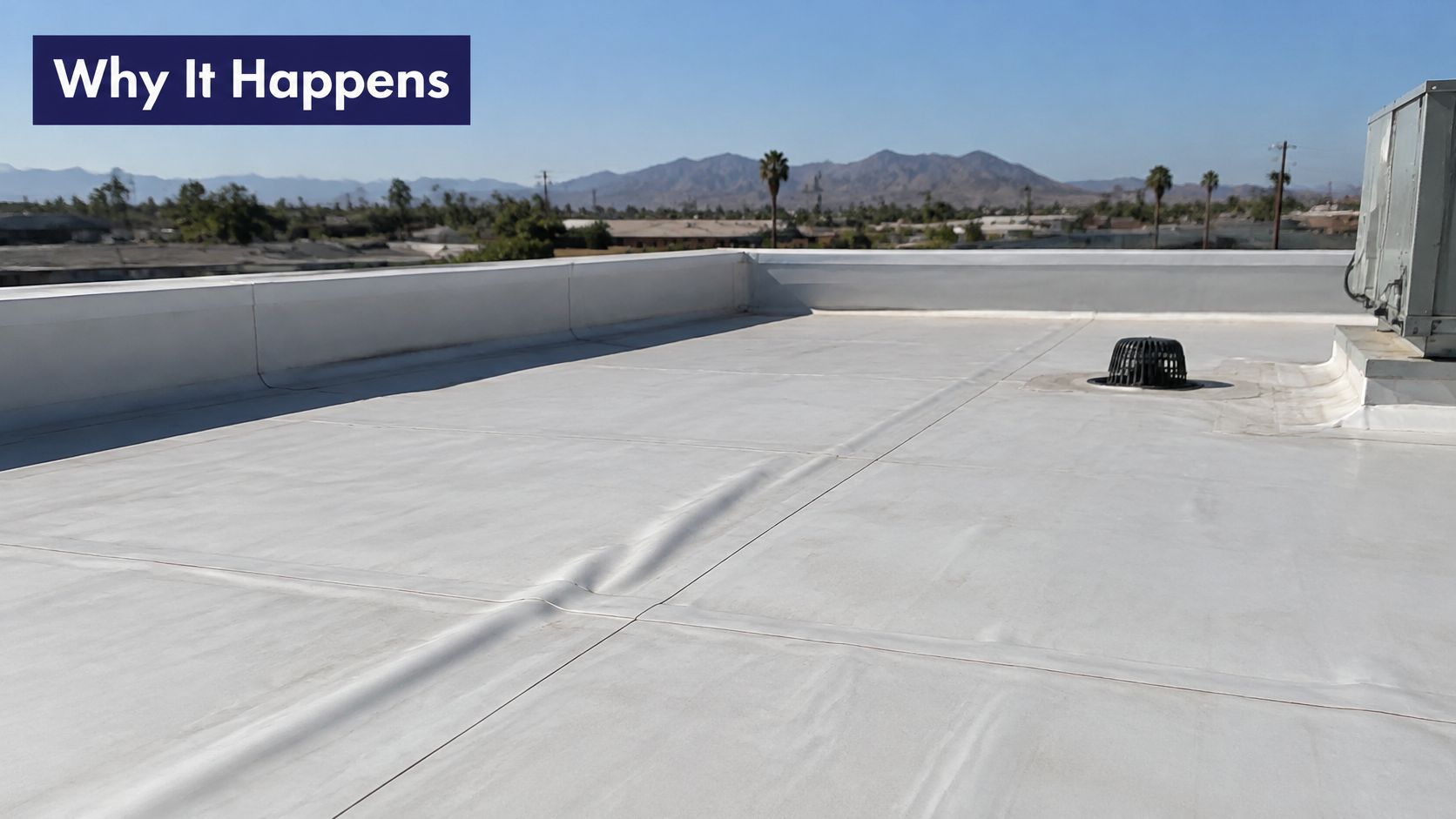
Heat acts through the assembly
A Canadian National Research Council study reports temperature differences exceeding 55°C between hot daytime exposure and nighttime conditions on conventional roofing membranes. That isn't a measured Phoenix roof temperature, but it demonstrates why repeated expansion and contraction deserve attention.
For adhered membranes, Lehigh University-hosted research on membrane wrinkling describes thermal-expansion mismatch among membrane, adhesive and substrate gathering existing slack into wrinkles. Some distortions persisted after cooling, so a heat-related wrinkle isn't necessarily fully reversible.
Mechanically attached sheets have a different restraint arrangement from fully adhered sheets. For TPO and PVC, the inspector must establish that arrangement before interpreting broad movement, while trapped air, moisture or displaced insulation remain alternative explanations.
Material history isn't a universal diagnosis
Historical EPDM shrinkage findings shouldn't be transferred to every TPO, PVC or modified-bitumen roof. An NRCA investigation of aged EPDM membranes found that most aged samples still met the elongation requirements for new material, illustrating why visible movement doesn't automatically establish wholesale loss of rubber properties.
America Roofing states that a membrane, coating or foam name doesn't define insulation, attachment, flashing, drainage or warranty. For a commercial flat roof, original assembly specifications and installation records are therefore more useful than a material name alone.
- Retrieve the assembly records. Identify membrane, reinforcement, attachment and perimeter details.
- Review changes. Include prior coatings, repairs, rooftop alterations and leak history.
- Separate aging from movement. Sun and UV exposure belong in the condition assessment, but don't prove the cause of a particular ridge.
Identical-looking distortions on different systems may require different repairs.
Location Clues That Separate Field Wrinkles From Edge Pull
The open field, seams and perimeter details present different inspection questions. A low isolated fold away from a water path is less immediately concerning than a tight bridge across a drain flashing, even when the fold looks larger.
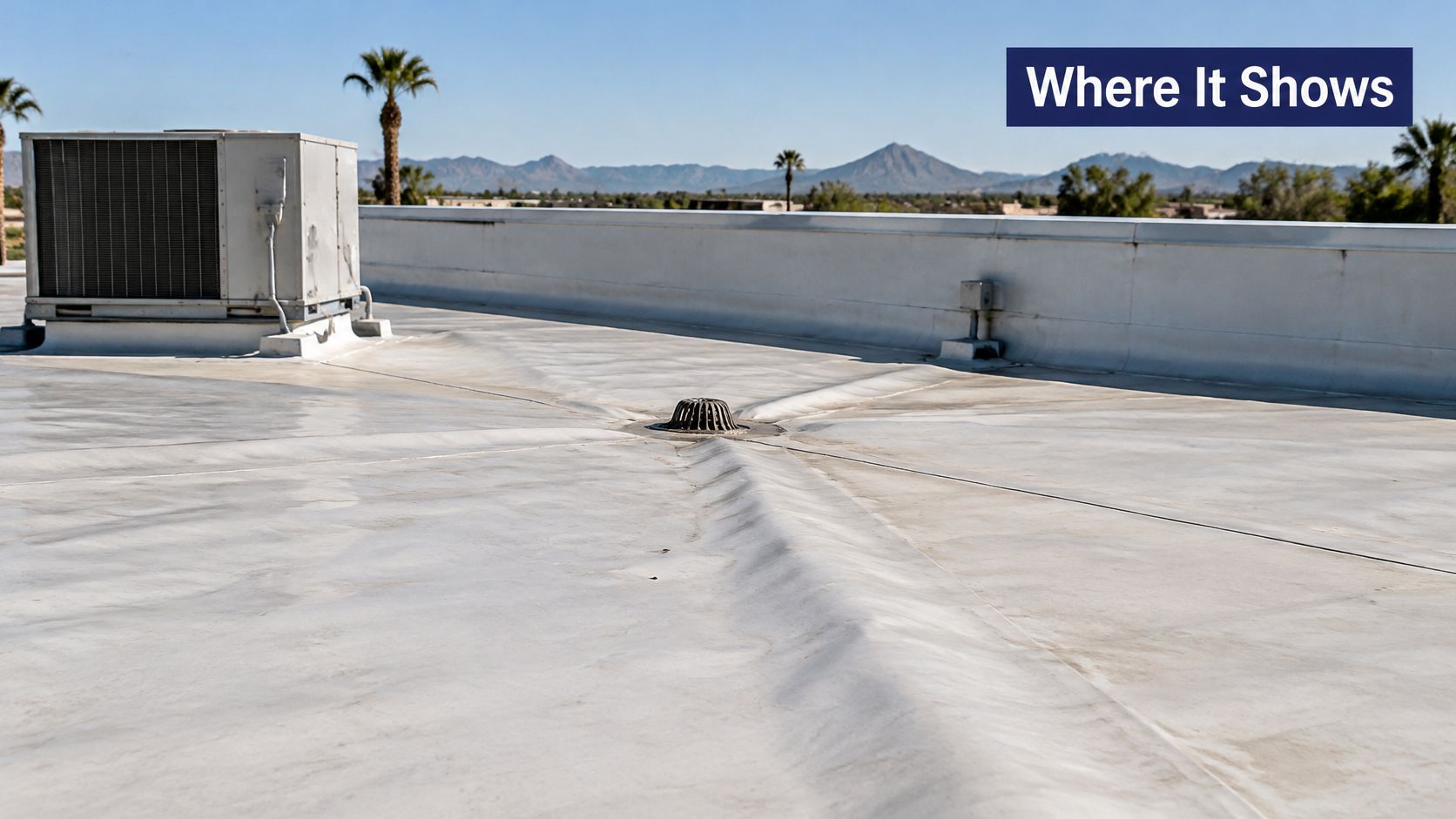
Follow the distortion toward the details
The NRCA technical discussion of membrane movement identifies expansion as a cause of wrinkling and shrinkage as a possible cause of tearing or cracking. It also notes thermal movement in TPO and the potential for application folds to become creases that contribute to crack propagation.
A useful zone-by-zone review focuses on specific clues:
- Open field. Check whether the fold ends within the sheet or continues along an insulation joint.
- Seams and laps. Look for distorted lap edges, openings and peeling; a roofing professional should perform seam probing.
- Perimeters and parapets. Record inward pull, exposed fasteners, lifted flashing, displaced nailers or widening gaps.
- Curbs and penetrations. Identify tight bridging where the sheet changes direction or meets fixed flashing.
- Drains and scuppers. Determine whether the raised area crosses a flashing connection or interrupts the water path.
For seam-specific warning signs, America Roofing TPO seam inspection advice provides a focused follow-up.
Map the pattern before choosing a repair
A roof-plan sketch should assign each distortion a reference mark. Beside that mark, record its orientation and distance from the nearest edge, seam, drain and penetration.
The map should also distinguish a ridge following a board joint from one pointing toward a restrained corner. Marks that repeatedly change after heat or rain deserve attention, but their direction alone doesn't prove shrinkage.
Concentrated stress at a penetration warrants faster follow-up than a comparable isolated field wrinkle. The inspector still needs to establish whether the sheet, its attachment or the material underneath is moving.
Monitoring Distortion With a Time and Temperature Log
A single photograph can document shape, but it can't establish whether movement is active. A useful baseline combines a dated image, a fixed reference point and an identified feature, such as edge pullback rather than a general note that the roof looks uneven.
Time and temperature observation log for a raised membrane feature
| Check and time | Wind, rain or traffic | Feature measured |
|---|---|---|
| Baseline, early morning before solar loading. Date/time ___; air/surface conditions ___ | None or light; actual conditions ___ | Wrinkle height and location, edge distance ___; baseline ___ |
| Midday on a hot day. Date/time ___; air/surface conditions ___ | None or light; actual conditions ___ | Same feature and reference points ___; change ___ |
| After monsoon rain or ponding. Date/time ___; conditions ___ | Rain; standing water observed ___ | Ponding depth, feature height, seam gap ___; change ___ |
| After foot traffic or equipment service. Date/time ___; conditions ___ | Traffic or service details ___ | Feature height, fastener or flashing condition ___; change ___ |
| Two-week recheck at the same time of day. Date/time ___; conditions ___ | Record actual wind, rain and traffic ___ | Same feature and reference points ___; change ___ |
This is a suggested observation schedule, not a manufacturer inspection interval. Unmeasured fields should remain blank rather than being estimated from an image.
Keep the observation method consistent
The baseline establishes position before strong solar loading. The midday check tests whether heat changes the same feature, while the post-rain check records drainage behavior without assuming moisture is trapped below.
A service-related check helps identify changes associated with access or traffic. The later comparison is most useful at a similar time of day, with differences in weather recorded rather than ignored.
Safety boundary: Owners shouldn't enter an unsafe roof or approach an unprotected edge to complete a log. Ground-level views, protected access points or professional observations are preferable.
A ruler in the frame helps only when it can be placed safely without disturbing the membrane. Monitoring should never involve walking on soft or distorted areas, probing seams, cutting a pocket or pressing a ridge flat.
Steady growth, increasing pullback or repeated return after cooling justifies professional investigation. The log guides that investigation; it doesn't replace testing.
Cosmetic Concerns Versus Performance Problems
A visible wrinkle isn't automatically a leak or a reason to replace the roof. NRCA reporting on modified-bituminous roofing found ridging and wrinkling on approximately 1% of the roofs reviewed, with most investigated conditions considered cosmetic and not compromising waterproofing.
For the mechanically attached TPO and PVC systems it addresses, a manufacturer technical bulletin on field wrinkles states that wrinkles less than 1 inch (25 mm) high when pressed together generally don't compromise integrity, while those greater than 1 inch may impede drainage. That's a system-specific screening criterion for a professional, not permission for an owner to manipulate the roof or apply the threshold to another assembly.
Performance concerns override appearance
Inspection priority rises when the distortion affects waterproofing, attachment or water flow:
- Lap involvement. A fold crosses a seam or accompanies an opening.
- Drainage interference. Water collects behind it after rain, particularly near a drain or scupper.
- Material damage. Splitting, cracking or exposed underlying material appears.
- Restraint problems. A curb, roof edge or flashing lifts, or attachment looks loose.
The same bulletin calls for damaged membrane repairs using material identical to the existing roof surface. A coating or generic patch isn't an automatic substitute for a compatible membrane repair.
A recurring distortion deserves closer evaluation, but recurrence alone doesn't prove failure. The important question is whether repeated movement is stressing a detail or interfering with performance.
Active water entry shouldn't wait for the next log entry. An unattended leak can damage insulation, finishes, wood components and indoor conditions.
What a Professional Inspection Should Test
A clear roof-condition assessment should begin with the existing roof-plan map, not a new set of disconnected photographs. The inspector should identify the assembly and compare each marked distortion with drainage, attachment and restrained details.
Ordered checks that support a decision
- Measure the geometry. Document wrinkle height using an appropriate professional method, perimeter pullback and seam displacement against fixed references.
- Check the connections. Inspect laps for fishmouths and peel, then examine wall, curb and penetration flashings for lifting or tenting.
- Check restraint and support. Review accessible fasteners, adhesive contact and whether a crest is bonded or detached; investigate insulation or substrate irregularities where accessible.
- Investigate suspected moisture. Explain whether a moisture survey or selected opening is appropriate, what it can establish and what remains uncertain.
A professional roof inspection should connect these findings to practical options. Roof age, previous repairs and the original installation records affect interpretation, especially where surface appearance conceals a different underlying condition.
Keep useful records, not just images
For facility managers considering digital documentation, Facility Management Insights discusses using technology for roof condition surveys. Technology should support a consistent condition record rather than substitute for assembly identification or physical verification.
The owner's documentation package should include dated photos, the marked plan, measurements and the observation log. Before repair, the inspector should also review the original assembly paperwork and applicable warranty conditions.
Prior repairs and potentially incompatible coatings need documenting. Coverage can't be inferred from the membrane name; the manufacturer's terms and the owner's contract govern, and this article doesn't establish coverage.
Choose Between a Local Repair and a System Evaluation
A local repair fits when the distortion is isolated and stable, and the surrounding attachment and substrate are sound. Repeated movement, returning distortion, or increasing pull at perimeter details calls for a broader system evaluation. Open seams, failed flashing, wet insulation, or recurring ponding also warrant investigation of concealed conditions.
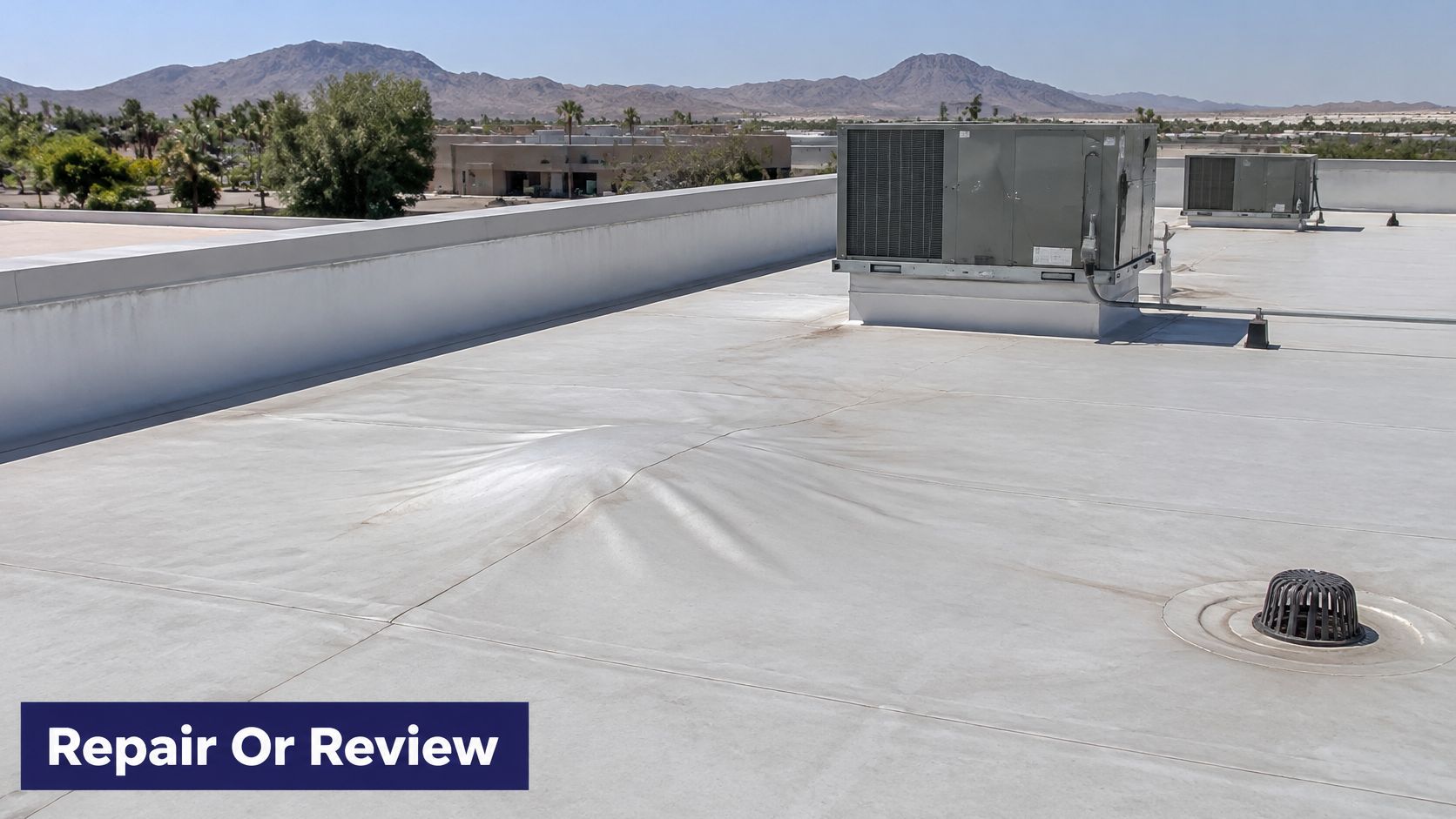
Repair the cause, not just the shape
When a repair is appropriate, America Roofing traces the path water is taking and targets the source. Its commercial roof repair options in Arizona provide a service path for evaluating repairable conditions and determining whether the system needs broader work.
Cutting out a fold will not correct moving insulation or inadequate restraint. A patch over an opening can also fail if continuing tension keeps pulling at the repaired area.
If concealed moisture could affect the scope, checking wet insulation before reroofing can help assess whether further investigation is appropriate. A roofing professional should plan and properly close any roof opening.
If replacement is necessary, the new assembly should address the underlying problem and fit the owner's long-term plans. The estimate should account for access, removal, deck condition, drainage details, and occupied-building protection, not just the visible ridge.
This week, mark the distortion's location on a roof plan and record its shape and condition with a dated photo. That record gives an inspector a useful baseline for deciding whether repair or system evaluation is the practical next step.
America Roofing offers roof-condition assessments, repair, and replacement services for Phoenix and Tucson property owners. To discuss membrane distortion or request an estimate, contact America Roofing.