
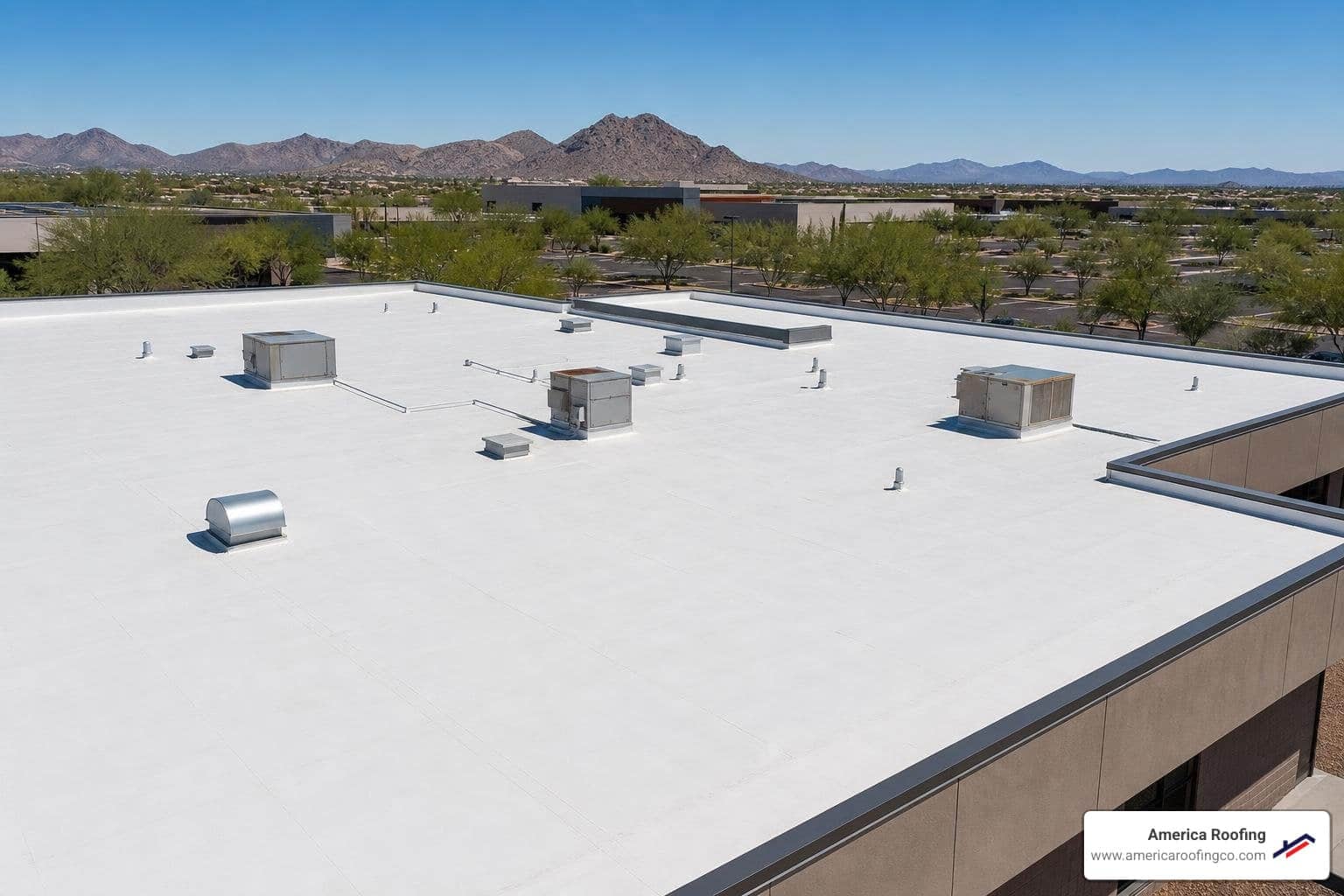
What Does 60 Mil TPO Roofing Actually Cost in 2026?
Understanding the 60 mil TPO roofing cost is the single most important step before committing to a flat roof project. Get it wrong and you could overpay by thousands — or worse, underbuy and end up with a membrane that fails too soon. Here's what you actually need to know before calling a contractor.
Quick answer for most property owners:
| Cost Type | Price Range |
|---|---|
| Material only (per sq ft) | $1.25 – $2.00 |
| Fully installed (per sq ft) | $5.00 – $7.50 |
| Typical 2,000 sq ft roof | $10,000 – $15,000 |
| Per roofing square (100 sq ft) installed | $300 – $700 |
| With full tear-off and replacement | $400 – $900 per square |
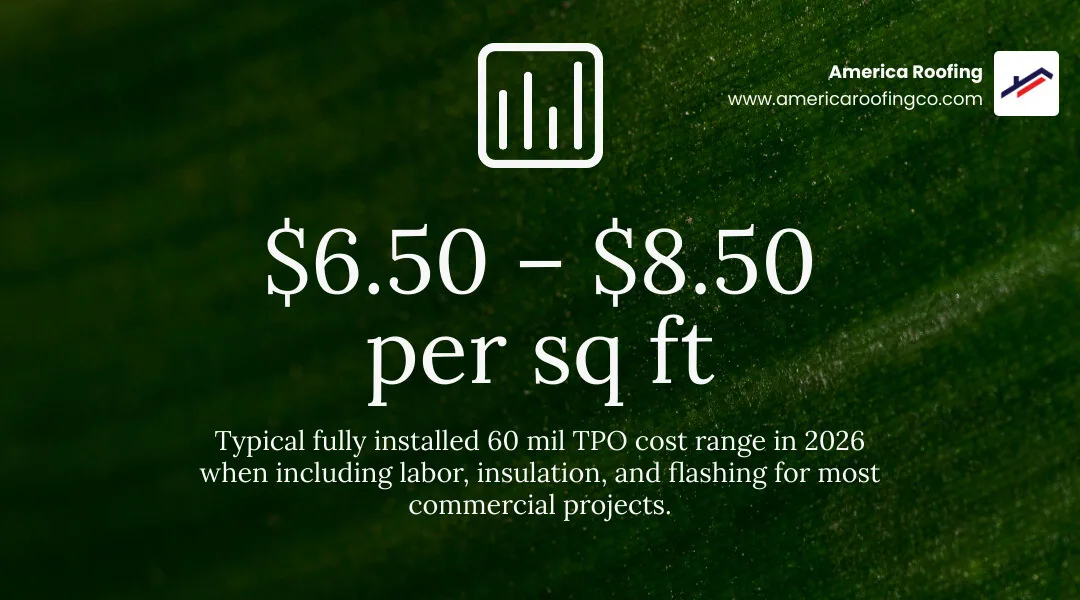
These are real 2026 numbers. Most commercial projects land in the $6.50 – $8.50 per square foot range when you factor in labor, insulation, and flashing.
Several things push that number up or down:
- Roof size — larger roofs cost less per square foot
- Attachment method — fully adhered systems cost 15–20% more than mechanically fastened
- Insulation type — PolyISO, EPS, and XPS all carry different price tags
- Tear-off — removing an old membrane adds roughly $1–$2 per square foot
- Roof complexity — penetrations, drains, and HVAC curbs add flashing labor
Honestly, the membrane itself is often not the biggest line item. Labor and prep work frequently drive the final invoice more than the TPO roll ever does.
Learn more about 60 mil tpo roofing cost:
Introduction
Investing in a flat roof is a major decision for any business or residential property owner. When evaluating single-ply membrane systems, finding the exact point where maximum durability meets upfront value is key. That is exactly why we created this guide—to demystify the numbers and help you navigate the process with complete confidence.
What is 60 Mil TPO and Why Does It Matter?
Thermoplastic Polyolefin (TPO) is a single-ply, highly reflective roofing membrane engineered specifically for flat and low-slope structures. The term "mil" refers to a thousandth of an inch (1 mil = 0.001 inches), meaning a 60 mil TPO membrane is approximately 0.060 inches thick.
To understand its strength, you have to look at how it is made. A standard TPO sheet consists of three integrated layers:
- The Bottom Bonding Layer: Engineered to adhere securely to the substrate or insulation.
- The Reinforcement Scrim: A tough, woven polyester fabric core that provides superior tear and puncture resistance.
- The Top Weathering Layer: This is where the magic happens. It contains proprietary UV stabilizers, flame retardants, and heat-aging packages designed to withstand decades of intense solar exposure.
Honestly, thickness isn't just a number—it's your roof's primary defense against the elements. Upgrading to a 60 mil membrane from a thinner option increases the material thickness above the reinforcement scrim by roughly 33% to 50%. This extra thickness directly translates into enhanced resistance against physical impacts, foot traffic, and UV degradation.
For a deeper dive into the chemical composition and structural benefits of this material, check out The Complete Guide to TPO Roofing.
Thickness Comparison: 45 Mil vs. 60 Mil vs. 80 Mil
Is upgrading to a thicker membrane actually worth the extra investment? To answer this, we must compare the three standard industry thicknesses:
- 45 Mil TPO: This is the budget-friendly, entry-level option. While it offers a low initial cost, it is highly vulnerable to punctures from dropped tools, windborne debris, or routine maintenance traffic. It typically carries a shorter lifespan and a maximum 10-to-15-year warranty.
- 60 Mil TPO: Widely considered the "sweet spot" of the commercial roofing industry. It offers a 2x increase in puncture resistance compared to 45 mil, easily handles moderate maintenance foot traffic, and supports 15-to-20-year manufacturer warranties.
- 80 Mil TPO: The heavy-duty option. It provides maximum protection and is designed for roofs with heavy HVAC equipment, frequent service traffic, or exposure to severe storms. While highly durable, its premium pricing can sometimes exceed standard project budgets.
To help you visualize these differences, we have compiled a side-by-side comparison of the three options:
| Membrane Thickness | Average Installed Cost (per sq. ft.) | Expected Lifespan | Typical Warranty Coverage | Best Used For |
|---|---|---|---|---|
| 45 Mil | $4.50 – $6.50 | 15 – 20 Years | 10 – 15 Years | Temporary structures, tight budgets, zero foot traffic |
| 60 Mil | $5.00 – $7.50 | 20 – 25 Years | 15 – 20 Years | Standard commercial buildings, residential flat roofs |
| 80 Mil | $7.00 – $10.00 | 25 – 30 Years | 20 – 30 Years | High-traffic roofs, heavy equipment zones, extreme climates |
For more details on how these thicknesses stack up across different property types, you can review the TPO Roof Cost (2026) - Pricing by Thickness & Size | ShinglesCalculator.
Understanding the 60 Mil TPO Roofing Cost
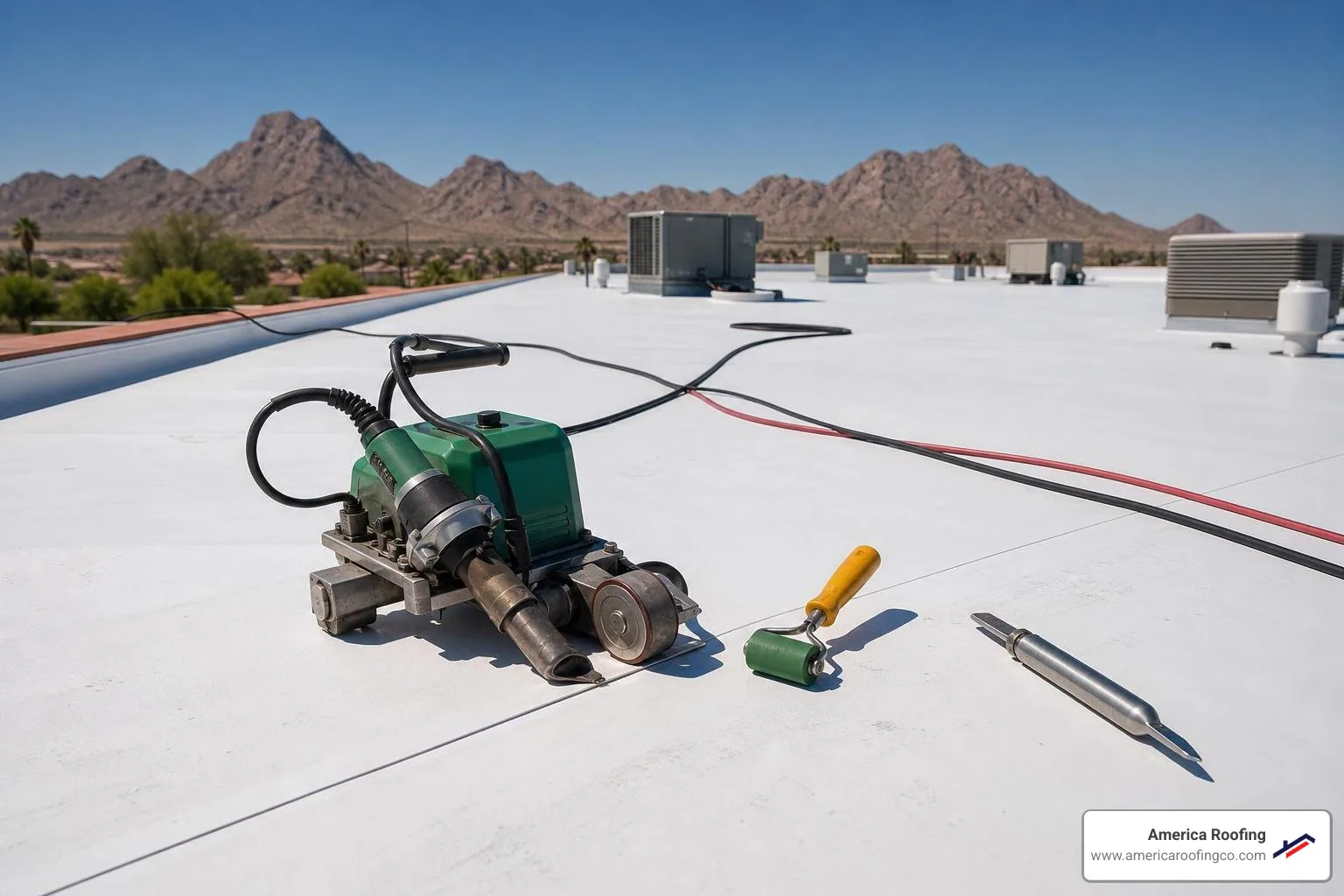
When planning your budget, it is important to look at the total project cost rather than just the raw material price. Fully installed costs must account for professional labor, structural preparation, proper insulation, and customized flashing.
Breakdown of the 60 Mil TPO Roofing Cost Factors
Here’s the thing: labor and prep work often dictate the final price more than the membrane itself. Let me explain.
- Insulation Materials (Approx. 25% of Total Cost): TPO must be installed over a solid substrate, which usually means rigid insulation boards.
- Polyisocyanurate (PolyISO): The industry standard, offering high R-value per inch ($1.60 – $2.40 per sq. ft.).
- Expanded Polystyrene (EPS) & Extruded Polystyrene (XPS): Alternative options ranging from $1.60 to $4.20 per sq. ft. depending on density and thickness.
- Attachment Methods:
- Mechanically Fastened ($2.00 – $3.00/sq. ft. installation cost): The membrane is screwed directly to the deck through the seams before heat-welding. Fast and cost-effective.
- Fully Adhered ($2.75 – $3.50/sq. ft. installation cost): The membrane is glued down with specialized adhesive. While it costs 15-20% more, it provides superior wind uplift resistance and minimizes leak risks.
- Ballasted ($1.50 – $2.50/sq. ft. installation cost): Held down by heavy gravel or pavers. Rarely used in modern configurations due to structural weight limits.
- Tear-Off and Deck Repairs: Removing an existing, water-damaged roof and hauling it away typically adds $1.00 to $2.00 per square foot. If the underlying wood or metal decking is rotted or rusted, structural deck repairs will add to the bottom line.
- Flashing and Accessories: Sealing around HVAC units, pipes, drains, and parapet walls requires specialized prefabricated boots and detail work, which can cost $50 to $200 per penetration.
For a comprehensive breakdown of flat roof installation costs, refer to our Flat Roof Replacement Cost Guide.
Regional Price Variations and the 60 Mil TPO Roofing Cost in Arizona
Roofing costs are highly regional. While national averages provide a starting point, local labor rates, municipal permitting fees, and regional climate demands heavily influence your final quote.
In Arizona, our extreme desert climate requires a highly specialized approach to flat roofing. With summer surface temperatures on a dark roof easily exceeding 160°F, the reflective properties of white 60 mil TPO are incredibly valuable.
At America Roofing, we have spent decades perfecting flat roof systems designed specifically for the Phoenix and Tucson metro areas. Our installations are engineered to withstand:
- Intense UV Radiation: High UV exposure degrades lower-quality materials quickly. A premium 60 mil TPO weathering package is essential.
- Monsoons and Haboobs: Strong winds and sudden, heavy downpours require flawless, heat-welded seams and heavy-duty mechanical fastening to prevent uplift and leaks.
- Thermal Cycling: Rapid temperature drops during desert nights cause roofs to expand and contract. TPO’s inherent flexibility prevents cracking under these stresses.
Whether your property is in Phoenix, Mesa, Chandler, Gilbert, Glendale, Scottsdale, Peoria, Tempe, Surprise, or Goodyear, local factors will shape your estimate. For localized pricing context, you can check out the Cost to install tpo roof in Scottsdale, AZ - Contractor Plus or read the TPO Roofing Cost Per Square Foot (2026 Pricing Guide).
Making the Right Investment for Your Flat Roof
Choosing a roof is about balancing immediate installation costs with long-term operational savings. 60 mil TPO is widely considered the smartest financial compromise for modern flat roofs.
TPO vs. EPDM vs. PVC: Cost and Performance
You know what? While EPDM and PVC have their places, TPO's heat-welded seams offer an unbeatable balance of cost and strength.
- EPDM (Ethylene Propylene Diene Monomer): A synthetic black rubber membrane. It is highly durable and costs slightly less to install ($4.00 – $7.00 per sq. ft.). However, because it is black, it absorbs heat rather than reflecting it, leading to significantly higher cooling bills in hot climates. Furthermore, its seams are sealed with adhesive tape, which can break down over time.
- PVC (Polyvinyl Chloride): A premium white single-ply membrane. Like TPO, it features hot-air welded seams that are incredibly strong. It is highly resistant to chemicals, oils, and grease, making it excellent for restaurants. However, PVC is significantly more expensive, running $6.00 to $9.00+ per square foot installed.
- 60 Mil TPO: Delivers the heat-welded seam strength and high reflectivity of PVC, but at a price point closer to EPDM ($5.00 – $7.50 per sq. ft. installed). This makes it the most cost-effective reflective roof system on the market.
For a deeper dive into alternative systems, you can review the TPO Roofing Cost: How Much Does It Cost in 2026? or check out How Much Does a TPO Roof Cost? 2026 Pricing Breakdown.
Lifespan, Warranties, and Long-Term ROI
A properly installed 60 mil TPO roof will easily last 20 to 25 years, and can stretch to 30 years with routine preventative maintenance.
When you invest in a 60 mil system, you also access superior warranty options. Most major manufacturers (such as GAF, Carlisle, or Firestone) offer 15-to-20-year No Dollar Limit (NDL) warranties on 60 mil systems. An NDL warranty means that if a leak occurs due to a material defect or installation error, the manufacturer covers the full cost of the repair, regardless of how much labor and material prices have risen since installation.
The real return on investment (ROI), however, comes from your energy bills. White TPO reflects up to 90% of UV rays, potentially reducing your building’s cooling loads by 20% to 30%. Over a 20-year lifespan, those utility savings can easily offset the entire initial cost of the roof replacement.
To read more about the performance metrics, wind uplift ratings, and thermal efficiency of these systems, explore The TPO Flat Roof System A Comprehensive Look at Performance and Durability.
Ready to secure a durable, energy-efficient flat roof for your property? Contact our expert team today at 602-237-2478 or Request a Free Quote to get a transparent, customized estimate tailored to your building's needs.